
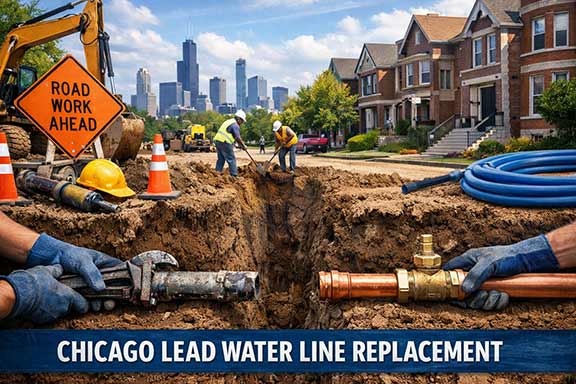
Over 400,000 Lead Service Lines Are Still Active in Chicago. Yours Could Be One of Them.
If you own a home in Chicago or the surrounding suburbs, there’s a real chance the pipe delivering water into your house right now is made of lead. Not decades ago — right now, today. Chicago required lead pipes to be used for residential water connections until they were federally banned in 1986, which is why the city has more lead service lines than any other city in the United States. More than 400,000 confirmed and suspected lead lines are still in the ground across Chicagoland, and according to an investigative report by WBEZ, Grist, and Inside Climate News, crews have replaced less than 4% of them in the past five years.
That means the vast majority of affected homeowners are still waiting — and many don’t even know they’re on the list.
This isn’t a scare piece. It’s a practical guide to understanding what a lead service line is, how to find out if you have one, what the city will and won’t do about it, and how to get it taken care of for good.
What Is a Lead Service Line and Why Does It Matter?
A service line is the pipe that runs from the city water main in the street into your home. In Chicago, tens of thousands of those pipes are made of lead — a material we now know has no safe level of exposure, particularly for children and pregnant women.
The problem isn’t just the pipe itself. Every time water sits in a lead line and then flows through your tap, it picks up trace amounts of the metal. Disturbing the line — through nearby construction, water main work, or pressure changes — can cause lead to flake off and spike the levels in your water dramatically and without warning.
The City of Chicago was legally required to notify approximately 900,000 affected homeowners, landlords and tenants about this risk. As of mid-2025, only about 8% had received that notification. In other words, if you’re waiting for the city to tell you whether you have a problem, you may be waiting a long time.
How to Find Out If You Have a Lead Service Line
The fastest way is to check Chicago’s online lookup tool at chicago.gov/leadcheck. Enter your address and it will tell you the known material of your service line based on city records. Keep in mind that records aren’t perfect — some lines are listed as “unknown” because the city simply doesn’t have confirmed data yet.
If you want to verify yourself, you can locate your service line where it enters your home — typically in the basement near the water meter. Lead pipe is dull gray, soft enough to scratch with a key, and will show a shiny silver mark when scratched. Copper is a different color entirely, and plastic is obvious. If it’s lead or you’re not sure, treat it as lead until confirmed otherwise.
You can also request free water testing through the Chicago Department of Water Management, which will tell you what’s actually coming out of your tap.
What Is the City Doing About It — And What Does That Mean for You?
Chicago has a federally backed replacement program underway, but progress has been slow. The city replaced roughly 7,000 lines in 2025 and is targeting 10,000 in 2026 — against a backlog of more than 400,000. At that pace, Chicago’s own submitted plan doesn’t reach full completion until 2076, three decades past the EPA deadline.
There are currently several programs available to Chicago homeowners depending on your situation. The Equity Lead Service Line Replacement Program provides free replacements for low-income households at or below 80% of the area median income in priority neighborhoods — you can apply through 311 or at chicago.gov/leadpipes. The Homeowner-Initiated Program waives up to $3,100 in permit and tap fees when you hire a licensed plumber to replace your line independently. The MeterSave Program offers free replacement in exchange for allowing a smart water meter to be installed.
Here’s the critical part most homeowners miss: a lead service line has both a public side (from the water main to the property line) and a private side (from the property line into your home). The city is responsible for the public side. You are responsible for the private side. And since January 2023, Illinois law prohibits partial replacements — if a line is being replaced, the whole thing must go, both sides. If your line breaks or leaks, you are now legally required to call 311 immediately so the city can coordinate a full replacement.
Why You Shouldn’t Just Wait for the City to Come to You
The city’s replacement schedule is behind, underfunded, and — by officials’ own admission — constrained by workforce and contractor capacity. Chicago has a $325 million federal loan for lead line replacements that expires at the end of 2026, and as of late 2025 less than a third of it had been spent. Even with accelerated efforts this year, the math simply doesn’t work out for hundreds of thousands of households who are years away from a proactive city replacement.
In the meantime, you and your family are drinking that water every day.
The homeowner-initiated route — where you hire a licensed plumber, get the permit fees waived, and get it done on your timeline — puts you in control rather than leaving you on a waitlist. Our team handles lead service line replacement across Chicago and the suburbs and can walk you through the permit process, coordinate with the city on the public side connection, and get your home off lead for good.
What About Homes in the Chicago Suburbs?
Lead service lines aren’t exclusively a Chicago city problem. Many older suburbs throughout Cook and DuPage County have their own aging infrastructure, and homes built before 1986 in communities across Chicagoland may also have lead lines or lead solder connections at fixtures and joints.
If you’re in a suburb and unsure about your service line, the first step is contacting your local water utility or municipality — many have their own inventory programs underway under the Illinois Lead Service Line Replacement and Notification Act. From there, a licensed plumber can inspect and confirm what you have. Our residential plumbing services cover the full Chicagoland area, and we’re familiar with the permit and coordination requirements in municipalities throughout the region.
What to Do While You Wait for Replacement
If replacement isn’t happening immediately, there are steps you can take right now to reduce exposure. Run your cold tap for three to five minutes before using water for drinking or cooking, especially after water has been sitting in the pipes for several hours. Always use cold water — not hot — for food prep, since hot water pulls more lead from pipes and fixtures. A certified filter rated for lead removal (look for NSF/ANSI Standard 53 certification) can also provide meaningful protection at the point of use.
These are stopgaps, not solutions. The only way to eliminate the risk is to replace the line.
Don’t Wait for a Crisis to Make the Call
Lead exposure has no safe threshold. The effects are cumulative and largely invisible until they’re not — and children are particularly vulnerable. If you have a lead service line and young kids in the house, this isn’t something to put off until next year’s to-do list.
Chicago is moving, but slowly. The permit fee waiver programs available right now may not last forever, and the contractors who know how to navigate the city’s coordination process are in high demand. If you’ve confirmed — or even suspect — that your home has a lead service line, the time to act is now.
Our team is licensed, insured, and experienced in water line repair and replacement throughout Chicagoland. We’ll assess your line, explain your options, handle the permits, and get the work done right.
Frequently Asked Questions: Lead Service Lines in Chicago
How do I know if my home has a lead service line?
The fastest way is to use the city’s online lookup tool at chicago.gov/leadcheck — enter your address and it will show the recorded material of your service line. You can also check yourself in your basement where the water line enters the home. Lead pipe is dull gray, soft, and will show a shiny silver scratch when you scrape it with a coin or key. If you’re still unsure, request free water testing through the Chicago Department of Water Management, which will tell you what’s actually coming out of your tap.
How much does lead service line replacement cost in Chicago?
If you qualify for the city’s Equity Program, replacement is completely free. If you go the Homeowner-Initiated route — hiring a licensed plumber independently — the city waives up to $3,100 in permit and tap fees, which covers a significant portion of the cost. The city also provides the new water main connection and a free water meter. The private side of the line, which runs from the property line into your home, is your financial responsibility. For a full breakdown of what repair vs. replacement actually costs in the Chicago market, check out our Chicago main water line repair vs. replacement cost guide. Our team can also give you a clear estimate before any work begins — there are no surprise charges.
What happens if my lead service line breaks or leaks?
Since January 2023, Illinois law requires that a broken or leaking lead service line must be completely replaced — partial repairs are no longer permitted. You are legally required to call 311 immediately to report it. The city will then contact you to coordinate a full replacement of both the public and private sides of the line. Do not attempt a partial patch — it won’t pass inspection and could result in fines.
Is lead in my drinking water dangerous even at low levels?
Yes. Federal health officials and the EPA are clear that there is no safe level of lead in drinking water. Even low-level chronic exposure can affect brain development in children, cause developmental delays, and contribute to cardiovascular and kidney problems in adults. The risk increases after any disturbance to the line — nearby construction, water main work, or pressure fluctuations can cause lead to flake off and spike your water levels without warning.
Can I just use a filter instead of replacing the line?
A filter certified to NSF/ANSI Standard 53 can meaningfully reduce lead at the point of use and is a smart stopgap while you wait for replacement. But it’s not a permanent solution — filters need regular replacement to stay effective, they don’t protect water used for bathing, and they do nothing about lead in your pipes, joints, or fixtures downstream. Replacement is the only way to fully eliminate the risk.
How long does lead service line replacement take?
For most single-family homes, the actual replacement work takes 1-2 days. The timeline from scheduling to completion depends on permit processing and coordinating with the city on the public side connection, which our team handles on your behalf. We aim to make the process as straightforward as possible — most homeowners are surprised by how quickly it goes once the paperwork is in order.
Do the Chicago suburbs have lead service line issues too?
Yes. Lead service lines aren’t exclusive to the city of Chicago. Many older suburbs throughout Cook and DuPage County have their own aging infrastructure, and homes built before 1986 across Chicagoland may have lead lines or lead solder at fixture connections. Under the Illinois Lead Service Line Replacement and Notification Act, all municipalities are required to inventory their lines and develop replacement plans. If you’re in the suburbs and unsure about your line, contact your local water utility or give us a call — we serve the full Chicagoland area and can help you figure out exactly what you have.
Will my homeowners insurance cover lead service line replacement?
Standard homeowners insurance policies typically do not cover lead service line replacement as a preventive measure. Some policies include a water service line endorsement that covers damage from a sudden break or leak — but proactive replacement generally falls outside that coverage. The city’s fee waiver and free replacement programs are your best financial resource. Ask your insurance agent specifically about your service line coverage so you know exactly where you stand.
—
Suburban Plumbing Sewer Line & Drain Cleaning Experts Licensed & Insured | Open 24 Hours | Serving Chicago & the Suburbs Since 2003
📞 Suburbs: 708-801-6530 📞 West Suburbs: 630-749-9057 📞 Chicago: 773-570-2191 🚨 24/7 Emergency Line: 708-518-7765
Get a Free Estimate — We’ll Be In Touch Fast
Have a lead service line question or ready to schedule? Send us a message and a member of our team will follow up shortly.
Or call us directly: 708-801-6530 | Open 24/7