

Your main water line is the single pipe connecting your home to the city’s water supply. When it fails — and in Chicago’s aging housing stock, it eventually does — you’re not dealing with a leaking faucet. You’re looking at excavation, permits, traffic, and a bill that can range from a few hundred dollars to well over $20,000 depending on what’s wrong, where you live, and what’s underground between your home and the street.
This guide covers everything Chicagoland homeowners need to know: what main water line problems actually cost in 2025, how to tell whether you need a repair or a full replacement, what drives the price in different suburbs, and how to avoid getting overcharged.
What Is the Main Water Line?
The main water line — also called the water service line — is the underground pipe that runs from the municipal water main in the street, through your property, and into your home. Every drop of water you use for drinking, bathing, cooking, and laundry travels through this one pipe. In most Chicagoland homes, this pipe runs anywhere from 20 to 80 feet depending on how far your house sits from the street. Older communities with large setbacks, alleys, or deep lots can have service lines exceeding 100 feet — and every extra foot adds to the cost of any repair or replacement. The pipe itself is usually one of four materials depending on when your home was built.
Lead pipes are common in homes built before 1986 and are still present in thousands of Chicagoland properties; the EPA’s revised Lead and Copper Rule now requires utilities to identify and replace all lead service lines, making this a pressing issue across the region. Galvanized steel was installed through the mid-20th century and corrodes from the inside out, restricting flow and eventually failing. Copper was the standard from roughly the 1950s through the 1990s — durable but vulnerable to pinhole leaks, freeze-thaw damage, and aggressive soil conditions. PVC or PEX are modern materials used in newer construction and replacements since the 1990s and are generally the longest-lasting option currently available.
Signs You Have a Main Water Line Problem
Main water line failures rarely announce themselves dramatically. More often, the warning signs are subtle and easy to misread as other issues. Inside your home, watch for a sudden drop in water pressure throughout the house rather than just one fixture, discolored or rust-tinted water especially on first use in the morning, an unexplained spike in your water bill with no change in usage, gurgling or hissing sounds from pipes when water isn’t running, and air in the lines causing sputtering faucets.
Outside your home, look for wet or soggy patches in your yard that persist even during dry weather, sinkholes or depressions forming in the lawn along the path from the street to your foundation, unusually lush green grass in one narrow strip of your yard where the pipe may be leaking and fertilizing the ground above it, water seeping up through cracks in your driveway or sidewalk, and muddy water coming from your outdoor spigots. Any one of these signs warrants a call to a licensed plumber. Multiple signs together suggest the situation is urgent. Learn more about our water line repair and replacement services and what to expect when you call.
Main Water Line Repair vs. Replacement: Understanding the Difference
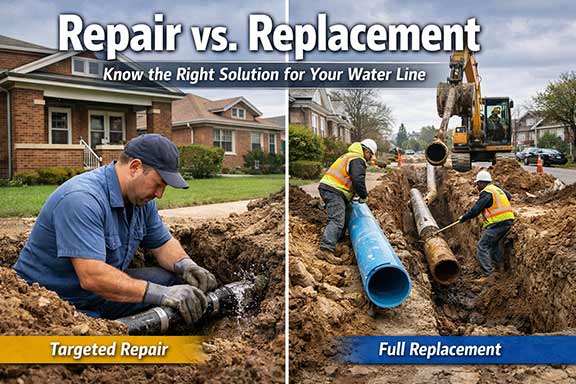
Not every main water line problem requires full replacement. The decision between repair and replacement depends on the location and extent of the damage, the pipe material, the pipe’s age, and the overall condition of the line. Repair makes sense when the damage is isolated — a single crack, a failed joint, or a localized corrosion point — and the rest of the line is in acceptable condition. A spot repair involves excavating a small section of the line, cutting out the damaged portion, and installing a new section of pipe. This is significantly less disruptive and less expensive than full replacement.
Replacement is the right call when the pipe is failing systemically — when corrosion, root intrusion, or deterioration affects the line throughout its length rather than in one spot. It’s also the clear choice when the existing pipe is lead or severely corroded galvanized steel that’s restricting flow. Replacing the full line from the street connection to the meter inside your home resolves the problem permanently rather than treating a symptom. Our water line repair and replacement team will assess your specific situation and give you a straight answer on which approach makes sense.
Main Water Line Cost in Chicagoland: A Complete Breakdown
Prices below reflect typical ranges in the Chicago metropolitan area in 2026. Costs vary significantly by municipality, soil conditions, depth of the existing line, and whether the work requires cutting through concrete, asphalt, or landscaping.
Repair Costs
| Type of Repair | Typical Cost Range | Notes |
|---|---|---|
| Spot repair (single crack or joint) | $500 – $1,500 | Minimal excavation, isolated section only |
| Section replacement (3–5 feet) | $1,000 – $3,000 | Small excavation, includes backfill and surface restoration |
| Leak repair at foundation entry | $800 – $2,500 | Requires interior access or foundation wall work |
| Frozen pipe thaw and repair | $300 – $1,200 | Emergency rate applies if after hours |
| Pinhole leak repair (copper) | $400 – $1,000 | Common in 1950s–1970s copper lines |
Replacement Costs
| Scenario | Typical Cost Range | Notes |
|---|---|---|
| Standard replacement (up to 50 ft, open yard) | $3,500 – $8,000 | Straightforward access, no concrete cutting |
| Replacement under driveway or sidewalk | $6,000 – $12,000 | Concrete cutting, restoration, permit |
| Deep line replacement (5+ ft depth) | $8,000 – $15,000 | Shoring required, longer excavation |
| Lead service line replacement | $5,000 – $20,000 | May be partially or fully covered by municipal programs (see below) |
| Long service line (75+ feet) | $10,000 – $25,000+ | Common in communities with large lot setbacks |
What Drives the Price Up or Down in Chicagoland
The Chicago area presents a specific set of factors that affect water line costs more than in most other Midwestern markets. Frost depth is one of the most significant: Illinois code requires water service lines to be buried at least 42 inches below grade to prevent freezing, and many older Chicagoland lines are actually deeper — 4 to 6 feet in some communities — which increases excavation cost and time. The Chicago region also sits on heavy clay soil that doesn’t drain or excavate as easily as sandy or loamy soil, requiring more labor and equipment time and shifting around pipes over decades in ways that cause joint separations and cracking. In established suburbs and city neighborhoods, mature trees line the parkway between the sidewalk and street, and tree roots migrate toward water lines and infiltrate through joint failures — adding to both the damage and the excavation complexity.
Every municipality in Chicagoland has its own permit and inspection process for water service line work; permit fees typically add $100 to $500 to the total job cost, and timelines vary. Finally, after excavation, the area has to be restored — backfilled, compacted, and finished — and if the line runs under a concrete driveway, brick paver walkway, or finished landscape, restoration can add $1,000 to $5,000 to the total. Emergency repairs in winter, common during polar vortex events when frozen pipes fail, often carry after-hours or emergency premiums that standard warm-weather jobs do not.
Cost by Pipe Material
| Pipe Material | Repair Cost Tendency | Replacement Recommendation |
|---|---|---|
| Lead | Spot repairs discouraged — full replacement strongly advised | Yes — check municipal programs first |
| Galvanized steel | Repairs rarely cost-effective after 50+ years of interior corrosion | Yes if low pressure, rust, or multiple failures |
| Copper (pre-1980) | Spot repairs viable for isolated pinholes | Evaluate — may have remaining life |
| Copper (post-1980) | Good repair candidate for most failures | Only if systemic failure confirmed |
| PVC/PEX | Repairs straightforward and cost-effective | Only if major damage confirmed |
Lead Service Line Programs Across Chicagoland
Illinois is in the middle of one of the most significant lead pipe replacement efforts in the country, and several Chicagoland municipalities have programs that can dramatically reduce — or completely eliminate — your out-of-pocket cost for lead service line replacement. The Illinois Environmental Protection Agency’s lead service line replacement program provides additional context on statewide requirements and funding. Here’s an overview of key programs as of 2025:
| Municipality | Program Coverage | Homeowner Cost |
|---|---|---|
| City of Chicago | Phased replacement program underway; utility side covered | Private side may be homeowner responsibility — contact CDWM |
| Naperville | Full line replacement covered by city (both sides) | $0 for qualifying homes |
| Evanston | Active replacement program; city covers curb-to-main | Private side may be homeowner cost |
| Oak Park | Active inventory and replacement underway | Varies — contact village |
| Lemont | Full replacement cost absorbed by village | $0 for qualifying homes |
| Berwyn | Replacement program in progress | Check with Public Works |
If your home was built before 1986, contact your municipality’s public works or water department to ask whether your address has a lead service line on record, whether you’re eligible for the replacement program, and who is responsible for the private-side portion of the replacement. Do this before hiring any contractor — you may be entitled to free replacement work. Even after a lead service line is replaced, interior plumbing components matter.
Lead solder used in copper pipe joints before 1986, older brass fixtures, and galvanized steel interior lines can still contribute lead to your drinking water. Our lead service line replacement team is familiar with the documentation and process requirements across Chicagoland municipalities and can help you navigate the full replacement from confirmation through completion.
The Permit Process in Chicagoland
Pulling a permit for water line work is not optional — it’s required in every municipality in the Chicago area, and it protects you. Work done without a permit creates problems when you sell your home and can void your homeowner’s insurance coverage for related damage. The typical permit process involves your contractor submitting a permit application to the municipality’s building department, the permit being issued within 1 to 5 business days for standard jobs, the work being performed, the municipality inspecting the completed work, and the permit being closed.
In some Chicagoland communities — including several collar counties — the permit for water service line work is routed through the water utility rather than the building department, and in others both are required. Your contractor should know the local process and handle the permit application on your behalf. If a contractor tells you a permit isn’t needed for water line work, that’s a serious red flag. The City of Chicago Department of Buildings handles permitting for work within city limits, while each suburban municipality maintains its own building department with varying requirements.
How to Get an Accurate Quote and Avoid Getting Overcharged
Main water line work is one of the areas of residential plumbing most prone to pricing variation. Here’s how to protect yourself. Get at least two quotes — water line work varies significantly in price between contractors, and a second or third quote helps you understand the market rate for your specific situation and spot outliers on either end. Ask for itemized pricing — a quality quote breaks down excavation, materials, labor, permits, and restoration separately; lump-sum quotes make it harder to compare bids and understand what you’re actually paying for. Verify licensing and insurance — in Illinois, plumbing contractors must hold a valid Illinois plumbing license, and for water service line work specifically, verify that your contractor holds both a plumbing contractor license and a sewer contractor license.
Suburban Plumbing Experts operates under Illinois Plumbing License #055-044116 and Sewer License #2565. Check permit requirements yourself by calling your municipality’s building department directly to confirm what permits are required for your project — if the contractor you’re talking to isn’t planning to pull a permit, find a different contractor. Understand the warranty by asking specifically what the contractor warrants on the work, both the labor and the materials, since quality contractors typically offer multi-year warranties on new service line installations.
Financing and Emergency Cost Considerations
Main water line failures rarely happen at convenient times or when you’ve budgeted for them. Most standard homeowner’s policies do not cover water service line repair or replacement because it’s considered a maintenance issue rather than sudden, accidental damage, though some policies and policy riders cover sudden pipe failures — review your policy or call your agent before assuming you’re not covered. Many Chicagoland utilities and municipalities offer optional water service line protection programs through third-party providers that are worth evaluating before a problem occurs.
Many reputable Chicagoland plumbing contractors offer financing options for large jobs — Suburban Plumbing Experts offers financing on all jobs, so ask about current options when you call for a quote. Beyond lead service line replacement, some municipalities offer low-interest loan programs or payment assistance for homeowners facing mandatory water line replacements, so contact your public works department to ask.
How Depth and Access Affect Your Cost
| Depth of Line | Access Condition | Estimated Cost Multiplier |
|---|---|---|
| 3–4 feet (standard) | Open lawn | Baseline (1x) |
| 3–4 feet | Under driveway/sidewalk | 1.4x – 1.8x |
| 5–6 feet | Open lawn | 1.5x – 2x |
| 5–6 feet | Under concrete | 2x – 3x |
| 6+ feet | Any condition | 2.5x – 4x |
Who to Call for Main Water Line Work in Chicagoland
Water service line work requires a licensed plumbing contractor who also holds a sewer contractor license — not all plumbers are licensed for both. In addition to licensing, look for a contractor who pulls all required permits and handles the inspection process, provides itemized written quotes, has documented experience with water service line work in your specific municipality, and carries full liability insurance and worker’s compensation. Suburban Plumbing Experts serves the full Chicagoland area including Chicago and all surrounding suburbs.
Our licensed team handles water line repair and replacement, lead service line replacement, permit coordination, and full restoration. We work in communities from Naperville and Lemont in the southwest to Oak Park and River Forest on the west side to Orland Park and Tinley Park to the south, and all of Chicago. Call 708-801-6530 for a same-day consultation, or reach our 24/7 emergency line at 708-518-7765 for urgent water line failures.
Quick Reference: Main Water Line Cost Summary
| Job Type | Low End | High End | Average |
|---|---|---|---|
| Spot repair | $400 | $1,500 | $900 |
| Section repair (3–5 ft) | $1,000 | $3,000 | $1,800 |
| Full replacement (standard) | $3,500 | $8,000 | $5,500 |
| Full replacement (under concrete) | $6,000 | $12,000 | $8,500 |
| Deep line replacement | $8,000 | $15,000 | $11,000 |
| Lead service line replacement | $5,000 | $20,000 | $11,000 |
| Long service line (75+ ft) | $10,000 | $25,000+ | $16,000 |
—
Prices reflect 2026 Chicagoland market conditions. Actual costs vary based on site conditions, municipality, materials, and contractor. Always obtain multiple written quotes and verify licensing before proceeding with any water service line work.









