
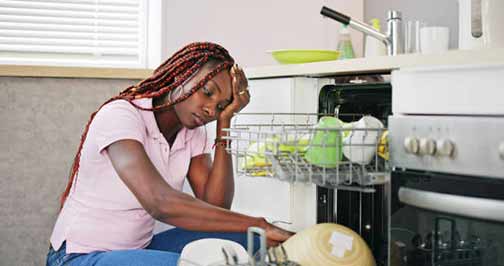
What should you do if you are ever caught in this situation?
You just finished dinner, you’re loading the dishwasher, and something is clearly wrong — it won’t start, it’s not filling with water, or it’s just not cleaning the way it should. Before you call a plumber or an appliance repair technician, it’s worth taking a few minutes to troubleshoot the problem yourself. Many common dishwasher issues have simple explanations that don’t require a service call at all, and knowing where to look can save you both time and money.
This guide walks you through the most likely causes of the most common dishwasher problems and what to check first — so you can figure out whether it’s something you can handle on your own or whether it’s time to bring in a professional.
Troubleshooting common dishwasher problems in your home
The dishwasher doesn’t clean well
What is the use of a dishwasher if your dishes don’t come out clean? The most probable cause of this problem is that the dishwasher is dirty. To eliminate this possibility, check the door gasket, strain screen and sprayer arms for dirt. Check that the correct cycle is selected and you don’t have low pressure from the spray arms. Be sure that the spray arm is not stuck or worn out. If the drying cycle is not enabled, enable it. Lastly, you may need a better detergent.
The dishwasher is not draining
If the dishwasher is not draining, there is a huge chance that it is clogged. Do this to unclog the apparatus; run a cleaning cycle with a solution of equal parts water and white vinegar. If the dishwasher is full when this problem happens, examine the check valve in the drain sump. It could be stuck. If this is the cause of the problem, replace the damaged part. The drain flapper is another common site for blockages.

Your dishwasher smells bad
A dishwasher should not have bad odors; it defeats the entire purpose of washing dishes in the first place. Bad odors in your dishwasher are caused by trapped food and grease. The strainer screen, jets in the sprayer arms and the bottom edge of the dishwasher door are common places where debris lodges. Clean the dishwasher, and spray a solution of equal parts water and baking soda on its walls, bottom and door. Let it sit for ten minutes. Lastly, run an empty hot cycle.
Your dishwasher is leaking
This problem could be due to improper loading. If loading the dishwasher in the right way doesn’t solve the problem, check the drainage hose for cracks or signs of wear. If necessary, replace the hose. Repeat the same procedure with the door gasket. If this doesn’t stop the leak, replace the door seal. If your dishwasher still leaks after these steps, you may want to contact a professional kitchen plumber.
The dishwasher is not starting
If the dishwasher door is not properly closed, it won’t start. Even if the door is closed, if the door latch has malfunctioned or the door latch switch is faulty, your dishwasher will not start. A broken timer will also prevent your dishwasher from starting. Lastly, the dishwasher may be disconnected from power. Ensure it is plugged in and the power cord and outlet are not damaged. Ensure that the dishwasher reset button has not been activated, the circuit breaker has not tripped, and the fuse has not blown.
The dishwasher doesn’t have water or has too much water
If the dishwasher is not getting any or too much water, the first place you want to look is the water inlet valve and the float and float switch. If the problem is insufficient or no water supply, you may need to replace the inlet valve. If the dishwasher does not stop filling up with water, the float and float switch may be obstructed by debris. The timer could also be stuck on full. Lastly, check that the hot water supply stop valve under the sink is not closed.
The dishwasher is noisy
If your previously quiet dishwasher has suddenly started making a lot of noise, there are a few likely causes worth checking before assuming the worst.
In the best case scenario, the spray arms are simply banging against dishes inside the appliance as they rotate — rearranging the load usually fixes this immediately. If the noise persists with an empty or properly loaded machine, the issue is more likely a defective pump, a worn wash arm seal, or a damaged bearing ring. Identifying which component is causing the noise and replacing it should resolve the problem.
If your dishwasher still isn’t working properly after working through these troubleshooting steps, it’s time to call a professional plumber. At that point the problem has likely gone beyond a straightforward DIY fix, and continuing to run a malfunctioning dishwasher can cause water damage or make the underlying issue worse. A licensed plumber can diagnose what’s actually going on and get it sorted out quickly.