

If your home was built before 1980 anywhere in the Chicago metropolitan area, there is a very good chance that the drain lines running through your walls, floors, and crawlspace are cast iron.
And if those cast iron pipes have never been properly evaluated — not rodded when they backed up but actually inspected with a camera — there is an equally good chance they are in worse condition than you realize.
This is not a scare tactic. It is the honest reality of what we see every week when we camera-inspect drain systems in communities like Westchester, Berwyn, Lyons, Palos Hills, Justice, Willowbrook, and dozens of other Chicago suburbs where the housing stock was built in a concentrated window between 1945 and 1975.
The pipes that went into the ground during that era are now between fifty and eighty years old. According to the International Association of Certified Home Inspectors (InterNACHI), cast iron drain pipes have a functional lifespan in the range of 50 years — and in clay-heavy soil like Chicago’s, that timeline runs toward the shorter end.
The math is not complicated. A significant portion of Chicagoland’s residential cast iron drain infrastructure is at or past the point where it needs to be evaluated — and in many cases replaced. The question for any individual homeowner is not whether this applies to their neighborhood. It almost certainly does. The question is whether it applies to their specific pipes. A camera inspection answers that definitively. Everything else is guessing.
What Cast Iron Is and Why It Was Used Everywhere in Chicago
Cast iron was the dominant material for residential drain, waste, and vent systems throughout the United States from roughly the late 1800s through the 1970s, when PVC plastic pipe began replacing it as the standard.
It was chosen for good reasons. Cast iron is strong, heavy, fire-resistant, and provides excellent sound dampening compared to plastic pipe — a quality anyone who has lived in a home with PVC drain lines running through interior walls can appreciate at 2 AM. It handled the thermal expansion and contraction of hot drain water better than early plastic alternatives, and it was the material plumbers knew how to work with.
In the Chicago area specifically, cast iron was essentially universal in residential construction through the postwar building boom that created the vast majority of the western and southwestern suburbs. The bungalows, ranches, Georgian two-stories, and brick two-flats built throughout communities like Berwyn, Cicero, Lyons, La Grange, Westchester, and Justice from the 1940s through the 1960s all went in with cast iron drain stacks and sewer laterals.
The split-levels and colonials built in the outer suburbs through the 1970s — communities like Tinley Park, Palos Hills, Bolingbrook, and Willowbrook — used cast iron for the drain stack and often combined it with clay tile for the sewer lateral.
This is the housing stock that defines the character of the Chicago suburbs. And it is carrying plumbing that is now at or past its expected service life.
How Cast-Iron Fails — and Why Chicago Makes It Worse
Cast iron does not fail suddenly the way a supply pipe might burst from a freeze. It deteriorates progressively, and the deterioration happens on the inside of the pipe where you cannot see it without a camera.
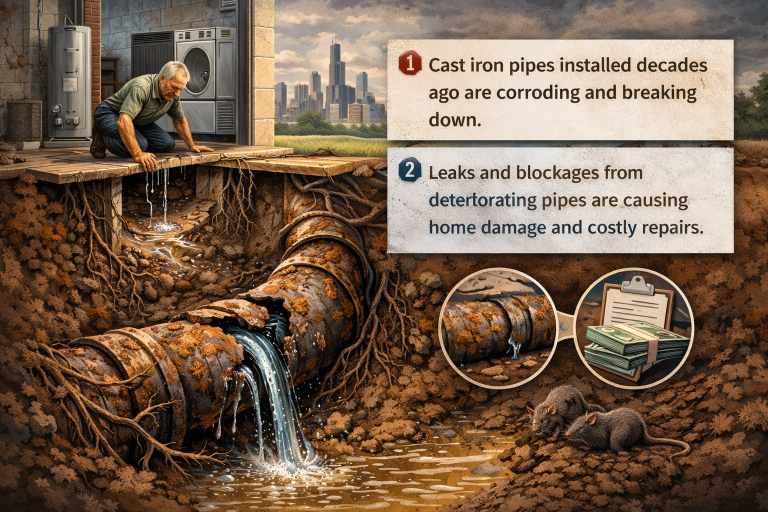
The primary failure mechanism is internal corrosion. Cast iron corrodes from the inside out when exposed to the gases, moisture, and organic acids present in a drain system — a process where hydrogen sulfide gas produced by bacterial activity reacts with the iron to form iron sulfide deposits and, eventually, pitting and perforation of the pipe wall. This process accelerates with age and is largely invisible until either the pipe leaks into surrounding structure or a camera inspection reveals the damage.
The practical effect of this internal corrosion is that the pipe wall roughens and pits dramatically. A new cast iron pipe has a relatively smooth interior surface. A fifty-year-old cast iron pipe in a Chicago home can have an interior that resembles the surface of a gravel road — pitted and irregular, with scale deposits creating a texture that catches and holds grease, hair, soap scum, and debris far more aggressively than smooth PVC.
This is why drain cleaning in older Chicago homes requires more frequent service than in newer construction, and why standard sewer rodding provides shorter-lasting relief over time. You are clearing a rough, corroded pipe that immediately begins accumulating new buildup — not a smooth pipe that stays clear.
Chicago’s environment accelerates every part of this failure process. The clay-heavy Drummer series soils that dominate Cook, DuPage, and Will Counties are dense, largely non-draining, and subject to significant movement during Chicago’s extreme freeze-thaw cycling. Clay soil expands when wet and contracts when dry. It heaves during freeze events and settles unevenly during thaw. Cast iron pipe joints are not flexible. When the soil around them shifts, the joints shift too — creating what a sewer camera inspection reveals as offset joints, separated joints, or in severe cases, fully collapsed sections.
Root intrusion makes everything worse. Chicago’s mature residential tree canopy — the elm, oak, maple, and cottonwood trees lining virtually every residential street in the older suburbs — sends root systems in every direction following moisture. An aging cast iron joint with deteriorated packing is a moisture source that tree roots find reliably. Root tendrils enter the joint, establish themselves, and grow. Sewer rodding cuts through the roots and provides temporary relief. The roots grow back, often faster than before, because the moisture source — the compromised joint — is still there. The only permanent solution for root intrusion is repairing or replacing the compromised pipe section.
The Communities Most at Risk Right Now
Not every Chicago suburb has the same cast iron risk profile. The communities where we consistently find the most significant cast iron drain system issues share a common characteristic: they were built out in a concentrated period in the late 1940s through the 1960s, meaning the overwhelming majority of their housing stock carries the same vintage plumbing in the same state of deterioration.
Westchester is perhaps the most striking example. As we document on our Westchester plumbing page, the village grew from roughly 4,300 residents in 1950 to over 18,000 by 1960 — almost entirely through new residential construction in a single concentrated decade. The ranches, Georgians, and split-levels built along streets like Canterbury, Windsor, Warwick, and Suffolk during that postwar buildout are now 65 to 75 years old. The cast iron drain systems that went in with those homes are at the age where deterioration is accelerating rather than beginning.
The communities along the I&M Canal corridor — Lyons, Justice, and the adjacent southwest Cook County villages — carry housing stock built primarily in the 1950s and 1960s as working-class bedroom communities along the Archer Avenue corridor. Cast iron laterals here are now 60 to 70 years old, subject to the additional stress of the Cal-Sag Channel watershed’s clay soil and high-water table.
Berwyn and Cicero, the densely built bungalow communities immediately west of Chicago, have some of the oldest residential cast iron infrastructure in the entire region — homes built in the 1920s and 1930s with drain systems now approaching 90 to 100 years in the ground. These laterals were never designed to last this long.
Palos Hills, with its median construction year of 1977 and its proximity to the 15,000-acre Palos Preserves, presents a specific combination of mature housing and aggressive root intrusion from woodland root systems adjacent to residential sewer laterals along 104th Avenue and preserve-edge streets.
Willowbrook and the Route 83 corridor communities built through the 1960s and early 1970s have cast iron laterals in the 50-to-60-year range — old enough to show significant deterioration, young enough that many homeowners haven’t thought to have them evaluated.
Tinley Park’s older neighborhoods — Parkside near downtown and the Cook County core communities like Brementowne and Lancaster Highlands built between 1970 and 1985 — are hitting the age range where cast iron assessment is genuinely warranted.
This is not a comprehensive list. If your home is in any Chicago suburb built primarily before 1980 and the drain system has never been camera-inspected, the conversation about cast iron condition is one worth having.
What a Failing Cast Iron System Looks Like From the Inside
One of the most useful things about sewer camera inspection is that it makes the invisible visible. Homeowners who have watched a camera inspection of their own fifty-year-old cast iron drain system consistently describe the experience as eye-opening.
Early-stage deterioration shows as interior roughening. The pipe wall has lost its smooth surface and developed a pitted, irregular texture. Deposits of iron corrosion products, calcium scale, and biofilm are visible on the pipe wall. The pipe is functional but accumulating buildup faster than a newer pipe would and drain cleaning service provides shorter relief between visits.
Mid-stage deterioration adds visible cracking and spalling of the pipe wall, offset joints where ground movement has shifted pipe sections out of alignment, and often visible root tendrils at joint locations. Hydro jetting can clean the pipe effectively at this stage, and a post-jetting camera inspection gives you an accurate picture of how much structural integrity remains.
Late-stage deterioration involves sections where the pipe wall has corroded through, active leaks into surrounding soil or structure, collapsed sections, or joint failures so severe that root intrusion has created a partial or complete blockage that cannot be reliably maintained. At this stage, repair or replacement is the appropriate recommendation — not because a plumber wants to sell you something, but because a pipe in this condition will not stay clear regardless of how aggressively it is maintained.
The camera tells you which stage you are in. Without a camera, every service call on an older cast iron system is informed guesswork.
The Warning Signs You Can See Without a Camera
While a camera inspection is the definitive diagnostic tool, there are warning signs you can observe without any equipment at all.
Multiple slow drains throughout the house simultaneously — not one slow bathroom sink, but multiple fixtures draining slowly at the same time — almost always indicates a main line issue rather than an isolated fixture problem. When a main line cast iron lateral has deteriorated to the point of significantly reduced capacity, every fixture in the house drains slowly because they all share the same compromised main.
A main line rodding that provides relief for only a few weeks or months before the problem returns is a strong indicator of a line with structural issues beyond a simple blockage. A properly maintained cast iron lateral in reasonable condition should stay clear for considerably longer than that after a thorough cleaning.
Sewage odors inside the house — particularly in the basement, near floor drains, or near washing machine connections — can indicate either a blockage causing gas backup, or more concerningly, sections of cast iron that have corroded through and are releasing sewer gas into surrounding space. This is both a plumbing problem and a health concern that warrants immediate attention.
Wet spots, efflorescence, or unexplained moisture on basement walls or floors near the main lateral or drain stack can indicate a pipe that is actively leaking into surrounding soil or structure.
Gurgling sounds from toilets or drains when another fixture is used — the toilet gurgling when the washing machine drains, for example — indicates either a partial main line blockage or a venting problem, both of which are more common in deteriorated cast iron systems.
Any of these warning signs in a home built before 1980 is a reasonable trigger for scheduling a camera inspection of the drain system. Addressing cast iron issues early — before a pipe that is deteriorating becomes a pipe that has failed — is almost always significantly less expensive than emergency response to a drain system failure that has been developing for years.

Repair vs. Replacement: How to Think About the Decision
Not every cast iron drain issue requires full replacement. The range of appropriate responses runs from hydro jetting and camera inspection, through targeted section repair, through partial replacement, to full home repiping where the entire drain system is replaced. The right answer depends on what the camera actually shows.
A cast iron drain stack that is rough and scaled but structurally intact is a candidate for aggressive cleaning and a maintenance schedule.
A lateral with one offset joint and otherwise adequate structural condition is a candidate for targeted excavation and spot repair at the damaged section.
A drain system where multiple sections show active corrosion-through, where the pipe wall has thinned to the point of structural compromise in several locations, or where root intrusion is recurring every few months because multiple joints are compromised — that is a system where full replacement is the economically honest recommendation. Ongoing maintenance of a system in that condition costs more over five years than replacing it correctly now.
Sewer line repair costs in Chicagoland for targeted section work typically run $1,500 to $4,500 depending on depth, access, and the length of pipe involved.
Full lateral replacement from the foundation to the city main runs $4,000 to $12,000 or more depending on depth, distance, and soil conditions.
Interior drain stack replacement in a multi-story home typically runs $3,000 to $8,000 for the primary stack.
Full home drain system repiping — replacing all drain, waste, and vent lines throughout the house — is a significant project ranging from $8,000 to $25,000 or more depending on the size and configuration of the home.
These are real numbers, not worst-case scenarios. They are also almost always more manageable than the cost of water damage, mold remediation, and structural repair that results from a drain system that fails catastrophically. We have been called to homes where a corroded cast iron drain stack was leaking into a floor system for years, discovered only when the floor structure became compromised. The repair cost in those cases is not just the plumbing — it includes carpentry, flooring, and in some cases drywall and insulation as well.
What to Do If You’re Buying a Home in Chicago’s Older Suburbs
Home purchases in the older Chicago suburbs are one of the highest-value use cases for sewer camera inspection. Standard home inspections do not scope the sewer lateral — the inspector looks at accessible systems and visible components, but the underground pipe from your foundation to the city main is not part of a standard home inspection protocol. That pipe is your financial responsibility from the moment you close.
In Chicagoland’s older communities, a lateral replacement can run $6,000 to $12,000. That is real money to either negotiate off the purchase price, require the seller to address as a condition of closing, or use as a basis for walking away from a property whose disclosed condition doesn’t match reality.
We work with real estate agents, buyers, and sellers throughout the Chicago suburbs to accommodate pre-closing camera inspections on realistic timelines. If you are purchasing a home built before 1980 in any Chicago area community, requesting a sewer camera inspection as part of the home inspection contingency period is one of the most financially protective steps you can take. If the seller declines to allow a camera inspection, that is itself information worth having.
Don’t Overlook the Supply Lines: Galvanized Steel Is a Different Problem but Just as Urgent
It is worth noting that cast iron drain lines are not the only aging plumbing infrastructure concern in Chicago’s older housing stock. Homes built before roughly 1970 often also have galvanized steel supply lines — the pipes carrying pressurized water to your faucets, shower, and appliances.
Galvanized steel corrodes from the inside out just as cast iron does, progressively narrowing the effective interior diameter of the pipe as mineral deposits and rust accumulate on the pipe wall. The symptoms are different from drain line issues: whole-house low water pressure that has worsened gradually over years, water that runs discolored when first turned on after sitting overnight, and pressure noticeably worse at upper-floor fixtures than at the first floor.
In homes in Westchester, North Riverside, La Grange, and the other uniformly postwar-built communities, galvanized supply line failure is as common a finding as cast iron drain deterioration. The two problems often coexist in the same home because both systems were installed in the same era and are aging on the same timeline.
Home repiping that replaces both the drain system and the supply lines in an older Chicago home addresses both problems together — and is often more cost-effective done as a coordinated project than as two separate emergency responses years apart.
Getting an Honest Assessment of Your Cast Iron System
The right starting point for any homeowner concerned about cast iron drain system condition is a camera inspection by a licensed plumber. Not a rod-and-clear-the-immediate-problem service call, but a camera inspection specifically intended to document the actual interior condition of the pipe.
Suburban Plumbing Experts performs sewer camera inspections throughout the Chicago suburbs under Illinois Plumbing License #055-044116 and Sewer License #2565. We do not use a camera inspection as a sales tool to generate replacement recommendations for pipes that don’t need it like quite a few other Chicago area plumbing companies do. We use it as a diagnostic tool to give homeowners accurate information about what they actually have.
If your cast iron is in reasonable condition, we will tell you that, along with what maintenance schedule makes sense. If it has specific issues that warrant targeted repair, we will show you the camera footage and explain what we are seeing and why it matters. If the system has deteriorated to the point where replacement is the honest recommendation, we will tell you that too — and explain the reasoning in terms that make sense without the runaround.
For scheduling or to ask questions about your specific situation, call us at 708-801-6530. We answer 24 hours a day, seven days a week. For after-hours emergencies, call 708-518-7765 directly.
You can also learn more about our sewer services, drain cleaning, sewer line repair, and home repiping at suburbanplumbingexperts.com.
Additional Resources
Metropolitan Water Reclamation District of Greater Chicago (MWRD) — The regional authority responsible for wastewater treatment and stormwater management for Chicago and 128 surrounding communities. The MWRD publishes extensive documentation on the region’s combined sewer overflow issues and the Tunnel and Reservoir Plan (TARP), providing essential context for why aging private sewer laterals matter so much in the Chicago area.
Illinois Department of Financial and Professional Regulation — License Lookup — The state’s official plumbing license verification database. Before authorizing any licensed plumbing work in Illinois, including camera inspection and pipe replacement, you can verify any contractor’s license status here directly from the IDFPR’s official databases, updated daily.
ASCE Report Card for Illinois Infrastructure — The American Society of Civil Engineers’ infrastructure assessment for Illinois, which assigns drinking water and wastewater a grade of “D+” — identifying aging infrastructure throughout the state as an area of significant concern. Illinois has over 675,000 identified lead service lines alone, underscoring the scale of the region’s aging underground infrastructure challenge.
InterNACHI — International Association of Certified Home Inspectors — The professional organization for certified home inspectors that publishes widely-referenced component lifespan data, including for cast iron drain systems. InterNACHI’s guidance is the standard reference used by home inspectors throughout Illinois when evaluating older residential plumbing — and their guidance is unambiguous about cast iron drainpipe age and the need for professional evaluation.
—
Suburban Plumbing Sewer Line & Drain Cleaning Experts — Brookfield, IL — 708-801-6530 — suburbanplumbingexperts.com — Illinois Plumbing License #055-044116 — Sewer License #2565