
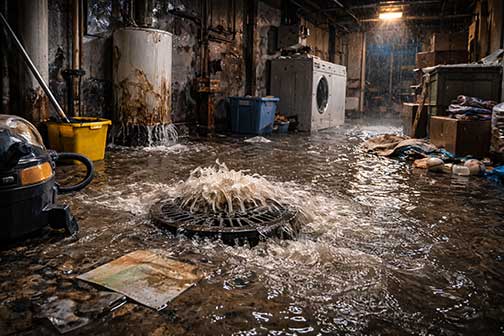
Chicago homes are notoriously infamous for being prone to sewer backups and basement flooding. Like many urban areas with aging infrastructure, including markets known for diverse Orlando rental options, over 270,000 properties in the city are exposed to this risk each year, with the bulk of the problem happening during periods of extreme rainfall or heavy snowmelt.
Why are Chicago homes so vulnerable to sewer line backup?
The issue has its roots in the city’s natural terrain, its history, climate, and certain developments over the last few decades. Below, we present a detailed explanation of the reasons why heavy rains nearly always result in a sewer backup in your Chicago home.
Reasons for frequent sewer backups in Chicago homes
A combined sewer system (CSS)
Most of Chicago’s municipal sewer lines are based on a 19th-century design that manages rainwater runoff and domestic sewage in a single pipe network. This is unlike modern designs, which collect and transport sanitary waste and stormwater in separate channels. The result of this faulty design is that when city sewer lines are overwhelmed by stormwater, their contents back up into the private sewer lines connected to them. This pushes the raw sewage inside those residential sewer lines backwards until they empty out inside the house.
Aging sewer infrastructure
Most of the city’s sewer lines, installed since the late 19th and early 20th centuries, have never been upgraded. These lines were built for a smaller population and not to handle the intense flows that they are frequently subject to today. Also, after decades of being in service, large sections of the lines have degraded, leaving them brittle and prone to blockages. These issues further limit the capacity of the city’s sewer lines to efficiently handle stormwater and sewage, making them even more prone to failure and subjecting Chicago homes to a higher risk of sewer backups.
Low-lying terrain and high water table
What is today the city of Chicago was once a natural floodplain for Lake Michigan. Historically, the entire area was initially a massive swamp dominated by the Chicago River. Although now built up, many of the features that made the area suitable as a floodplain remain. Furthermore, Chicago has low-lying terrain and a very high water table. This means the ground beneath the city quickly becomes saturated after short spells of heavy rain. And since rainwater cannot soak into the ground, it becomes runoff that floods roads, yards, and sewer lines.
Heavy clay soils
Another problem is the type of soil found in most parts of Chicago. About 85% of the soil in the Chicago area is heavy clayey soil. These soil types have fine particles that are tightly packed together and tiny pores that do not allow water to pass through. This leads to poor drainage; instead of infiltrating into the soil, rainwater is more likely to settle on the top of clay-rich soils. When they eventually absorb water, clay soils hold onto their water for a longer time. This makes them prone to becoming waterlogged, forcing the excess water to be diverted into nearby basements, streets, and sewer lines.
An overabundance of impervious surfaces
Chicago abounds in impervious surfaces like rooftops, parking lots, paved walkways, and streets. About 42% to 50% of the land surface across the city is asphalt and concrete. The absence of natural surfaces that can absorb water means that rainwater, which should have soaked into the soil, is diverted into drains and stormwater management systems. This increases runoff volume and adds more pressure to the city’s already overwhelmed sewer system, leading to more incidents of sewer backups in Chicago homes.
Extreme weather events
The above problems are worsened by the city’s increasingly chaotic climate. Chicago is one city in the USA where the impact of climate change truly comes to the fore. The city’s already extreme weather is compounded by changing climate patterns across the country and the entire globe. Whether these events happen as snow squalls or intense rainstorms, the consequences are seen in a direct increase in the rate of sewer backups and other drainage problems across the city.
Protecting your Chicago home from sewer backups
What can you do to protect your home?
The city is already taking steps to address some of these problems through its Tunnel and Reservoir Plan (TARP), a program that aims to build additional infrastructure across the city to capture and manage excess water during intense storms.
You can also protect your home by adopting measures like:
- Installing a backwater valve in your sewer line ensures that backups in the city sewer lines don’t ripple outwards into your home.
- Installing a rain garden on your property to divert runoff away from your home and store the water safely on your property.
- Servicing your sump pump seasonally to ensure it is in top condition to keep your basement dry and protect your home from water damage.
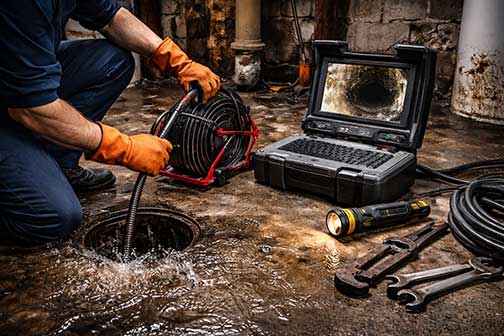
- Periodically inspecting your sewer line and cleaning the system to get rid of build-up that can encourage clogs and backups in the line.
And, most importantly, working with a expert Chicago plumber to assess the vulnerabilities of your drainage system and design a holistic strategy to help defend your home against the risks of sewer backups highlighted in this article.