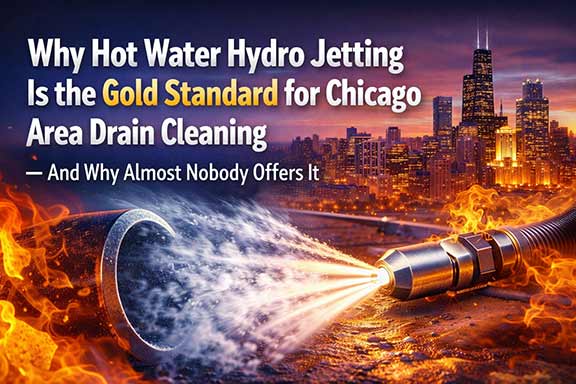
There’s a difference between clearing a drain and cleaning it. Most plumbing companies in the Chicago area offer one. Suburban Plumbing Experts offers both — and the distinction matters more than most homeowners and property managers realize until they’ve seen what hot water hydro jetting actually does to a pipe that’s been accumulating grease, scale, and debris for decades. Hot water hydro jetting is exactly what it sounds like: high-pressure water, heated to temperatures that liquefy and dissolve grease on contact, delivered through a specialized nozzle that scrubs the interior of your drain and sewer lines clean in a way that cold-water jetting and standard sewer rodding simply cannot replicate. It is, without question, the most thorough drain and sewer cleaning method available today — and it’s one of the reasons Chicagoland homeowners and commercial property managers who’ve experienced it once don’t go back to anything else.
What makes this service genuinely unusual is not just the technology. It’s the scarcity of it. Despite its effectiveness, hot water hydro jetting is not widely available in the Chicago suburbs. The equipment is more expensive than standard cold-water jetting units, the operational demands are higher, and the training required to use it correctly — knowing the right temperature, pressure, and nozzle configuration for different pipe materials and blockage types — goes beyond what most drain cleaning companies provide their crews. Suburban Plumbing Experts is among a very small number of licensed plumbing contractors in the Chicagoland area equipped and trained to deliver true hot water hydro jetting service for both residential and commercial properties. When you call us and ask specifically for hot water jetting, you’re getting a service that the majority of plumbers in the region simply cannot provide.
What Hot Water Hydro Jetting Actually Does
To understand why heat changes the equation, you need to understand what’s actually inside a drain line that hasn’t been properly maintained. Standard sewer rodding — which uses a flexible steel cable to punch through blockages — clears a path but leaves the pipe walls largely as they are. Cold-water hydro jetting improves on that significantly by using high-pressure water to scour the walls, but grease presents a specific challenge that cold water addresses only partially. Grease doesn’t dissolve in cold water. It breaks apart, gets pushed downstream, and often re-adheres to the pipe wall further along the line. You’ve moved the problem, not solved it. Hot water changes the chemistry of what’s happening inside the pipe. Grease — whether it’s cooking oil from a residential kitchen that’s been draining into a cast iron stack for thirty years, or commercial fryer grease that’s built up in the drain lines of a restaurant on Archer Avenue or Joliet Road — emulsifies when it contacts hot water at the right temperature. It doesn’t just get pushed around. It dissolves, suspends in the water, and gets flushed entirely out of the system. The pipe wall left behind is genuinely clean, not just cleared.
Beyond grease, hot water jetting is significantly more effective on the biofilm that forms on the interior of residential drain lines over time — the combination of bacteria, soap scum, hair follicles, and organic material that gives slow drains their characteristic odor and that provides the surface grease and debris adhere to. Cold water disrupts biofilm. Hot water destroys it. For homeowners dealing with drains that smell even after clearing, that detail matters. The practical result of a hot water hydro jetting service is a pipe that is as close to its original interior condition as it can be after years or decades of use. Drain capacity is fully restored. The buildup that was causing recurring slow drains and backups is gone — not just compressed, not just pushed downstream, but gone. And because the pipe wall is clean rather than coated, the interval before the next service is needed is longer than it would be after cold-water jetting or rodding.
Why Chicago Area Homes and Businesses Need This More Than Most
The Chicago metropolitan area presents a specific combination of factors that make thorough drain cleaning more valuable here than in many other regions of the country. Chicagoland’s housing stock is old. The western and southwestern suburbs — Brookfield, La Grange, Lyons, Berwyn, Cicero, Justice, Palos Hills, and dozens of communities in between — contain an extraordinary concentration of homes built in the 1940s, 1950s, and 1960s. These homes overwhelmingly have cast iron drain stacks and sewer laterals that have been in the ground for sixty to eighty years. Cast iron corrodes from the inside out over decades, developing a roughened, pitted interior surface that catches and holds grease and debris far more aggressively than smooth PVC pipe.
A cast iron drain line in a Chicago bungalow that’s never been properly cleaned isn’t just slow — it may be operating at a fraction of its original capacity, with pipe walls coated in layers of material that have been accumulating since the Eisenhower administration. Hot water hydro jetting on that kind of line doesn’t just restore flow. It reveals the actual condition of the pipe underneath, which is why we almost always recommend a sewer camera inspection in conjunction with the service — so you know exactly what you’re working with once the decades of buildup are gone. Chicago’s clay soil adds another dimension to the problem. The Drummer series clay soils that dominate the southwest suburbs hold moisture at pipe joints and create ideal conditions for root growth.
Tree roots follow moisture into older pipe joints, establish themselves, and grow — slowly at first, then aggressively as the root mass builds. Standard rodding cuts through roots but leaves fragments and root tendrils in the pipe. Cold-water jetting flushes more of that material out. Hot water jetting with the right nozzle configuration removes root material more completely and leaves the pipe wall cleaner, which slows the rate at which debris accumulates around remaining root entry points. For properties near the Palos Preserves, along the Des Plaines River corridor, or in any of the heavily tree-lined older neighborhoods throughout Cook, DuPage, and Will Counties, that difference is meaningful. The food service industry along Chicagoland’s major commercial corridors — Archer Avenue, Ogden Avenue, Midwest Road in Oak Brook, Joliet Road in Hodgkins — has no better tool for maintaining code-compliant drain systems than hot water hydro jetting.
Commercial kitchen drain lines accumulate grease at a rate that would surprise most people who haven’t seen a camera inspection of an unmaintained restaurant drain. Grease that has hardened on pipe walls over months of high-volume kitchen operation does not respond adequately to rodding or cold-water jetting alone. Hot water emulsification is the appropriate treatment, and it’s the reason we specifically provide this service to commercial food service operators throughout the area.
Hot Water Hydro Jetting vs. Standard Drain Cleaning Methods
It’s worth being direct about the comparison because there’s a lot of imprecise language in the drain cleaning industry, and customers deserve to understand what they’re actually buying. Sewer rodding is the baseline — a cable machine that clears blockages by punching through them. It is fast, relatively inexpensive, and appropriate for many situations. If you have an isolated clog that hasn’t been recurring, rodding is often the right first step, and we use it regularly. What it doesn’t do is clean the pipe. Standard hydro jetting — cold water at high pressure — is a significant step up. A quality cold-water jetting service from a licensed plumber with commercial-grade equipment genuinely cleans pipe walls and is far superior to rodding for lines with scale, grease accumulation, or root material. For many applications, it’s the right service.
Hot water hydro jetting is above that. The temperature addition is what separates it for grease-intensive applications — residential kitchen lines that have never been properly cleaned, commercial kitchen drains with heavy grease loading, and any line where a camera inspection has revealed a significant coating of organic material on the pipe wall. The Hotsy brand hot water jetting equipment that Suburban Plumbing Experts uses is commercial-grade industrial cleaning equipment — the same technology used for facility cleaning, equipment degreasing, and industrial wash-down operations, adapted and applied to drain and sewer cleaning with the specialized nozzles and access equipment that licensed plumbing work requires. It is not consumer-grade. It is not a power washer with a drain attachment. It is purpose-built commercial hot water jetting equipment operated by licensed plumbers who know the difference between what each pipe material and each blockage type actually needs.
The Services That Benefit Most From Hot Water Jetting
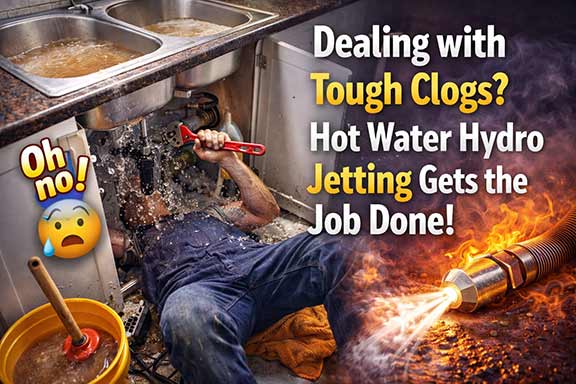
Drain cleaning in residential kitchens is one of the single best applications for hot water jetting that exists. The kitchen drain is where grease enters the system — cooking oil, meat fat, butter, soap, and food particles that go down the drain every day. Over time this material coats the drain line from the fixture all the way to the stack. A kitchen line that’s been in service for twenty years in an older Chicagoland home without ever being properly cleaned can have significant grease coating that a camera inspection makes immediately visible. Hot water jetting on that line produces results that standard methods don’t come close to matching. Sewer line cleaning — the full main lateral from the foundation to the city main — benefits from hot water jetting when a camera inspection reveals scaling or grease accumulation in the line. This is less common than kitchen line grease but does occur, particularly in neighborhoods where kitchen grease has been draining into the system for decades.
For commercial properties, the commercial drain cleaning application is the most compelling. Restaurants, commercial kitchens, food processing facilities, and any property with high-volume food service operations should be on a maintenance schedule that includes periodic hot water jetting of their drain system. The cost of scheduled maintenance is a fraction of the cost of an emergency backup during service hours — or worse, a health code citation from a failed inspection. Grease trap cleaning and hot water drain line maintenance work together as a system. A grease trap that’s properly maintained prevents large volumes of grease from entering the drain line — but some grease gets through in every food service operation, and that grease accumulates over time. Periodic hot water jetting of the drain lines downstream of the grease trap keeps the system functioning properly and eliminates the buildup that rodding alone would leave behind.
What to Expect From a Hot Water Hydro Jetting Service
When Suburban Plumbing Experts performs a hot water hydro jetting service, the process begins with an honest assessment of what the situation actually calls for. We don’t recommend hot water jetting for every drain call — that would be overselling a premium service to customers who don’t need it. If a basic rodding or cold-water jetting service is the right call for what you’re dealing with, we’ll tell you that. When hot water jetting is the appropriate service, we’ll explain why. The service itself begins with identifying the correct access point — ideally a cleanout, but we can work through other access points when needed.
We use a sewer camera inspection before the jetting service on any line where there’s uncertainty about the pipe condition, because sending high-pressure hot water into a structurally compromised pipe is not something any responsible plumber does. A camera inspection protects you and protects the pipe. Once we confirm the line is in condition to be jetted, we bring the equipment to temperature and begin the service. The hot water nozzle is fed through the line, working from downstream back toward the access point so that dislodged material is flushed out ahead of it rather than compacted. On a heavily scaled residential kitchen line, the transformation is visible in real time on the monitor — the coated pipe wall becoming clean as the nozzle advances.
On a commercial line with heavy grease loading, the water returning to the bucket is opaque with emulsified grease that was bonded to the pipe wall minutes before. When the service is complete, we recommend a post-service camera inspection to document the condition of the cleaned line and identify any structural issues that the jetting has revealed — joints that have shifted, sections that have thinned, or intrusions that were hidden under the buildup. This documentation is particularly valuable for older lines and for any property where the drain history involves recurring problems.
For scheduling hot water hydro jetting service or to ask whether your situation calls for it, call us directly at 708-801-6530. We answer 24 hours a day, and for after-hours emergencies the direct line is 708-518-7765. You can also learn more about our full range of sewer services and plumbing services at suburbanplumbingexperts.com. Illinois Plumbing License #055-044116. Sewer License #2565.
Additional Resources
For homeowners and property managers who want to understand more about the regulatory and infrastructure context for drain maintenance in the Chicago area, the following resources are worth bookmarking. The Metropolitan Water Reclamation District of Greater Chicago publishes extensive documentation on the Cal-Sag Channel watershed, combined sewer overflow issues, and the stormwater challenges facing the region’s older communities — all of which are directly relevant to why drain maintenance matters here more than in many parts of the country. The Illinois Environmental Protection Agency oversees wastewater standards and discharge regulations for Illinois municipalities and commercial operations, and their published guidance on commercial kitchen grease management is worth reviewing for any food service operator.
The Illinois Department of Financial and Professional Regulation maintains the state plumbing license database — you can verify any Illinois plumbing contractor’s license status online, which is the single most important check you can do before authorizing any licensed plumbing work on your property. The City of Chicago Department of Water Management provides information specific to Chicago residents on sewer maintenance responsibilities and the city’s own infrastructure programs, including documentation on the Tunnel and Reservoir Plan (TARP) deep tunnel project that has significantly reduced — but not eliminated — combined sewer overflow events throughout the metropolitan area. Understanding how that system works and what its capacity limits are is directly relevant to why basement backup protection and maintained drain lines matter even in communities served by the most sophisticated stormwater infrastructure in the world.
Suburban Plumbing Sewer Line & Drain Cleaning Experts — Brookfield, IL — 708-801-6530 — suburbanplumbingexperts.com — Illinois Plumbing License #055-044116 — Sewer License #2565