
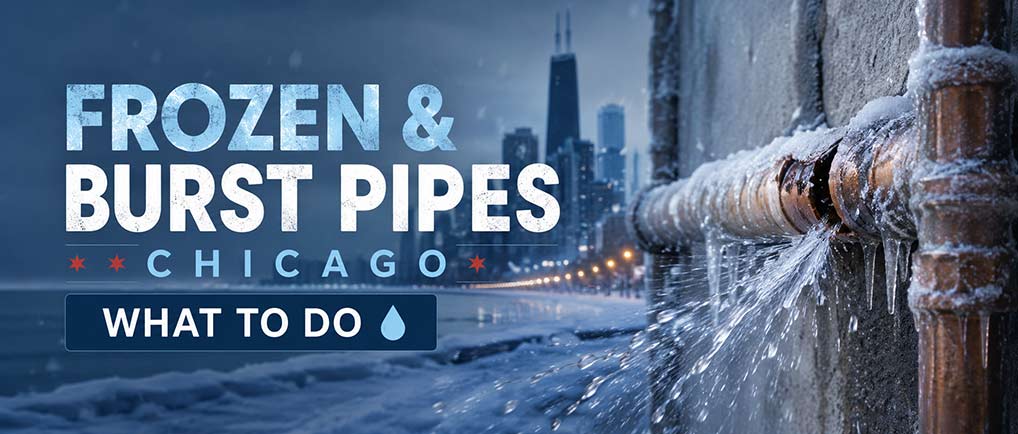
What Every Chicago Homeowner Should Know Before the First Hard Freeze — Not After the First Burst Pipe
Illinois isn’t just a cold-weather state. According to State Farm’s most recent winter claims data, Illinois ranks among the top five states in the country for total frozen-pipe claim costs paid — alongside Oregon, Washington, Texas, and Tennessee. That list isn’t sorted by which states are coldest. It’s sorted by which states’ homeowners actually filed the most expensive frozen-pipe claims, and Illinois made the cut.
Nationally, the numbers behind that ranking are significant on their own. The Insurance Information Institute reports that water damage and freezing together account for roughly a quarter of all homeowners insurance claims filed in the United States each year, with an average claim payout in the range of $11,000 to $15,000. State Farm alone handled more than 20,000 winter water-damage claims between 2024 and June 2025, paying out over $628 million — an average claim of more than $30,000.
Burst pipes aren’t a minor seasonal inconvenience. According to the Insurance Institute for Business & Home Safety, they’re the single leading cause of property damage from winter weather in the United States — ahead of snow load, ahead of ice dams, ahead of wind damage. And the mechanism that produces that damage is almost always preventable, almost always misunderstood, and in Chicago specifically, almost always avoidable with the right preparation before the cold arrives.
This guide covers what’s actually happening inside a freezing pipe, which pipes in a Chicago home are most at risk, what to do in the first five minutes if one bursts, and the complete prevention checklist that should be part of every Chicago homeowner’s pre-winter routine. If you’re already dealing with a frozen pipe, burst pipe, or sewer backup emergency, visit our Chicago Emergency Plumber Guide for immediate response steps and 24/7 service information.
What’s Actually Happening Inside a Freezing Pipe
Here’s the detail that surprises most homeowners: a pipe almost never bursts at the spot where the ice forms. Water expands by roughly 9% in volume when it freezes. As ice forms inside a section of pipe, it creates a blockage — and any water trapped between that blockage and a closed faucet has nowhere to go. Continued freezing keeps expanding that trapped water, and the pressure inside the sealed section climbs until something gives way. The rupture typically happens not at the ice plug itself, but at the weakest point in the pressurized section downstream from it — often a fitting, a joint, or a straight run of pipe some distance from where the actual ice formed.
This is exactly why a frozen pipe so often produces a surprising amount of water damage relative to how small the actual crack is. The Insurance Institute for Business & Home Safety notes that once a pipe ruptures, as little as a one-eighth-inch crack can release up to 250 gallons of water in a single day once the ice thaws and full water pressure returns. As one Illinois property management resource put it, with frozen pipes it isn’t really the freeze that causes the damage — it’s the thaw, when the ice plug melts and all that built-up pressure finally has somewhere to go.
Why This Is a Genuine Chicago Problem, Not Just a “Cold State” Problem
Chicago’s winter climate creates a specific risk profile that’s different from steadier, uniformly cold climates. The Chicago area regularly experiences sudden, sharp temperature drops — a 30-to-40-degree swing within 24 hours is common during an arctic air mass or polar vortex event — combined with periods of dangerously low wind chill that can drive effective temperatures well below zero. That combination of speed and severity is exactly the condition that catches homeowners off guard: pipes that have been fine for years suddenly freeze during one unusually sharp cold snap, often overnight, often in a section of the home nobody thinks to check.
Chicago’s older housing stock compounds the risk. As our complete decade-by-decade Chicago home plumbing guide covers in detail, a significant share of Chicago-area homes have pipe runs in unheated or marginally insulated spaces — additions, vintage sunporches, garage-adjacent walls, and basement rim joists — that were never built with modern insulation standards in mind. Galvanized supply lines in particular, common throughout Chicago’s pre-1960 housing stock, are both more prone to bursting under freeze pressure and harder to thaw safely than modern materials.
Where Pipes Actually Freeze in a Chicago Home
Pipes don’t freeze randomly. They freeze in specific, predictable locations — almost always somewhere with limited exposure to a home’s heated interior air.
Exterior wall cavities. Any supply line run through an exterior wall — common for kitchen sinks, bathroom vanities, and laundry hookups positioned against an outside wall — has only the wall’s insulation standing between the pipe and outdoor temperatures. Older Chicago homes with minimal or settled insulation in these cavities are particularly vulnerable.
Unheated basements, crawl spaces, and garages. Supply lines running through an unheated or marginally heated basement section, a crawl space, or along a garage wall are exposed to ambient temperatures that can drop close to outdoor conditions during an extended cold snap, especially overnight when heating systems cycle down.
Attic runs. Less common in Chicago single-family homes than in some other markets, but present in some additions and converted spaces — any supply line routed through an unconditioned attic is exposed to the most extreme temperature swings in the house.
Exterior hose bibs and sillcocks. The single most common freeze point in any Chicago home. A garden hose left connected to an outdoor spigot traps water in the line between the spigot and the shutoff valve — and that trapped water has nowhere to expand when it freezes except backward into the pipe inside the wall.
Vacant or minimally heated homes. A home where the thermostat is set unusually low, or a vacation property left unattended during a cold stretch, has no internal heat source working against outdoor temperatures at all. This is the single highest-risk scenario for a whole-house freeze event.
Which Pipe Materials Are Most Vulnerable in a Chicago Home
Not every pipe material responds to freezing the same way, and understanding the difference matters for both prevention priorities and what to expect if a freeze does occur. For the full material-by-material breakdown of what’s likely running through your specific home, see our complete Chicago home repiping guide.
Galvanized steel is rigid and offers no give whatsoever when ice expands inside it — making it one of the more failure-prone materials under freeze pressure, particularly in pipe that’s already corroded and weakened from decades of service in Chicago’s hard water.
Copper is also rigid and will rupture under sustained freeze pressure, typically at a soldered joint or fitting rather than along a straight run.
CPVC becomes more brittle in cold temperatures and can crack under freeze pressure, particularly at fittings.
PEX has meaningfully better freeze tolerance than rigid materials — its flexibility allows it to expand somewhat under freeze pressure without rupturing in many cases. This is one of the specific advantages we cover in our repiping guide for Chicago’s climate. PEX is not freeze-proof, however — sustained, severe freezing can still produce a failure, particularly at rigid fittings or connection points.
Our own service records reflect exactly this range of vulnerability — including a single home in Midlothian, Illinois where a severe cold snap produced burst copper and galvanized pipe in three separate locations and required thawing in five more areas of the home in one visit, alongside a separate repair where burst copper supply lines behind a Chicago tub, toilet, and sink were replaced with Type L copper and properly insulated to prevent the same section from failing again.
The Complete Prevention Checklist
Before the Season Starts
Disconnect every garden hose. This is the single highest-impact prevention step available and it takes minutes. Disconnect hoses from every exterior spigot before the first hard freeze, drain any remaining water from the hose itself, and if your home has interior shutoff valves for exterior spigots, close them and drain the line on the house side.
Insulate exposed pipe runs. Foam pipe sleeves or heat tape on any supply line running through an unheated basement section, crawl space, or exterior wall significantly reduces freeze risk for a relatively small investment.
Seal air leaks near pipe runs. Gaps around foundation penetrations, dryer vents, and cable or utility entry points let cold air directly onto nearby pipes. Sealing these gaps protects plumbing as effectively as it improves energy efficiency.
Know where your main shutoff valve is — and confirm it actually works. In an active freeze emergency, the difference between shutting off water in under a minute and spending several minutes searching for the valve is the difference between minor cleanup and significant water damage. Test it now, before you need it under pressure. For even greater protection, consider installing a smart water monitoring system. Our guide to smart leak detection devices explains how they can automatically detect leaks and even shut off your water before major damage occurs.
During a Cold Snap or Extreme Cold Warning
Open cabinet doors under sinks on exterior walls to allow warm interior air to circulate around the supply lines.
Let faucets drip slightly on fixtures served by exposed or vulnerable pipe runs. A small continuous flow relieves the pressure buildup that freezing creates and keeps water moving rather than sitting still.
Keep the thermostat at a consistent, adequate temperature — most guidance, including from the Insurance Institute for Business & Home Safety, recommends no lower than 55°F throughout the home, including in areas you don’t regularly use, during sustained cold periods.
Keep garage doors closed, especially if any supply lines run through or near the garage.
When You’re Away From Home
Never turn the heat off or set it dramatically lower while traveling during winter. Many homeowners insurance policies specifically require maintaining a minimum interior temperature, or shutting off the water supply entirely, to keep coverage valid for freeze-related damage on an unoccupied home. Leaving the thermostat at a normal winter setting, or arranging for someone to check the home periodically during an extended absence, is far less expensive than the alternative.
Consider shutting off and draining the water supply entirely for an extended vacancy — a longer winter trip, a property between tenants, or a seasonal home — after confirming with your insurer what their specific requirements are for maintaining coverage.
The First Five Minutes — What to Do If a Pipe Freezes or Bursts
If you discover a frozen pipe that hasn’t burst yet: Shut off the water supply to that section if you’re able to isolate it, then apply gentle heat — a hair dryer on a low setting, an electric heating pad wrapped around the pipe, or towels soaked in hot water — starting at the end of the pipe closest to the nearest open faucet and working back toward the blockage. For a detailed step-by-step walkthrough of safe thawing methods, see our guide on how to thaw a frozen pipe in Chicago.
If a pipe has already burst: Shut off the main water supply immediately. This is the single most important action in the first minute, and it’s why knowing your main shutoff location in advance matters so much. Once the water is off, open the nearest faucet on the affected line to drain remaining water and relieve pressure. If the leak is anywhere near electrical outlets, panels, or fixtures, avoid the area and shut off electricity to that section at the breaker if it can be done safely. Move anything valuable away from the water as quickly as possible, and begin documenting the damage with photos for insurance purposes before cleanup begins. Our own crews have responded to exactly this scenario throughout the region — including a recently purchased home in Schaumburg where a frozen pipe burst before the new owners had even settled in, and two split water pipes in a Downers Grove basement after a weather-related burst on the home’s cold side.
Then call a licensed plumber. A burst pipe isn’t a single-point repair in many cases — the same conditions that caused one section to fail may be present at other vulnerable points throughout the home, particularly in an older Chicago property. Our burst pipe repair services provide 24/7 emergency response throughout Chicago and the suburbs.
What Insurance Typically Covers — and What It Doesn’t
Most standard homeowners insurance policies cover frozen and burst pipe damage when the failure is considered sudden and accidental and the home was reasonably maintained and heated. This typically includes both the cost of repairing the pipe itself and the resulting water damage to walls, floors, ceilings, and in many policies, personal belongings.
Where claims commonly run into trouble: policies frequently include a maintained-temperature requirement for coverage to apply, particularly for vacant or seasonally occupied properties. If an insurer determines that a home was left without adequate heat, or that reasonable preventive steps weren’t taken, a freeze-related claim can be reduced or denied entirely on the basis that the damage resulted from neglect rather than a sudden, unavoidable event.
Document your prevention efforts. If you have a vacation property, a rental between tenants, or any home that’s periodically unoccupied during winter months, keeping a simple record of thermostat settings, any professional system checks, and dates when the property was inspected can matter significantly if a freeze-related claim ever needs to be filed.
Renters vs. Homeowners — Whose Responsibility Is a Frozen Pipe?
In most rental situations, the property owner or landlord is responsible for the building’s plumbing infrastructure, including preventing freeze damage to supply lines within walls and unheated spaces. However, tenants typically share responsibility for reasonable day-to-day prevention steps within their control — keeping the unit at an adequate temperature, not propping windows open near plumbing fixtures during extreme cold, and promptly reporting any signs of a developing problem, like reduced water flow from a specific fixture, which can be an early warning sign of a partially frozen line.
For Chicago-area landlords and property managers, our emergency plumbing services include both emergency response for active freeze events and pre-winter assessment of vulnerable supply lines across rental properties.
For landlords and property managers specifically, our guide to frozen pipes in rental properties covers tenant communication, liability, and prevention across multi-unit properties in more depth.
After a Freeze Event — What to Check
Even if your pipes survive a hard freeze without an obvious rupture, a few checks afterward are worth the time:
Run every fixture in the home and confirm normal flow and pressure at each one. Reduced flow at a specific fixture can indicate a partial blockage or a hairline crack that hasn’t fully failed yet.
Check for any new dampness, staining, or musty odor in basement areas, around exterior walls, or near any pipe runs that were exposed during the cold snap — early signs of a slow leak that hasn’t become an obvious flood.
Have any pipe that was visibly frozen professionally assessed, even if it appears to be functioning normally now. A pipe that froze once and didn’t rupture has demonstrated it’s in a genuinely vulnerable location — insulating or rerouting that specific run is a worthwhile investment before the next cold snap tests it again.
What This Means for Chicago Homeowners Heading Into Winter
The data is consistent across every source: frozen and burst pipes are not a minor seasonal nuisance, they’re one of the single most expensive and most common categories of winter property damage in the country — and Illinois homeowners specifically are filing among the costliest claims nationally. The good news is that nearly every prevention step covered in this guide costs little to nothing and takes minutes, while the average claim for the damage they prevent runs well into five figures.
If you haven’t walked through your home’s vulnerable pipe runs before the first hard freeze of the season, that’s the single most valuable thing to do this week — not in January when a cold snap has already arrived.
Frequently Asked Questions: Frozen and Burst Pipes in Chicago
My pipes have never frozen before. Do I really need to worry about this?
A pipe that hasn’t frozen in past winters has either never been exposed to a sufficiently severe cold event, or has been protected by conditions — a milder winter, a slightly warmer thermostat setting, a different occupancy pattern — that may not hold every year. Chicago’s increasingly volatile winter temperature swings mean a home that’s been fine for a decade can still experience its first freeze during an unusually severe cold snap.
How long does it actually take for a pipe to freeze?
This depends heavily on the specific location, insulation, and how cold it gets, but a pipe in a genuinely vulnerable, poorly insulated location can begin freezing in well under 24 hours during a sharp cold snap with sustained sub-freezing temperatures. This is why prevention steps matter most in the hours before and during an extreme cold warning, not after.
Is it true that a slowly dripping faucet can really prevent a frozen pipe?
Yes, within reason. A small continuous flow keeps water moving through the line and relieves the pressure buildup that occurs when water is completely static and freezing. It’s not a guarantee against freezing in a severely exposed location, but combined with the other prevention steps in this guide, it’s a meaningful and essentially free precaution.
Should I shut off my water completely if I’m leaving town for a week in January?
For most occupied homes with a functioning heating system, simply maintaining adequate heat is sufficient. For an extended absence, a seasonal property, or any situation where you’re uncertain the heat will reliably stay on, shutting off the main supply and draining the lines is the more conservative and protective choice — just confirm with your insurance provider what their specific requirements are first.
Pipes Already Frozen or Burst? We’re Available 24/7.
Licensed, insured, and serving Chicago and the suburbs since 1978. Whether you need emergency burst pipe response right now or want a pre-winter assessment of vulnerable supply lines before the first hard freeze, our team is ready. Written quotes before we start, our own licensed plumbers on every call. Send us a message and we’ll get back to you fast.
Or call us directly: 708-801-6530 | Open 24/7
—
Suburban Plumbing Sewer Line & Drain Cleaning Experts
Licensed & Insured | Open 24 Hours | Serving Chicago & Suburbs Since 1978
📞 Suburbs: 708-801-6530 | 📞 Chicago: 773-570-2191 | 🚨 Emergency: 708-518-7765