
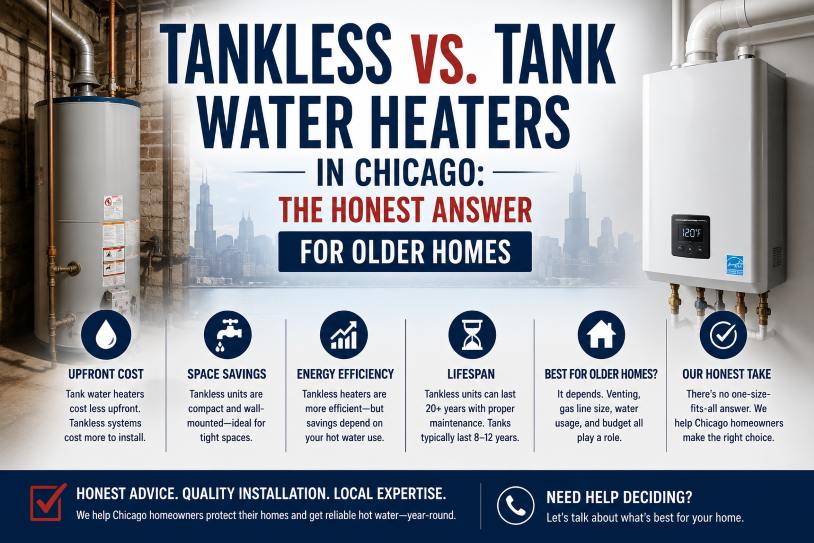
What the Marketing Doesn’t Tell You About Chicago’s Hard Water, Aging Bungalows, and Why the Right Answer Isn’t the Same for Every Home
Every water heater manufacturer’s website tells you tankless is the future. Endless hot water. 30% energy savings. Space-saving compact design. Never run out of hot water again. The pitch is compelling, the technology is real, and for the right home in the right situation, a tankless water heater is genuinely the better choice.
The right home and the right situation, however, are not the 1955 Berwyn bungalow with a half-inch gas line, a B-vent flue shared with the furnace, and 150 parts per million of dissolved calcium coming through the supply line. In that home — and in thousands of similar homes throughout Chicago and the inner-ring suburbs — the decision is more complicated than any manufacturer’s website suggests. And getting it wrong means spending $3,000 to $6,000 on a system that underperforms, requires expensive add-ons that weren’t in the original quote, or needs its heat exchanger descaled every two years because nobody warned you about what Chicago’s water does to tankless units over time.
This guide covers the honest version of this comparison — written for Chicago-area homes specifically, not for a national audience in a hypothetical average house.
The Chicago Factor Nobody Puts in the Marketing: Hard Water and Tankless Heat Exchangers
Chicago’s Lake Michigan water supply runs at 130 to 150 parts per million of dissolved calcium and magnesium — moderately hard to hard water by the EPA’s classification, harder than the national average, and harder than most markets where tankless water heaters were originally designed and tested for performance.
Here’s what happens in a tankless water heater running Chicago’s water: dissolved calcium precipitates out of solution when water is rapidly heated in the heat exchanger — the small-diameter copper or stainless coil that produces the tankless unit’s signature on-demand performance. At 150 PPM of calcium, that precipitation happens every single time the unit fires. Over months and years, scale accumulates inside the heat exchanger’s narrow passages, progressively restricting flow and reducing heat transfer efficiency. The unit that produced a strong 6.6 gallons per minute of hot water at installation may be producing 4 to 5 GPM five years later, with significantly longer lag time before hot water reaches distant fixtures.
This isn’t a defect. It’s mineral chemistry. And it has a solution: annual descaling with a citric acid or vinegar flush that dissolves the calcium scale and restores flow through the heat exchanger. But that annual service — which runs $150 to $300 depending on the unit and the extent of scaling — is a maintenance cost that the 30% energy savings calculation almost never includes in its math. A tankless unit that costs $1,500 more than a tank unit upfront, saves $100 a year in energy costs, and requires $200 a year in descaling service hasn’t produced a positive ROI in year 15 the way the manufacturer’s chart suggests it will.
What this means practically: In Chicago, a tankless water heater without an upstream water softener is a tankless water heater that needs annual professional descaling to maintain its rated performance. If you’re genuinely interested in a tankless unit, budget for either a whole-home water softener (adds $800 to $2,000 to the project cost) or annual descaling service as a permanent maintenance line item. Many Chicago homeowners also consider whole-home water filtration systems as part of their long-term water quality strategy. While filtration does not replace regular tankless maintenance or descaling, it can help address common water concerns like sediment, taste issues, and mineral content throughout the home while protecting plumbing fixtures and appliances.
Our water heater maintenance services include descaling for existing tankless units throughout the Chicago area — and we’ll give you an honest assessment of your unit’s current scale condition before recommending whether descaling is the right next step.
The Bungalow Problem: Why Older Chicago Homes Make Tankless More Expensive Than the Quote Suggests
A tankless water heater installed in a 2015 new construction home is a relatively straightforward project: properly sized gas line already in place, appropriate venting location already planned, adequate clearances already built in. A tankless water heater installed in a 1948 Chicago bungalow is frequently a project with three or four components that don’t show up in the initial quoted price.
Gas line sizing. A standard 40-gallon tank water heater uses 40,000 to 50,000 BTUs per hour. A tankless water heater uses 150,000 to 200,000 BTUs per hour — three to four times the gas demand of the unit it’s replacing. The half-inch or three-quarter-inch gas line that fed the original tank may not deliver adequate gas volume to the tankless unit at full demand. A gas line upgrade from the meter to the water heater location — which in a Chicago bungalow may involve running new pipe through finished spaces or an exterior chase — adds $500 to $2,000 to the project before the unit is even installed.
Venting. Modern high-efficiency tankless units require either direct-vent (two pipes — one for combustion air intake, one for exhaust) or power-vent configurations. In Chicago bungalows where the existing water heater used a B-vent flue shared with the furnace, converting to a direct-vent tankless may require drilling through an exterior masonry wall — a task that varies from straightforward to genuinely complicated depending on where the unit is positioned relative to exterior walls and what’s in those walls. Add $300 to $800 for venting work, potentially more in difficult configurations.
Unit location. Tankless units have specific clearance requirements for combustion air — they can’t be crammed into a tight utility closet the way a compact tank sometimes can. In older Chicago homes where the water heater lives in a small basement utility area surrounded by ductwork and mechanicals, clearance requirements sometimes mean relocating the unit — which means extending the gas line, the water lines, and the venting to the new location.
The total installed cost of a tankless water heater in an older Chicago home after accounting for gas line work, venting modifications, and any necessary relocation typically runs $3,000 to $6,500 — significantly above what “tankless water heater cost” searches suggest, and significantly above what installers who don’t disclose add-ons upfront put in their initial quotes.
As our water heater replacement cost guide documents in detail, venting upgrades add $200 to $800 and gas line work adds $500 to $2,000 to Chicago-area water heater projects. These aren’t rare exceptions. They’re common realities in a housing stock that was built before tankless technology existed.
The Traditional Tank Water Heater: What It Does Well in Chicago
The 40 to 50-gallon gas tank water heater has been the correct answer for most Chicago-area households for generations. And in 2026, for most households, it still is — for specific, Chicago-relevant reasons.
Hard water affects tanks too — but differently. Mineral scale accumulates in tank water heaters the same way it does in tankless heat exchangers, but the larger tank volume and lower operating temperatures mean the scale builds more slowly, accumulates in the bottom of the tank (where it reduces efficiency and causes the rumbling you eventually hear), and is manageable through annual flushing. A tank that’s flushed annually in Chicago’s hard water environment performs reliably for 10 to 14 years. A tank that’s never flushed may start producing symptoms within 5 to 8 years. The maintenance is simpler and cheaper than tankless descaling.
Installation in older homes is dramatically simpler. A tank replacement in a Chicago bungalow where an existing 40 or 50-gallon gas tank is being replaced typically involves removing the old unit, connecting the new unit to existing gas, water, and vent connections, and testing. The gas line and venting that served the old unit almost always serve the new one — no upgrades required, no additional scope that changes the quote after the job starts.
Repair economics favor tanks. A failing tank water heater typically needs one of a small set of parts: thermocouple, pilot assembly, anode rod, or heating element. Parts are inexpensive, widely available, and serviceable by any competent plumber. A failing tankless unit may need a circuit board, a flow sensor, a heat exchanger component, or a proprietary part that’s specific to that brand and model. Repair costs for tankless units in their second decade of service can run $500 to $1,500 — not far from replacement cost, which is part of why we see so many tankless units get replaced rather than repaired once they’ve had a few years of Chicago hard water running through them.
For the complete picture of warning signs that your current water heater — tank or tankless — is approaching the end of its service life, see our complete Chicago water heater warning signs guide.
The Heat Pump Water Heater: The Option Most People Aren’t Considering
There’s a third option that doesn’t get nearly enough attention in the Chicago market, particularly for homeowners with electric service or large finished basements: the heat pump (hybrid) water heater.
A heat pump water heater works by extracting heat from ambient air and using it to heat water — the same principle as a heat pump HVAC system, applied to water heating. The efficiency gains are substantial: heat pump water heaters use 60 to 70% less energy than a standard electric resistance tank. They qualify for federal tax credits under the Inflation Reduction Act (30% of the cost, up to $600 in tax credits) and ComEd incentives for qualifying models.
Why it works well in Chicago specifically:
- Large finished basements common in Chicago-area housing provide the air volume and temperature range that heat pump water heaters need (they need unconditioned or partially conditioned space — a tight utility closet doesn’t work)
- No gas line required — relevant for Chicago-area homeowners converting away from gas service or on electric heat
- Federal and ComEd incentives make the upfront cost substantially lower than sticker price suggests
- Hard water affects heat pump water heaters the same way it affects tank units — manageable with annual flushing, less aggressively than it affects tankless heat exchangers
The Chicago limitations:
- Heat pump water heaters extract heat from ambient air — in a fully conditioned, sealed basement space, they pull heat away from the space you’ve paid to heat, creating a slight heating penalty in winter months
- They need adequate air volume around them — rule of thumb is 1,000 cubic feet of air space
- They’re electric only — not a direct replacement for a gas tank unit without electrical modifications
The Honest Decision Framework — Which Unit Is Right for Your Chicago Home
Choose a traditional gas tank unit if:
- Your home is pre-1980 with existing gas/vent connections sized for a tank
- Your household is 1 to 4 people with normal simultaneous hot water demand
- You’re replacing a failed unit on an urgent timeline where the additional scope of tankless installation isn’t practical
- Budget is a constraint and the upfront premium and potential add-ons of tankless aren’t feasible right now’
Before purchasing a replacement, make sure you’re selecting the correct capacity for your household. Our guide on what size water heater you need for your Chicago home explains how to choose the right gallon size based on your family’s hot water usage, number of bathrooms, and daily demand.
Consider a tankless unit if:
- Your household has genuinely high simultaneous hot water demand — multiple showers running at once is a regular occurrence
- You’re doing a renovation that already involves gas line and venting work in the relevant area
- You have adequate budget for both the unit and the probable add-ons: gas line upgrade, venting modification, and annual descaling service
- You’re committed to the maintenance regimen that Chicago’s hard water requires
Seriously consider a heat pump unit if:
- You have electric service or are converting away from gas
- You have a large, partially conditioned basement with adequate air volume
- You want the best long-term energy economics and are willing to capture the available tax credits and utility incentives that can significantly offset the upfront cost
- You can accommodate the installation timeline — these aren’t available for same-day emergency replacement the way tank units are
Our water heater installation team assesses your specific home’s configuration, gas line capacity, venting situation, and hot water usage pattern before recommending any unit — so the recommendation matches your actual situation rather than what’s simplest to install or highest margin to sell.
Our Documented Chicago-Area Work — Tank and Tankless Both
The Palos Park Rinnai tankless installation in our service records represents exactly the kind of situation where tankless genuinely made sense — the right household demand, the right home configuration, the right client expectations about maintenance. The Bradford White tank replacements across Alsip, Evergreen Park, Chicago Ridge, Oak Lawn, and dozens of other communities in our service records represent the situations where a quality tank unit was the honest right answer.
We don’t have a preferred unit type to push. We have 47 years of experience across both, including specific Chicago-area hard water experience with tankless heat exchanger scaling that most national guides don’t address. When you call us for a water heater assessment, you get the honest recommendation for your home — not the most expensive recommendation, and not the most convenient one for us.
For emergency water heater service when you don’t have time for a comparison — same-day and 24/7 response throughout Chicago and the suburbs — see our water heater repair and water heater replacement services.
Frequently Asked Questions: Tankless vs. Tank in Chicago
I was quoted $1,800 for a tankless water heater. Is that realistic for a Chicago bungalow?
Almost certainly not the complete project cost. A $1,800 quote for tankless installation in a Chicago bungalow either reflects a very specific situation with no gas line or venting upgrades needed — or it’s a base quote that doesn’t include the gas line work, venting modification, and potential unit relocation that older Chicago homes frequently require. Get the quote in writing and ask specifically: does this price include any required gas line upgrade, venting modification, and all permits? If those are add-ons presented after the job starts, the real project cost is different from what you were initially told.
How often does a tankless water heater actually need to be descaled in Chicago?
Annually is the honest answer for most Chicago installations without a whole-home water softener. Some units with better flow management may go 18 months before scaling affects performance noticeably. The Rinnai and Navien units we’ve worked with in this market generally need annual service to maintain their rated output in Chicago’s water conditions. Building that into your cost comparison is important — it’s $150 to $300 per year that tank ownership doesn’t require.
Is the federal tax credit for heat pump water heaters still available in 2026?
Yes — the Inflation Reduction Act’s residential energy credits remain available for qualifying heat pump water heater installations. The credit is 30% of the equipment and installation cost, up to $600 per year in the energy efficient home improvement credit category. Confirm current availability and income/credit limitations with a tax professional, as specific rules can change. ComEd also maintains separate incentives for qualifying models — check the ComEd rebate portal for current offers before purchasing.
My current water heater is 12 years old and still works. Should I switch to tankless when I replace it?
Only if the replacement is planned rather than emergency. A planned replacement gives you time to properly assess gas line capacity, venting configuration, and household demand — the three factors that determine whether tankless is genuinely the right fit for your home. An emergency replacement almost always favors a tank unit because the same-day availability, simpler installation, and no-surprise pricing are exactly what a household without hot water needs.
Tank, Tankless, or Heat Pump? Let’s Look at Your Home Before Recommending Anything.
Licensed, insured, and serving Chicago and the suburbs since 1978. We install Bradford White tank units, Rinnai and Navien tankless systems, and heat pump water heaters — and we give you the honest answer about which is right for your specific home’s gas line, venting, and hard water situation before anyone commits to anything. Same-day and emergency service available 24/7. Send us a message and we’ll get back to you fast.
Or call us directly: 708-801-6530 | Open 24/7
—
Suburban Plumbing Sewer Line & Drain Cleaning Experts
Licensed & Insured | Open 24 Hours | Serving Chicago & Suburbs Since 1978
📞 Suburbs: 708-801-6530 | 📞 Chicago: 773-570-2191 | 🚨 Emergency: 708-518-7765