
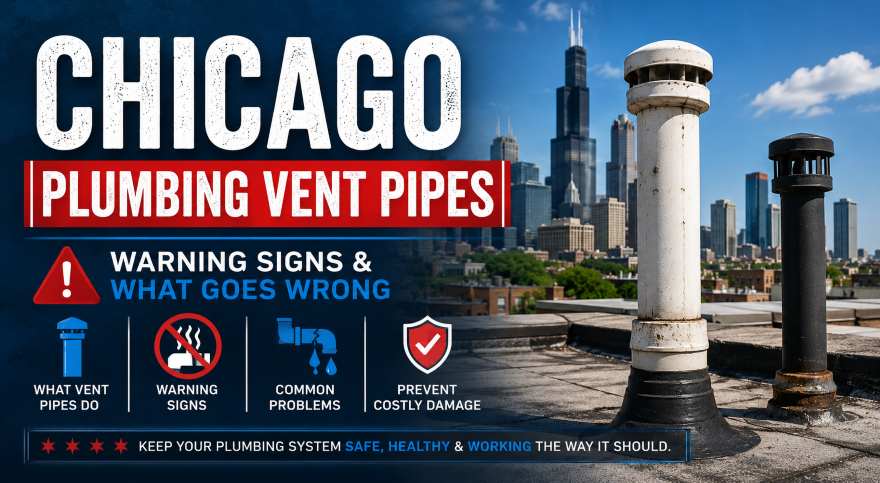
The Complete Guide for Chicago Homeowners Who Have Tried Everything to Fix Slow Drains, Gurgling Toilets, and Mysterious Sewer Smells — and Nothing Has Worked
You’ve had the kitchen drain rodded. The bathroom sink drain is clear. You’ve poured water down every floor drain to refresh the traps. You’ve had a plumber out twice and both times the drains looked fine. Yet the toilet still gurgles when the shower runs. The basement still smells faintly of sewer on humid days. The bathroom sink still drains slowly despite being clean.
Nobody has mentioned your plumbing vent pipes.
This is the gap in most Chicago homeowners’ understanding of how their plumbing system works — and it’s one of the most diagnostically important gaps there is. Plumbing vent pipes are the invisible, silent component of every drain system that makes gravity drainage work correctly. When they’re functioning, you never know they exist. When they fail — which in Chicago’s older housing stock happens through specific, predictable mechanisms — they produce a set of symptoms that are frequently misattributed to drain clogs, P-trap problems, or even sewer lateral issues. The drain gets rodded again. The problem persists. The vent pipe is never diagnosed.
This guide covers everything Chicago homeowners need to know about plumbing vent pipes — what they do, why the drain system can’t function without them, what specifically goes wrong with them in Chicago’s older homes, and what every symptom they produce actually means.
What Plumbing Vent Pipes Actually Do
To understand vent pipe failure, you need to understand what vent pipes are actually for. They’re not decorative. They’re not optional. They’re the mechanism that makes gravity drainage physically possible.
The Air Pressure Problem That Vents Solve
Every drain fixture in your home connects to a P-trap — the curved pipe section under every sink, in every shower drain, and inside every toilet. The water that sits in that curve creates a liquid seal that physically blocks sewer gas from traveling up through the drain and into the living space. Remove the water seal and sewer gas enters freely. Maintain the water seal and the drain remains odor-free regardless of what’s in the sewer below.
The problem: gravity drainage creates a pressure problem that threatens that water seal continuously.
When water drains from a fixture, it falls through the drain pipe. That falling water column creates a zone of negative pressure — a partial vacuum — in the pipe behind it. That negative pressure is literally suction, pulling on whatever is immediately behind the water column. And what’s immediately behind the water column is your P-trap’s water seal.
Without any relief for that negative pressure, the falling water column would siphon the water right out of the P-trap — pulling the water seal down the drain behind it. An empty P-trap means an open path for sewer gas from the drain system directly into your home.
Vent pipes provide the air that relieves this negative pressure. By connecting the drain system to the outdoor atmosphere through pipes that terminate above the roofline, the vent system equalizes pressure in the drain pipes — the falling water column pulls in air from the vent rather than pulling the water seal out of the trap. The trap remains full. The sewer gas stays in the sewer.
This is why the Illinois Plumbing Code Part 890, Subpart K — Vents and Venting establishes mandatory venting requirements for every fixture in every Illinois plumbing system. Venting isn’t a preference — it’s the mechanism that makes the entire drain system safe and functional. Every fixture drain must vent to the atmosphere for the trap protection system to work.
The Stack Vent Configuration in Most Chicago Homes
In most Chicago homes, the plumbing vent system works through a central vent stack — the same large pipe that carries waste downward from bathroom and kitchen fixtures also continues upward above the top-floor fixtures through the attic space and terminates above the roof. This combined drain-waste-vent stack (DWV stack) is typically a 3 or 4-inch pipe that you can see where it exits through the roof — it looks like a small pipe sticking up from the roof surface.
Individual fixtures connect to the main stack through smaller branch vent pipes that run through the walls. The whole system is a network of connected air paths that all eventually reach the outdoor atmosphere through the roof termination point.
That roof termination is a critical point that many Chicago homeowners have never thought about — because it’s the first failure point that Chicago’s winters create.
Chicago-Specific Vent Pipe Problems — What Goes Wrong Here and Why
Frost Closure — Chicago’s Unique Vent Pipe Emergency
This is the most distinctly Chicago vent pipe failure and the one with the most dramatic acute symptoms. During extended periods of very cold weather — which Chicago experiences reliably every January and February — moisture in the warm, humid air rising through the vent stack from the heated home condenses and freezes at the cold roof termination of the vent pipe. Ice accumulates on the inside of the pipe opening, progressively narrowing the opening until it closes completely.
When the vent pipe is fully frost-closed, the drain system loses its pressure equalization entirely. Every drain in the house becomes affected simultaneously:
- All drains drain slowly because there’s no air movement to relieve negative pressure
- All P-traps are under continuous suction from the sealed system
- Toilets gurgle when any fixture drains because the air displacement has nowhere to go except backward through the toilet trap
- Sewer gas smell may develop throughout the house as traps are siphoned dry
This is the symptom pattern that looks most like a main sewer line blockage but isn’t. A homeowner who calls an emergency plumber in February because every drain in the house stopped working and sewage smell is developing may be experiencing frost-closed vents — a condition that resolves entirely when temperatures rise above freezing and no drain cleaning or lateral work is needed.
The Chicago-specific winter diagnostic: if all-drain slowdown and gurgling appear simultaneously during an extended cold snap and resolve when temperatures warm, frost-closed vents are the cause. Prevention involves increasing the roof termination size — a 3-inch vent termination extended 6 to 12 inches above the roofline reduces frost closure risk compared to a flush termination.
Cast Iron Vent Stack Deterioration
In Chicago’s pre-1960 housing stock, the main vent stack is original cast iron — the same material as the drain lines, and the same material that’s corroding from the inside out throughout the drain system. Cast iron vent stacks develop internal corrosion and scale, can develop cracks that allow sewer gas to escape into the wall cavity rather than exiting through the roof, and in advanced cases can develop partial obstructions from corroded material shedding into the stack.
A cast iron vent stack with internal deterioration produces a different symptom pattern than frost closure — it’s chronic rather than acute, present year-round rather than weather-correlated, and typically produces the persistent low-level sewer gas smell and intermittent gurgling that homeowners notice for months before calling anyone.
Blocked Roof Termination From Debris
The roof vent termination is open to the outdoor environment — which means it accumulates everything the outdoor environment delivers. Leaves and debris that fall on the roof and find their way into the open pipe opening. Birds and small animals that nest in the open termination during warmer months, blocking the pipe with nesting material. Wasp nests established at the interior of the termination during summer. Any of these blockages produces the same symptom pattern as frost closure — partial or complete loss of drain system ventilation — but at any time of year rather than specifically in winter.
Homeowners who notice all-drain sluggishness beginning in fall — after leaf drop season when leaves are most likely to find their way into open vent terminations — may be experiencing debris-blocked vent pipes rather than drain line accumulation.
Improper Venting in Older Chicago Plumbing Configurations
Chicago’s older housing stock contains significant plumbing work performed over decades by contractors with varying levels of compliance with the Illinois Plumbing Code’s venting requirements. Drain additions — a basement bathroom added in the 1970s, a laundry relocation in the 1980s, a kitchen renovation in the 1990s — are some of the most common sources of improper venting in older Chicago homes.
An improperly vented fixture is one that has no vent connection or an inadequate vent connection — the drain runs to the stack without a corresponding vent providing the pressure equalization the trap requires. The fixture may drain adequately under light use because the draft in the stack provides incidental pressure relief. Under heavier use — multiple fixtures running simultaneously — the inadequate venting becomes apparent through persistent gurgling, intermittent drain slowdown, and recurring sewer gas at that fixture’s location.
Warning Signs Your Vent Pipes Are Failing — And What Each One Means
🚨 Gurgling Toilets When Other Fixtures Drain
Run the kitchen sink at full flow for 30 seconds. The toilet gurgles — air bubbles up through the bowl water without being flushed. This is air being displaced from the drain system through the toilet bowl — the path of least resistance for trapped air when the vent system isn’t providing adequate pressure relief.
Distinguishing vent failure from lateral restriction: Both conditions produce toilet gurgling when other fixtures drain. The key distinction is scope:
- If gurgling occurs specifically during multiple-fixture simultaneous use and all individual fixtures drain normally when used alone, the vent system is the more likely cause — inadequate air supply for the combined demand.
- If gurgling occurs even when a single fixture drains, and if the toilet itself is slow to clear, the lateral restriction is more likely — the restriction is backing up pressure regardless of vent adequacy.
Urgency: Moderate. Gurgling toilets are a chronic symptom that warrants professional diagnosis but doesn’t represent an immediate emergency.
🚨 Slow Drains Throughout the House With No Identified Clog
Drain slowness that persists after professional rodding, that affects multiple fixtures simultaneously, that has no obvious accumulation source, and that resists repeated cleaning attempts is one of the clearest vent pipe failure indicators.
A drain pipe that’s adequately clean but inadequately vented drains slowly because negative pressure from the falling water column creates resistance to drain flow — the water has to fight its way down rather than flowing freely. Rodding or hydro jetting a clean pipe doesn’t change the venting condition, which is why the slowness persists after cleaning.
The test: Does the drain slowness correlate with other fixture use? If the bathroom sink drains fine when used alone but slows noticeably when the shower is running simultaneously, the shared vent path is undersized or partially blocked — demand from both fixtures simultaneously exceeds what the available vent capacity can supply.
🚨 Persistent Sewer Gas Smell Inside the House
A sewer gas smell — the sulfur or rotten egg odor of hydrogen sulfide from the sewer system — present inside the house has two possible vent-related causes:
Trap siphoning from inadequate venting: If venting is inadequate, P-traps are being slowly siphoned dry. A dry P-trap allows sewer gas to pass directly from the drain system into the living space. The smell from a dry trap develops gradually after the fixture hasn’t been used — it’s strongest in rooms with infrequently used fixtures.
Cracked or broken vent pipe inside the wall: A cast iron vent pipe that has developed a crack inside the wall doesn’t vent sewer gas through the roof — it vents it into the wall cavity, where it migrates to the living space through gaps around electrical outlets, light switches, and pipe penetrations. This produces a diffuse, hard-to-locate sewer gas smell throughout an area of the house rather than at a specific fixture.
The distinction from a sewer lateral crack: A sewer lateral crack produces sewer gas smell specifically at the basement level or near the floor, where the lateral runs. A cracked vent pipe inside the wall produces sewer gas smell at the wall or ceiling surfaces where the vent pipe runs — often in the wall above the first floor bathroom, or throughout a room adjacent to the vent stack.
🚨 Dry or Low P-Traps Despite Regular Use
If you notice the sewer gas smell specifically from a fixture that you use regularly — not an infrequently used trap that’s simply dried out — and adding water to the drain temporarily resolves the smell but it returns within hours, the P-trap is being actively siphoned by inadequate venting. The fixture is used, the drain runs, the negative pressure from drainage partially siphons the trap, and the water seal is insufficient to block sewer gas until the next use replenishes it.
This is a classic inadequate venting symptom — the trap isn’t evaporating dry, it’s being mechanically drained by every use of the fixture through the siphoning effect that proper venting prevents.
🚨 Slow Kitchen Drain That Clears After the Dishwasher Finishes
The kitchen sink and dishwasher typically share both a drain connection and a vent connection. When the dishwasher runs and simultaneously the sink is used or draining, the combined demand on the shared vent path may exceed its capacity — producing slow drainage from the sink while the dishwasher is running that clears after the dishwasher cycle ends. This specific pattern is a shared vent inadequacy indicator rather than a drain clog.
🚨 All-Drain Simultaneous Slowdown in Winter
As described in the frost closure section above — simultaneous slow drainage throughout the house appearing during cold weather is the frost closure pattern. This is specifically a Chicago winter vent problem that deserves its own recognition because it’s frequently misdiagnosed as a main sewer line backup.
The EPA’s WaterSense Home Maintenance program recommends annual plumbing system inspection specifically to identify developing issues before they become acute problems — a principle that applies directly to Chicago vent stack inspection, where catching frost closure prevention needs or early cast iron deterioration before a Chicago winter prevents the acute symptoms that winter brings.
Professional Vent Pipe Assessment and Repair
How Vent Pipe Problems Are Diagnosed
Sewer smoke testing: The same smoke testing used for sewer lateral leak detection is the primary tool for vent pipe assessment. Non-toxic smoke is introduced into the drain system through a cleanout. Smoke that exits through the roof vent termination confirms the vent path is open and clear. Smoke that appears from cracks in walls or at unexpected locations inside the house identifies the specific location of vent pipe failures — cracks, disconnected joints, or missing vent connections.
Our sewer smoke testing service is available throughout Chicago and the suburbs and is the definitive diagnostic for vent pipe failures that are producing sewer gas symptoms inside the home.
Sewer camera inspection: A camera run through the vent stack from the roof termination downward confirms the condition of the interior pipe — corrosion level, obstruction location, and crack identification in accessible sections.
Visual roof inspection: For debris-blocked and frost-prone terminations, visual inspection of the roof vent pipe terminations confirms whether debris accumulation or ice formation is contributing to the symptoms.
Vent Pipe Repair and Replacement
Roof termination extension and screening: Extending the roof termination height and adding appropriate screening addresses both frost closure risk and debris blockage — an accessible repair that prevents both problems.
Vent pipe section repair: Cracked or deteriorated vent pipe sections in accessible wall or attic locations can be repaired or replaced through targeted opening of the wall or ceiling at the specific failure location — identified precisely through smoke testing before any wall is opened.
Vent stack replacement: In older Chicago homes where the cast iron vent stack has deteriorated beyond targeted repair — widespread corrosion, multiple cracks, or complete obstruction — full vent stack replacement brings the system to current Illinois Plumbing Code standards and eliminates every vent-related symptom simultaneously.
New vent connection installation: For fixtures that were installed without adequate venting — a basement bathroom addition from the 1970s, a relocated laundry from an older renovation — installing the proper vent connection that Illinois code requires resolves the chronic drain performance issues that the improperly vented fixture has been producing.
All vent pipe work in Illinois requires permits. We pull all required permits as part of every vent pipe repair and replacement project.
Chicago’s Vent Pipe Reality — What Pre-1960 Homeowners Need to Know
If your Chicago home was built before 1960, your vent stack is original cast iron. That pipe has been in service for 65 to 100 years in Chicago’s specific environment of hard water moisture, basement humidity cycling, and thermal stress from the temperature differential between the heated interior and the cold exterior in winter.
The same cast iron deterioration process that affects drain lines — rough interior surface from corrosion, progressive wall thinning, eventual crack formation — affects the vent stack on the same timeline. A pre-1960 Chicago home that has never had its vent stack inspected has a pipe of the same age and material as the drain lines that the sewer camera inspection articles on our site cover extensively.
The practical implication: if you’re scheduling a sewer camera inspection of your drain lines, asking the plumber to assess the vent stack condition at the same visit is the most efficient approach. The plumber is already in the basement with equipment that can evaluate both systems.
For the complete picture of how aging pipe materials affect every system in a pre-1960 Chicago home — supply lines, drain lines, gas lines, and vent stacks — see our complete Chicago residential plumbing guide.
Frequently Asked Questions: Plumbing Vent Pipes in Chicago
Every drain in my house started draining slowly on the same day in January. No clogs anywhere. What happened? This is the frost closure pattern — ice has formed at the roof vent termination and is blocking the vent stack. The symptom typically resolves when temperatures rise above freezing and the ice melts. If you’re able to safely access the roof, pouring warm water into the vent termination can accelerate clearance. If the frost closure has fully sealed the vent, a licensed plumber can clear it from the roof and assess whether the termination needs to be extended to reduce future frost closure risk.
I can smell sewer gas in one room of my house but none of the drains have a problem and no fixtures are nearby. What’s causing it? The sewer gas smell appearing away from fixtures and drains in a specific room is the pattern of a cracked vent pipe inside the wall. The crack is venting sewer gas into the wall cavity rather than up through the roof, and it’s migrating to the room through gaps around electrical penetrations and outlets. Smoke testing identifies the specific crack location so wall opening is targeted rather than exploratory.
My plumber says my toilet gurgles because of a sewer lateral restriction. Another plumber says it’s a vent problem. How do I know which is right? Both can produce toilet gurgling. The diagnostic test is whether the gurgling occurs when a single fixture drains alone or only when multiple fixtures are draining simultaneously. Single-fixture gurgling (toilet gurgles when you drain only the kitchen sink with all other fixtures closed) points more toward a lateral restriction. Multi-fixture gurgling (toilet gurgles when the shower and sink run simultaneously but not when either runs alone) points more toward a venting inadequacy. Camera inspection of the lateral combined with smoke testing of the vent system confirms which system has the problem.
My basement was finished in the 1980s and a bathroom was added. Could the venting be wrong? Very possibly. Basement bathroom additions from the 1970s, 1980s, and 1990s in Chicago frequently involved minimal permits and varying compliance with venting requirements. A basement bathroom toilet that gurgles, a basement sink that drains slowly, or a recurring sewer gas smell in the basement bathroom area — with no lateral restriction identified on camera — is a strong indicator of improper venting at those fixtures. Adding the correct vent connection brings the installation into compliance and resolves the chronic symptoms.
How much does vent pipe work cost in Chicago? Roof termination extension and screening: $200 to $500. Targeted vent pipe section repair at an identified crack location: $400 to $900. New vent connection installation for an improperly vented fixture: $600 to $1,500 depending on access and routing. Full vent stack replacement in an older Chicago home: $1,500 to $4,500 depending on the stack height, accessibility, and number of branch connections.
Experiencing Gurgling Drains, Sewer Smells, or Slow Drains That Nobody Can Explain? Your Vent Pipes May Be the Answer.
Licensed, insured, and locally based in Brookfield since 1978. We diagnose and repair plumbing vent pipe problems throughout Chicago and the suburbs — smoke testing, camera inspection, vent stack repair and replacement, and new vent installation for improperly vented fixtures. Written quotes before we start, permits on every job, our own licensed plumbers on every call. Send us a message and we’ll get back to you fast.
Or call us directly: 708-801-6530 | Open 24/7
—
Suburban Plumbing Sewer Line & Drain Cleaning Experts
Licensed & Insured | Open 24 Hours | Serving Chicago & Suburbs Since 1978
📞 Suburbs: 708-801-6530 | 📞 Chicago: 773-570-2191 | 🚨 Emergency: 708-518-7765