
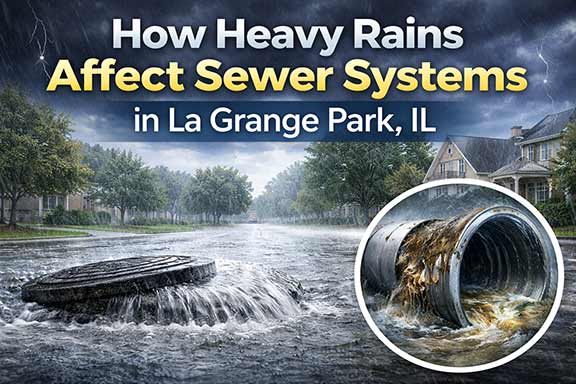
For homeowners and residents of La Grange Park in Cook County, Illinois, every minute of heavy rainfall in this quiet, residential village can mean flooded streets and overflowing municipal sewer lines, with the possibility of sewer backups in homes and damaged basements, a concern often noted by Streamline rental services.
Midway through March 2026 alone, nearly 5.3 inches of rain have been dumped on the homes and streets of La Grange Park. The result of these high-intensity rainfall events has been a harvest of exorbitant water damage repair costs for many citizens.
What can homeowners in La Grange Park do about these problems? The first step is to understand why the problems happen in the first place. La Grange Park is not alone in these problems; many parts of the great state of Illinois suffer the same issues.
Root causes of the constant sewer issues in La Grange Park, IL
Combined sewer overflow (CSO)
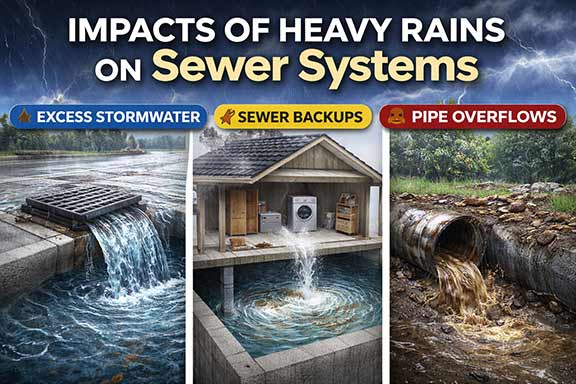
La Grange Park operates a combined sewer system – an older sewer design that collects rainwater, domestic sewage, and industrial wastewater in a single pipe. The fallout of this design is that during heavy rainfall, if the sewer line exceeds its capacity, the impact is not confined to the sewer line. An overflowing combined sewer system will force its contents into nearby residential sewer lines, causing the sewage inside those private lines to back up into homes.
Outdated sewer infrastructure
In addition to its capacity challenges, La Grange Park’s sewer network is grossly outdated. Due to its age, the network is highly susceptible to corrosion, leaks, and cracks – problems that increase the risk of sewer line clogs and blockages. Also, owing to population growth and modern plumbing systems, the infrastructure now handles more water than it was originally meant to carry. These problems increase the risk that the sewer line will overflow.
Oversaturated clay-rich soils
The clay-rich soils that are prevalent across La Grange Park prevent the easy absorption of rainwater. These soils have tiny, tightly-packed particles with minimal air pores to allow water absorption. As a result, when it rains, water runs off the ground instead of soaking into it. Additionally, the soil doesn’t quickly release any water that manages to enter it, quickly becoming oversaturated and increasing the rate of flooding in the area.
High water table
La Grange Park’s low-lying terrain and high water-table also predispose it to flooding. Due to groundwater being so close to the surface and with frequent heavy rainfall, the soil has a very limited capacity to absorb and hold water. Instead of flowing into the ground, stormwater is diverted into the already strained sewer system, resulting in flooded streets, pools of water in the yard, overflowing private/public sewer lines, and basement flooding.
Preventing sewer issues in your La Grange Park home
Install overhead sewers
This solution will raise your home’s lowest sewage drain above the ground level, sometimes as high as the basement ceiling. Instead of running below ground, the sewer lines are rerouted to run along the basement ceiling. This solution permanently solves the problem of sewer backups in your home.
Install a backflow prevention valve
If your sewer line issues are not serious enough to justify the cost of an overhead sewer line, a backflow prevention valve may be a better option. This valve stops the flow of wastewater inside your sewer line if it senses a reversal in flow. The valve is designed to stay open only when water flows in the right direction within the pipes.
Disconnect downspouts and reduce water usage
If your downspouts and sump pump are set up to discharge into the combined sewer system, consider disconnecting them. This helps to ensure that the system is not overcharged and your sewer line doesn’t back up as a result. For the same reason, it is also a good idea to reduce your home’s water usage during heavy rain events.
Install a battery-powered sump pump
As long as it is connected to the grid, your sump pump can be put out of commission by power outages during rainstorms. A battery-powered backup sump pump ensures that even if this happens, your home will not be at the mercy of basement flooding. If your primary sump fails, the backup system will kick in automatically.
Proper disposal of waste
Protect your sewer lines and municipal sewers by not disposing of fats, oils, and grease in your drains or dumping non-flushable items in the toilet. Also, avoid the indiscriminate dumping of food waste into the kitchen sink. Sewer systems don’t handle these materials very well, and they are a major cause of clogs and blockages in both private and public sewer systems.
Other solutions to consider include having a French drain installed in your yard, rain gardens, and periodic cleaning of your sewer lines by a professional plumber. But which of these options is best for your home? That depends on the details of the sewer line issues in your home. Before adopting any of the above solutions, it is a good idea to have a reliable La Grange Park plumber come take a look at the issues in your home.
—
🛠️ We’re Here to Help
Heavy rain can quickly overwhelm sewer systems and lead to backups, flooding, and costly damage. If you’re experiencing sewer issues or want help preventing future problems in La Grange Park, IL, our team at Suburban Plumbing Experts is ready to help with fast, reliable service and honest solutions.
📞 Contact Us
☎️ Chicago Suburbs: 708-801-6530
📧 info@suburbanplumbingexperts.com
🔗 https://suburbanplumbingexperts.com