
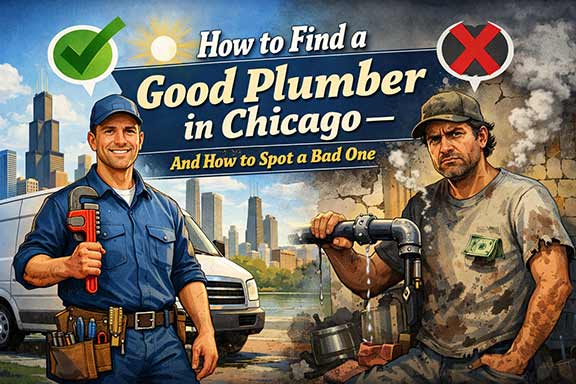
A Chicago Plumber Tells You Exactly What to Look For, What to Ask, and What Should End the Conversation Immediately
Every Chicagoland homeowner eventually faces the same moment: something is wrong with the plumbing, you need someone in your house, and you have no idea who to call or whether the person you’re about to call can actually be trusted.
You Google “plumber near me.” You get a page of results, all claiming to be licensed, insured, affordable, and available 24/7. You pick one. Someone shows up — or doesn’t. A quote gets thrown at you — often verbal, often vague, sometimes inflated. Work gets done — or doesn’t, or gets done wrong, or gets done without a permit that surfaces as a problem two years later when you try to sell your home.
This guide is written from the inside. We’ve been plumbing in Chicagoland since 1978 and we know exactly what distinguishes a licensed, accountable contractor from the kind of outfit that leaves homeowners with code violations, water damage, and no recourse. We’re going to tell you everything — what to look for, what to ask before you hire anyone, what the red flags are that should end the conversation immediately, and why Chicago’s specific infrastructure environment makes choosing the right plumber more consequential here than in most other markets.
Why Finding a Good Plumber in Chicago Is Harder Than It Should Be
Chicago is a large, dense market with a high volume of plumbing need — aging housing stock, a combined sewer system that creates chronic flood control issues, lead service lines that still exist under tens of thousands of properties, and a winter climate that stresses pipes hard every year. That demand creates a market where operators of every quality level can find work.
The barrier to presenting yourself as a plumber is lower than most homeowners realize. A business card, a van, and a website are all it takes to look legitimate. The licensing and bonding requirements that protect homeowners exist — but they’re only protective if you verify them, and most homeowners never do.
The consequences of hiring the wrong plumber in Chicago are also higher than in markets with newer housing stock. An unlicensed contractor working on a 70-year-old lateral with clay tile joints and root intrusion, installing repairs that don’t meet code, skipping permits, and disappearing afterward leaves the homeowner holding the bag entirely. In Chicago, that bag can be very heavy.
Step 1: Verify the License — Actually Verify It
Illinois requires anyone performing plumbing work to hold a valid state plumbing license issued by the Illinois Department of Public Health. The Illinois IDPH Plumbing Program licenses approximately 8,900 plumbers and 2,000 apprentice plumbers statewide, and requires plumbing contractors — the businesses that employ licensed plumbers — to register separately with the state and maintain insurance coverage.
This is not a technicality. It is the single most important credential to verify before you let anyone touch your plumbing. A licensed plumber has passed a state examination after a minimum four-year apprenticeship under a licensed plumber, meets continuing education requirements, and is accountable to a regulatory body that can suspend or revoke their license for misconduct. An unlicensed operator has none of that accountability.
Illinois plumber license numbers begin with “058-” and plumbing contractor registration numbers begin with “055-” — which is why you’ll see our credentials listed as IL Plumbing License #055-044116 and Sewer License #2565. You can verify any plumber’s license status in real time using the Illinois IDPH Plumber License Search — it’s a free, public database. Enter the contractor’s name or license number and verify the license is current and active before work begins.
For work in the City of Chicago specifically, the City has its own licensing requirements in addition to state requirements. Any plumber working within Chicago city limits must hold a valid City of Chicago plumbing license — separate from the state license. Ask for both.
If a contractor cannot provide a license number on request — or provides one that doesn’t match an active record in the state database — stop the conversation there.
Step 2: Confirm Insurance — and What It Actually Covers
A licensed plumber should carry two types of insurance: general liability and workers’ compensation. These protect you, not just the contractor.
General liability insurance covers damage to your property caused by the plumber’s work — a pipe that’s improperly connected and leaks into your finished basement, a fitting that fails the day after installation. Without it, you’re pursuing the contractor directly in court for damages, which is expensive and often fruitless if the contractor is a small operator without significant assets.
Workers’ compensation insurance protects you if a plumber is injured on your property. Without workers’ comp, an injured worker can potentially pursue a claim against your homeowners insurance — or against you personally. In Illinois, plumbing contractors are required to maintain workers’ compensation coverage as a condition of their contractor registration.
Ask for a certificate of insurance before work begins. A legitimate contractor will provide it without hesitation. If they resist, deflect, or claim it’s unnecessary for a “small job,” that tells you something important about how they operate.
Step 3: Insist on a Written Quote Before Any Work Starts
A verbal quote is not a quote. It’s a number that can change the moment work begins — and in plumbing, “additional issues discovered during the job” is one of the most commonly used justifications for inflating a final bill beyond what was discussed.
A legitimate plumber provides a written estimate that specifies the scope of work, the materials to be used, the labor cost, any permit fees, and what is and is not included in the quoted price. That document is your protection. It establishes what was agreed to and gives you recourse if the final invoice diverges significantly without documented cause.
For any significant job — a sewer line repair, a water heater replacement, a flood control installation — insist on a written quote. Compare it against one or two other written quotes from licensed contractors. A legitimate plumber provides a written estimate that specifies the scope of work, the materials to be used, the labor cost, any permit fees, and what is and is not included in the quoted price. That document is your protection. It establishes what was agreed to and gives you recourse if the final invoice diverges significantly without documented cause. Before comparing quotes, it also helps to know exactly what you’re looking at and which differences actually matter. Our guide to how to compare plumbing estimates in Chicago walks through the details homeowners should examine. The lowest price is not always the right choice, but having multiple written quotes from credible contractors gives you a reasonable sense of fair market pricing for the job.
Be especially cautious about contractors who quote dramatically lower than everyone else. In plumbing, a price that seems too good to be true is almost always reflecting something — unlicensed labor, inferior materials, no permit, or work that won’t pass inspection. Any of those outcomes costs you more in the long run than paying a fair price to a legitimate contractor upfront.
Step 4: Ask About Permits — and Whether They Pull Them
Permits are one of the clearest dividing lines between a legitimate plumbing contractor and one cutting corners. In Chicago and most Chicagoland municipalities, permits are required for water heater replacements, sewer line work, flood control installations, gas line work, and any significant alteration of the plumbing system. A licensed plumbing contractor pulls permits as a matter of course — it’s part of the job. Before excavation begins, there is another step homeowners should never overlook: calling JULIE to have underground utility lines marked. Our guide to why your Chicago plumber should always call JULIE before they dig explains what the process involves, why it matters, and how proper utility locating helps prevent dangerous and costly damage during excavation.
An unlicensed contractor, or a licensed contractor willing to skip permits for speed or lower cost, is offering you a false economy. Unpermitted work has no official record of code compliance. It creates complications when you sell your home — a buyer’s attorney or inspector may discover unpermitted work and require remediation before closing. It can give your homeowners insurer grounds to deny a claim if the unpermitted work is implicated in subsequent damage. And the municipality can require you to open up finished surfaces to expose the work for inspection — at your expense.
When you ask a contractor about permits, watch the response carefully. A legitimate contractor says “yes, we pull all required permits as part of the job, the permit fee is included in the quote.” A contractor who says “we can skip the permit to save you money” or “that doesn’t really need a permit” has just told you something important about their approach to compliance.
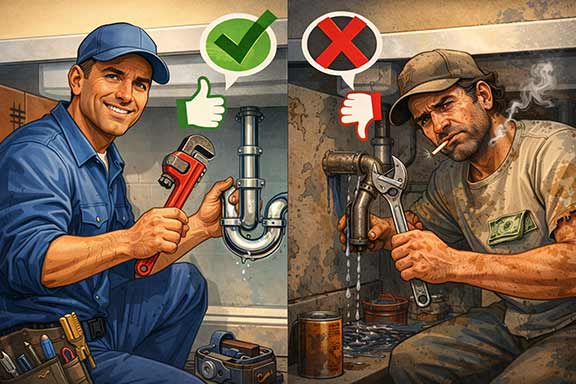
Step 5: Ask Whether Subcontractors Will Be Used
Some larger plumbing companies in the Chicago market handle volume by dispatching subcontractors — workers they’ve never met, whose skills and licensing they may not have independently verified, showing up at your door under the company’s name and brand.
This isn’t inherently disqualifying, but it’s worth knowing. Ask directly: “Will the person doing the work be an employee of your company or a subcontractor?” A company that uses subcontractors extensively can still provide good service — but the quality control is harder to guarantee, and the licensing accountability is more diffuse.
The companies that have the strongest track records for consistent quality — particularly for complex work like sewer line repairs, flood control installations, and lead service line replacements — tend to use their own trained, licensed employees rather than rotating subcontractor crews. Our team at Suburban Plumbing Experts consists entirely of our own licensed employees. We don’t subcontract work.
Step 6: Read the Reviews — But Read Them Correctly
Online reviews are valuable but require critical reading. Here’s what to look for beyond the star rating:
Recency matters. A company with 400 five-star reviews from five years ago and a handful of two-star reviews from the past six months is trending in the wrong direction. Weight recent reviews more heavily than historical ones.
Specificity signals authenticity. A review that mentions a specific technician’s name, a specific job type, and specific details about the experience is far more credible than a generic “great service, highly recommend!” A collection of reviews that all sound identical — same phrasing, same level of vagueness — can indicate manufactured reviews.
How the company responds to negative reviews. Every company gets a negative review occasionally. How they respond tells you how they treat disputes. A professional response that acknowledges the concern and offers resolution is a positive signal. An aggressive, defensive response that blames the customer is a significant red flag.
Volume relative to years in business. A company claiming to have been in business for 20 years with only 15 reviews has either not been doing consistent volume or has been operating under different names. A company with 350+ reviews and a 4.9★ rating over many years has a consistent track record that’s hard to manufacture.
We’re rated 4.9★ across 350+ Google reviews from real Chicagoland homeowners and businesses. We’ve never asked anyone to leave a review and we respond personally to every single one — positive and negative.
Step 7: Understand Chicago’s Infrastructure — and Hire Someone Who Does
This is the factor that distinguishes a good Chicagoland plumber from a technically licensed contractor who’s unfamiliar with this specific market’s challenges.
Chicago’s plumbing environment is genuinely different from most of the country. The combined sewer system — where stormwater and sanitary sewage share the same infrastructure — creates flood control dynamics that don’t exist in separated sewer communities. The housing stock has a higher proportion of lead service lines than virtually any other city in the country. Clay tile sewer laterals installed 60 to 80 years ago are the norm rather than the exception in established neighborhoods. Chicago’s frost line requirements mean lateral work is deeper and more complex than in warmer markets. DuPage County’s clay soil creates lateral and water main stress that doesn’t exist in sandier soil conditions.
A plumber who understands all of this — who recognizes a clay tile joint failure on camera and knows what it means, who understands the difference between a sewer surcharge backup and a groundwater flooding problem and recommends the right solution for each — is worth significantly more than a technically licensed contractor who’s unfamiliar with these conditions. That same local expertise matters when plumbing needs change inside the home, particularly when homeowners are planning bathroom modifications for accessibility or long-term living. Our guide to aging-in-place bathroom plumbing in Chicago explains the plumbing considerations that can come into play when adapting a bathroom for safer, easier use.
Ask directly: “How long have you been working in this area?” and “What are the most common sewer problems you see in homes like mine?” The answers tell you a great deal about whether the person across from you actually knows what they’re dealing with.

The Red Flags That Should End the Conversation
No license number provided on request. Walk away.
Pressure to make a decision right now. A legitimate contractor gives you time to review a written estimate and make an informed decision. “I can only hold this price for the next hour” is a sales tactic, not a reflection of genuine scheduling pressure.
Dramatically lower price than all other quotes. As discussed above — figure out why before proceeding. The answer is almost never reassuring.
Offers to skip the permit. This directly benefits the contractor, not you, and exposes you to real risk.
Recommends major repairs before running a camera inspection. Any contractor who quotes a full sewer line replacement without first performing a camera inspection is guessing — and the guess favors them financially. The camera inspection is what tells you what’s actually in the pipe. A legitimate contractor runs the camera, shows you the video, and recommends a repair based on what’s there. Want to know what a camera actually finds inside Chicago sewer lines? Read our real-world guide: What Your Plumber Saw That You Didn’t — Real Sewer Camera Findings in Chicago Homes.
Vague or verbal-only quotes. If they won’t put it in writing, they’re protecting themselves — not you.
No physical address or local presence. A company that operates entirely from a mobile phone without a verifiable local address can disappear after a job in a way that a locally rooted business with 45 years of community presence cannot.
Pushes one solution without assessing your specific situation. The contractor who walks in recommending trenchless sewer lining before they’ve looked at your lateral, or who immediately recommends a full replacement without exploring whether a spot repair would suffice, is selling a product rather than solving your problem.
Why Local Presence and Longevity Matter in Chicago
A plumbing contractor with deep local roots has something that a national franchise or a recently formed company doesn’t — accountability that’s built up over decades and a community reputation that matters.
Suburban Plumbing Experts has been based in Brookfield and serving Chicagoland since 1978. Our office is at 9100 Plainfield Road — not a call center, not a dispatch hub, but the actual home base of our operation. We’ve built our reputation in this market one job at a time over 45 years. We’re not going anywhere. And that permanence means that when we do a job, we do it right — because we’re going to be here when you need us again, and when your neighbor asks you who to call.
Our residential plumbing services cover the full spectrum of what Chicago-area homes need — from drain cleaning and sewer camera inspections to sewer line repair and replacement and flood control system installation. We pull all required permits, use our own licensed employees, provide written quotes before any work starts, and answer the phone 24 hours a day.
If you want to verify our credentials before calling, you can search our license numbers — IL Plumbing License #055-044116 and Sewer License #2565 — in the Illinois IDPH license database. We’d expect nothing less.
Frequently Asked Questions: Hiring a Plumber in Chicago
How do I verify a plumber’s license in Illinois?
Use the Illinois IDPH Plumber License Search — a free, public database where you can search by name or license number. Plumber license numbers begin with “058-” and contractor registration numbers begin with “055-” — verify the license is active before authorizing any work.
What’s the difference between a licensed plumber and a handyman for plumbing work?
In Illinois, performing plumbing work without a state plumbing license is illegal — regardless of what the work is called or how it’s marketed. A handyman can legally perform very minor maintenance tasks, but any work that involves the water supply, drain, waste, or vent system requires a licensed plumber. The practical difference is training, code knowledge, permit authority, and insurance accountability.
Should I get multiple quotes before hiring a plumber?
Yes — for any significant job. Getting two to three written quotes from licensed contractors gives you a market sense of fair pricing and allows you to evaluate how different contractors communicate, diagnose, and propose solutions. The goal isn’t to find the lowest price — it’s to find the best value from a contractor you can trust.
What should I do if a plumber recommends major work I wasn’t expecting?
Ask for documentation. Any recommendation for significant repair should be backed by physical evidence — camera footage showing what’s in the pipe, measurements, photographs. Ask to see the video if a sewer repair is recommended. Ask what specifically was found and what happens if the repair isn’t done. A legitimate contractor welcomes these questions. A contractor who can’t answer them clearly or becomes defensive is not someone you should trust with a major repair.
Is the cheapest plumber usually the worst?
Not automatically — but dramatically low pricing almost always reflects something. The most common reasons for significantly below-market quotes are unlicensed labor, inferior materials, no permit, or scope that’s been deliberately underquoted to get the job with the intention of adding costs once work is underway. Get written quotes from multiple licensed contractors and compare them on the full scope of work, not just the bottom line number.
What makes Suburban Plumbing Experts different from other Chicago-area plumbers?
We’ve been here since 1978, we’re based in Brookfield right in the heart of our service area, we use our own licensed employees on every job, we pull all required permits, we run a camera before recommending any sewer repair, and we provide written quotes before we start any work. Our 4.9★ rating across 350+ Google reviews reflects 45 years of doing it right. Call us at 708-801-6530 and find out.
Ready to Work With a Plumber You Can Actually Trust?
Licensed, insured, locally based in Brookfield since 1978. Written quotes before we start, permits pulled on every job that requires them, and our own licensed employees on every call — not subcontractors. Send us a message and we’ll get back to you fast.
Or call us directly: 708-801-6530 | Open 24/7
—
Suburban Plumbing Sewer Line & Drain Cleaning Experts
Licensed & Insured | Open 24 Hours | Serving Chicago & the Suburbs Since 1978
📞 Suburbs: 708-801-6530
📞 West Suburbs: 630-749-9057
📞 Chicago: 773-570-2191
🚨 24/7 Emergency Line: 708-518-7765