You step into the shower and within minutes you’re standing in a pool of foamy water that refuses to drain. Your first instinct is probably to reach for a drain snake — and for a basic blockage near the top of the drain, that’s a perfectly reasonable move. But what happens when the obstruction is deeper inside the system, or when the real culprit isn’t a single clog at all?
For those situations, two professional methods have become the go-to solutions for clearing blocked pipes: sewer rodding and hydro jetting. Neither one replaces a drain snake for every job, but both go far beyond what a snake can do when the problem runs deeper. Understanding how each method works — and when to use one over the other — can save you time, money, and a lot of unnecessary stress.
How Drains Actually Get Clogged
Most homeowners assume a blocked drain means something fell into it — a clump of hair, a piece of debris, a foreign object. And sometimes that’s true. But the more common culprit is something you never see coming: sludge.
Sludge is a slow-building mixture of soap residue, grease, and other organic matter that gradually coats the interior walls of your drainpipes and sewer lines. Over time, the passage narrows until even a small object can trigger a full blockage. This is why professional drain cleaning in Chicagoland calls often reveal pipes that are severely restricted long before any single “clog” ever developed.
Standard drain snakes can punch a hole through an obstruction, but they don’t scrub the walls clean. Corrosive chemical drain cleaners, meanwhile, can eat away at your pipes — especially older ones — creating a bigger problem than the one you started with. The sludge keeps building back up, the cycle repeats, and before long you’re dealing with the same slow drain every few months wondering why nothing ever seems to stick.
The good news is that modern sewer cleaning methods are far more effective at breaking that cycle for good. Instead of punching through a blockage and calling it done, they address the root cause — the buildup itself.
What Is Sewer Rodding (Power Rodding)?
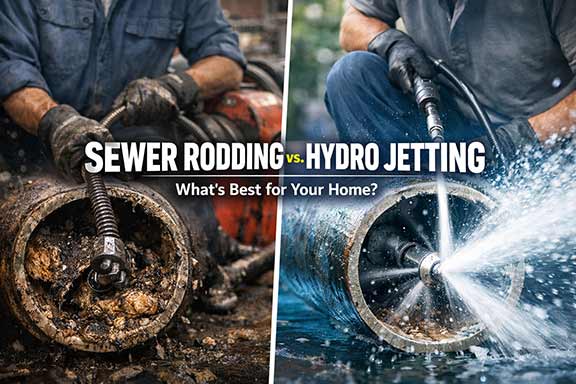
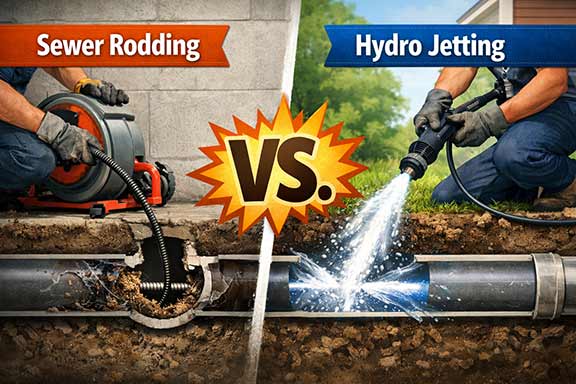
Sewer rodding, also called power rodding or rooter service, uses a flexible metal cable with a motorized, sharp-toothed cutting head at the leading end. As the cable is fed through your pipe system, it follows every bend in the line while the cutting head spins at high speed to cut through tree roots, grease buildup, hard clogs, and other obstructions blocking the passage. To learn more about how the process works, when it’s recommended, and why it’s one of the most effective methods for clearing sewer lines, read our guide on rooter service and sewer rodding in Chicago.
Before power rodding existed, a blockage that couldn’t be cleared chemically or with a basic cable snake often meant physically removing the affected section of pipe — an expensive, time-consuming job depending on where the blockage was located. Power rodding your sewer line solves the same problem faster and without tearing anything open.
It’s worth noting that sewer rodding has its limits. Because the cutting head is roughly the diameter of the pipe, it does a solid job of breaking up hard obstructions — but it doesn’t necessarily scrub the pipe walls the way hydro jetting does. Think of it like coring an apple: you remove what’s in the center, but the walls aren’t necessarily clean. For pipes with heavy sludge coating, rodding is often a first step rather than a complete solution. Want to see it in action? Watch our sewer rodding video to see exactly how the process works.
What Is Hydro Jetting?
Hydro jetting is a newer technology that uses highly pressurized water — typically between 3,500 and 4,500 PSI — to blast obstructions and sludge buildup completely out of a pipe. A thin, high-pressure hose fitted with a specialized nozzle shoots powerful jets of water in multiple directions simultaneously, scouring the pipe walls clean rather than simply punching through a blockage. According to plumbing industry sources, this method is effective even against tree roots and can restore a pipe to near-original flow capacity.
Because of its versatility, hydro jetting for stubborn sewer line buildup has become the preferred method among plumbing professionals for both residential and commercial drain cleaning. It works on pipes as small as a one-inch home drain and as large as a municipal sewer main. That said, it isn’t the right tool for every situation — and knowing the difference is what separates a quick fix from a lasting one.
One thing that sets hydro jetting apart is how thoroughly it cleans. Where rodding breaks up what’s blocking the pipe, jetting removes the debris entirely — flushing it out of the system rather than leaving residue on the walls that can quickly become the foundation of the next clog. For homeowners who find themselves calling a plumber for the same drain over and over, hydro jetting often ends that pattern for good. See our hydro jetting video to watch the difference it makes firsthand.
When to Use Sewer Rodding
If your drainpipes or sewer lines are old, sewer rodding is typically the safer choice. Older pipes may be too brittle or deteriorated to handle the force of high-pressure water without cracking or collapsing. A sewer camera inspection before any cleaning work can confirm which method your pipes can actually handle — and show you exactly what you’re dealing with before anyone touches a tool.
Space is another factor. Hydro jetting requires large equipment — often a truck-mounted rig — to generate the pressure needed. If your property has limited access or tight clearance, rodding is the more practical option.
Rodding also has a mechanical edge in certain scenarios. A hard, dense clump of tree roots or a compacted clog is sometimes easier to break apart with the spinning cutting head of a rodding line than with a stream of water alone. For stubborn root intrusion, rodding is often the first step before jetting finishes the job. The two methods aren’t always competitors — in the right situation, they work best together.
When to Use Hydro Jetting
Hydro jetting is the cleaner, more thorough option when mess is a concern — which makes it especially well-suited for commercial and restaurant environments where sewer rodding’s cleanup requirements are simply not acceptable.
Speed matters too. If you have a serious blockage that needs to be resolved quickly, hydro jetting is faster and more adaptable across a wider range of pipe configurations. It’s also the better long-term solution for sludge-heavy lines, since it actually removes buildup from the pipe walls rather than just clearing a path through it. For newer construction where pipes can handle the pressure, hydro jetting is almost always the more thorough clean.
Hydro jetting is also increasingly used as a preventive maintenance tool, not just an emergency fix. Having your lines jetted on a routine schedule — particularly in older homes or properties with a history of slow drains — can stop buildup from ever reaching the point where it causes a problem. It’s a much less expensive call than dealing with a full sewer backup or emergency excavation.
It’s worth noting that the EPA has identified grease and debris buildup as a leading cause of sanitary sewer overflows across the country — exactly the kind of chronic problem that hydro jetting is designed to prevent before it turns into a backup or flooding emergency.
Which Method Is Right for Your Pipes?
The honest answer is that it depends on your pipe age, available access, the nature of the blockage, and how thoroughly you want the job done. A professional assessment — ideally starting with a camera inspection — is always the right first move before committing to either method. The camera tells you what you’re actually dealing with so the solution fits the problem, not the other way around.
What’s clear is that neither method is one-size-fits-all, and a plumber who recommends the same approach for every job isn’t doing you any favors. The right answer comes from actually looking at your system, understanding what’s causing the problem, and choosing the tool that solves it completely rather than temporarily.
If you’re dealing with slow drains, recurring clogs, or suspect there’s sludge building up in your lines, the team at Suburban Plumbing Experts serves Chicago and the surrounding suburbs and can help you figure out exactly what’s going on and get it resolved the right way.