
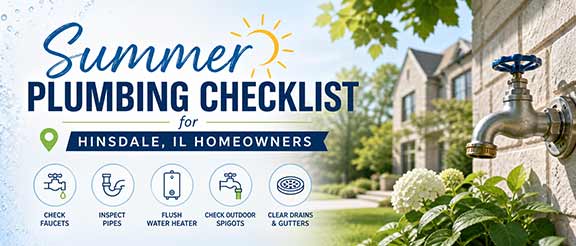
Before the Season Gets Away From You — Here’s How to Protect Your Hinsdale Home’s Plumbing This Summer
Summer in Hinsdale means the pool at Burns Field, evenings at Katherine Legge Memorial Park, weekends along the Salt Creek trail, and the kind of relaxed outdoor living that makes this village one of the most sought-after communities in the western suburbs. The last thing any Hinsdale homeowner wants is a plumbing failure interrupting all of that.
But summer is actually one of the most demanding seasons for your home’s plumbing. Increased household water usage, outdoor irrigation running daily, kids home from school, guests staying over, and the heat stress of a Chicago summer on aging pipe materials all combine to turn minor vulnerabilities into expensive emergencies. A little attention at the start of the season goes a long way toward making sure none of that disrupts your summer.
This checklist is built specifically for Hinsdale homeowners — taking into account the village’s housing stock, the specific plumbing challenges that come with DuPage County’s clay soil and hard water environment, and what the village itself is doing with its water infrastructure right now. Work through it before the Fourth of July and you’ll be set for the season.
If you’re new to a home or planning to purchase in Hinsdale, it’s also important to understand what a professional plumbing inspection should include before seasonal maintenance begins, since hidden issues like sewer wear, pipe corrosion, and pressure problems often aren’t visible during a standard walkthrough. You can learn more here: what homeowners should know about plumbing inspections before buying a home in Hinsdale.
Why Summer Is Especially Hard on Hinsdale Plumbing
Hinsdale’s housing stock skews older and larger than most of the western suburbs. The village’s teardown culture has brought a significant number of newer builds into the mix, but a substantial portion of homes on tree-lined streets like Grant, Garfield, and Stough date to the 1950s, 60s, and 70s — with original copper supply lines, cast iron drain stacks, and clay tile sewer laterals that have been in the ground for 50 to 70 years.
That aging infrastructure doesn’t announce its vulnerabilities. It waits for stress. And summer delivers stress in abundance. As your local Hinsdale, IL plumber, we see these issues play out every summer across the village — and the ones that turn into emergencies are almost always the ones that were quietly developing for months before anyone noticed.
Rising water demand, thermal expansion and contraction in pipes that have already been compromised by decades of DuPage County’s freeze-thaw cycling, irrigation systems running for the first time since fall, and outdoor fixtures that sat idle through a Chicago winter and may have taken on damage you haven’t yet discovered — all of it converges in summer.
According to the Village of Hinsdale Water Department, the village is actively working through its infrastructure — with $1.7 million budgeted for Sixth Street water main replacement and ongoing lead service line inventory work as of April 2026. That’s the public infrastructure. The private infrastructure — your lateral, your supply line, your interior plumbing — is entirely your responsibility to maintain.
Hinsdale also enforces specific lawn sprinkling restrictions from May 15 through September 15 — even and odd calendar days based on your address number, permitted only between 6:00 AM to 10:00 AM and 6:00 PM to 10:00 PM. Make sure your irrigation timer reflects these rules before the season begins.
The Summer Plumbing Checklist for Hinsdale Homeowners
1. Inspect Every Plumbing Fixture in the Home
Summer typically brings more people using more water — houseguests, kids home from school, more cooking, more laundry. Any fixture that’s been dripping slowly or running intermittently under normal conditions will accelerate under that increased load.
Walk through every bathroom and kitchen. Check faucets for drips at the spout and at the base. Check toilets for running — put a few drops of food coloring in the tank and wait 15 minutes without flushing. If color appears in the bowl, your flapper is leaking. Check shut-off valves under sinks and behind toilets for corrosion or mineral buildup — valves that haven’t been operated in years can seize or fail when you actually need them during an emergency.
Replace worn washers, aerators, and flapper valves before the season starts. These are inexpensive parts with an outsized impact on your water bill and your ability to shut down a problem quickly when one develops.
2. Check Your Water Heater for Summer Readiness
Hinsdale’s hard water environment — supplied from a DuPage County water system with significant calcium and magnesium content — accelerates sediment buildup inside water heater tanks at a rate faster than national averages. If your water heater hasn’t been flushed in more than a year, summer is the right time to address it.
Sediment buildup on the tank floor reduces efficiency, creates the rumbling and popping sounds you may have noticed during heating cycles, and can shorten the unit’s lifespan by two to three years. Flushing removes that sediment and restores the unit to near-original efficiency.
Check the pressure relief valve — lift the lever briefly to verify it opens and closes cleanly. Inspect the flue connection if your unit is gas-fired. If your water heater is approaching 10 years old in Hinsdale’s hard water environment, have it assessed by a professional before the summer season. Our water heater services cover everything from annual maintenance to full replacement across DuPage County.
3. Audit Your Irrigation System Before the First Run
Hinsdale’s established lots typically have mature landscaping with in-ground irrigation systems that sat inactive through a Chicago winter. Before you set the timer and walk away, walk every zone manually while the system runs.
Look for broken or misdirected sprinkler heads, zones that spray unevenly or create overspray onto hardscape, and any area where water is pooling rather than dispersing. Check every connection at the backflow preventer — Hinsdale homes with in-ground irrigation are required to have a properly functioning backflow preventer in place. If yours hasn’t been tested recently, that’s a compliance issue worth addressing before the season begins.
According to the EPA’s WaterSense program, homes with automatic sprinkler systems use about 50 percent more water outdoors than homes without them — and experts estimate that half of all outdoor water use is wasted through evaporation, wind, and overwatering from improperly maintained systems. A 30-minute irrigation audit at the start of summer pays for itself in reduced water bills by August.
Also confirm your irrigation timer is programmed to run within Hinsdale’s permitted sprinkling hours — even-numbered addresses on even calendar days, odd-numbered addresses on odd calendar days, between 6:00 AM–10:00 AM and 6:00 PM–10:00 PM only.
4. Check Your Home’s Water Pressure
Water pressure issues are more disruptive in summer when more fixtures are running simultaneously. Low water pressure at all fixtures simultaneously — not just one — typically indicates a supply line issue, a partially closed main shutoff, or significant internal corrosion in galvanized steel pipes that have narrowed over time.
High water pressure is actually the more damaging condition. Municipal water pressure in Hinsdale can fluctuate, and sustained high pressure — above 80 PSI — stresses pipe joints, accelerates appliance wear, and makes your home more vulnerable to sudden failures. If you’ve noticed aggressive water flow at fixtures, banging pipes during shutoff, or have experienced unexplained appliance failures, a pressure test is worth doing.
5. Inspect for Leaks — Including the Hidden Ones
The water meter test is the most reliable way to identify hidden leaks. Locate your meter in the basement near the front of the house, write down the reading, turn off every water-using fixture and appliance, wait 30 minutes, and check the meter again. Any movement confirms water is flowing somewhere it shouldn’t be.
Hinsdale’s clay soil and temperature variation make pinhole leaks in copper supply lines a consistent finding — the soil contracts and expands with moisture and temperature changes, stressing buried and exposed copper at fittings and bends. Our leak detection services and thermal imaging leak service can locate hidden leaks precisely without opening walls unnecessarily.
6. Inspect and Clean All Drains
Summer brings increased strain on drain lines — more cooking, more entertaining, more debris from outdoor activities working its way into interior drains. Before the season starts, pour water down every floor drain in the basement to verify the trap seals are intact and sewer gas isn’t entering the home through dried-out traps.
If you’ve had slow drains in the kitchen or basement, or if your home has a history of backups during heavy rain, a sewer camera inspection before summer is well worth the investment. Hinsdale’s mature tree canopy — the oaks and maples lining the parkways throughout the village — sends roots toward sewer laterals aggressively, and summer is when root-impacted lines show their first symptoms under increased usage load.
7. Service Your Sump Pump Before Storm Season Peaks
DuPage County’s storm season peaks in June and July, and a sump pump that fails during a major rainfall event is one of the most common and preventable basement flooding scenarios in the western suburbs. Test yours now while conditions are calm.
Pour a bucket of water into the pit and verify the float switch triggers the pump within seconds. Listen for the pump to run cleanly without laboring or grinding. Check the discharge line to confirm it’s directing water away from the foundation. If your pump is more than seven to ten years old or failed to engage cleanly during the test, replacement before peak storm season is strongly advisable.
Our sump pump services cover assessment, repair, and replacement across the Hinsdale area. Battery backup systems are strongly recommended given how frequently major storm events coincide with power outages.
8. Check Outdoor Plumbing and Hose Bibs
Outdoor hose bibs can develop cracks or failed washers during freeze-thaw cycling and not show obvious symptoms until you apply pressure by running a hose. Turn each one on and off fully — check for drips at the spigot body, at the wall connection, and in the basement at the pipe behind the bib. A freeze-damaged hose bib can weep slowly into the wall cavity all summer without announcing itself until the moisture damage is evident.
If you have an outdoor kitchen, a pool fill connection, or any exterior plumbing that was shut down for winter, test each connection before loading them with summer use.
9. Clean Gutters and Verify Downspout Discharge
Hinsdale’s tree canopy is magnificent. It also drops a continuous load of organic material into gutters through late spring and early summer. Clogged gutters back water up under roof edges and can contribute to foundation saturation around your home’s perimeter.
More importantly — verify that downspouts are discharging to a location that moves water away from your foundation, and not into your sanitary sewer lateral if your home was built before separate storm and sanitary connections were code-required. An illegal downspout-to-sanitary connection is a primary contributor to basement flooding during combined sewer surcharge events.
10. Know Your Lead Service Line Status
The Village of Hinsdale submitted its updated Service Line Material Inventory to the IEPA in April 2026 as part of the state’s Lead Service Line Replacement and Notification Act compliance. If your home was built before 1986, there is a meaningful possibility that your water service line contains lead.
The village’s inventory map is publicly available on the Village of Hinsdale Water Department page. Check where your property falls. If you have a confirmed or likely lead service line, our lead service line replacement specialists can assess your situation and walk you through replacement options. Summer is an ideal time to address this — the ground is workable and the weather won’t complicate the excavation and restoration work.
One More Thing: Have a Licensed Hinsdale-Area Plumber You Can Actually Reach
The best summer plumbing preparation still leaves room for emergencies. A pipe doesn’t care about your July Fourth plans. The difference between an emergency that costs a few hundred dollars and one that costs several thousand is almost always how fast a reliable Hinsdale plumber responds.
Suburban Plumbing Experts is based in Brookfield — just minutes from Hinsdale — and provides 24/7 emergency plumbing service throughout DuPage County and all of the western suburbs. We’re rated 4.9★ across 350+ Google reviews from real Chicagoland homeowners — check what your neighbors are saying before you call. When something goes wrong on a summer weekend, we answer the phone. Call us at 630-749-9057.
Frequently Asked Questions: Summer Plumbing in Hinsdale, IL
Why does my water pressure drop in summer?
Summer water demand across the Hinsdale municipal system increases significantly — more irrigation, more pool filling, more household usage. During peak demand periods, municipal pressure can drop slightly. If you’re experiencing consistent low pressure throughout the home rather than occasional fluctuations, the issue is more likely an aging supply line with internal corrosion restricting flow, or a partially closed main shutoff valve. A plumber can diagnose the cause quickly.
Does Hinsdale have sprinkling restrictions I need to follow?
Yes. From May 15 through September 15, outdoor sprinkling is restricted to 6:00 AM–10:00 AM and 6:00 PM–10:00 PM. Even-numbered addresses may sprinkle on even calendar days only; odd-numbered addresses on odd calendar days. No sprinkling on May 31, July 31, or August 31. Make sure your irrigation timer reflects these rules before the season begins.
My basement floor drain smells like sewage in summer. What causes that?
A sewage smell from a basement floor drain almost always means the trap has dried out — the water seal that normally blocks sewer gas from entering the basement has evaporated from lack of use. Pour a gallon of water into the drain to restore the seal. If the smell persists, there may be a more significant issue with the trap or drain connection that warrants a professional look.
How do I know if my sewer lateral needs attention before summer?
The warning signs are slow drainage throughout the house rather than at just one fixture, gurgling sounds when you flush toilets or run the washing machine, and any history of backups during heavy rain. A sewer camera inspection gives you a definitive picture of what’s in your lateral — root intrusion, belly, offset joints — before summer usage increases put the line under maximum stress.
Is my home’s plumbing affected by the Hinsdale water main projects?
The village’s ongoing water main replacements address the public infrastructure up to the property line. Your private service line from the meter to the house, your lateral to the city main, and all interior plumbing are your responsibility regardless of what work the village is doing on the public system.
Need a Plumber in Hinsdale, IL This Summer?
We’re based in nearby Brookfield and provide fast, licensed plumbing service throughout Hinsdale and DuPage County — 24 hours a day, 7 days a week. Send us a message and we’ll get back to you fast.
Or call us directly: 630-749-9057 | Open 24/7
Serving Hinsdale, IL
Your Local Plumber — Just Minutes Away!
Suburban Plumbing Experts is based in Brookfield, IL — a short drive from Hinsdale. We provide licensed, 24/7 plumbing, sewer, and drain services throughout DuPage County and all of the western suburbs.
- 📍9100 Plainfield Road, Suite #9A, Brookfield, IL 60513
- 📞 630-749-9057 — Hinsdale
- 🚨708-518-7765 — 24/7 Emergency Line
- 🕐Open 24 Hours · 7 Days a Week · 365 Days a Year
- ⭐4.9★ Rated · 350+ Google Reviews — See what your Hinsdale neighbors are saying