
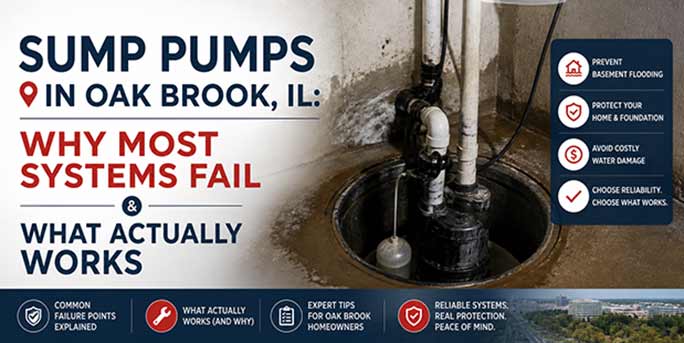
Oak Brook Homeowners Have More at Stake Than Most — Here’s Why the Standard Sump Pump Setup Isn’t Enough
Oak Brook has a reputation for well-maintained properties, finished basements, and home values that reflect serious investment in the structure. What Oak Brook also has — sitting in the Des Plaines River watershed on the flat, clay-heavy terrain of DuPage County — is a hydrology problem that doesn’t care about property values. When the ground saturates and the water table rises during a heavy spring rain, it rises under Oak Brook’s luxury homes just as fast as it rises under a 1950s Cicero bungalow. The difference is that in Oak Brook, what’s at stake in the basement is often a finished family room, a home theater, a wine cellar, or a home office — and the cost of getting it wrong runs significantly higher.
The frustrating reality is that most Oak Brook homes have a sump pump. The problem isn’t the absence of flood protection — it’s that the sump pump system that was installed when the home was built, or replaced with the cheapest available option at the last failure, isn’t actually adequate for what Oak Brook’s water table and storm events demand. And most homeowners don’t find that out until they’re standing in three inches of water at 2 a.m. during a June thunderstorm.
This guide explains exactly why sump pump systems fail in Oak Brook’s specific environment, what a system that actually works looks like, and what it costs to get from where most homes are to where they need to be.
Why Oak Brook’s Environment Is Particularly Hard on Sump Pump Systems
Understanding why standard sump pump setups fall short in Oak Brook starts with understanding what the ground beneath the village actually does during a weather event.
The Des Plaines River floodplain influence. Oak Brook sits in close proximity to the Des Plaines River corridor and Salt Creek, and significant portions of the village — particularly in lower-lying areas near Midwest Road, along the York Road corridor, and backing up to the forest preserve edges — sit in or adjacent to floodplain territory. When upstream drainage systems surcharge during heavy rain, water doesn’t just fall from the sky — it also rises from below as the water table follows the floodplain. A sump pump that’s sized for normal groundwater infiltration can be completely overwhelmed by a rising water table event without a single rain drop coming through a window.
DuPage County clay soil. Like Cook County to the east, Oak Brook sits on Drummer silty clay loam — heavy clay soil that doesn’t absorb water so much as it redirects it. During a wet spring, water that can’t percolate downward moves laterally through the upper soil layer and finds the path of least resistance — which, in a residential setting, is the void space around the foundation. Homes with poured concrete foundations and those with block foundations both see this infiltration; block foundations see it faster. A sump pit that fills gradually during a steady rain can fill dramatically fast during a heavy event on saturated clay soil because the clay is functionally impermeable once it’s wet — all the water has to go somewhere, and it goes around your foundation.
Oak Brook’s finished basement investment. This isn’t a hydrology point — it’s a consequence point. The average Oak Brook home has significantly more finished square footage in the basement than the regional average. That means the consequence of a sump pump failure isn’t a wet concrete floor and some stored boxes — it’s $30,000 to $100,000 in finished space, custom cabinetry, flooring, electronics, and personal property. The math on investing in a properly engineered sump system changes completely when you account for what’s at stake.
Power outages during the storms that stress the system most. The storms that produce the heaviest groundwater infiltration in Oak Brook — the late spring derechos, the extended overnight rain events — are also the storms most likely to knock out power. A sump pump without battery backup that loses power during the worst storm of the year isn’t a sump pump system — it’s a false sense of security with a cord plugged into the wall. In situations where a sump pump has failed or is not operating, even normal household water use can become a risk. For example, something as simple as showering may contribute to basement flooding depending on drainage conditions — we break that down in detail in our article on if you can take showers if your sump pump isn’t working.
The Four Reasons Sump Pump Systems Fail in Oak Brook
Sump pump systems don’t usually fail for one dramatic reason. They fail because of combinations of factors that add up to a system that can’t handle the conditions it faces. Here are the four most common failure patterns we see in Oak Brook homes.
Reason 1: The pump is undersized for the pit’s inflow rate.
Sump pumps are rated by how many gallons per hour they can move at a specific head pressure — the height the pump has to push water up through the discharge line. A pump rated at 2,500 gallons per hour at a 10-foot head sounds adequate until you realize the pit is filling at 3,200 gallons per hour during a saturated soil event and the pump is running continuously, overheating, and burning out — typically at the worst possible moment.
Most builder-grade sump pumps installed in Oak Brook homes during original construction were sized for average infiltration conditions, not worst-case storms. When the ground saturates and inflow spikes, the pump meets its limit exactly when you need it most. Proper pump sizing requires calculating the pit’s potential inflow rate during a 100-year storm event, not just average conditions — and then sizing the pump to exceed it with margin to spare.
Reason 2: No battery backup.
This is the single most common deficiency we find in Oak Brook sump systems. A primary pump with no backup at all means that every power outage during a heavy rain event — and they happen every spring — creates a window of zero protection. The pit fills, the water has nowhere to go, and by the time power is restored or you notice the pump isn’t running, the water is already on the floor.
A proper battery backup system isn’t a small secondary pump sitting in the corner — it’s a system engineered to run the backup pump for a meaningful duration on a charged battery, with a monitoring system that alerts you when the battery is low, when the backup activates, or when the primary pump fails. The backup pump needs to be capable of moving enough water to handle the infiltration rate during an outage, not just trickle water while you wait for the power to come back.
Reason 3: Discharge line problems.
The sump pump’s job is to get water out of the pit and away from the foundation. Where that water goes matters enormously. Discharge lines that terminate too close to the foundation allow the water to re-infiltrate immediately — the pump is essentially moving water from the pit to the soil three feet away, which drains back into the pit. Discharge lines that aren’t properly sloped can hold standing water that freezes in winter, blocking the line entirely when it’s needed in spring. Discharge lines that tie into municipal sewer or drain tile systems may be code violations and can back-pressure during heavy rain events when those systems are surcharging.
In Oak Brook, we recommend discharge lines that terminate at least 10 feet from the foundation, slope away from the home continuously, and drain to daylight — not into the sewer system. We also recommend freeze protection at the discharge outlet, particularly for homes with below-grade discharge configurations.
Reason 4: The float switch fails and nobody knows.
The float switch is the component that tells the pump when to turn on and when to shut off. It’s also the most mechanically vulnerable component in the system — a plastic float on a lever arm sitting in a pit full of sediment-laden water, cycling thousands of times per year. Float switches fail in both directions: they can stick in the off position (pump never activates, pit overflows) or stick in the on position (pump never shuts off, burns out the motor in hours).
A failed float switch that sticks in the off position is the failure nobody sees coming because the pump looks fine, the wiring looks fine, and everything appears normal — right up until the first heavy rain of the season when the pit fills and nothing happens. Annual testing of the float switch, by manually lifting the float and verifying the pump activates and shuts off correctly, takes two minutes and is the most important maintenance step most Oak Brook homeowners never do.
What a System That Actually Works Looks Like
There’s a significant difference between a sump pump and a sump pump system. Here’s what the latter looks like in an Oak Brook home with a finished basement and real stakes.
A properly sized primary pump. Cast iron is the material of choice — not thermoplastic. Cast iron pumps dissipate heat better during extended run cycles, last longer, and handle the sediment-laden water that Oak Brook’s clay soil produces better than plastic housing. The pump should be sized not for average conditions but for a sustained heavy infiltration event with room to spare. For most Oak Brook finished basements, that means a primary pump in the ¾ to 1 HP range with a verified GPH rating appropriate to the pit size and expected inflow.
A genuine battery backup system. Not a second small pump plugged into an extension cord — a properly installed battery backup with a maintenance-free AGM battery, a dedicated charger that keeps the battery at full capacity continuously, and a monitoring system that sends an alert if the battery drops below operating threshold or if the backup pump activates. The backup pump should be capable of moving enough water to handle infiltration for at least 8 to 12 hours of operation — long enough to cover an overnight power outage during a heavy rain event.
A properly terminated discharge line. Sloped to daylight, terminating at least 10 feet from the foundation in a direction that drains away from the home, with freeze protection at the outlet, and no connection to the sanitary or storm sewer system. If the existing discharge line terminates too close to the foundation or has freeze vulnerability, correcting it is part of the system — not an optional upgrade.
Annual inspection and testing. A sump system that’s never tested between failures isn’t a system — it’s an appliance that may or may not work when it’s needed. Annual inspection covers float switch function, pump activation and shutoff, battery backup charge level and operational test, discharge line confirmation, and pit condition. Our sump pump services team performs this inspection and documents the results so you have a maintenance record — which matters both for your own peace of mind and for insurance purposes if you ever need to demonstrate that the system was maintained.
Integration with broader flood control. For Oak Brook homes with significant finished basement investment, a standalone sump pump — even a properly sized one — is one layer of protection, not a complete flood control strategy. An overhead sewer conversion eliminates the risk of sewer backflow into the basement entirely. Backflow prevention addresses the combined sewer surcharge risk. A French drain system manages perimeter groundwater before it reaches the foundation. The right combination of these systems depends on your home’s specific construction, your basement’s elevation relative to the sewer main, and your flooding history.
The Oak Brook Sump Pump Failure Scenarios We See Most Often
Every basement flooding call we take in Oak Brook has a story. Here are the patterns that repeat.
The spring startup failure. The pump ran fine last fall. Over the winter, the discharge line froze solid — a common occurrence in Oak Brook homes where the discharge terminates below grade or in a sheltered area with poor drainage. The first real spring rain arrives, the pit fills, the pump activates, and the water has nowhere to go because the discharge is blocked. By the time the homeowner hears the pump running continuously and goes to check, there’s water on the finished floor.
The multi-day rain event burnout. Three days of steady rain in June. The primary pump has been running nearly continuously for 36 hours. It’s a 10-year-old builder-grade unit with a thermoplastic housing that can’t dissipate heat effectively under continuous duty. The motor overheats. The thermal overload trips and the pump stops. There’s no backup. The pit overflows into the finished basement at 3 a.m. on night two.
The power outage window. A fast-moving severe thunderstorm takes out power to the neighborhood for four hours on a Saturday afternoon. The primary pump sits idle. There’s no battery backup. In four hours on saturated clay soil, the pit overflows and water reaches the finished floor before power is restored. Total damage — flooring, drywall, furniture — runs $18,000. A battery backup system costs $800 to $1,400 installed.
The silent float switch failure. Annual inspection was never done. The float switch corroded and stuck in the off position sometime in the last two years. Nobody noticed because it didn’t rain hard enough to overflow the pit — until a heavy May storm. The pump has power. The wiring is fine. The pump just never turns on. The result is identical to a complete pump failure.
What It Costs to Fix This Right in Oak Brook
Oak Brook homeowners sometimes push back on the cost of a properly engineered sump system — until they price a basement remediation. Here’s what the investment actually looks like.
Primary pump replacement (cast iron, properly sized): $450 to $950 installed, depending on pump capacity and pit access.
Battery backup system (genuine, not toy): $800 to $1,400 installed for a quality AGM battery backup system with monitoring. This is not optional in a finished basement.
Discharge line correction: $300 to $800 depending on the length of correction needed and whether excavation is required to reroute the termination point.
Complete system replacement (primary + backup + discharge correction): $1,500 to $3,200 for a properly engineered system in a typical Oak Brook home. Compare this to the cost of a single finished basement flood event and the math is not complicated.
Annual inspection: Typically $100 to $200 as a standalone service; often included as part of a broader plumbing maintenance visit.
For the full picture of what plumbing and flood control work costs across the Chicagoland market, our Chicago plumbing pricing guide gives you detailed ranges across every service category. And if you want to understand the repair vs. replacement cost comparison specifically for sump systems, our Chicagoland sump pump cost breakdown walks through the full decision framework.
Why Oak Brook Homes Need to Think Beyond the Sump Pump
The sump pump handles groundwater infiltration through the foundation. It does not handle sewer backup — which, in DuPage County’s combined sewer areas and in communities adjacent to Chicago’s combined system, is an entirely separate and potentially more damaging failure mode.
During a severe storm event, when the sewer system surcharges — fills beyond its capacity — the pressure in the pipe reverses and sewage flows backward toward the lowest entry point in your home. In a basement without backflow protection, that entry point is the floor drain or the basement toilet. Sewage backup is categorically different from groundwater flooding: it requires professional remediation, creates health hazards, and often results in total loss of finished materials and contents.
An overhead sewer conversion eliminates this risk entirely by raising the sewer connection above the flood level so that no amount of sewer surcharge can reach your living space. For an Oak Brook home with a finished basement, this is the gold standard of flood protection — and our overhead sewer team installs these systems throughout DuPage County.
The Metropolitan Water Reclamation District of Greater Chicago (MWRD) offers rebate programs for qualifying flood control improvements — including overhead sewers and backwater valves — that can offset a meaningful portion of installation costs for eligible homeowners.
Frequently Asked Questions: Sump Pumps in Oak Brook, IL
How do I know if my sump pump is the right size for my home?
The only way to know for certain is to calculate your pit’s potential inflow rate during a heavy storm event and compare it to your pump’s rated output at your specific head pressure. A pump that looks adequate based on horsepower alone may be undersized when actual flow rates and head pressure are calculated. If your pump runs continuously during a moderate rain or has ever failed to keep up with inflow, that’s the clearest evidence you have a sizing problem.
How long should a sump pump last in Oak Brook?
A quality cast iron primary pump, properly sized and annually inspected, typically lasts 10 to 15 years in Oak Brook’s operating environment. Builder-grade plastic housing pumps in homes where the pump runs frequently — and in Oak Brook’s high water table areas, that means frequently — often fail in 5 to 7 years. The pump that came with your home and has never been replaced is the pump most likely to fail during the next significant storm.
Can I just add a battery backup to my existing pump without replacing it?
Yes — if the primary pump itself is in good condition and properly sized. Adding a battery backup to an aging or undersized primary pump buys you some additional protection but doesn’t fix the underlying deficiency. If the primary pump is undersized or near the end of its service life, addressing both at the same time is the more cost-effective approach.
My basement has never flooded. Do I still need to upgrade?
The fact that your basement hasn’t flooded yet tells you about your luck to date — not about your system’s actual capability. If you have a builder-grade pump with no battery backup and a discharge line that terminates close to the foundation, you have a system that will eventually fail under the right conditions. What those conditions look like in Oak Brook — a 4-inch overnight rain on already-saturated clay soil during a power outage — isn’t a rare scenario. It’s a normal spring.
Want to Know If Your Oak Brook Sump System Is Actually Ready?
We inspect what’s there, tell you honestly what it can and can’t handle, and give you a written estimate before any work begins. See what Oak Brook and Chicagoland homeowners say about working with us on our Google reviews. No pressure — just a real assessment of what’s protecting your basement. Same-day and next-day scheduling available across Oak Brook and DuPage County.
Or call us directly: 630-749-9057 | Open 24/7
—
Suburban Plumbing Sewer Line & Drain Cleaning Experts
Licensed & Insured | Open 24 Hours | Serving Chicago & the Suburbs Since 1978
📞 West Suburbs: 630-749-9057
🚨 24/7 Emergency Line: 708-518-7765