
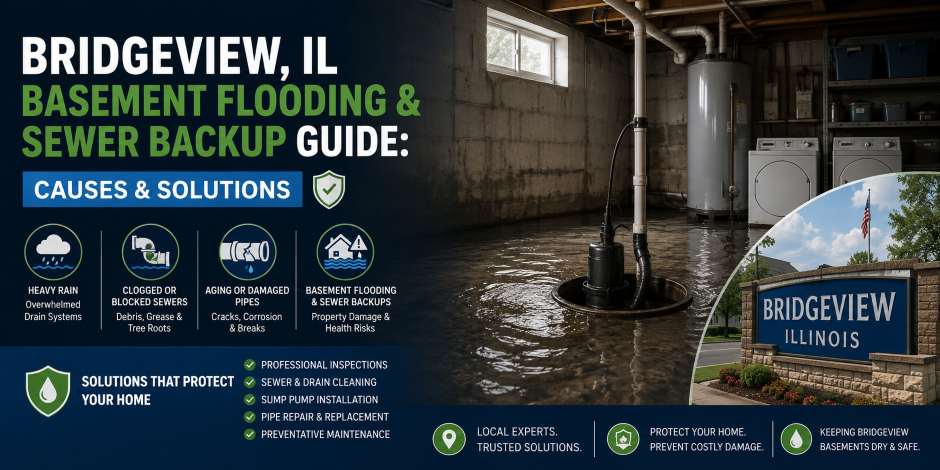
The South Suburban Reality: Why Bridgeview Basements Flood, What the Village Is Doing About It, and What You Can Do Right Now
If you’ve lived in Bridgeview for more than a few years, you know the feeling. A significant rainstorm rolls through — the kind that drops two inches in 90 minutes over the south suburbs — and you head down to the basement to find water on the floor, sewage backing up through the floor drain, or both. You call a plumber, get the line rodded, clean up the mess, and wait for the next storm to see if it happens again.
For too many Bridgeview homeowners, it does happen again. And the reason it keeps happening has nothing to do with bad luck and everything to do with understanding what’s actually causing the flooding — which determines what the right fix actually is.
This guide tells you exactly what causes basement flooding and sewer backups in Bridgeview specifically, what the Village is doing with its infrastructure right now, what the village’s own rules require of homeowners, what flood control solutions actually work for Bridgeview’s specific conditions, and how to stop the cycle of reactive cleanup and replacement with a permanent solution.
What Makes Bridgeview Particularly Susceptible to Basement Flooding
Bridgeview’s geography and infrastructure create conditions that combine to make basement flooding more prevalent here than in many Chicagoland communities. Understanding these factors is the starting point for understanding why your basement floods — and what will actually stop it.
Combined sewer system. Bridgeview — like most of Chicago’s south and southwest suburbs — uses a combined sewer system in older neighborhoods where stormwater runoff and sanitary sewage flow through the same underground pipes. When a major storm event overwhelms the system’s capacity, the only outlet for the excess volume is backward — through private sewer laterals and into the basements of connected homes. This is called a surcharge backup, and it’s fundamentally different from a simple drain clog. Rodding a clog solves the clog. Rodding a surcharge backup does nothing — because the water isn’t coming from a blockage inside your pipe, it’s coming from the city’s system under excess pressure.
Proximity to the Chicago Sanitary and Ship Canal. Bridgeview sits in the drainage basin of the Chicago Sanitary and Ship Canal, which runs along the village’s western and southern edges. During major precipitation events, the water table in this corridor rises significantly — creating groundwater pressure against basement foundations that produces a different type of flooding than surcharge backup. Water seeps through foundation walls, through floor cracks, and through window wells — not through the sewer system. This type of flooding requires a different solution than surcharge backup protection.
Postwar housing stock and aging laterals. Bridgeview was developed substantially in the 1950s, 1960s, and 1970s — meaning a large portion of the village’s housing stock has sewer laterals that are 50 to 70 years old. Those laterals — clay tile in the oldest homes, early PVC or cast iron in mid-century builds — have been accumulating root intrusion, joint deterioration, and structural wear for decades. A lateral with developing root intrusion or a partially offset joint doesn’t cause dramatic backups on its own, but it dramatically reduces the lateral’s ability to handle flow during high-demand periods like major storms — tipping a surcharge situation into an active backup.
The 87th Street and Harlem Avenue commercial corridor. The commercial density along Bridgeview’s major corridors creates significant impervious surface — parking lots, roadways, rooftops — that generates high volumes of stormwater runoff with very little ground absorption. That runoff hits the storm and combined sewer system simultaneously from multiple properties, creating concentrated peak loads that residential infrastructure downstream handles less well. For businesses in this corridor, plumbing demands are often more complex and require commercial-grade service, especially in restaurants, retail buildings, and multi-tenant properties — see our commercial plumbing services in Bridgeview for more details.
The Village’s water infrastructure investment. The Village of Bridgeview has been actively investing in its water infrastructure — most recently completing interior cleaning, repair, and resurfacing of the Bridgeview Water Tower in late 2024, the first time workers had been inside the tower in approximately 25 years. Mayor Steven Landek noted that the village’s “years of financial investment in our water infrastructure has made us an example for surrounding communities to follow.” That commitment to public infrastructure is real — but it ends at your property line. Everything from there to your foundation is your responsibility.
What the Village of Bridgeview Requires of Homeowners
The Bridgeview Public Works Department is explicit about several homeowner responsibilities that directly affect flooding risk:
Sump pump discharge rules. Sump pumps in Bridgeview are not permitted to pump water directly into storm sewers — and sump pumps cannot be connected to sanitary sewers under any circumstances. Discharge hoses connected to sump pumps must be no longer than 10 feet from the building. If your sump pump is currently discharging to a floor drain or into a sanitary sewer connection, that’s both a code violation and a contributor to the sewer system loads that cause surcharge backups in your neighborhood.
Storm sewer maintenance. The village is explicit that it is extremely important to keep storm sewers clean — no oil or other materials are to be poured down sewer drains. Leaves and grass clippings should be kept out of sewers. If you notice surface water flowing out of the street, sidewalk, or ground, report it to the Bridgeview Customer Service at 708-594-2525 or call 9-1-1 after hours.
Report sewer problems to the village first. Before calling a plumber for a sewer backup, call the village to report the problem. If the backup is caused by a condition in the public main — a blockage or surcharge in the village’s sewer infrastructure — the village addresses it. If the main is clear, the problem is in your private lateral and that’s where you need a plumber.
As your local Bridgeview, IL plumber, we work alongside the village’s public works department regularly — and understanding the boundary between public and private responsibility is the first step in addressing any flooding situation correctly.
The Two Types of Basement Flooding in Bridgeview — and Why the Difference Matters
Every Bridgeview homeowner dealing with a wet basement needs to understand which type of flooding they have — because the permanent fix is completely different for each.
Type 1: Sewer surcharge backup. Water and sewage entering the basement through floor drains, basement toilets, or utility sinks during or immediately after heavy rain. The water has a sewage odor or appearance. The backup happens specifically during storms — not during normal household water use in dry weather. This is a combined sewer surcharge event. The city’s system is overwhelmed and pressurizing your lateral.
The right solution: A backwater valve (also called a backflow preventer) installs in your main sewer lateral in the basement floor and physically blocks sewage from flowing backward into your home when the city main surcharges. It allows normal wastewater to flow out in dry conditions and closes when back-pressure is detected during a storm event. If you have basement plumbing — a bathroom, laundry connections — the system needs a bypass pump to handle wastewater generated while the valve is closed.
Type 2: Groundwater intrusion. Water entering the basement through foundation walls, through floor cracks, or through window wells — not through the drain system — during or after sustained rainfall or snowmelt. The water is clean, not sewage. It seeps through the foundation rather than backing up through drains.
The right solution: Interior drainage and a sump pump — an interior perimeter drain collects groundwater at the base of the foundation walls and channels it to a sump pit where the pump removes it to the exterior. A French drain system on the exterior can reduce the hydrostatic pressure reaching the foundation in the first place.
The most common Bridgeview scenario: both types simultaneously. A major storm event creates surcharge backup through the floor drain while simultaneously raising the water table enough to create seepage through the foundation. Solving one without addressing the other produces incomplete protection. We assess both conditions during every flood control consultation and recommend the combination of solutions that addresses your specific situation completely.
What Flood Control Solutions Work in Bridgeview
Backwater valve installation — $2,500 to $5,500 installed — is the minimum viable flood control solution for a Bridgeview home experiencing sewer surcharge backup during storms. It physically prevents sewage from entering your home regardless of what happens in the public system during a storm. The installation involves sawcutting the basement floor, accessing the main lateral, installing the valve in the line, and restoring the concrete. We coordinate permit requirements with the village as part of the installation.
Complete flood control system (backwater valve + ejector pump + access pit) — $6,000 to $12,000 installed — addresses surcharge backup while keeping basement plumbing functional even when the backwater valve is closed. This is the appropriate solution for homes with basement bathrooms, basement laundry, or any below-grade plumbing that needs to function during a storm event when the valve would otherwise block discharge.
Overhead sewer conversion — $12,000 to $25,000 installed — is the most comprehensive and permanent flood control solution. All basement drain lines are rerouted above the level of the city main, making it physically impossible for sewage to back up into your home regardless of what happens in the combined sewer system. This solution eliminates surcharge backup permanently — no valve, no pump, no electricity required to prevent a backup. For Bridgeview homeowners who have flooded multiple times, this is the solution worth serious consideration.
Sump pump installation with battery backup — $1,500 to $4,000 installed — addresses groundwater intrusion and provides redundancy during power outages that frequently accompany major storm events. Battery backup is strongly recommended in Bridgeview given how often power outages coincide with the storms that create flooding risk.
Our flood control services cover the full range of Bridgeview flood protection solutions — and we assess your specific situation before recommending anything. Read our complete flood control cost guide for a detailed breakdown of what each solution costs and what drives prices up or down in the Chicago area.
The Sewer Lateral Picture in Bridgeview
Your private sewer lateral — the pipe from your foundation to the village’s main sewer — is your responsibility throughout its length, including the section that runs beneath the public parkway. Understanding the condition of that lateral is essential for understanding your flood risk completely.
Bridgeview’s postwar housing stock means many laterals were installed in the 1950s, 1960s, and 1970s. Clay tile laterals from this era are approaching or past their functional lifespan in Cook County’s clay soil environment. Root intrusion from Bridgeview’s residential tree canopy — silver maples and other mature parkway trees — consistently finds joint failures in aging laterals and builds progressive blockages that make surcharge backup events more severe and more frequent than they would be in a clean, structurally sound lateral.
A sewer camera inspection tells you exactly what’s in your lateral — root intrusion, pipe belly, offset joints, structural damage — before a backup event forces your hand. If the camera reveals a lateral in deteriorated condition, the combination of lateral repair and backwater valve installation addresses both the structural vulnerability and the surcharge protection need simultaneously.
We completed a sewer camera inspection, hydro jetting, and sewer backflow valve replacement for a customer in Bridgeview in March 2026 — a comprehensive approach that cleared the line, cleaned the pipe walls, and installed permanent surcharge protection in a single project visit.
What to Do During an Active Backup Right Now
If sewage is actively backing up into your Bridgeview basement:
Step 1 — Stop using all water immediately. Every flush, every sink run sends more volume toward a system that can’t handle what’s already there.
Step 2 — Call the village. Report the backup to Bridgeview Public Works at 708-594-2525 during business hours (Monday through Friday 8AM–6PM, Wednesday until 8PM, Saturday 9AM–1PM). After hours, call the non-emergency police line. If the backup is caused by a condition in the public main, the village addresses it.
Step 3 — Stay out of the sewage water. Raw sewage is a Category 3 biohazard — dangerous to humans and pets. Keep the area clear until it can be professionally remediated.
Step 4 — Document everything before cleanup. Photograph and video the affected area, water levels, and the entry point before anything is touched. This documentation is essential for your insurance claim.
Step 5 — Call our emergency line at 708-518-7765. We respond 24 hours a day throughout Bridgeview and the south suburbs. We’ll clear the backup, assess the cause, and give you honest options for preventing the next one.
Frequently Asked Questions: Basement Flooding in Bridgeview, IL
My basement floods every time it rains hard. Is that a sewer problem or a foundation problem?
Possibly both — and the difference is important. If water enters through floor drains or the basement toilet during and after heavy rain, that’s almost certainly sewer surcharge backup from the combined system. If water seeps through walls or the floor slab itself during sustained rain, that’s groundwater intrusion. If you have both during major storms — which is common in Bridgeview — you need solutions that address both sources. A site assessment tells you which is which and what the right fix is.
Can I prevent my basement from flooding without a major flood control installation?
For surcharge backup — no. There’s no maintenance service that prevents a surcharge event from pushing sewage backward through your lateral into your basement. The only protection against surcharge is a mechanical barrier — a backwater valve or overhead sewer — that physically blocks the backward flow. For groundwater intrusion, a properly functioning sump pump with battery backup provides meaningful protection during typical storm events.
Does the village have any flood control rebate program for Bridgeview homeowners?
Contact Bridgeview Village Hall at 708-594-2525 and ask specifically about any available flood control assistance programs. Municipal rebate programs for backwater valve installation and flood control systems change frequently — a five-minute call before any installation is always worth making.
How do I know if the backup is caused by the city’s sewer main or my own lateral?
Call the village first and report the backup. The village will check whether the public main has a condition causing the problem. If the main is clear and functioning normally, the backup originated in your private lateral — and a plumber is the right next call. If the main is surcharging during a storm, that’s the city’s infrastructure responding to excess storm volume — and the permanent solution is flood control protection on your private system, not rodding.
My sump pump runs constantly during storms but my basement still floods. What’s wrong?
A sump pump removes groundwater from a pit — it has no effect on sewage that’s backing up through floor drains from the combined sewer system. If your basement floods through floor drains specifically during storms despite a working sump pump, you have a surcharge backup problem that requires a backwater valve — not a bigger sump pump. These are different systems solving different problems.
How quickly can you get to Bridgeview for an emergency?
We’re based in nearby Brookfield and provide 24-hour emergency response throughout the south suburbs including Bridgeview. For emergencies, call 708-518-7765 and we’ll dispatch immediately.
Had a Basement Flood in Bridgeview? Want to Make Sure It Never Happens Again?
We serve Bridgeview and all of the south and southwest suburbs 24 hours a day — sewer backups, flood control installation, camera inspections, and emergency response. Send us a message and we’ll get back to you fast.
For emergencies call: 708-518-7765 | Open 24/7
Serving Bridgeview, IL
Your Local Plumber — Fast Response to the South Suburbs
Suburban Plumbing Experts is based in Brookfield, IL — just minutes from Bridgeview. We provide licensed, 24/7 plumbing, sewer, and flood control services throughout Cook County and all of the south and southwest suburbs.
- 📍9100 Plainfield Road, Suite #9A, Brookfield, IL 60513
- 📞708-801-6530 — Suburbs | 630-749-9057 — West Suburbs
- 📞773-570-2191 — Chicago
- 🚨708-518-7765 — 24/7 Emergency Line
- 🕐Open 24 Hours · 7 Days a Week · 365 Days a Year
- ⭐4.9★ Rated · 350+ Google Reviews — See what your neighbors are saying