
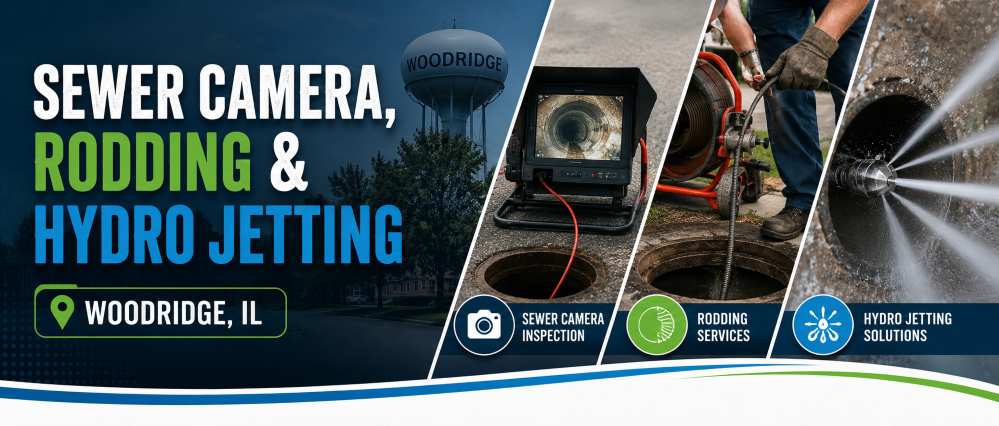
The Complete Guide for Woodridge Homeowners Who Want the Problem Fixed Once Instead of Coming Back Every Six Months
There’s a pattern that plays out in Woodridge homes with sewer problems more often than it should. A drain backs up. A plumber comes out and rods the line. The drain works fine for three months. Then it backs up again. The same plumber comes back and rods it again. Six months later, it backs up again. Same call, same rod, same temporary fix, same bill — repeated until the homeowner either accepts this as normal or finally asks the right question: why does this keep happening?
The answer is almost always the same. Rodding alone addressed the obstruction without addressing the condition of the pipe that created it. The root mass was cut through but the root entry point was never identified. The grease clog was pushed through but the grease deposits on the pipe walls were never removed. The camera that would have shown the root entry joint, the corroded pipe section, or the accumulated wall deposit was never run. So the problem rebuilds — predictably, repeatedly — at the same location for the same reason.
The service bundle that actually solves the problem is camera inspection first, then the appropriate cleaning method based on what the camera finds, then a post-service camera confirmation that the work was effective. Camera, clean, confirm. Not three separate service calls spread over a year — one comprehensive service visit that gives you the information, performs the right treatment, and confirms the result.
This guide covers everything Woodridge homeowners need to know about that complete service approach: what each component does, why the order matters, what Woodridge’s specific sewer infrastructure creates as service requirements, and why the right bundle approach costs less over a three-year period than repeated single-service calls that never solve the underlying problem.
Woodridge’s Sewer Infrastructure — What You’re Actually Working With
Understanding the service approach requires understanding what the sewer system in Woodridge’s residential neighborhoods actually looks like underground.
The Separate Sewer System Context
As covered in our complete Woodridge flood control guide, Woodridge operates a municipal separate storm sewer system — stormwater and sanitary sewage run in separate underground pipes. This distinction matters for sewer service because it means the surcharge backup mechanism that affects Chicago’s combined sewer neighborhoods is largely absent in Woodridge. When your Woodridge sewer lateral is backing up, the cause is almost always within the private lateral itself — root intrusion, pipe deterioration, grease accumulation, or structural failure — rather than pressure reversing from a surcharging municipal combined main.
This is actually good news for Woodridge homeowners: the sewer problems you experience are almost always diagnosable and solvable within your own private sewer lateral. The camera shows what’s there, the appropriate cleaning method addresses it, and the repair targets the specific failure point. There’s no city surcharge variable complicating the picture.
The East Branch DuPage River Watershed and Root Intrusion
Woodridge’s established residential neighborhoods — particularly those developed in the 1960s through 1980s — have mature tree canopies that are the most significant source of sewer lateral service demand in the village. The East Branch DuPage River watershed that runs through Woodridge supports a tree environment where roots extend aggressively toward moisture sources. A sewer lateral with clay tile joints — present in every Woodridge home built before approximately 1975 — is one of the most attractive moisture sources a tree root system can find.
Our own service record in Woodridge includes a tree root removal call where the team used sewer camera inspection, hydro jetting, and sewer rodding to clear the blockage and restore normal flow — exactly the bundled approach this article covers. Roots don’t grow in sewer laterals because something went wrong with the pipe. They grow because the clay tile joints that were installed correctly 50 years ago have moved enough from soil movement and freeze-thaw cycling to create a gap. That gap is the root entry point, and it doesn’t close after the roots are cut. It needs to be identified and sealed — which is why camera inspection after root clearing is the step that prevents the problem from rebuilding on the same timeline as before.
The Two-Era Pipe Situation in Woodridge
Woodridge’s residential development history creates two distinct pipe profiles:
Pre-1975 Woodridge homes — clay tile laterals with mortar joints that have been through 50 or more years of soil movement. These are the homes where root intrusion through joint gaps is the primary service demand. Camera inspection of a pre-1975 Woodridge lateral almost always identifies multiple joint gaps at different points along the run, root intrusion of varying severity at those gaps, and in some cases joint offset or partial collapse from accumulated freeze-thaw movement.
Post-1975 Woodridge homes — PVC or ABS laterals installed as modern construction standards replaced clay tile. These pipes don’t have the joint gap vulnerability that clay tile has, but they’re now approaching 40 to 50 years in service — an age at which joint sealant deterioration, physical damage from nearby construction, and tree root pressure at connection points becomes a legitimate service concern. Camera inspection of a post-1975 Woodridge lateral that’s showing symptoms typically identifies specific failure points rather than the widespread joint deterioration pattern of clay tile.
The Three Services — What Each One Does and Why Each One Matters
Service 1: Sewer Camera Inspection — The Diagnostic Foundation
A sewer camera inspection inserts a waterproof, high-resolution camera on a flexible cable into the sewer lateral through a cleanout, the basement cleanout fitting, or through an access point at the base of the main stack. The camera travels through the lateral — typically from the house to the connection with the city sewer main — providing real-time video of the interior pipe condition.
What camera inspection reveals that no surface assessment can:
Root intrusion — the camera identifies exactly where roots have entered the pipe, how dense the root mass is, and how much pipe diameter is occupied by the intrusion. A root mass that’s filling 20% of the pipe diameter needs a different response than one filling 80%. Camera inspection shows which situation you’re dealing with.
Joint condition — clay tile joints that have separated, offset, or developed significant gaps are visible as the camera passes through. The specific location of each compromised joint is documented in the inspection video. This is the information that makes repair decisions accurate — the joints that need sealing are the same joints the roots entered through.
Pipe belly or sag — ground settlement that has created low points in the lateral where water and waste pool rather than flowing are visible as standing water pools the camera must navigate. A pipe belly doesn’t clear with rodding or hydro jetting — it’s a grade problem that requires specific repair.
Structural failures — cracks, collapsed sections, and pipe deterioration beyond what cleaning can address are visible before any cleaning is attempted. This is the camera inspection finding that changes the service recommendation from cleaning to repair — and identifying it before sending a rod through a collapsed section prevents the rod from making a partial collapse worse.
Post-service confirmation — after rodding or hydro jetting, a camera run confirms that the cleaning was effective, that no secondary obstruction was missed, and that the joints at root entry points are identified for follow-up repair recommendation.
Our documented Woodridge service: We completed a sewer camera inspection in Woodridge confirming the condition of the sewer line before the home was listed for sale — exactly the kind of comprehensive assessment that gives homeowners and buyers complete confidence in the lateral’s condition before any transaction.
Our sewer camera inspection service is available throughout Woodridge on same-day and next-day scheduling.
Service 2: Sewer Rodding — Mechanical Clearing for Active Blockages
Sewer rodding uses a flexible steel cable — driven by a mechanical rodding machine — through the sewer lateral. The cable’s cutting attachment breaks through root masses, pushes accumulated debris toward the main, and restores flow through a fully or partially blocked pipe.
When rodding is the right tool:
Active emergency blockages — a sewer line that’s completely backed up needs flow restored immediately. Rodding accomplishes this faster than any other method. Our service record in Woodridge includes emergency sewer rodding that cleared a main line blockage to restore proper drainage for a Woodridge homeowner experiencing active backup. When a Woodridge basement is flooding, rodding is the right first response.
Root cutting in advance of hydro jetting — in a lateral with significant root intrusion, rodding with a root-cutting attachment breaks up the root mass before hydro jetting flushes the cut material. The combination is more effective than either method alone for heavy root conditions.
Annual maintenance on a confirmed-clear lateral — in a Woodridge home where camera inspection has confirmed that the lateral is in good structural condition with manageable, predictable accumulation, annual rodding maintains clear flow at the lowest service cost.
What rodding doesn’t do:
Rodding cuts through and clears obstructions. It doesn’t clean the pipe walls. Grease deposits that coat the interior of the pipe, scale buildup from Chicago-area hard water, and biological material that has accumulated on the pipe surface are largely unaffected by rodding. The rod punches a path through accumulated material but doesn’t remove the material clinging to the walls that continues to catch new debris. This is why a rodded line that hasn’t been camera-inspected and hydro jetted often rebuilds its obstruction on a 3 to 6 month cycle — the wall deposits that weren’t addressed by rodding become the new accumulation surface.
Our sewer rodding service covers the full Woodridge area with same-day and 24/7 emergency response.
Service 3: Hydro Jetting — Complete Pipe Wall Cleaning
Hydro jetting uses high-pressure water — typically 2,500 to 4,000 PSI for residential sewer laterals — directed through specialized nozzles that clean the pipe wall in all directions simultaneously. Forward-facing jets break up obstructions. Rear-facing jets scour the pipe walls and propel the loosened material toward the main.
What hydro jetting does that rodding can’t:
Pipe wall cleaning — the high-pressure water removes the grease deposits, scale, biological growth, and root debris that coat the interior pipe walls after years of use. The result is a pipe interior returned to near-original surface condition — smooth, clean, with maximum flow diameter. A hydro-jetted pipe starts the next accumulation cycle from a genuinely clean baseline, which meaningfully extends the time before the next service is needed.
Complete root debris removal — after rodding cuts a root mass, the cut root material is still in the pipe. Hydro jetting following rodding flushes all cut root material through to the main, ensuring no secondary blockage forms from accumulated root debris downstream of the cutting point.
Scale and mineral deposit removal — Chicago’s hard water environment creates mineral scale on pipe interiors over years of service. Hydro jetting removes this scale and the rough surface it creates that catches future debris, restoring smooth flow characteristics.
Our documented Woodridge service: We completed sewer rodding and hydro jetting in Woodridge, clearing the main sewer line and cleaning the cleanout using high-pressure water. This combined service — which is exactly the bundle this article covers — restores normal flow and prevents future blockages in a way that rodding alone doesn’t accomplish.
Our hydro jetting service is available throughout the Woodridge area for both routine maintenance and emergency clearing.
The Complete Bundle — Why the Order Matters
The right sequence for comprehensive sewer service in a Woodridge home isn’t arbitrary — the order is determined by what each step reveals and what each step requires.
Step 1: Camera Inspection Before Any Cleaning
Camera inspection before cleaning confirms what’s in the pipe, identifies the specific failure points, determines which cleaning method is appropriate, and flags any structural conditions that would make cleaning counterproductive or damaging.
A collapsed section in the lateral that’s discovered during camera inspection changes the service recommendation from cleaning to repair. Running a rod through that collapsed section without knowing it’s there can worsen a partial collapse into a complete one. Camera before rod — always.
Step 2: Rodding for Active Blockage or Root Mass Reduction
If the camera identifies an active blockage or a root mass of significant volume, rodding addresses the immediate obstruction and reduces the root mass to a level that hydro jetting can then completely flush. For Woodridge homes with clay tile laterals and root intrusion — the most common service scenario in established Woodridge neighborhoods — the rodding step cuts through the root accumulation that the camera identified.
Step 3: Hydro Jetting for Complete Pipe Wall Cleaning
After rodding has restored flow and reduced any root mass, hydro jetting scours the complete pipe wall — removing wall deposits, flushing all cut root material, and cleaning the surface condition back to near-original. This step is what transforms a temporary clearing into a lasting result.
Step 4: Post-Service Camera Confirmation
A final camera run after hydro jetting confirms the effectiveness of the cleaning, identifies the specific joint locations where roots entered (which should be the target of a repair recommendation to seal those joints), and documents the post-service pipe condition for the homeowner’s maintenance records.
This four-step sequence — camera, rod, jet, confirm — is the complete service that solves the problem rather than managing it. For Woodridge homeowners who have been in the recurring-rodding cycle, this sequence is what breaks it.
The Woodridge Service Scenarios We See Most Often
Scenario 1: Emergency Backup in an Established Neighborhood Home
A Woodridge home in an established neighborhood with mature trees. The main sewer line has backed up — basement floor drain is backing up, all drains are slow simultaneously. Emergency call.
Response: Sewer rodding to restore flow immediately. Camera inspection once flow is restored to assess the cause of the blockage — almost always root intrusion at clay tile joint gaps in pre-1975 Woodridge homes. Hydro jetting to remove cut root material and clean the pipe walls. Post-service camera to document joint conditions and recommend sealing at root entry points.
Our documented service: We performed emergency sewer rodding in Woodridge — the team cleared a main line blockage to restore proper drainage. This service removed the obstruction and allowed normal wastewater flow to resume.
Scenario 2: Pre-Sale Sewer Camera Inspection
A Woodridge homeowner preparing to list the property. The sewer lateral has never been camera-inspected. The real estate transaction requires or the homeowner wants a documented condition assessment.
Response: Camera inspection of the full lateral from the house to the main connection. Video documentation of pipe condition, joint status, any root intrusion, and overall structural assessment. Written report for use in the transaction. If cleaning is warranted based on inspection findings, rodding and hydro jetting can be bundled with the inspection.
Our documented service: We completed a sewer camera inspection in Woodridge, confirming the condition of the sewer line before the home was listed for sale, helping the homeowner assess system integrity.
Scenario 3: Recurring Backup Despite Regular Rodding
A Woodridge homeowner who has had the sewer rodded multiple times in the past two years. Backup pattern recurs every 3 to 6 months despite rodding. Wants to break the cycle.
Response: Camera inspection identifies the specific root entry points that have been creating recurring intrusion — the joints where roots keep growing back because the entry point was never sealed. Hydro jetting provides a complete pipe wall cleaning that rodding alone never accomplished. Post-service camera documents joint conditions and identifies which joints need repair to prevent the cycle from restarting.
What Sewer Camera, Rodding, and Hydro Jetting Cost in Woodridge in 2026
Sewer camera inspection (residential lateral, full run): $200 to $450. Includes video documentation and written condition findings. This is the diagnostic investment that makes every subsequent decision accurate.
Sewer rodding (main lateral): $250 to $500. Standard lateral clearing for most Woodridge residential situations. Emergency rates apply for after-hours response.
Hydro jetting (main lateral, residential): $350 to $700. For complete pipe wall cleaning following rodding or for a lateral where accumulation is confirmed by camera but no active blockage exists.
Combined service — camera inspection + rodding + hydro jetting (same visit): $650 to $1,200 for most Woodridge residential laterals. The per-service cost of the bundle is consistently less than three separate mobilizations for the same scope — and the result is meaningfully more durable than any single service provides.
Sewer line repair (spot repair at identified failure point): $1,500 to $4,500 depending on depth, access, and extent. Camera inspection identifies the specific repair location before any excavation — targeted repair rather than guesswork.
Our Woodridge plumbing services include all of the above with same-day scheduling available and 24/7 emergency response for active backup situations throughout the village.
Frequently Asked Questions: Sewer Service in Woodridge, IL
My sewer was rodded six months ago and it’s backing up again. Does that mean I need a repair or replacement? Not necessarily — it means rodding alone isn’t providing lasting results, which is a strong indicator that camera inspection and hydro jetting should be added to the service scope. In most Woodridge cases of recurring backup after rodding, the camera identifies root entry joints that keep producing new intrusion. Hydro jetting removes the existing intrusion and wall deposits. Joint repair or sealing at the identified entry points prevents new intrusion. This three-component approach breaks the recurring cycle that rodding alone maintains indefinitely.
How often should a Woodridge home’s sewer lateral be serviced? For a pre-1975 Woodridge home with clay tile lateral and mature trees nearby: camera inspection every 3 to 5 years to assess joint and root condition, with annual or biannual rodding if root intrusion is an established pattern. For a post-1975 home with PVC lateral and no root intrusion history: camera inspection every 5 to 7 years, cleaning only when symptoms develop or camera inspection identifies accumulation.
Is Woodridge’s separate sewer system an advantage compared to Chicago’s combined system? For sewer backup risk specifically, yes. The combined sewer surcharge mechanism that pushes sewage backward through Chicago residential laterals during heavy rain events is largely absent in Woodridge’s separate sewer system. When a Woodridge lateral backs up, the cause is almost always within the private lateral itself — diagnosable and solvable through the camera-rod-jet-confirm approach. The separate sewer doesn’t eliminate sewer service needs, but it simplifies the diagnostic picture significantly.
I’m buying a home in Woodridge. Should I get a sewer camera inspection before closing? Yes — and this is one of the highest-value due diligence steps available to any Woodridge home buyer. Standard home inspections don’t assess the sewer lateral. A pre-purchase camera inspection of a pre-1975 Woodridge home’s clay tile lateral frequently identifies root intrusion, joint conditions, or structural issues that affect both the negotiation and the maintenance planning for the property. We completed this exact service for a Woodridge homeowner preparing to list — confirming system integrity before the transaction.
Need Sewer Camera Inspection, Rodding, or Hydro Jetting in Woodridge, IL?
Licensed, insured, and serving Woodridge since 1978 — based just minutes away in Brookfield. We perform sewer camera inspections, rodding, hydro jetting, and sewer line repair throughout Woodridge and DuPage County. Same-day and emergency response available 24/7. Written quotes before we start, our own licensed plumbers on every call. Send us a message and we’ll get back to you fast.
Or call us directly: 630-749-9057 | Open 24/7
—
Suburban Plumbing Sewer Line & Drain Cleaning Experts
Licensed & Insured | Open 24 Hours | Serving Woodridge & DuPage County Since 1978
📞 Woodridge & Suburbs: 630-749-9057 | 🚨 Emergency: 708-518-7765