
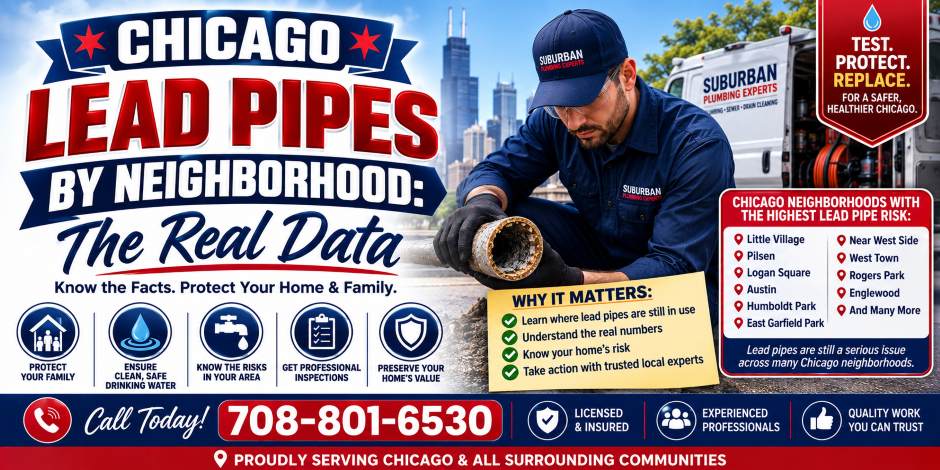
Chicago Has More Lead Water Pipes Than Any City in America — an Estimated 412,000 of 491,000 Service Lines. The City’s Own Plan Doesn’t Finish Replacing Them Until 2076. And the Risk Isn’t Spread Evenly: Nine of the Ten Worst-Affected Community Areas Are on the South Side. Here’s the Real Breakdown, Neighborhood by Neighborhood.
Every Chicago neighborhood has lead service lines. That’s the uncomfortable starting point, confirmed by the city’s own inventory data. But “every neighborhood has some” and “your specific block has one” are very different pieces of information, and a 2025 investigation by WBEZ, Grist, the Chicago Sun-Times, and Inside Climate News — built from the city’s actual service line inventory, obtained through public records requests — gives Chicago homeowners something they’ve never really had before: a real, address-level and neighborhood-level picture of where the risk actually concentrates. This guide focuses specifically on that neighborhood-by-neighborhood breakdown and what it means for your household. If you’re looking for a broader overview of Chicagoland’s drinking water—including hard water, chlorine, filtration options, lead service lines, and what homeowners should know before choosing a treatment system—read our Complete Guide to Chicagoland Tap Water.
For the mechanics of the city’s replacement programs, eligibility rules, and the public-side/private-side responsibility split, our companion piece on whether your Chicago home has a lead water line covers that ground in full — this guide picks up where that one leaves off. Whichever path applies to you, it starts with a free water test and filtration consultation, using a free way to check your own address first through the WBEZ, Grist, and Inside Climate News interactive lead pipe lookup tool.
The Scale, Briefly — and Why This Piece Goes Further
Chicago has an estimated 412,000 lead or lead-contaminated service lines out of roughly 491,000 total — more than any other city in the country. The city’s own replacement plan doesn’t reach full completion until 2076. We’ve covered the programs, eligibility rules, and cost figures behind those numbers in detail elsewhere — what most coverage of Chicago’s lead pipe problem stops short of is showing you where within the city that risk actually concentrates, and why. That’s what the rest of this guide does.
Where the Risk Actually Concentrates
The 2025 investigation found that lead service line risk isn’t distributed evenly across the city — it correlates directly with race and income. In majority-Latino census tracts, 92% of service lines require replacement. In majority-Black tracts, it’s 89%. In majority-white tracts, 74%. In the city’s majority-Asian tracts, concentrated in and around Chinatown, it’s 65%. Every one of those numbers is high in absolute terms — even the “best” group is still two-thirds lead-affected — but the gap between them is real and well-documented.
Geographically, the pattern is stark: nine of the ten Chicago community areas with the highest percentage of service lines requiring replacement are on the South Side. The tenth is Belmont Cragin, a majority-Latino neighborhood on the Northwest Side. The investigation didn’t publish the complete named list of all nine South Side areas in the reporting reviewed for this guide, but the pattern lines up with what a separate, earlier academic mapping analysis found using a different methodology: Brighton Park, Gage Park, Chicago Lawn, New City, Englewood, and West Englewood carried the highest combined lead-risk scores in an independent 2023 study, all on the South and Southwest Sides. The two analyses used different data and different years, but they point in the same direction.
Why the South Side Specifically
This isn’t random. It comes down to two things layered on top of each other: when a neighborhood was built out, and what happened to it afterward. Much of the South Side’s housing stock — the two-flats, workers’ cottages, and early brick bungalows that define neighborhoods like Auburn Gresham, Englewood, and West Englewood — went up in the first few decades of the 20th century, well within the era when Chicago required lead service lines by code. Auburn Gresham alone is roughly 3.77 square miles of housing built predominantly in that window, now home to just over 45,000 residents, more than 93% Black, with a median household income around $37,700 — a fraction of the city average. That combination of old housing stock and limited household resources to pay for private-side replacement out of pocket is exactly the pattern researchers point to when explaining why lead risk and income correlate so strongly. (Community area demographic and housing data via the U.S. Census Bureau.)
Layer historical disinvestment on top of that construction-era pattern and the picture gets clearer still. Many of the same South and West Side community areas carrying the heaviest lead burden today were subject to decades of redlining and reduced infrastructure investment throughout the 20th century — the kind of neighborhood-level disinvestment that shows up not just in housing values, but in which streets got water main upgrades and which didn’t. Researchers involved in the 2025 mapping project were direct about this in public comments: it’s a whole-city problem, but even the neighborhoods with comparatively less exposure often still have well over half their service lines made of lead. There isn’t a Chicago neighborhood where “lead pipes aren’t really a concern here” is an accurate statement — there are only neighborhoods where the odds are somewhat better instead of overwhelming.
What This Looks Like on the North Side
The North Side isn’t exempt, even though the concentration is lower. Neighborhoods like Lincoln Park and the Loop, with more redevelopment, teardown-and-rebuild activity, and newer construction mixed into older housing stock, tend to show comparatively lower lead line percentages — new construction after 1986 legally cannot have a lead service line, and any home that’s been substantially rebuilt or had its service line replaced during a major renovation is off the list. But “comparatively lower” in a citywide dataset where even the best-performing group is at 65% still means most homes are affected. A well-off North Side neighborhood with newer construction mixed in is not the same as a neighborhood with no lead risk at all.
Why Your Specific Block Still Matters More Than Your Neighborhood’s Average
Here’s the detail that gets lost in city-wide and neighborhood-wide statistics: lead service lines were installed and, occasionally, replaced block by block and building by building, not neighborhood by neighborhood. A two-flat on one corner can have a confirmed lead line while the building next door was fully replumbed decades ago. The city’s own inventory data has real gaps too — reporters found many addresses missing entirely, with some service lines logged only by nearest intersection rather than a specific address, and multiple households sometimes served by a single recorded line. That means even a “good” neighborhood average doesn’t clear your specific home, and a “bad” neighborhood average doesn’t automatically confirm yours is lead. The only way to know for certain is to check your own address specifically, through the City of Chicago’s own service line inventory lookup tool, rather than extrapolate from your zip code.
What to Actually Do About It: Test, Filter, Decide on Replacement
The right sequence matters here, and it’s simpler than most homeowners assume. First, confirm your specific service line status — through the city’s own lookup tool, a professional water test, or both, rather than guessing based on your home’s age or neighborhood. Second, address what you can control immediately: a properly certified filtration system reduces lead exposure at the tap right away, regardless of where your address falls on the city’s decades-long replacement schedule. Third, decide on full replacement based on your specific situation — whether you qualify for the city’s income-based free replacement program, whether you’re willing to pay for private replacement now, or whether certified filtration is your realistic near-term answer while you weigh the cost.
Our water filtration installation service starts every job with a free test of your actual water, not a citywide assumption, and we’re straightforward about when filtration makes sense as a bridge and when a full lead service line replacement is worth pursuing instead — including walking you through whether you might qualify for the city’s free program before you spend anything privately. For homes where hard water is a factor alongside lead and chlorine concerns, particularly common in older housing stock throughout the South and Southwest Side neighborhoods carrying the heaviest lead burden, our dedicated water softener installation service addresses scale and mineral buildup as part of the same conversation, rather than treating it as a separate problem requiring a separate contractor visit.
If you live outside the city, our guide to the Chicago Suburbs with the Worst Lead Pipe Problems explains which suburban communities have the highest concentrations of aging lead service lines and what homeowners should know about replacement options.
Reverse Osmosis and Filter Selection: Why Certification Matters More Than Marketing
Not every filter marketed for “lead removal” actually removes lead reliably. The certification to look for is NSF/ANSI 53 or 58 — standards that specifically test and verify lead reduction performance, rather than a general “filters your water” claim on the packaging. A reverse osmosis system installed under the kitchen sink is generally the most thorough option for lead specifically, since it removes dissolved solids at a molecular level that carbon filtration alone can’t fully address. For households in the highest-risk South Side and Southwest Side community areas identified in the 2025 data, we typically recommend starting there rather than a whole-house carbon system alone, since drinking and cooking water is where lead exposure actually matters most for health.
Housing type matters for how we approach the install, too. In a South Side two-flat or workers’ cottage with an unfinished basement and an accessible main line, a whole-house system paired with a dedicated RO unit at the kitchen sink is usually straightforward to install in a single visit. In a North Side vintage courtyard building or a condo with limited access to the building’s main line, an under-sink or countertop unit is often the realistic starting point, since altering shared building infrastructure isn’t always possible for an individual unit owner. Either way, the point is the same: match the system to the actual home, not a one-size-fits-all recommendation based on the neighborhood alone.
Frequently Asked Questions
Why do majority Black and Latino neighborhoods have such a higher concentration of lead pipes?
It’s a combination of when those neighborhoods were built out and what happened afterward. Much of the South and West Side housing stock went up in the early 1900s, squarely within the era when Chicago required lead service lines by code. Decades of historical redlining and reduced infrastructure investment in many of those same neighborhoods compounded the problem, affecting which streets received water main and service line upgrades over the following century. Household income also plays a direct role, since private-side replacement costs real money that not every homeowner can absorb without assistance.
I live in a condo or vintage courtyard building. Can I still get a filtration system installed?
Usually yes, though the approach differs from a single-family home. If you don’t have direct access to the building’s main water line, an under-sink or countertop reverse osmosis unit at your own kitchen tap is typically the realistic option, since it doesn’t require altering shared building infrastructure. A whole-building solution would need building ownership or management involvement.
My neighborhood wasn’t named as one of the highest-risk areas. Does that mean I don’t need to worry about lead?
No. Even the lowest-risk group identified in the 2025 data — majority-Asian census tracts around Chinatown — still had 65% of service lines requiring replacement. Lead service lines exist in every part of Chicago. A lower neighborhood-wide percentage means somewhat better odds, not a guarantee about your specific address.
If I’m in one of the highest-risk South Side neighborhoods, should I just assume I have a lead line?
It’s a reasonable starting assumption for a home built before 1986, but “reasonable assumption” still isn’t the same as confirmation. Check your specific address through the city’s lookup tool or get a professional water test before deciding on next steps — some individual lines in even the highest-risk areas have already been replaced or were never lead to begin with.
Is filtration actually enough, or do I need full replacement no matter what?
A certified lead-reduction filter meaningfully reduces exposure right away and is a legitimate answer for households who can’t do a full replacement immediately, whether due to cost or the city’s own multi-decade timeline. It’s not usually presented as a permanent substitute for replacing a confirmed lead line long-term, but given realistic wait times, filtration in the meantime is far better than doing nothing while you save up or wait for your number to come up in the city’s queue.
How much does full lead service line replacement cost in Chicago if I don’t qualify for the free city program?
City officials have reported full replacements averaging around $31,000 when homeowners pay privately, with permitting alone sometimes running $5,000 to $7,000 depending on the block. That cost gap is exactly why filtration matters as an immediate, affordable step regardless of your long-term replacement plans.
Worried About Lead in Your Chicago Tap Water?
Licensed, insured, and serving Chicago and the surrounding suburbs since 1978. We start every water filtration consultation with a free test of your actual water — not a citywide average — and we’ll give you a straight answer on filtration versus full lead service line replacement based on your specific situation.
Suburbs: 708-801-6530 | Chicago: 773-570-2191 | Open 24/7
—
Suburban Plumbing Sewer Line & Drain Cleaning Experts
Licensed & Insured | Open 24 Hours | Serving Chicago & Chicagoland Since 1978
📞 Suburbs: 708-801-6530 | 📞 Chicago: 773-570-2191