
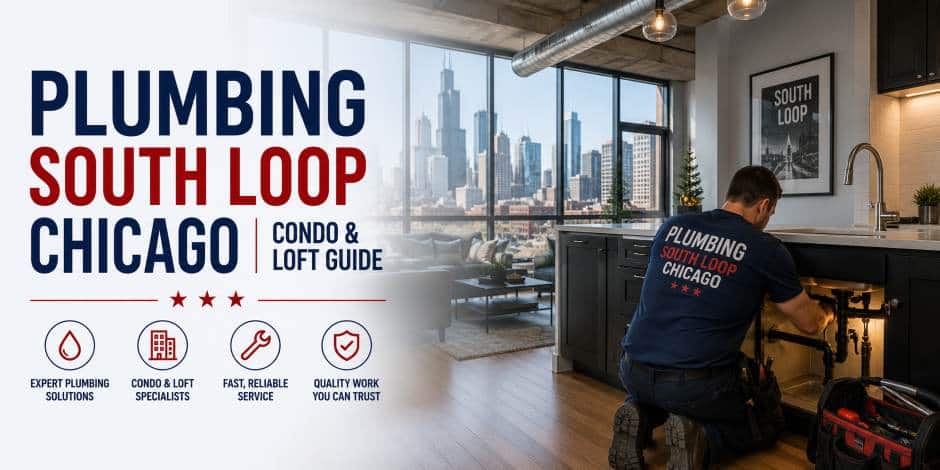
Plumbing in Chicago’s South Loop: What High-Rise Condo Owners, Loft Residents, and Renters Need to Know About Their Unique Urban Plumbing Reality in 2026
The Article That Finally Explains South Loop Plumbing the Way It Actually Works — Not the Way Single-Family Home Guides Describe It
The South Loop is not like other Chicago neighborhoods. It is not a bungalow belt community with aging clay tile laterals and root intrusion from parkway trees. It is not a neighborhood of two-flats and three-flats with shared cast iron kitchen drain branches. It is not a single-family homeowner community where the resident controls every pipe from the main connection to the faucet. For homeowners in Chicago’s historic two-flat neighborhoods, the plumbing concerns are very different. Our Wicker Park & Bucktown Plumbing Guide explains the sewer, drain, and aging pipe issues commonly found in some of Chicago’s most iconic residential communities.
The South Loop is the most concentrated vertical residential market in the Midwest — a neighborhood of mid-rise and high-rise condo towers, converted Printer’s Row loft buildings, luxury rental apartments, and a growing townhome community along Prairie Avenue. NEMA Chicago’s 76-story tower. The 1000M luxury apartments. Riverline’s riverfront development. Dearborn Tower. The Grant. The Guild. Dozens of condominium associations managing buildings where the plumbing questions that arise — who owns which pipe, who fixes which leak, who pays for what restoration — are governed not by a homeowner’s instinct but by the Illinois Condominium Property Act, the building’s declaration, and in many cases, a property manager who may not have the complete picture.
The South Loop’s plumbing reality has nothing to do with tree roots or cast iron bungalow drains. It has everything to do with the question that defines every plumbing event in a vertical urban building: whose problem is this? And in a neighborhood where that question involves dozens of condominium associations, hundreds of property managers, and tens of thousands of unit owners who paid substantial sums for their South Loop addresses — getting the answer wrong costs serious money.
The South Loop’s Two Plumbing Worlds — Knowing Which One You Live In
The South Loop contains two fundamentally different residential plumbing environments, and which one you live in determines everything about your plumbing responsibilities and the issues you’re most likely to face.
World One: The High-Rise and Mid-Rise Condo Tower
The residential towers that define the South Loop’s skyline — built primarily from the mid-1990s through the present — have modern building systems with sophisticated plumbing infrastructure: centralized mechanical rooms, building-wide riser stacks serving dozens or hundreds of units, pressure-reducing valves at each floor to manage the pressure differential of delivering water to upper floors, and common element drain stacks that carry waste from every unit on every floor to the building drain.
In these buildings, the distinction between what belongs to the association and what belongs to the unit owner is architecturally clear — clear enough to understand once you know the rule, complicated enough to produce genuine disputes when neither the unit owner nor the property manager has read the declaration carefully.
The rule in South Loop high-rise condo towers: The riser stack — the vertical pipe that runs from the building’s mechanical room upward through each floor, serving multiple units — is a common element. The association is responsible for it. The branch lines that break off from the riser at your floor level and run to your specific unit’s kitchen, bathrooms, and laundry are within your unit’s space. You are responsible for them. Every fixture within your unit — toilet, sink, shower, dishwasher, in-unit water heater — is your responsibility.
The dispute that most commonly arises in South Loop high-rise towers: water appears in one unit from a source above. Is it the riser (association)? Is it a unit owner’s supply line failure (their responsibility)? Is it a unit owner’s drain overflow (their responsibility, potentially with liability to the unit below)?
The answer to this question — which determines who calls whom, which insurer responds, and who pays for what — is precisely what our complete Chicago condo plumbing guide covers in exhaustive detail. For South Loop condo owners specifically, that guide is the foundational document for understanding your plumbing rights and responsibilities before any water event makes those questions urgent.
World Two: Printer’s Row and the Converted Loft Buildings
Printer’s Row — the historic district roughly bounded by Congress Parkway, Polk Street, Clark Street, and the south branch of the Chicago River — contains one of the most architecturally significant collections of converted industrial buildings in any American city. The former printing industry warehouses and manufacturing buildings that were converted to residential condominiums from the 1970s through the 1990s are now Printer’s Row’s signature residential product: brick and timber loft condos with soaring ceilings, exposed ductwork, and original building bones from the late 19th and early 20th centuries.
Those original building bones include plumbing infrastructure that predates the residential conversion by 50 to 100 years. The industrial water supply systems of a 1905 printing warehouse were not designed for residential plumbing loads. The drain systems that carried industrial process waste from printing operations were not designed for residential kitchen and bathroom fixtures. When these buildings were converted to residential condominiums, the plumbing systems were adapted and upgraded — but the adaptation occurred within building structures whose original infrastructure reflected an entirely different era and use.
Printer’s Row loft buildings have specific plumbing characteristics that high-rise towers don’t:
Cast iron drain infrastructure from the industrial era. The building drain system in an 1890s or 1900s Printer’s Row building has cast iron pipe — the same material as South Side bungalow drains, but in a building that has been converted from industrial to residential use. This cast iron has been in service for 120 to 130 years. Its interior surface condition, wall thickness, and structural integrity reflect that age in Chicago’s hard water environment.
Original supply infrastructure within converted spaces. The supply lines serving Printer’s Row loft units run through spaces that were adapted from industrial configurations — through the thick timber columns and masonry floors that give these buildings their character. When supply line failures occur in these buildings, accessing and repairing them involves the building’s historic structural elements in ways that high-rise tower supply line repairs don’t.
Unique HOA governance in older conversions. Printer’s Row buildings were converted to condominiums at different points in the past 30 to 50 years — and their declarations reflect the condominium governance standards of those earlier eras. Some older Printer’s Row declarations have less precise language about the unit/common element boundary for plumbing than declarations from more recent condo developments. This imprecision produces ambiguity in plumbing disputes that more recent declarations resolve more clearly.
The Most Common South Loop Plumbing Issues — By Building Type
In-Unit Water Heater Failures — The #1 Unit Owner Plumbing Emergency in South Loop Condos
Many South Loop condo towers — particularly the mid-rise buildings from the 1990s and early 2000s — were built with in-unit water heaters: individual water heaters inside each condo unit rather than a central building water heater serving multiple units. These in-unit water heaters are:
- Definitively the unit owner’s responsibility, not the association’s
- The same age as the building — meaning units in buildings from 2000 now have 25-year-old water heaters
- Running Chicago’s hard Lake Michigan water continuously
- Subject to the mineral scale accumulation that hard water produces on heating elements and tank floors
A water heater failure in a South Loop high-rise unit is not a localized problem. When an in-unit water heater fails catastrophically — releasing 40 to 80 gallons of hot water onto the unit floor — that water flows to the unit below through the building’s construction. A water heater failure on the 22nd floor of a South Loop high-rise becomes a water damage event for the 21st floor as well — and potentially multiple floors below depending on the volume of water released before the unit is shut off.
This specific risk — in-unit water heater failure cascading to neighboring units — is why South Loop condo owners should know:
- The age of their in-unit water heater (decoded from the serial number)
- Where the unit main water shutoff is
- That every adult in the household knows where that shutoff is
A 25-year-old water heater in a South Loop condo is a liability. Our complete Chicago water heater warning signs guide covers every symptom an aging water heater sends before it fails — and in a high-rise setting where failure affects neighbors, catching those symptoms is more urgent than in a single-family home. Our water heater services cover South Loop buildings with same-day scheduling and response.
Hidden Leaks Between Units — The South Loop’s Most Contentious Plumbing Event
In a South Loop high-rise tower, every unit has neighbors above, below, and potentially on both sides. A supply line failure, a toilet seal failure, an overflowing fixture, or a slow leak from a connection inside a wall can affect multiple neighboring units before the source is identified and the water is shut off.
The diagnostic challenge in a multi-unit South Loop building: water appearing in Unit 14C may have originated from Unit 15C above, from the riser stack in the wall between 14C and 15C, from the common corridor above the ceiling of 14C, or from a unit two floors up that has been leaking slowly for weeks. Without professional leak detection, the source is not identifiable from the point of water appearance — and attributing cause before diagnosis is the most common way water damage events in South Loop high-rises become disputes rather than resolved maintenance issues.
Professional thermal imaging leak detection identifies moisture within wall, floor, and ceiling cavities before any surface evidence appears — and before any contractor opens any wall to find a leak whose source hasn’t been confirmed. In a South Loop building where opening a wall incorrectly means damaging a common element and triggering association vs. unit owner liability questions, knowing where the leak is before touching anything is not just practical — it’s financially essential.
Our thermal imaging inspections and leak detection services provide the pre-action diagnosis that South Loop condo owners need before any claim is filed, any contractor is called, and any neighbor conversation becomes contentious. For the complete guide to what the Illinois Condominium Property Act says about who is responsible for which leak in a South Loop condo building, see our complete Chicago condo plumbing guide.
Drain Cleaning in South Loop Condo Units — The High-Rise Version
The drain cleaning picture in a South Loop high-rise is different from the bungalow drain cleaning picture — but it’s not less important. In many cases, what starts as a slow or inconsistent toilet flush is actually caused by deeper buildup or partial restrictions in branch or stack lines. For a detailed breakdown of why toilets keep clogging in Chicago buildings and what’s actually happening inside the system, see our guide on toilet drain cleaning in Chicago and the suburbs.
Condo unit drains in South Loop buildings accumulate the same FOG, soap scum, and mineral deposits that any Chicago residential drain accumulates. The difference is that in a high-rise, a slow unit kitchen drain may indicate wall accumulation within the unit’s branch line, or it may indicate a building-wide stack condition that affects multiple units and is the association’s responsibility to address.
The diagnostic first step when a South Loop condo drain is consistently slow: confirm whether the problem is isolated to the unit or affects other units on the same riser. If neighbors on the floors above and below are experiencing the same slow drain on the same fixture type, the problem is in the building’s common drain stack — the association’s responsibility. If the slow drain is isolated to your unit’s fixtures, it’s within your unit’s branch line — your responsibility.
Our drain cleaning services and hydro jetting service cover South Loop condo units with scheduling designed for building access requirements — coordinating with property managers and building staff as needed for units in managed condo associations.
The Illinois Condominium Property Act — What South Loop Condo Owners Must Know
The Illinois Condominium Property Act (765 ILCS 605) governs every condo association in the state — including every South Loop high-rise and Printer’s Row loft conversion. Under the ICPA, the association’s declaration defines the boundary between common elements (association responsibility) and unit space (owner responsibility).
For South Loop condo owners, three specific ICPA provisions are most relevant:
The access right. The association can enter your unit to repair a common element — like a riser stack — with proper notice, except in emergencies. This means that when a plumber arrives to address a riser condition inside your wall, the association has the right to perform that access. You don’t have the right to refuse entry for common element repairs.
The restoration standard. After a common element repair that required opening your wall or floor, the association must restore to the standard specified in the declaration — either “bare wall” (patching but not finishing) or “original condition” (restoring to prior condition including tile, paint, and flooring). South Loop condo owners need to know which standard their building’s declaration specifies before any wall is opened for a common element repair.
The unit owner’s HO-6 obligation. South Loop condo owners should carry HO-6 insurance that includes loss assessment coverage (for association special assessments after common element damage), improvements and betterments coverage (for upgrades above the building’s standard), and personal property coverage. The association’s master policy covers the building’s common elements — the gap between what the master policy covers and what the unit owner needs to protect is precisely what HO-6 fills.
The South Loop Building Scenarios That Drive Plumbing Service Calls
The 2005 Mid-Rise Building With 20-Year-Old In-Unit Water Heaters
A South Loop condo building from 2005 now has 20-year-old in-unit water heaters in every unit — approaching or past the end of their reliable service life in Chicago’s hard water environment. The building management may not have communicated to unit owners that their water heaters are aging. The unit owners, not having experienced a failure, may not realize a 20-year-old water heater in a hard water city is a liability rather than a fixture.
One unit’s water heater fails on a Saturday night. Hot water flows across the unit floor, through the building’s construction, and into the unit below — which has recently finished concrete floors and a new kitchen renovation. The 20-year-old water heater produced a $35,000 water damage event across two units. The unit owner’s HO-6 insurance responds. The unit below’s owner files a claim. The question of negligence — whether the failure of a 20-year-old water heater was foreseeable — affects how the claim resolves.
The cost of proactive water heater replacement in a South Loop condo: $900 to $1,400 installed. The cost of reactive replacement after a failure that damaged a neighboring unit: replacement plus damage claim exposure plus the emergency service premium.
The Printer’s Row Loft With a Hidden Slow Leak in the Industrial-Era Supply Line
A Printer’s Row loft from a 1902 converted printing warehouse has a supply line running through the original thick masonry floor — copper pipe installed during the 1980s conversion now 35 to 40 years old in Chicago’s hard water environment. A pinhole failure at a fitting inside the masonry has been leaking slowly for months before staining appears on the unit below’s ceiling.
The building’s declaration from the 1985 conversion says the boundary is “the inner surface of the perimeter walls” — language that doesn’t clearly address supply lines running through common structural elements. Who is responsible for the copper supply line inside the original masonry floor? The unit above’s owner, because it serves their fixtures? The association, because it’s within the building structure?
Professional thermal imaging confirms the leak location before any masonry is cut. The building’s attorney reviews the 1985 declaration language. The outcome: the unit owner’s supply line within the masonry is the owner’s responsibility, but restoration of the masonry after access is shared — because the masonry itself is a common structural element.
The thermal imaging that confirmed the leak location before anyone opened anything cost $350. The masonry that was carefully accessed for the pipe repair — rather than guessed at by an area-wide opening — was 4 square feet rather than 40. The early professional diagnosis saved both parties thousands of dollars in unnecessary restoration work.
The New Luxury Tower Unit With High-End Fixture Issues
The South Loop’s newest luxury towers — NEMA, 1000M, Riverline, and the other premium developments — have high-specification fixtures, smart home plumbing integrations, and in-unit filtration systems that require professional service by plumbers familiar with premium residential specifications. These aren’t standard residential fixtures — they’re commercial-grade kitchen faucets, thermostatic shower systems, and integrated water treatment systems that require specialized knowledge for repair and replacement.
For South Loop luxury condo owners with premium fixture issues — Kohler, Waterworks, Toto, Hansgrohe installations — generic plumber service that’s unfamiliar with premium fixture specifications risks incorrect repair, voided fixture warranties, and work that doesn’t meet the building’s standard for unit owner improvements. Our residential plumbing services cover premium fixture repair and replacement with the specification knowledge that South Loop luxury residential requires.
What South Loop Residents Should Do Right Now
Know where your unit main water shutoff is. In a South Loop high-rise, this is typically under the kitchen or bathroom sink, or in a utility closet within the unit. Every adult in the unit should know where it is and confirm it operates freely. In a water emergency, the difference between shutting off in 30 seconds and spending 5 minutes finding the shutoff is the difference between minor cleanup and a claim affecting the unit below.
Know your in-unit water heater’s age. Decode the manufacture date from the serial number. If your water heater is over 10 years old in a South Loop condo, it warrants assessment. If it’s over 15 years old, replacement planning should be underway.
Read your association’s declaration before any plumbing dispute arises. The restoration standard, the unit/common element boundary, and the access provisions are the three plumbing-relevant sections. Know what they say before you need them.
For any slow drain or suspected leak — get professional diagnosis before opening anything. In a South Loop condo, opening a wall without confirming the leak source risks damaging common elements, triggering association liability questions, and causing unnecessary restoration costs. Thermal imaging and professional leak detection are the pre-action steps that make every subsequent action accurate.
For Printer’s Row loft owners with older supply line infrastructure: Consider a scheduled assessment of the copper supply lines installed during the building’s original conversion — particularly if the building is from a pre-1990 conversion and the supply lines have never been assessed or replaced.
Frequently Asked Questions: South Loop Plumbing
Water is coming through my South Loop condo ceiling. Whose problem is it?
Get the source confirmed before attributing responsibility. Thermal imaging of the ceiling and the floor of the unit above identifies where the moisture is concentrated. Is it the unit above’s supply line (their responsibility)? The riser stack in the wall (association)? The building’s HVAC condensate line in the ceiling (association)? Diagnosis before attribution is the step that makes every subsequent conversation accurate rather than speculative. Our leak detection services provide that diagnosis.
My South Loop building’s HOA says they’ll repair the riser but will only restore to “bare wall.” My bathroom had expensive tile. What are my options?
Your association’s declaration specifies the restoration standard. “Bare wall” means the association patches to the structural surface but doesn’t restore your finishes. Your HO-6 insurance — if you carry improvements and betterments coverage — covers the restoration of your tile above the bare wall standard, since those improvements were your investment above the building’s standard. Review your HO-6 policy’s improvements coverage before the restoration conversation with your association.
I own a Printer’s Row loft. The copper supply lines are from the 1987 conversion. Should I be worried?
Copper supply lines from 1987 are now 39 years old — in Chicago’s hard water environment, they’re approaching the age range where pitting corrosion failures begin appearing at fittings and elbows. One pinhole leak in a Printer’s Row loft building where supply lines run through the original masonry is a leak that’s difficult to locate without thermal imaging and difficult to access without careful masonry work. A scheduled assessment of the visible supply line runs and fittings — with thermal imaging of any areas showing moisture signs — converts an unknown condition into documented information you can plan around.
South Loop Plumbing Issue? We Know How High-Rise and Loft Buildings Actually Work.
Licensed, insured, and serving the South Loop since 1978. We handle in-unit water heater replacement, leak detection and thermal imaging, drain cleaning, supply line assessment, and emergency plumbing service throughout South Loop condo towers, Printer’s Row loft buildings, and Prairie District townhomes — understanding the HOA vs unit owner reality that generic plumbers don’t address. Written quotes before we start, our own licensed Chicago plumbers on every call. Send us a message and we’ll get back to you fast.
Or call us directly: 773-570-2191 (Chicago direct) | Open 24/7
—
Suburban Plumbing Sewer Line & Drain Cleaning Experts
Licensed & Insured | Open 24 Hours | Serving Chicago’s South Loop Since 1978
📞 Chicago: 773-570-2191 | 🚨 Emergency: 708-518-7765