
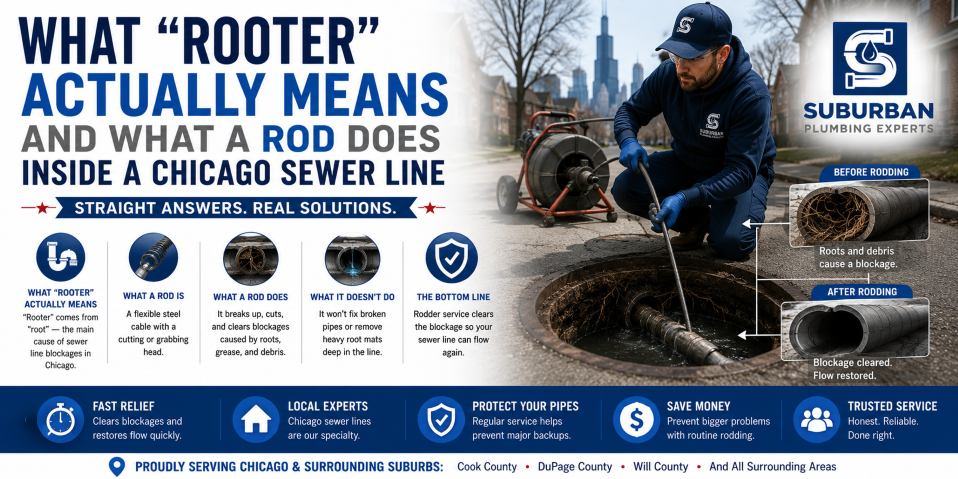
“Rooter” Isn’t a Brand — It’s a Century-Old Term for a Specific Mechanical Process, and What’s Safe to Run Through Your Pipe Depends Heavily on What Chicagoland Era Your Home Was Built In. A Cutting Head That’s Perfectly Safe in a 1985 Naperville PVC Lateral Can Be the Wrong Call Entirely in a 1928 Berwyn Bungalow’s Clay Tile, or a 1955 Oak Lawn Ranch’s Orangeburg. Here’s the Real Mechanics of Sewer Rodding, Matched to What’s Actually in the Ground Across Chicago and the Suburbs.
“Call a rooter service” has become one of those phrases — like “Kleenex” for tissue or “Xerox” for photocopying — that outgrew its origin and became the generic term for an entire category. The word comes from the same root as “root,” and the earliest power-rodding equipment was built specifically to cut through tree roots that had grown into sewer lines. Decades later, people throughout Chicago and the suburbs still say “rooter service” even for a clog that has nothing to do with roots at all — grease, sludge, paper buildup, or a collapsed section of pipe. The name stuck, and it’s still what most people mean when they call our sewer rodding service. But the mechanics behind it matter more here than in most parts of the country, because Chicagoland’s housing stock spans four distinct pipe-material eras — and what a technician should safely run through your line depends entirely on which one your home falls into.
At a Glance
- What “rooter” means: A generic term derived from root-cutting sewer equipment, now used broadly for power rodding and drain cleaning service in general.
- What sewer rodding actually is: A flexible steel cable with a motorized, interchangeable cutting head fed directly into the pipe to physically cut, snag, or break apart a blockage.
- What it’s genuinely good at: Tree roots, compacted paper and debris, and localized hard blockages — precision cutting at a specific point in the line.
- What it doesn’t do: Scour the full interior wall of the pipe the way hydro jetting does, or tell you what caused the clog the way a camera inspection does.
- Why it’s still the right first call for most residential clogs: It’s fast, it doesn’t require excavation, and for the majority of single-point blockages, it’s the most direct path back to normal flow.
What’s Actually on the End of the Cable
A rodding machine feeds a flexible steel cable through the pipe from an accessible point — typically an outside cleanout, a floor drain, or a roof vent — using a motorized drum that both pushes the cable forward and spins it. What’s attached to the leading end determines what the tool is actually capable of doing once it reaches the blockage:
- Root cutting heads — bladed heads designed specifically to shred root intrusion inside the pipe without damaging the pipe wall itself, the original purpose the “rooter” name comes from.
- Spear or spade heads — pointed heads built to punch through and break apart a solid, compacted blockage rather than cut it.
- Retrieval heads — hooked attachments used to snag and pull back an object lodged in the line, rather than cutting through it.
- Brush or scraper heads — used for a lighter scouring pass along the pipe wall once the main blockage has been cleared.
Choosing the right head for what’s actually in the pipe is the difference between a technician who clears the symptom and one who solves the problem. A root cutting head run through a line that’s actually blocked by a foreign object won’t retrieve anything — it’ll just spin past it. This is also why a generic store-bought drain snake, which typically has one fixed head and far less cutting power, works for a surface-level clog near a drain opening but consistently fails once the blockage is further down the line or requires actual cutting force rather than just probing.
Why What’s Actually in the Ground Changes the Whole Job
This is where rodding in Chicagoland is genuinely different from rodding in a region with more uniform infrastructure. Depending on when and where your home was built, your lateral is very likely one of four distinct materials — and each one changes what a technician should do with the cable.
- Clay tile (pre-1945, common throughout the bungalow belt — Berwyn, Cicero, Oak Park, Forest Park, and Chicago’s own Northwest and Southwest Side bungalow neighborhoods): The pipe sections themselves are usually sound after 80 to 100+ years, but the joints are the weak point — root intrusion enters almost exclusively at these joint gaps. A root cutting head is exactly the right tool here, but a technician needs to feel for the joint locations and cut cleanly rather than forcing the cable through an already-offset section, which can widen a joint separation instead of just clearing it.
- Cast iron (interior drain stacks in most homes through roughly 1980, and some Chicago two-flat and three-flat laterals): Decades of Chicago’s water chemistry corrode cast iron from the inside, narrowing the effective diameter and roughening the interior wall. A cutting head still works here, but a technician needs to run it at a more measured pace — cast iron that’s heavily corroded can have thin spots where aggressive cutting force risks perforating a wall that’s already compromised, rather than just clearing debris caught on the rough interior surface.
- Orangeburg (common in postwar ranch communities built roughly 1945 to 1972 — Oak Lawn, Evergreen Park, Hometown, Chicago Ridge, and similar-era suburbs): This is the one material where rodding requires real caution. Orangeburg was a wartime substitute material — compressed wood pulp sealed with coal tar pitch, adopted when steel and cast iron were diverted to the war effort — and it deforms under soil pressure over decades, losing its circular shape and narrowing dramatically. Running an aggressive cutting head through a badly deformed Orangeburg section can do more harm than the original clog — the pipe itself is often the actual problem, not just debris inside it. If a technician hits Orangeburg on a rodding pass and feels unusual resistance or an inconsistent bore, that’s a signal to stop and camera the line rather than force it clear.
- PVC (the standard for lateral construction since the early 1970s, dominant throughout Naperville, Orland Park, and most post-1975 suburban construction): The most forgiving material for rodding — smooth-walled, corrosion-resistant, and able to tolerate a full range of cutting heads without the same risk of compounding existing damage.
Our complete guide to Chicago’s aging sewer infrastructure by neighborhood and era breaks down exactly which material is most likely under your specific home based on when and where it was built — worth reading before a rodding appointment if you’ve never had a camera inspection, since it tells a technician what to expect before the cable ever goes in.
Why Cutting Beats Dissolving
Chemical drain cleaners work by a completely different mechanism: caustic or oxidizing chemicals that react with organic material to break it down or generate heat that melts through grease. That reaction has two consistent problems. First, it’s slow and often incomplete on anything beyond a soft, surface-level clog — a compacted mass of grease, paper, and mineral scale usually just develops a channel through the middle rather than being fully cleared, which is why the same clog tends to return within weeks. Second, the same chemical reaction that attacks the clog also attacks the pipe, particularly older cast iron and galvanized lines common throughout Chicago’s pre-1960s housing stock — repeated chemical use accelerates the exact corrosion that eventually causes a pipe to need full replacement.
A rodding cutting head does something mechanically different: it physically removes material from the pipe rather than dissolving it in place. Debris gets cut, broken up, and either pulled back out with the cable or flushed downstream in pieces small enough to pass through the system — which is also why a technician follows a rodding pass with water flow, confirming the line is actually clear rather than assuming it from the absence of resistance on the cable.
When Rodding Is the Right Call — And When It Isn’t
Rodding is the right first move for the majority of residential and light commercial clogs: tree root intrusion, a single compacted blockage, paper buildup in an older line, or a recurring slow drain that hasn’t been diagnosed yet. It reaches around bends that a rigid tool never could, it requires no excavation, and a technician can typically complete a full mainline pass in a few hours from an existing cleanout.
Where rodding reaches its limit: a pipe with heavy, widespread grease or sludge coating along the full interior wall — common in restaurant lines and older homes with decades of buildup — benefits more from hydro jetting, which uses high-pressure water to scour the entire pipe wall rather than cut a path through the center of the blockage. Our own comparison of sewer rodding versus hydro jetting breaks down exactly how to tell which situation you’re in. And when a line keeps clogging in the same spot no matter which method clears it, that’s usually a sign of a structural problem — a bellied section, an offset joint, or a partial collapse — that no amount of cutting or jetting will permanently fix. That’s the point where a sewer camera inspection stops being optional and starts being the only way to actually see what’s happening inside the pipe instead of guessing from the symptoms.
The Prevention Case: Why Scheduled Rodding Beats Reactive Rodding
Every one of the failure modes rodding fixes reactively — root intrusion, paper and debris buildup, grease accumulation — builds gradually before it ever causes a backup. A line rodded on a routine schedule, before a full blockage forms, is a fundamentally different job than an emergency call at 11 p.m. on a Saturday with sewage already backing into a basement. This is especially true for the mature, tree-lined streets throughout Chicago’s older bungalow neighborhoods and inner-ring suburbs, where clay tile and cast iron sewer laterals installed decades ago sit directly in the path of root systems from trees that have had just as many decades to grow. Root intrusion into a joint isn’t a one-time event — once roots find a water and nutrient source, they keep growing back into the same crack, which is exactly why a property with documented root intrusion history benefits from rodding on a fixed annual or biannual schedule rather than waiting for the next backup to make the decision for you.
Recent work across our service area reflects exactly this pattern: mainline rodding to clear a blockage in Country Club Hills, a sewer rodding service that restored flow in Bedford Park, a severe clog cleared in Palos Park that eliminated backflow risk, and rodding paired with camera inspection in Crestwood to both clear the immediate blockage and document the line’s condition going forward. In each case, the rodding pass solved the immediate problem — but the property owners who pair that service with a documented inspection are the ones who know whether they’re looking at a one-time event or the start of a recurring pattern.
Frequently Asked Questions
Is “rooter service” different from “drain cleaning” or “sewer rodding,” or are they the same thing?
In practice, they overlap heavily. “Drain cleaning” is the broad category — any method used to clear a blockage, including rodding, hydro jetting, and simpler tools. “Sewer rodding” and “rooter service” both specifically refer to the cable-and-cutting-head method described in this guide; “rooter” is simply the older, brand-derived term for the same process. When you call for drain cleaning service, rodding is very often the actual method a technician uses, especially as the first diagnostic and clearing pass before deciding whether a heavier method like hydro jetting is needed.
How often should a residential sewer line actually be rodded?
For a property with no history of problems, an annual mainline rodding is a reasonable preventive schedule. For a property with documented tree root intrusion or a known older clay tile or cast iron lateral, every 6 to 12 months is more realistic, since root regrowth into an existing crack happens faster than most homeowners expect. The honest answer for any specific property comes from its own service history, not a generic calendar — which is exactly why documenting each visit matters.
Can rodding damage my pipes?
Used correctly, with the right cutting head for the situation and a technician who knows how much force a given pipe material can take, rodding is a safe, non-destructive process — it’s been the standard mechanical clearing method for decades precisely because it works around bends and through cast iron, clay tile, and PVC without harming sound pipe. The risk isn’t the tool; it’s using the wrong head for the situation, or continuing to force a cable through a line that’s actually structurally compromised rather than simply clogged — which is why a technician who hits unexpected resistance should stop and investigate rather than push harder.
My home is in Oak Lawn and was built in the 1950s. Is rodding even safe for my pipe?
It depends entirely on what’s actually in the ground, which for a 1950s Oak Lawn home is very possibly Orangeburg — a fiber pipe material used heavily during that construction era that deforms under decades of soil pressure. Rodding is still often the right first move, but a technician should proceed carefully and stop to recommend a camera inspection if the cable meets unusual resistance or an inconsistent bore, rather than forcing an aggressive cutting head through a pipe that may already be structurally compromised. If you’ve never had a camera inspection and don’t know your pipe material, that’s worth finding out before your next service call, not during an emergency one.
My drain keeps clogging in the same spot every few months even after rodding. What does that mean?
It usually means the rodding is clearing the symptom without addressing a structural cause — a bellied section holding standing water and collecting debris, a root system that’s regrown into the same joint, or an offset pipe connection that catches material passing through. At that point, a camera inspection is the only way to actually see what’s causing the repeat clog instead of paying for the same reactive service every few months.
Sewer Rodding & Drain Cleaning Across Chicago and the Suburbs
Licensed, insured, and serving the region since 1978. Every truck carries both cable rodding equipment and hydro jetting capability, because the right tool depends on what’s actually in the pipe — not what’s fastest to set up. If a camera inspection is what a recurring clog actually needs, we do that too, in the same visit whenever possible. Emergency line answered 24 hours a day.
Emergency: 708-518-7765 | Chicago: 773-570-2191 | Suburbs: 708-801-6530 | Open 24/7
—
Suburban Plumbing Sewer Line & Drain Cleaning Experts
Licensed & Insured | Open 24 Hours | Serving Chicago & the Suburbs Since 1978
📞 Chicago: 773-570-2191 | 📞 Suburbs: 708-801-6530 |🚨 Emergency: 708-518-7765