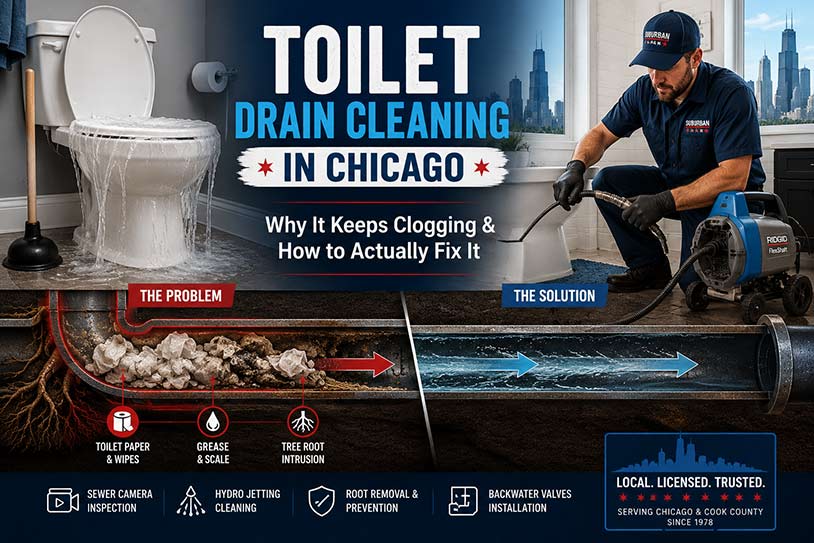
The Chicago-Specific Guide That Explains What’s Really Happening in Your Toilet Drain — and Why a Plunger Is Only Solving Half the Problem
Every Chicago homeowner has dealt with a clogged toilet. Most have plunged it, watched it clear, and moved on — assuming the problem was solved. But if the same toilet clogs again three weeks later, or if the plunger stops working as well as it used to, or if multiple toilets in the house are sluggish at the same time, something else is happening. Something the plunger never reached.
Chicago’s specific housing stock, water supply, and sewer infrastructure create toilet drain conditions that are genuinely different from other markets — and understanding those conditions is the difference between solving a toilet clog and managing one indefinitely. This guide explains exactly what causes toilet drain problems in Chicago and the suburbs, what the difference is between a toilet clog and a sewer line problem, when a plunger is the right answer and when it isn’t, and what a licensed plumber actually does when your toilet won’t clear.
At a Glance: Toilet Drain Cleaning in Chicago
Most common cause of a single slow toilet: mineral buildup in the rim jets from Chicago’s hard water, or a partial blockage in the toilet trap from non-flushable materials.
Most common cause of multiple slow toilets: root intrusion or debris accumulation in the main sewer lateral — a main line problem, not a toilet problem.
What works for a simple toilet clog: a properly used flange plunger or a toilet auger. Chemical drain cleaners do not work on toilet clogs and damage older pipe materials.
What doesn’t work: cup plungers (wrong shape for toilets), chemical cleaners, repeated plunging of a clog that won’t clear — these indicate a problem deeper than the toilet trap.
When to call a plumber: the toilet won’t clear after two attempts with a proper plunger, other fixtures are slow simultaneously, you hear gurgling from other drains when you flush, or the toilet has been partially blocked for more than a week.
What professional toilet drain cleaning costs in Chicago in 2026: $150 to $350 for a standard toilet auger service. $350 to $600 if the issue requires main line rodding. $200 to $400 for a sewer camera inspection if the cause isn’t clear.
Why Chicago’s Water Creates Toilet Problems That Other Cities Don’t Have
Before we talk about clogs, we need to talk about Chicago’s water — because it’s the invisible contributor to toilet drain problems that most homeowners never connect to the symptoms they’re experiencing.
Chicago’s municipal water supply is sourced from Lake Michigan and treated by the Chicago Department of Water Management at two filtration plants. It’s clean, safe, and meets all federal standards. It is also significantly hard — containing elevated levels of dissolved calcium and magnesium that leave mineral deposits on every surface the water contacts.
In your toilet, those mineral deposits accumulate in two critical locations:
The rim jets — the small holes around the underside of the toilet rim that direct water into the bowl during flushing. In Chicago’s hard water environment, calcium deposits gradually block these holes, reducing the force of the flush. A toilet that flushed powerfully when it was new and now seems weak or slow is almost always suffering from partially blocked rim jets rather than any problem in the drain. The toilet isn’t clogged — it’s not getting enough flush force to clear waste effectively.
The siphon jet — the larger hole at the bottom of the toilet bowl that initiates the siphon action that pulls waste into the trap. Calcium buildup at the siphon jet reduces its effectiveness, which means waste that should be pulled completely through the trap during flushing may only be partially cleared — leaving material in the trap that accumulates with each subsequent flush until a blockage develops.
The fix for rim jet and siphon jet buildup is mineral acid treatment — typically muriatic acid or a specialized toilet bowl cleaner with adequate acid concentration — applied directly to the affected areas to dissolve calcium deposits. This is not a drain cleaning service in the traditional sense. It’s a fixture maintenance service that restores flush performance without touching the drain at all. In Chicago homes where the toilet hasn’t been maintained against hard water mineral buildup, this single service often resolves slow-flush problems that have been developing for years.
The Five Things Chicago Homeowners Flush That Cause the Most Toilet Clogs
The Metropolitan Water Reclamation District of Greater Chicago — which manages wastewater treatment for Cook County and processes everything that goes down your toilet — is direct on this point: please do not flush anything other than toilet paper to avoid any potential problems. The MWRD manages over a billion gallons of wastewater daily and has documented exactly what creates blockages throughout the Cook County sewer system. Their list of items that should never be flushed includes:
“Flushable” wipes. This is the number one cause of recurring toilet clogs in Chicago homes — and it’s the one most homeowners are most reluctant to believe, because the packaging says flushable. The MWRD is unambiguous: wipes do not break down in water the way toilet paper does. They pass through the toilet and may even clear the immediate trap — but they accumulate downstream, catching at root intrusion points, at bends in older cast iron drain lines, and at partial restrictions in aging clay tile laterals. A household that uses flushable wipes regularly in a Chicago home with original 1950s plumbing is building a blockage with every flush. The plumber who clears it doesn’t solve the problem — the next load of wipes starts building the next one.
Paper towels. Paper towels are engineered to be durable in water — they’re designed to not fall apart when wet. That durability is exactly what makes them a toilet clog waiting to happen. A single paper towel flushed down a toilet with an aging cast iron trap can catch and hold everything that follows it until the pipe is packed.
Feminine hygiene products. These expand significantly when wet and are completely non-degradable in a drain system. They’re among the most common foreign object finds when a plumber augers a completely blocked toilet.
Excessive toilet paper in a single flush. This is a real issue in Chicago’s older housing stock where the original 3-inch or 3.5-inch drain connections have narrowed with decades of scale buildup. A toilet that handles normal use fine but blocks when someone uses a large amount of paper is a toilet with a restricted drain — the paper isn’t the root cause, the restriction is.
Cotton products, dental floss, and similar items. Cotton balls, cotton swabs, dental floss, and similar bathroom products are consistently non-degradable in drain systems. Dental floss in particular creates a net-like structure in drain lines that catches and holds everything else.
The Critical Difference: Is It Your Toilet or Your Main Line?
This is the most important diagnostic question for any Chicago homeowner dealing with a toilet problem — and it’s the one that determines whether the right solution costs $150 or $1,500.
It’s almost certainly your toilet if:
- Only one toilet is affected and all other fixtures drain normally
- The toilet has been partially slow for weeks or months, gradually getting worse
- The toilet produces a complete flush but leaves residue or requires double-flushing
- The problem developed after a known incident — a child’s toy went in, too much paper was flushed, the toilet was unused for an extended period
It’s almost certainly your main sewer line if:
- Multiple toilets are slow or backing up simultaneously
- The toilet gurgles when you run water in the sink or bathtub
- The basement floor drain gurgles or backs up when you flush the toilet upstairs — this is the most definitive indicator of a main line restriction, where the partial blockage downstream is displacing air back through the lowest fixture
- The problem affects every toilet in the house equally
- The toilet backs up during or after heavy rain specifically — this indicates a sewer surcharge condition in Chicago’s combined sewer system, not a toilet or even a lateral blockage
If water also starts rising through the shower or tub drain, see our guide on why showers overflow and how sewer backups can cause it.
Treating a main line problem at the toilet level is the most expensive mistake in residential plumbing diagnostics. A plumber who augers the toilet, clears it, charges for the service, and leaves without assessing the main line has treated the symptom. When the main line restriction creates the next backup — days or weeks later — the homeowner pays again. Our drain cleaning and sewer rodding services assess both the toilet and the main line before recommending any specific service — because knowing which problem you have determines which solution is worth paying for.
Why Chicago’s Housing Stock Creates Specific Toilet Drain Challenges
The plumbing in Chicago’s older housing stock creates toilet drain conditions that national statistics and generic plumbing guides completely ignore. Here’s what’s actually happening in the pipes of Chicago’s bungalows, two-flats, and ranches:
Original cast iron toilet connections in pre-1970 homes. The drain connections from toilet flanges to horizontal drain runs in Chicago homes built before 1970 are almost universally original cast iron — 50 to 70 years old in a hard water environment. Cast iron corrodes from the inside over time, and in Chicago’s specific water chemistry, the corrosion scale that accumulates on interior pipe walls creates a surface that catches and holds debris aggressively. A toilet connected to a 1958 cast iron horizontal drain run is not draining through smooth pipe. It’s draining through a rough, narrowed interior that makes every piece of non-toilet-paper material much more likely to catch and accumulate. If you’re dealing with older cast iron throughout the home, see our guide to whether cast iron pipes need to be replaced in Chicago and what homeowners should look for before assuming full replacement is necessary.
3-inch drain connections in older homes. Modern toilet installations use 4-inch drain connections as standard. Many Chicago homes built before 1960 have 3-inch or 3.5-inch horizontal drain runs from the toilet to the stack — connections that were adequate for the toilet paper of the era but are meaningfully more prone to blockage with modern toilet paper formulations and the additional materials that contemporary households introduce to the drain system.
Drum traps in original bathrooms. Many Chicago bungalows and two-flats built before 1950 still have their original drum traps — cylindrical trap devices set into the floor near the bathtub that were standard plumbing practice in the early 20th century but have been prohibited in new construction for decades. Drum traps don’t create toilet blockages directly, but they indicate the presence of original plumbing that is almost certainly original cast iron throughout — and a plumber working on a toilet in a home with drum traps is working in a building where the full drain system is aging infrastructure.
Two-flat and three-flat shared drain stacks. In Chicago’s multi-unit buildings, multiple toilets from different units share a common vertical drain stack before connecting to the main lateral. A blockage in the stack below the toilet connection — but above the connection of the lower unit’s toilet — affects the upper unit’s toilet while the lower unit’s drains normally. This creates an apparent toilet problem in the upper unit that is actually a stack problem — one that requires access at the stack cleanout rather than the toilet itself.
The Right Tools for Toilet Drain Cleaning — What Works and What Doesn’t
The flange plunger (the right tool). Most homeowners own the wrong type of plunger. A cup plunger — the standard red rubber dome on a stick — is designed for flat surfaces like sink drains. A toilet requires a flange plunger — one with an extended rubber flap that fits inside the toilet drain opening to create a seal. Without that seal, plunging moves water back and forth without creating the directional pressure needed to clear a toilet trap blockage. If your plunger isn’t working, the first question is whether you have the right type.
The toilet auger (the next step). A toilet auger — also called a closet auger — is a specialized tool with a protective sleeve that prevents the cable from scratching the porcelain and a curved guide that directs the cable through the toilet trap. It extends further than a plunger can reach, allowing it to break up or retrieve blockages in the trap and immediately downstream. A toilet auger is the appropriate tool when a flange plunger doesn’t clear the blockage after two or three properly executed attempts.
Chemical drain cleaners (the wrong tool for toilets). Chemical drain cleaners — sodium hydroxide based products — are ineffective against the types of blockages that cause toilet clogs. They work on soft organic material near the surface of a drain opening. They do not work on the non-degradable materials that cause most toilet blockages — wipes, paper towels, feminine hygiene products. They also generate heat as they react, which in a toilet’s ceramic trapway can create thermal stress, and in older cast iron connections downstream can accelerate corrosion. The MWRD’s own guidance is consistent with every licensed plumber’s recommendation: skip the chemicals and use mechanical methods. This is one of several common plumbing misconceptions we see from Chicago homeowners. For more examples, see our guide to 10 plumbing myths Chicago homeowners still believe.
Professional toilet drain snake (what a plumber uses). A professional toilet drain snake — distinct from a consumer toilet auger — has a motorized drive that can clear blockages a hand-operated auger can’t reach, retrieve foreign objects from deep in the trap, and assess whether the blockage is in the toilet itself or further downstream. When a professional uses a motorized snake on a toilet and the blockage doesn’t clear, that’s diagnostic information — it means the blockage is past the toilet’s immediate drain connections and in the shared stack or main line.
When Toilet Drain Cleaning Becomes a Camera Inspection
There’s a specific scenario that comes up regularly in Chicago’s older housing stock and that every homeowner should understand: the toilet that keeps coming back.
A toilet that blocks, gets cleared with a plunger or a service call, works for two to four weeks, and then blocks again is not a toilet problem. It’s a downstream restriction problem — a point in the drain system below the toilet where debris accumulates because something is catching it. In Chicago homes, that catching point is almost always one of three things: a root intrusion point in the main lateral where root mass catches debris; a section of partially scaled cast iron where the rough interior surface accumulates material; or an offset joint in the drain stack or lateral where the pipe’s misalignment creates a step that catches everything passing through.
A plumber who keeps clearing the same toilet without investigating the downstream condition is managing a symptom. A sewer camera inspection of the drain line identifies the catching point precisely — showing exactly what’s there, where it is, and what the appropriate permanent solution is. For a toilet that has been cleared professionally three or more times in a two-year period, the camera inspection cost is always recovered in the service calls it prevents.
What Professional Toilet Drain Cleaning Actually Involves
When you call us for a toilet that won’t clear, here’s what actually happens:
Assessment before tools. We ask specific questions about the symptom pattern — how long the problem has been developing, whether other fixtures are affected, whether there’s gurgling from other drains when the toilet is flushed, whether the problem is worse at specific times. These questions take two minutes and tell us whether we’re dealing with a toilet problem or a system problem before we touch a single tool.
Toilet inspection. We inspect the rim jets and siphon jet for mineral buildup that’s reducing flush force. We check the toilet’s condition — age, visible cracks, flapper condition — to assess whether the fixture itself is contributing to the problem. We test flush volume and observe the drain pattern. For homeowners planning bathroom improvements around accessibility or long-term use, aging-in-place bathroom plumbing in Chicago can also help identify plumbing considerations before remodeling begins.
Appropriate mechanical clearing. If the blockage is in the toilet trap, we use a professional toilet auger. If the blockage is past the toilet connection and in the stack or main line, we access the appropriate cleanout and rod the relevant section. We don’t rod the main line to clear a toilet trap blockage, and we don’t auger the toilet when the problem is in the main line.
Assessment of the cleared line. After clearing, we assess whether the line is flowing normally or whether the blockage cleared into a downstream restriction that will create the next backup. If the symptom pattern or the clearing process suggests a downstream condition, we recommend a camera inspection before closing the service call.
Our drain cleaning services and hydro jetting service cover toilet drain cleaning, main line rodding, and hydro jetting throughout Chicago and all of Chicagoland — with same-day and emergency scheduling available 24 hours a day.
Chicago’s Combined Sewer System and Toilet Backups During Storms
One specific scenario that confuses Chicago homeowners and deserves its own explanation: the toilet that backs up specifically during or after heavy rainstorms.
This is not a toilet problem. This is not even a toilet drain problem. This is a combined sewer surcharge event — and understanding the difference protects you from paying for the wrong service.
Chicago’s combined sewer system routes both stormwater and sanitary sewage through the same underground pipes. During major rain events, stormwater overwhelms the system’s capacity. The excess has nowhere to go except backward — through private laterals and into basements through the lowest fixtures, which are typically basement floor drains and basement toilets. The MWRD issues Overflow Action Alerts during severe rain events — asking Chicagoland residents to delay showers and reduce water use to reduce the load on the system during peak events. This is the same system pressure that pushes sewage backward into connected basements.
A toilet that backs up only during storms and functions normally in dry weather has a combined sewer surcharge problem. The right solution is a backwater valve or overhead sewer conversion — not a drain cleaning service. Read our complete flood control cost guide to understand what protection options are available and what they cost.
What Your Toilet Drain Is Telling You — A Symptom Guide
Toilet flushes but drains slowly, leaving water in the bowl longer than usual. Check the rim jets first — hold a mirror under the rim and look for blocked holes. If the jets are clear, the issue is a partial restriction in the trap or immediately downstream. A toilet auger is the next step.
Toilet requires double-flushing to clear waste completely. Almost always a flush force problem from blocked rim jets or a weak flapper that doesn’t stay open long enough to deliver a full flush. Mineral cleaning and flapper replacement before any drain service.
Toilet gurgles after you flush but drains. The gurgling indicates air being displaced as water moves through a partially restricted section of drain. The restriction is downstream of the toilet — in the stack or main line. A camera inspection identifies the location.
Toilet gurgles or backs up when you run the washing machine or dishwasher. This is a main line symptom. Water from laundry or dishwasher discharge is filling a partial main line restriction and displacing air (or sewage) back through the toilet — the lowest connected fixture. Main line rodding or camera inspection is the appropriate response.
Toilet backs up completely and won’t drain at all. A foreign object or dense non-flushable blockage fully occluding the trap or immediately downstream. A professional toilet auger will retrieve or break up the blockage in most cases. If the auger passes without resistance and the toilet still doesn’t drain, the blockage is further downstream and main line access is required.
Multiple toilets back up simultaneously. Main line blockage — virtually always. Every toilet in the house connects to the same lateral before the city main. When that lateral is blocked, every toilet above the blockage is affected at the same time.
Frequently Asked Questions: Toilet Drain Cleaning in Chicago
How much does toilet drain cleaning cost in Chicago in 2026?
A standard toilet auger service in the Chicago area runs $150 to $350 for a single toilet. If the issue requires main line rodding rather than toilet-level clearing, expect $350 to $600 depending on the length of the run and access conditions. A sewer camera inspection — recommended when the same toilet has blocked multiple times — runs $200 to $400 and produces video documentation of exactly what’s downstream.
Why does my toilet keep clogging even though I only flush toilet paper?
Recurring toilet clogs with only toilet paper being flushed indicate one of three conditions: reduced flush force from blocked rim jets (a mineral buildup issue, not a drain issue); a partial restriction downstream from scale buildup in aging cast iron drain connections; or a main line condition — root intrusion, pipe belly, or offset joint — that catches even toilet paper before it reaches the city main. A camera inspection of the drain line identifies which condition is causing the pattern.
Can I use Drano or similar products to clear a toilet clog?
No — not effectively and not safely for older pipe materials. Chemical drain cleaners don’t work on the non-degradable materials that cause most toilet clogs, and the heat they generate can stress ceramic toilet components and accelerate corrosion in aging cast iron drain connections common in Chicago’s older housing stock. A toilet auger used correctly is faster, safer, and more effective than any chemical product.
My toilet gurgles when I run the sink. Is that a toilet problem?
No — it’s a drain system problem downstream of both fixtures. The gurgling indicates a partial restriction in a shared drain connection that is displacing air back through the toilet when the sink adds volume to the system. A camera inspection of the horizontal drain run connecting both fixtures to the stack — or of the stack itself — identifies the specific restriction.
How do I know if my toilet problem is actually a sewer line problem?
The most reliable indicator is whether multiple fixtures are affected. If only the toilet is slow and every other fixture in the house drains normally, the problem is at or near the toilet. If the toilet backs up when you run the washing machine, if the basement floor drain gurgles when you flush, or if multiple toilets are slow simultaneously — you have a main line condition that needs main line service. Read our complete guide to drain cleaning in Chicago — what actually works for the full breakdown of how to identify your specific drain problem type before calling anyone.
Are flushable wipes really causing toilet clogs?
Yes — and not just at the toilet level. The MWRD, which manages wastewater treatment for Cook County, is explicit: flushable wipes do not break down in pipes and should not be flushed. In Chicago homes with aging clay tile laterals and root intrusion, wipes accumulate at the root mass and create dense blockages that rodding clears temporarily — with the next load of wipes beginning to rebuild the blockage immediately. Eliminating flushable wipes is frequently the single most effective change a Chicago homeowner can make to reduce drain service frequency.
Toilet Won’t Clear? We Can Help.
We diagnose before we drill — assessing whether the problem is in the toilet, the stack, or the main line before recommending any service. Same-day and emergency scheduling available 24/7 across Chicago and all of Chicagoland. Send us a message and we’ll get back to you fast.
Or call us directly: 708-801-6530 | Open 24/7
—
Suburban Plumbing Sewer Line & Drain Cleaning Experts
Licensed & Insured | Open 24 Hours | Serving Chicago & the Suburbs Since 1978
📞 Suburbs: 708-801-6530
📞 West Suburbs: 630-749-9057
📞 Chicago: 773-570-2191
🚨 24/7 Emergency Line: 708-518-7765