
The Complete Guide for Chicago Homeowners Who Are Done Swatting Tiny Fuzzy Flies and Want to Actually Solve the Problem
You’ve seen them. Small, fuzzy, moth-like insects hovering near the bathroom sink. Clustered on the shower wall. Appearing every morning on the mirror over the vanity. Or worse — rising from the basement floor drain in the evening like a small biblical plague.
You’ve killed dozens of them. They come back. You’ve poured bleach down the drain. They come back. You’ve sprayed the bathroom. They come back. You’ve Googled “tiny flies in my bathroom” and gotten seventeen different answers — fruit flies, fungus gnats, drain flies, phorid flies — and you’re not sure which one you have, where they’re actually coming from, or why nothing you’ve tried has worked.
Here’s the honest answer: nothing you’ve tried has worked because you’ve been treating the adult flies rather than eliminating the breeding site. Killing adult drain flies is exactly as effective as bailing water out of a bathtub with the faucet running. You can keep bailing indefinitely, or you can turn off the faucet. The drain — or more precisely, the organic material inside the drain — is the faucet. Until that’s gone, the flies keep coming.
This guide covers everything: what drain flies actually are, why Chicago homes are particularly vulnerable, how to tell them apart from other small flies you might be confusing them with, exactly how to find every breeding site in your home, what actually eliminates them permanently, when DIY approaches fail and professional drain cleaning is the only solution, and what Chicago-specific factors make this problem more persistent here than in most American cities.
What Drain Flies Actually Are — The Biology You Need to Know to Beat Them
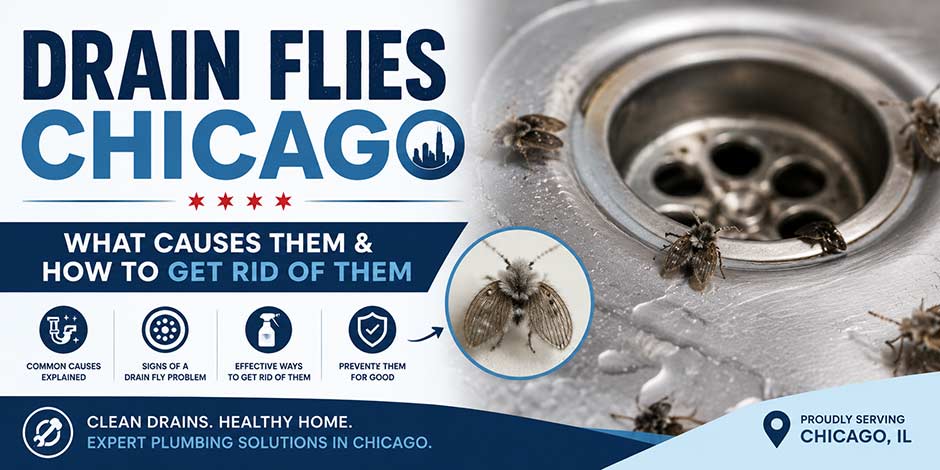
Before you can eliminate drain flies permanently, you need to understand what you’re dealing with. Drain flies — also called moth flies, sewer flies, or filter flies — are members of the family Psychodidae. They are not related to fruit flies, fungus gnats, or common houseflies, and they respond to completely different elimination approaches.
According to the UC IPM Program’s research on moth flies, adult drain flies are small — approximately 1/6 to 1/5 of an inch — with fuzzy, moth-like bodies covered in tiny hairs. They hold their wings roof-like over their bodies at rest, which is the most reliable visual identification feature. They are weak, erratic fliers that travel only a few feet at a time. They are most active in the evening — which is why you often notice them at night near bathroom lights. They do not bite.
The adult fly is not your problem. The adult fly is the symptom.
Your problem is the larva — and where it’s living.
The Lifecycle That Explains Everything
According to the Ohio State University Extension’s drain fly fact sheet, female drain flies lay egg masses of 10 to 200 eggs directly in or on the gelatinous organic biofilm — the slime layer — that accumulates on the interior walls of drain pipes. In warm conditions, those eggs hatch in as little as 32 to 48 hours. The larvae — pale, legless, approximately 3/8 of an inch long — then feed on the biofilm itself: the bacteria, fungi, algae, grease deposits, hair, soap scum, and organic matter that accumulates in drain pipes over time. Larvae mature in 9 to 15 days, pupate, and emerge as adult flies within 20 to 40 hours of pupation.
The entire lifecycle from egg to adult can complete in as little as 8 to 24 days depending on temperature.
Here’s why this matters for your elimination strategy: at any given moment, your drain isn’t just hosting adult flies — it’s hosting eggs, larvae, and pupae at various stages of development, all inside the biofilm on the pipe walls. Killing the adults you see removes one stage of a four-stage lifecycle that the drain continues to sustain. A week after you kill the adults, the larvae that were already in the drain emerge as a new generation of adults. Two weeks after that, another generation. This cycle continues indefinitely as long as the breeding material — the organic biofilm — exists inside the drain.
This is why every approach that targets adult flies — sprays, swatters, fly traps — provides temporary visual relief but doesn’t solve the problem. You’re removing flies from a functioning breeding facility without shutting down the facility.
Why Chicago Homes Are Particularly Prone to Drain Flies
Drain flies exist in homes across America, but Chicago homes create conditions that are specifically conducive to severe and persistent infestations. Understanding these Chicago-specific factors explains why the problem is so common here and why elimination is harder than in newer construction markets.
Aging Cast Iron Drain Pipes
Chicago’s pre-1970 housing stock — the bungalows, two-flats, greystones, and ranches that define most of the city and inner-ring suburbs — has original cast iron drain lines that are now 50 to 80 years old. Cast iron that has corroded internally develops a rough, pitted interior surface that accumulates biofilm significantly faster than smooth PVC pipe. The rough surface acts as an anchor for the gelatinous organic layer that drain fly larvae need to survive — more surface texture means more biofilm, which means a more stable and extensive breeding environment.
A smooth PVC drain pipe that has been in service for 5 years has a thin, relatively easy-to-disrupt biofilm. A cast iron drain pipe that has been in service for 60 years in a Chicago bungalow may have a thick, layered biofilm that has been building since before the current homeowners were born. Standard drain cleaning methods that would disrupt the biofilm in a newer pipe may only partially address it in decades-old cast iron.
Hard Water Mineral Deposits Create Additional Biofilm Anchoring
Chicago’s municipal water — averaging 130 to 150 parts per million of dissolved minerals — deposits calcium and magnesium scale on drain pipe walls. This mineral scale creates an additional rough texture on already-corroded cast iron surfaces, providing even more surface area for biofilm to anchor. The combination of cast iron corrosion and mineral scale creates optimal drain fly habitat that is significantly more resistant to disruption than the interior of a newer, smooth pipe.
FOG Accumulation From Chicago’s Food Culture
Fats, oils, and grease from Chicago’s heavy, fat-intensive cooking culture contribute significantly to the organic biofilm that drain fly larvae feed on. Kitchen drain pipes in older Chicago homes accumulate years of grease deposits that form the ideal growth medium for the bacteria, fungi, and organic material that make up the drain fly’s food source. A kitchen drain pipe that hasn’t been professionally cleaned in years isn’t just clogged — it’s a functioning ecosystem that actively supports drain fly reproduction.
The Combined Sewer System and Basement Floor Drains
In Chicago and many inner-ring suburbs, basement floor drains connect to the combined sewer system. During periods of warm, humid weather — exactly when drain fly populations peak — the city’s sewer system can create conditions where the biofilm environment in floor drains is particularly rich and moist. A basement floor drain that isn’t regularly used maintains a static environment with minimal water flow — exactly the standing, moist, organic-rich conditions that drain fly larvae require.
How to Tell Drain Flies Apart From Other Small Flies
Before committing to a drain fly elimination strategy, it’s worth confirming that you’re actually dealing with drain flies rather than one of the other small flies that appear in similar locations. Each type requires a different approach.
Drain Flies vs Fruit Flies
Drain flies are fuzzy and moth-like — their bodies and wings are visibly hairy, giving them a distinctly fluffy appearance. They hover near drains, rest on walls and bathroom fixtures, and are most active in the evening. Their movement is slow and erratic — short, hesitating hops rather than sustained flight.
Fruit flies are smaller, smoother, and have distinctly red eyes visible under magnification. They hover near overripe fruit, open wine bottles, the compost bin, or any fermenting organic material. Their movement is faster and more direct than drain flies. If you’re seeing flies near your fruit bowl or recycling rather than near drains, you likely have fruit flies.
The quick test: Set a glass of red wine or apple cider vinegar on the counter near where the flies appear. Fruit flies are strongly attracted to fermenting liquid and will investigate within minutes. Drain flies are not attracted to it and will ignore it. If you get fruit flies in the glass, you have fruit flies. If the glass attracts nothing, you have drain flies.
Drain Flies vs Fungus Gnats
Fungus gnats are tiny, thin-bodied insects that breed in the moist soil of houseplants. They look like tiny mosquitoes — long, thin legs, thin body, and a distinctive long-legged hovering flight pattern. They’re commonly seen hovering near potted plants or crawling across soil surfaces. They are not fuzzy.
Drain flies are noticeably fuzzier and rounder in body shape, hover near drains rather than plants, and rest with wings held flat over their bodies rather than dangling their legs when hovering.
If your flies are hovering near houseplants rather than drains, fungus gnats are the likely culprit and the breeding site is in the potting soil rather than the drain.
Drain Flies vs Phorid Flies (Scuttle Flies)
Phorid flies are smooth, humpbacked, and move with a distinctive scuttling run across surfaces rather than flying. They breed in a wide range of organic material and can indicate drain issues but also indicate dead organic material elsewhere — inside a wall, under a floor, or in a void space. If you’re seeing flies that run across surfaces rather than hover, and the infestation appeared suddenly and doesn’t seem to respond to drain treatment, a pest control inspection is warranted.
Finding Every Breeding Site in Your Chicago Home
The most critical step in eliminating drain flies is finding every breeding site — not just the obvious ones. A treatment plan that misses even one breeding location will produce a new generation of flies within 2 to 3 weeks, making it appear that treatment failed when it actually succeeded at every treated location but missed one.
The Tape Test — The Most Reliable Breeding Site Identification Method
Before treating any drain, confirm it’s an active breeding site using the tape test. Place a piece of clear sticky tape over the drain opening — sticky side down — and leave it for 24 to 48 hours. Adults emerging from the drain will be caught on the tape. Any drain that produces flies on the tape is an active breeding site. Any drain that produces nothing is not actively breeding and doesn’t need treatment.
The tape test prevents over-treating drains that aren’t contributing to the infestation while ensuring every active site is identified.
Every Location Drain Flies Can Breed in a Chicago Home
Bathroom sink drain. The most commonly identified breeding site because adults rest near the sink and are visibly associated with the drain. The organic biofilm on the drain arm, P-trap walls, and pop-up pivot rod provides excellent breeding conditions.
Shower drain. Often the densest breeding site in a Chicago home because shower drains accumulate the highest volume of organic material — hair, soap scum, shampoo and conditioner residue, body oil — in the most consistently moist environment. In older Chicago homes with cast iron shower drain arms, the biofilm layer can be substantial.
Bathtub drain. Similar conditions to the shower drain. The overflow drain — the opening near the top of the tub front — is a frequently overlooked breeding site. The pipe behind the overflow cover accumulates organic material and creates a consistently moist, relatively undisturbed environment that is ideal for drain fly development.
Kitchen sink drain. In Chicago homes with grease accumulation in the kitchen drain branch, the kitchen drain can be a productive breeding site — particularly if the drain has slow drainage that allows water to stand in the pipe rather than flushing through cleanly.
Basement floor drain. One of the most commonly overlooked breeding sites and one of the most important to check, particularly in Chicago homes. A basement floor drain that isn’t regularly used maintains standing water in the P-trap, accumulates biofilm from infrequent flushing, and creates exactly the static, moist, organic-rich conditions that drain flies prefer. In many Chicago homes, basement floor drains are the primary breeding site for an infestation that presents in the upper floors.
Laundry drain/standpipe. Laundry drains accumulate lint, detergent residue, and fabric softener deposits over time. The standpipe — the vertical pipe that receives the washing machine drain hose — can accumulate biofilm on its interior walls. Often overlooked in drain fly investigations.
Sump pit. In Chicago homes where the sump pit accumulates organic material — leaf debris, soil particles, biological growth — it can support drain fly breeding. Less common than drain pipes but worth checking if all pipes have been treated and flies persist.
Under-sink areas with condensation or slow leaks. Any area under a sink where moisture has accumulated and organic material is present — mold growth, damp wood, or leaking plumbing connections — can potentially support drain fly activity. If you’re noticing mold or black or pink buildup around a sink drain, the problem may also involve organic material and biofilm inside the drain itself. Our guide to mold in sink drains explains what causes this buildup, why it keeps coming back, and why cleaning only the visible area may not solve the problem. If you’ve had a slow under-sink leak that you’ve repaired, the damp material left behind may be a secondary breeding site.
Seldom-used toilets. The water seal in a toilet bowl P-trap prevents this in actively used toilets, but in a guest bathroom or basement bathroom that sits unused for weeks at a time, the toilet’s P-trap water seal can develop sufficient biofilm to support limited drain fly activity.
Why DIY Methods Fail — and What Actually Works
Most homeowners who are battling a persistent drain fly infestation have already tried several approaches that haven’t worked. Understanding why each one fails helps you avoid wasting more time and money on ineffective treatments.
Why Bleach Doesn’t Work
Pouring bleach down a drain feels satisfying and smells like it should be killing everything in the pipe. It isn’t. Bleach is a surface disinfectant — it kills microorganisms on contact but doesn’t penetrate or remove the organic biofilm coating the drain pipe walls. The bleach rinses through the drain with the water and exits the pipe. The biofilm — with its embedded eggs, larvae, and the organic material that sustains them — remains on the pipe walls largely undisturbed. A new generation of adults emerges within two weeks.
Why Drain Gels and Enzyme Treatments Provide Limited Results
Enzyme-based drain treatments work by introducing biological enzymes that break down organic material over time. They are more effective than bleach because they actually target the biofilm rather than just disinfecting the surface. However, their penetration into thick, established biofilm in Chicago’s older cast iron drain pipes is limited. They are most effective as a preventive maintenance tool in pipes that have already been professionally cleaned — not as a primary treatment for a serious infestation with extensive biofilm accumulation.
Why Boiling Water Doesn’t Work
Boiling water kills organisms on contact but rinses through the pipe within seconds. The biofilm on the pipe walls is not dislodged by the brief thermal exposure, and the drain pipe returns to ambient temperature within minutes of treatment. Larvae in the deeper layers of the biofilm are largely unaffected.
Why Fly Traps and Sprays Don’t Solve the Problem
Traps and sprays kill adult flies. Adults represent one of four lifecycle stages. The eggs, larvae, and pupae in the drain are unaffected and continue developing. Within 8 to 24 days of eliminating the adults, a new generation emerges. Traps and sprays are useful for monitoring (they help you track which drains are producing flies) but are not elimination tools.
What Actually Works: The Three-Step Elimination Process
Step 1: Locate every active breeding site using the tape test. As described above — tape every suspect drain for 24 to 48 hours before treatment to confirm which drains are actively producing flies. Treat every drain that tests positive.
Step 2: Physically remove the biofilm from every breeding site. This is the critical step that most DIY approaches skip. The organic biofilm must be physically removed from the drain pipe walls — not killed on the surface, not broken down over time, but removed. If you’re still dealing with recurring drain pests even after cleaning, our guide on how to kill those pesky gnats in your drains for good walks through the exact elimination process homeowners use when DIY methods keep failing. The method depends on the drain type and the extent of accumulation:
For bathroom sink drains: Remove the pop-up stopper and clean the pivot rod thoroughly. Then physically clean the drain arm with a long-handled brush — a flexible bottle brush or specialized drain brush — scrubbing the interior pipe walls down to the clean metal. This physical scrubbing disrupts and removes the biofilm from the accessible portion of the drain.
For shower and tub drains: Remove the drain cover and clean the accessible portion of the drain with a stiff brush. For drains with significant accumulation below the accessible section, professional rodding or hydro jetting is necessary.
For kitchen drains, basement floor drains, and laundry drains where the accumulation extends beyond what surface tools can reach: Professional drain cleaning is required. Our drain cleaning services address the full drain pipe — not just the opening — using equipment that reaches every section of the line.
Step 3: Flush thoroughly and repeat. After physical cleaning, flush the drain with hot water for several minutes to remove dislodged material. Repeat the tape test 5 to 7 days later to confirm no adults are emerging. If flies continue to emerge, the biofilm removal was incomplete and either deeper cleaning is needed or an additional breeding site hasn’t been identified.
When Professional Drain Cleaning Is the Only Solution
For many Chicago homeowners — particularly those in pre-1970 homes with cast iron drain lines — DIY biofilm removal addresses the accessible portions of drain pipes but doesn’t reach the accumulation deeper in the system. A drain brush might clean the first 6 to 12 inches of a drain arm, but the branch line running through the wall behind it may have significant biofilm extending further than any surface tool can reach.
Professional drain cleaning eliminates drain fly breeding conditions by addressing the entire drain line — not just the accessible opening. The method depends on the extent and nature of the accumulation:
Professional drain rodding mechanically breaks through and displaces the biofilm accumulation, restoring flow and disrupting the breeding environment throughout the accessible drain line. Appropriate for moderate accumulation and drain fly infestations that haven’t responded to surface-level DIY cleaning.
Hydro jetting uses high-pressure water at up to 4,000 PSI to scour the drain pipe walls completely clean — removing biofilm, grease deposits, and the gelatinous organic layer that drain flies require for breeding. The result is a pipe interior returned to near-original condition with no breeding substrate remaining. Our hydro jetting service is the most thorough available solution for drain fly elimination in Chicago’s older housing stock — particularly for cast iron drain lines with thick, established biofilm that surface tools and standard rodding can’t fully address.
Sewer camera inspection before treatment confirms the extent and location of biofilm accumulation and identifies any structural issues — pipe belly, root intrusion, partial collapse — that might be contributing to standing water conditions that support drain fly development.
The professional service call that completely eliminates drain fly breeding conditions in a Chicago home’s drain system is consistently less expensive than months of repeated enzyme treatments, fly trap purchases, and pest control visits that treat symptoms rather than causes.
Chicago-Specific Drain Fly Hotspots: Where We Find Them Most Often
Based on service calls throughout the Chicago and Chicagoland area, here are the situations and locations where drain fly infestations are most severe and most persistent:
Pre-1960 bungalows with original cast iron drain systems. These homes have decades of accumulated biofilm in rough-surfaced cast iron drain arms and branch lines. The combination of thick biofilm, mineral scale deposits, and aging pipe material creates optimal drain fly habitat throughout the drain system. Hydro jetting of the full drain system is almost always the appropriate treatment.
Finished basements with bathroom additions. The ejector pump basin and the drain connections from a basement bathroom are frequently overlooked in drain fly investigations. The ejector basin — a sealed pit receiving waste from basement fixtures — can accumulate the organic material that supports drain fly development if it has any leakage at the lid seal or isn’t serviced regularly.
Homes returning from extended vacations. Drain P-traps that haven’t had water flow through them for 2 to 4 weeks develop dry seals and accumulate biofilm in static conditions — perfect for drain fly colonization. Pre-vacation drain flushing and post-vacation drain treatment is the preventive protocol for Chicago homeowners who travel regularly. For homeowners preparing their plumbing system before travel, it’s also worth understanding whether you should turn off your water heater when on vacation and how that affects overall system conditions during periods of inactivity.
Older multi-unit buildings. Two-flats and three-flats in Chicago often have shared drain stacks and branch lines serving multiple units. A drain fly infestation in one unit’s bathroom that appears to respond to treatment may recur because the shared stack serving multiple units continues to have biofilm that the treated unit’s drains reconnect to. Full stack cleaning — rather than individual unit drain cleaning — is necessary in these buildings.
Properties near Chicago’s combined sewer infrastructure. During warm, humid weather — June through September in Chicago — the temperature and moisture conditions in drain pipes connected to the combined sewer system are optimal for drain fly reproduction. Properties that have drain fly issues specifically in summer but not in winter may be experiencing seasonal population increases related to ambient temperature affecting the reproductive cycle in drain pipes that connect to the warm, moist combined sewer environment.
After Elimination: Preventing Drain Flies From Coming Back
Eliminating an existing infestation is a clean-slate moment. Keeping drain flies from reestablishing requires ongoing maintenance that disrupts biofilm formation before it reaches the density needed to support breeding.
Run water through every drain regularly. Floor drains and infrequently used fixtures should be flushed with water weekly to prevent biofilm accumulation in static conditions. This is the simplest and most effective prevention for basement floor drains specifically.
Clean pop-up assemblies monthly. The pivot rod behind bathroom sink pop-up stoppers is the most accessible biofilm accumulation point in most bathrooms. Monthly cleaning takes five minutes and prevents the organic buildup that creates drain fly breeding conditions at the most reachable point in the drain system.
Use drain strainers in showers. Catching hair before it enters the drain removes the primary organic material that anchors biofilm development in shower drains.
Schedule professional kitchen drain cleaning annually. Chicago kitchen drains accumulate grease deposits faster than most American cities due to hard water and cooking habits. Annual professional cleaning — hydro jetting for older cast iron lines — resets the biofilm accumulation level and prevents the organic buildup that supports drain fly reproduction between service intervals. For a complete breakdown of kitchen drain maintenance for Chicago homes, see our complete Chicago kitchen plumbing guide.
Use enzyme drain maintenance treatments monthly after professional cleaning. Enzyme-based drain maintenance products — used as monthly preventive treatments in professionally cleaned pipes — slow biofilm re-accumulation by continuously breaking down the organic material as it deposits. They’re not effective against an established infestation but are a reasonable preventive maintenance tool in a recently cleaned system. Follow product instructions and avoid combining with bleach, which kills the bacterial enzymes.
Address slow drains immediately. A slow drain is accumulating material faster than it’s draining — exactly the condition that supports drain fly development. A drain that’s started to slow is a drain that’s building the biofilm density needed to become a breeding site. Addressing slow drains promptly — before they become either a complete blockage or an infestation — is the best preventive investment available. For the complete guide to diagnosing slow drains throughout your home, see our full Chicago drain cleaning guide.
Drain Flies in Chicago Commercial Properties
Drain flies in commercial settings — restaurants, office buildings, retail spaces — carry implications beyond the nuisance they represent in homes. In food service establishments, drain flies present a health code exposure: as the Ohio State University Extension notes, because drain flies develop in filthy organic conditions, they carry the potential to transmit pathogens to food preparation areas. A Chicago health inspector finding drain flies in a restaurant kitchen is finding a potential violation.
Commercial kitchen floor drains and the drain lines between commercial kitchen fixtures are particularly prone to drain fly development because of the high FOG loading, the volume of organic material that passes through commercial kitchen drains, and the warm, consistently moist conditions that commercial kitchen environments maintain.
Professional hydro jetting of commercial kitchen drain lines — which is the recommended annual maintenance for Chicago restaurant drain systems regardless of drain fly activity — simultaneously addresses both the drain maintenance need and the drain fly breeding conditions. For a complete breakdown of commercial kitchen drain cleaning requirements and what Chicago’s FOG ordinance requires, see our guide to commercial drain cleaning in Chicago.
Frequently Asked Questions: Drain Flies in Chicago
I’ve been pouring bleach down my drains for two weeks and I still have drain flies. Why? Bleach doesn’t remove biofilm — it disinfects the surface it contacts and then exits the drain with the water. The biofilm containing eggs, larvae, and the organic material that sustains them remains on the pipe walls. Physical removal of the biofilm is required to eliminate the breeding site. See the three-step elimination process above.
I treated one drain and the flies stopped there but now they’re coming from somewhere else. What’s happening? You’ve correctly eliminated one breeding site, but there’s at least one other active site you haven’t identified. Run the tape test on every drain in the house simultaneously — including basement floor drains, laundry drains, and the tub overflow — to map all active locations before treating.
My drain is completely clear with no obvious buildup but flies keep coming out of it. What am I missing? The biofilm that drain flies breed in is inside the drain pipe — not at the drain opening surface. A drain that looks clean at the opening can have significant biofilm accumulation further down the drain arm or in the branch line. Camera inspection of the drain shows exactly what’s inside the pipe.
I treated all my drains, the flies stopped for two weeks, and now they’re back. Did the treatment fail? Either the biofilm removal was incomplete and the remaining biofilm has regenerated to breeding density, or there’s a breeding site you didn’t identify or treat. The two-week timeframe is consistent with a new generation emerging from larvae that survived the treatment. Repeat the tape test to identify which drain is now producing adults, and treat it more aggressively — professional cleaning rather than surface treatment.
Are drain flies dangerous to my family? Drain flies do not bite. However, the Ohio State University Extension notes that inhaling fragments and dust from dead drain flies can trigger bronchial asthma in sensitive individuals, and because they breed in organic waste material, there is potential for pathogen transmission to food surfaces if they’re present in food preparation areas. An infestation is a legitimate health concern beyond just nuisance, particularly for households with asthmatic family members.
I have drain flies only in summer. Why do they go away in winter? Drain fly reproduction accelerates in warm conditions — their 8 to 24 day lifecycle shortens significantly at higher temperatures. In winter, lower ambient temperatures in Chicago basements and less-heated spaces slow reproduction enough that populations can’t maintain themselves. The breeding conditions (biofilm) still exist in winter — the flies just can’t reproduce fast enough to maintain a visible population. Each summer, the population rebuilds from whatever biological material survived the winter in the drain. This pattern indicates a persistent breeding site that needs to be addressed rather than a seasonal problem that resolves on its own.
Should I call a pest control company or a plumber? For drain flies specifically — a plumber. Pest control companies treat adult insects. Drain flies require biofilm removal from drain pipes — which is drain cleaning work, not pest control work. A pest control treatment that kills adult drain flies while leaving the biofilm intact will provide 2 to 3 weeks of apparent success followed by a new infestation from the next generation emerging from the untreated breeding site. The right call for drain flies is professional drain cleaning that removes the breeding substrate.
Done Fighting Drain Flies? Let’s Eliminate the Breeding Site for Good.
Licensed, insured, and locally based in Brookfield since 1978. We professionally clean drain lines throughout Chicago and the suburbs — removing the biofilm that drain flies need to survive, not just treating the adult flies you can see. Same-day scheduling, written quotes before we start, our own licensed plumbers on every call. Send us a message and we’ll get back to you fast.
Or call us directly: 708-801-6530 | Open 24/7
—
Suburban Plumbing Sewer Line & Drain Cleaning Experts
Licensed & Insured | Open 24 Hours | Serving Chicago & Suburbs
📞 Suburbs: 708-801-6530 | 📞 Chicago: 773-570-2191 | 🚨 Emergency: 708-518-7765