
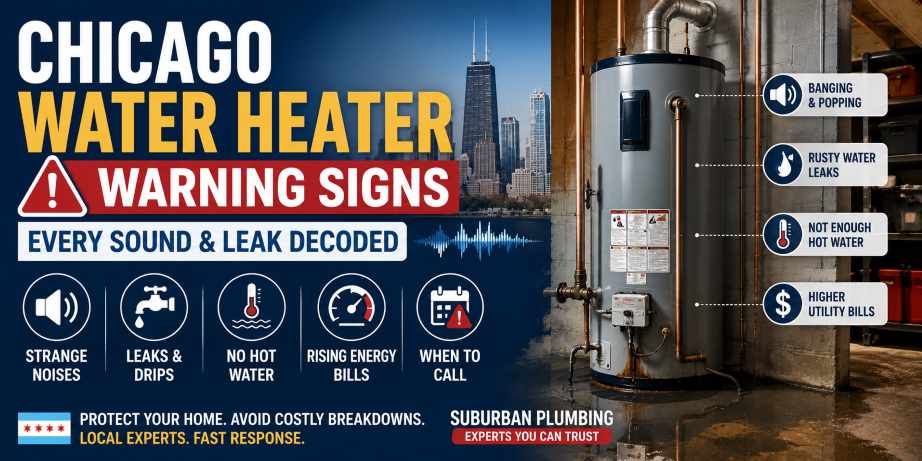
The Complete Diagnostic Guide for Chicago Homeowners Who Want Answers Before They’re Standing in a Flooded Basement at 6am
Your water heater has been trying to talk to you. Not loudly — not yet. It started months ago with a sound you wrote off as the house settling. Then a slight reduction in hot water that you assumed was normal. Then the faint smell one morning that you couldn’t quite place and decided to ignore. These aren’t random occurrences. They’re messages — a water heater communicating its condition in the only language it has: heat, sound, water, and pressure. If you’re trying to figure out whether those warning signs point to a repair or a full replacement, this guide explains it clearly: repair vs replace water heater Chicago
Most Chicago homeowners don’t learn to read those messages until the day their water heater fails completely — and by then, the basement floor is wet, the morning shower isn’t happening, and an emergency service call is the only option. The difference between a water heater that’s replaced on your schedule at a planned cost and one that fails catastrophically at the worst possible moment is almost always the difference between paying attention to the warning signs and ignoring them.
This guide teaches you to read every message your Chicago water heater sends — every sound, every leak location, every performance change, every visual indicator. What each one means, how urgently it requires attention, whether it points to repair or replacement, and what happens if you ignore it. Read it once, know it forever, and you’ll never be surprised by a water heater failure again.
Why Chicago Water Heaters Speak More Urgently Than Those in Most American Cities
Before getting into specific warning signs, it’s worth understanding why Chicago water heaters deteriorate faster than those in most comparable markets — and why the warning signs arrive sooner and escalate faster here than the manufacturer’s service life estimates suggest.
Hard Water Is Destroying Your Water Heater From the Inside
Chicago’s municipal water averages 130 to 150 parts per million of dissolved calcium and magnesium. Every gallon of water that enters your water heater carries that mineral load. When the water is heated, those dissolved minerals precipitate out of solution and settle to the bottom of the tank as sediment — calcium carbonate and magnesium deposits that accumulate layer by layer with every heating cycle, every single day. This sediment buildup is one of the primary reasons Chicago water heaters lose efficiency and develop performance issues earlier than expected — we break down exactly how and why it forms in detail here: What Causes Sediment Buildup in Your Water Heater
The U.S. Department of Energy’s water heating efficiency guidance notes that a water heater’s efficiency is measured by its Uniform Energy Factor — how effectively it converts fuel to hot water. What the efficiency label doesn’t show you is how dramatically that efficiency degrades as sediment accumulates inside a tank in hard water conditions. A water heater in Chicago that was rated at 0.67 UEF on its label may be operating significantly below that rating after three to four years of mineral accumulation without annual maintenance flushing.
The EPA’s WaterSense home maintenance program specifically recommends annual water heater flushing to reduce sediment buildup — guidance that’s more critical in Chicago’s hard water environment than anywhere with softer water.
The practical consequences: Chicago water heaters typically operate at meaningfully reduced efficiency within 3 to 5 years without maintenance, develop the characteristic sediment-related sounds earlier than units in soft-water markets, and fail 2 to 4 years before their rated service life more frequently than the national average.
The Chicago Cold Water Problem
Chicago’s cold water supply temperature drops to 35 to 42 degrees Fahrenheit in winter months — cold enough that the water entering your tank requires significantly more energy to reach the thermostat set point than summer water that enters at 65 to 72 degrees. This seasonal demand variation means your water heater works harder, runs more frequently, and cycles through more heating cycles during Chicago’s winters than the same unit would in a milder climate.
More heating cycles means more sediment precipitation. More heating cycles means more stress on the heating element or burner. More heating cycles means faster wear on the thermostat, the anode rod, and every mechanical component in the system. The brutal Chicago winter that’s hard on your pipes, your car, and your catch basins is equally hard on your water heater.
The Age Factor in Chicago’s Older Housing Stock
Chicago’s housing stock skews old — the majority of homes in the city and most inner-ring suburbs were built before 1970. While Chicago homes have their own unique plumbing challenges, homeowners in nearby suburbs can also benefit from understanding how local infrastructure, water quality, and housing age affect their plumbing systems in our Complete Plumbing Guide for Lombard, IL. Water heaters in these homes face an additional challenge: the existing gas supply lines, venting infrastructure, and installation conditions in a 1950s Chicago bungalow were designed for the standards and equipment of that era. Older flue pipes, inadequate combustion air, corroded gas lines, and decades-old installation configurations create operating conditions that shorten the service life of even new, well-maintained water heaters. For a broader breakdown of how Chicago’s residential plumbing systems work together — including supply lines, drainage, fixture behavior, and whole-home system interactions — see our complete residential plumbing guide in Chicago.
The Warning Signs: Every Message Your Water Heater Sends and What Each One Means
Part One: What Your Water Heater Is Saying Through Sound
Sound is your water heater’s most frequent communication. Different sounds indicate different conditions at different stages of urgency. Learning to distinguish between them is the foundation of proactive water heater care.
Popping, Cracking, or Rumbling During Heating Cycles
This is the most common sound complaint from Chicago homeowners — and the most diagnostic. That rhythmic popping or low rumbling you hear when the burner fires is the sound of water trapped beneath a layer of mineral sediment boiling and forcing its way through the accumulation. The sediment layer at the bottom of your tank has grown thick enough to trap water between it and the heating surface, and each heating cycle is essentially steam explosions — micro-bursts of trapped water flashing to steam and pushing through sediment.
What it means: Your tank has significant sediment accumulation. The sediment is acting as an insulating layer between the burner and the water, reducing efficiency and causing the bottom of your tank to overheat. Overheating at the tank floor accelerates corrosion, weakens the glass lining inside the tank, and shortens the remaining service life of the unit. This sound is your water heater telling you it needs maintenance immediately and may be approaching replacement consideration.
Urgency level: Moderate to high. If the water heater is less than 7 years old, professional flushing and maintenance may resolve the issue. If it’s 8 years or older, this sound combined with sediment accumulation often indicates a unit that is entering its terminal decline and should be assessed for replacement planning. Our water heater maintenance service includes thorough flushing to remove sediment and an honest assessment of whether the unit’s condition warrants continued service.
Ignore it and: The sediment layer continues to grow, efficiency continues to drop, your gas bill increases, the tank floor continues to overheat, and the timeline to catastrophic tank failure accelerates.
High-Pitched Whining, Screaming, or Whistling
A high-pitched sound during operation is almost always a pressure or flow restriction issue — and it’s the sound that most urgently demands immediate attention.
What it means: One of three conditions. First — the temperature and pressure relief valve, the T&P valve, may be opening under excess pressure. The T&P valve is the safety device that prevents your water heater from becoming a pressure vessel — it opens if tank pressure exceeds safe limits to vent excess pressure. A T&P valve that’s cycling open under normal conditions indicates dangerously high water pressure in the home, a thermostat set too high, or a failing T&P valve. Second — a scale-restricted flow at the cold water inlet can create a whistling sound as water forces through a narrowed opening. Third — in gas water heaters, a whistling sound from the combustion area may indicate a partially obstructed burner orifice. Water heater leaks are one specific category within the broader hidden leak picture. For a complete guide to every type of hidden leak in Chicago homes — supply lines, slab leaks, behind-wall pipes, sewer lines, and shower pans — and how each is professionally detected, see our complete Chicago hidden water leak detection guide.
Urgency level: High. A T&P valve that’s opening under normal operating conditions requires immediate assessment — a failed T&P valve on a water heater with excessive pressure is a genuine safety emergency. This is not a wait-and-see situation.
Ignore it and: A failed T&P valve combined with high water pressure is the condition responsible for catastrophic water heater failures. A tank operating at pressures above its rated limit with a failed pressure relief system can fail explosively.
Knocking or Banging — Water Hammer at the Water Heater
A sharp knock or bang that occurs when the cold water inlet shuts off after the tank refills — or when any hot water demand suddenly stops — is water hammer: the pressure shock wave created when flowing water is suddenly stopped.
What it means: Your home’s water pressure may be too high, the water heater’s cold water inlet shut-off valve may be partially closed creating turbulent flow, or the expansion tank (if present) may have lost its pre-charge. Water hammer at the water heater specifically often indicates that the thermal expansion of heated water in a closed system has nowhere to go — every heating cycle pressurizes the tank as water expands, and that pressure releases as a knock when demand shuts off.
Urgency level: Moderate. Not immediately dangerous in most cases but indicative of a pressure management issue that stresses every component in the water heating system and accelerates wear on valves, connections, and the tank itself.
Ticking, Clicking, or Metallic Tapping When Not in Operation
These sounds from a water heater that isn’t actively heating are almost always thermal expansion and contraction — the normal movement of metal pipes, the heat trap nipples at the water heater connections, or the flue pipe as temperature changes cause the metal to tick. In most cases this is normal and benign.
What it means: Normal thermal expansion in the vast majority of cases. If the ticking is rapid, irregular, or accompanied by any other symptom, it warrants investigation — but isolated ticking from a water heater that’s otherwise performing normally is typically not a concern.
Urgency level: Low. Monitor in combination with other symptoms. Isolated ticking without other warning signs generally doesn’t require service.
Hissing
A hissing sound — particularly from the area of the T&P valve or from the tank body — is the sound of a slow water leak contacting a hot surface.
What it means: Water is escaping from somewhere on the unit and landing on the hot tank exterior or the hot flue area, producing steam and a hissing sound. This is a leak warning — find the source immediately.
Urgency level: High. Any active leak from a water heater requires professional assessment same day. A hissing sound without a visible leak means the leak source is on a hot surface where it vaporizes before pooling — which makes it harder to find but not less serious.
Part Two: What Your Water Heater Is Saying Through Leaks
Water around or beneath a water heater is never normal and always requires immediate investigation. The location of the leak, however, tells you very different things about cause and urgency.
Water at the Top of the Tank — Cold Water Inlet or Hot Water Outlet Connections
Water appearing at the top of the tank, around the cold water inlet pipe or the hot water outlet pipe, indicates a connection failure — typically a loose fitting, a failed dielectric union, or a corroded nipple connection at the tank fitting.
What it means: The threaded connection between the tank and the water supply pipe has failed or is failing. Dielectric unions — the fittings designed to prevent galvanic corrosion between dissimilar metals at the tank connection — are a common failure point in Chicago homes with original metal supply pipes. This is a repair rather than a replacement situation in most cases, as long as the tank itself is sound.
Urgency level: Moderate. The connection needs repair, but the leak is typically slow and controllable by shutting the cold water inlet valve to the heater while waiting for service. Do not ignore — a slow connection leak will eventually become a faster leak and can cause significant water damage if unattended.
Water at the T&P Relief Valve Discharge Pipe
The T&P valve has a discharge pipe that runs from the valve to within a few inches of the floor or to a drain. Water at the end of this discharge pipe — either dripping continuously or pooling at the floor near the discharge outlet — means the T&P valve has opened.
What it means: The T&P valve is doing exactly what it was designed to do — releasing excess pressure or temperature. This can indicate high water pressure in the home (above 80 PSI), a thermostat set above the safe range, a water heater that has overheated due to a thermostat failure, or a T&P valve that has worn out and is now opening under normal conditions. Any of these conditions requires professional assessment.
Urgency level: High. A T&P valve that’s opening indicates a pressure or temperature management problem that must be diagnosed. Do not plug or cap the T&P discharge — that’s the mechanism preventing a genuinely dangerous pressure buildup. Our water heater repair service diagnoses T&P valve conditions same day throughout Chicago and the suburbs.
Water at the Base of the Tank — Pooling at the Floor
Water pooling directly at the base of the tank — not from a connection above, not from the T&P discharge, but from the tank itself — is the most serious water heater finding. This is an internal tank leak.
What it means: The tank’s glass lining has failed — typically from corrosion accelerated by sediment accumulation, overheating at the tank floor, or simply age — and the steel tank body is corroding through from the inside. Once the interior tank lining fails, corrosion of the steel tank body accelerates rapidly. There is no repair for an internally leaking water heater. This is a replacement situation.
Urgency level: Urgent — replacement required. A water heater with an active tank body leak will fail completely — often suddenly — with very little additional warning. The only question is whether it fails before or after you schedule replacement on your own timeline. Continuing to operate a leaking tank is risking a catastrophic flood. Our water heater replacement service is available throughout Chicago and the suburbs — same-day and next-day scheduling in most cases.
Ignore it and: The tank fails completely, typically releasing the full contents of the tank — 40 to 80 gallons of hot water — onto the basement floor with no warning. Combined with the water damage, you also lose the option of scheduling replacement on your timeline at a planned cost. Homeowners who want an extra layer of protection should also consider smart leak detection devices, which can alert you to a leak—or even automatically shut off the water—before major damage occurs.
Condensation on the Tank Exterior
Water droplets on the exterior of a cold water tank — particularly a new installation — can be normal condensation when cold water first fills the tank in a warm environment. This typically resolves within a few hours of initial operation. Condensation appearing on a water heater that’s been in service for years, or continuing beyond the initial startup period, warrants attention.
What it means: If it’s happening consistently on an older unit, it may indicate that the tank is running cold more than it should — possibly a failing thermostat or a unit struggling to maintain temperature due to sediment accumulation. Rule out condensation as the source before diagnosing a true leak by drying the tank surface and waiting to see whether the moisture returns from above (a connection leak running down) or appears broadly across the tank surface (condensation).
Part Three: What Your Water Heater Is Saying Through Hot Water Performance
Performance changes are the most gradual and most commonly ignored category of water heater warning signs — they come on slowly, get normalized, and by the time they’re unmistakable, significant underlying deterioration has often already occurred.
Not Enough Hot Water — Running Out Earlier Than You Used To
The household hasn’t changed but your hot water runs out noticeably sooner than it used to. Where you once got through two full showers before the water cooled, now you’re lucky to get through one and a half.
What it means in a gas water heater: The burner is delivering less heat to the water than it used to. Either the burner orifice is partially obstructed by scale or debris, the thermocouple or thermopile is degrading and the burner isn’t running at full input, or — most commonly in Chicago — sediment accumulation has insulated the water from the burner so effectively that full burner operation heats a smaller effective volume of water than it used to.
What it means in an electric water heater: The lower heating element — which does the majority of the water heating work — has failed or is significantly degraded. Electric water heaters use two elements: an upper element that heats the top portion of the tank for quick recovery, and a lower element that heats the full tank capacity. A failed lower element dramatically reduces effective hot water capacity.
Urgency level: Moderate. This symptom warrants a professional service call to diagnose the specific cause. In many cases it’s a maintenance issue — sediment flushing, element replacement, or burner cleaning — rather than a replacement trigger. In a water heater over 10 years old, reduced capacity alongside other symptoms shifts the recommendation toward replacement.
Hot Water That Fluctuates — Comfortable, Then Scalding, Then Lukewarm
Temperature inconsistency during a single use — hot water that swings between too hot and not hot enough without you changing the faucet setting — is one of the most disruptive performance symptoms.
What it means: The most common cause is a failing thermostat — either the thermostat is reading temperature inaccurately and cycling the burner or element erratically, or a dip tube failure is allowing cold water to mix with hot water in the tank. The dip tube is a plastic tube that directs cold water inlet flow to the bottom of the tank for heating — when it breaks, cold inlet water mixes directly with the hot water at the top of the tank, creating alternating cold and hot pockets that deliver inconsistent temperature.
Urgency level: Moderate. The water heater is still functional but delivering inconsistent performance. Dip tube replacement and thermostat replacement are typically repair-level solutions rather than replacement triggers — unless the unit is approaching the end of its service life, in which case investing in repairs extends the life of a unit that will need replacement soon anyway.
Slow Hot Water Recovery — Long Waits Between Uses
The water heater used to recover within 30 to 40 minutes after a shower — enough for the next person. Now it takes an hour or more, and back-to-back showers aren’t realistic.
What it means: Recovery time is how long the water heater takes to reheat a full tank after depletion. Extended recovery time indicates the burner or heating element is no longer delivering heat efficiently — most commonly because sediment has accumulated to the point where heat transfer from the burner to the water is significantly impaired. This is one of the clearest efficiency indicators that sediment accumulation has reached a stage requiring professional attention.
Urgency level: Moderate. Annual maintenance flushing prevents this. If it’s already occurring in a unit that’s been running without maintenance, professional service is warranted.
Consistently Lukewarm Water — Never Hot Enough
Hot water that never reaches the temperature it used to — where a full hot tap is noticeably less hot than it was previously — is a different symptom from running out of hot water too quickly.
What it means: The thermostat may have drifted below its set point, the burner may be operating at reduced capacity due to a failing gas valve or degraded thermocouple, or — in electric units — both heating elements may be partially failing simultaneously. In gas water heaters specifically, a blue flame that appears orange or yellow indicates incomplete combustion — the burner isn’t firing correctly and is delivering reduced heat output.
Urgency level: Moderate to high. A water heater that can’t reach adequate temperature is also potentially a Legionella risk — the Department of Energy’s guidance recommends water heater temperatures of at least 120°F to prevent bacterial growth in the tank. Below that threshold, certain bacteria including Legionella pneumophila can survive and grow in standing water. Our water heater service diagnoses temperature performance issues and corrects the underlying cause.
Part Four: What Your Water Heater Is Saying Through Smell
Rotten Egg Smell From Hot Water
A sulfur or rotten egg odor that appears specifically in hot water — cold water from the same faucet doesn’t smell, but hot water does — is one of the most alarming and most commonly misdiagnosed water heater symptoms.
What it means: Sulfur bacteria — naturally present in most municipal water supplies at low levels — react with the sacrificial anode rod inside the tank to produce hydrogen sulfide gas. The anode rod is a magnesium or aluminum rod suspended inside the tank that protects the tank’s steel body from corrosion by sacrificially corroding itself. When sulfur bacteria interact with magnesium anode rods specifically, hydrogen sulfide is produced — the rotten egg smell. The hot water environment accelerates bacterial activity, which is why cold water from the same source doesn’t have the odor.
What it does NOT mean: This is not a gas leak. Gas added to natural gas for detection smells like rotten eggs, but a gas leak smell would be present throughout the home — not specifically in hot water from the tap. If you smell rotten eggs throughout your home and not specifically from the hot water tap, turn off the gas supply and call your gas utility immediately.
Resolution: Anode rod replacement with an aluminum/zinc alloy rod rather than straight magnesium typically resolves the odor. Flushing the tank with a diluted hydrogen peroxide solution kills the sulfur bacteria. In persistent cases, raising the water temperature temporarily to 140°F for several hours kills the bacteria — but this temperature poses scalding risk and should only be done with appropriate precautions and professional guidance.
Urgency level: Moderate. Not dangerous, but a sign that the anode rod needs attention and an opportunity to assess its overall condition.
Burning Dust or Singed Smell — First Use After Extended Downtime
A faint burning smell from a gas water heater on first fire after a long period of non-use is typically burning dust that has accumulated on the burner assembly. This usually resolves within a few minutes of operation.
What it means: Normal in most cases if it clears quickly. If the smell persists or is accompanied by visible smoke from the exhaust, the burner assembly may need cleaning or there may be a venting issue requiring professional assessment.
Metallic Smell in Hot Water
Hot water that tastes or smells metallic — particularly in an older Chicago home — often indicates that the anode rod has depleted completely and the tank’s steel interior is beginning to corrode directly into the water. Rusty or brown-tinted hot water confirms this.
What it means: The anode rod — the sacrificial component that protects the tank — has been completely consumed. The tank is now unprotected and actively corroding internally. This is one of the clearest replacement indicators on this list. A tank producing metallic or rust-colored hot water has progressed beyond maintenance intervention.
Urgency level: High — replacement should be scheduled promptly. Operating a corroding tank continues to introduce rust particles into your hot water supply and accelerates the timeline to tank failure.
Part Five: What Your Water Heater Is Saying Through Visual Signals
Rust-Colored or Brown Hot Water
As noted above — discolored hot water from a tank water heater almost always indicates internal tank corrosion. If the discoloration is specifically in hot water (cold water from the same tap runs clear), the source is the water heater tank.
Confirm: Run cold water from a tap for several minutes. If clear, run hot water until it reaches full temperature. If the hot water is discolored while cold is clear, the water heater is the source.
What it means: Internal corrosion of the tank body. Replacement required. Our water heater installation service covers complete removal and installation of the new unit including all connections, permits where required, and disposal of the old unit.
Visible Exterior Rust, Corrosion, or Staining on the Tank Body
Rust staining on the outside of the tank — particularly around the T&P valve, the drain valve at the bottom, or anywhere along the tank body seams — indicates either an external corrosion issue or evidence of previous seepage.
What it means: Rust at the T&P valve or its discharge connection often indicates the valve has opened and released water in the past, leaving rust staining on the valve and surrounding metal. Rust staining on the tank body itself — particularly at seams or the tank base — can indicate a weeping leak that is evaporating before pooling visibly. Either finding warrants professional assessment.
Water Heater Age — The Warning Sign That Requires No Symptoms
A water heater that is 10 to 12 years old is telling you something important regardless of whether it’s showing any other symptom: it is approaching or past the end of its statistically reliable service life, and the probability of failure increases meaningfully each year beyond that threshold.
According to the Department of Energy’s guidance on water heater service life, traditional tank water heaters have an average lifespan of 8 to 12 years with proper maintenance. In Chicago’s hard water environment without consistent annual maintenance — which describes the majority of Chicago water heaters — that average shifts toward the lower end.
A 10-year-old water heater in a Chicago home that hasn’t been annually maintained is a water heater that may be fine tomorrow or may fail next Tuesday. The difference between having that conversation now — when you can make a planned, researched decision and schedule installation at a convenient time — and having it when the tank fails is enormous. Our water heater installation service handles the full process from removal of the old unit through new unit installation, all connections, and venting — so replacement is a one-call, one-visit solution when you’re ready.
The Repair vs Replace Framework: How to Make the Right Call
Every water heater service situation comes down to the same fundamental question: repair or replace? Getting this decision right the first time saves money and avoids the frustration of repairing a unit that fails six months later anyway. Here’s the honest framework we use.
If replacement is becoming the better option, one of the biggest decisions you’ll face is whether to install another traditional tank or upgrade to a tankless system. Our guide comparing tankless vs. tank water heaters in Chicago explains the real costs, advantages, and which option is the better fit for different homes.
Almost always repair:
- Water heater is less than 7 years old
- The issue is a single identifiable component failure — thermocouple, heating element, dip tube, anode rod, T&P valve
- No evidence of internal tank corrosion (no rust-colored water, no rust at the tank base, no internal leak)
- The unit has been maintained and sediment accumulation is manageable
Repair consideration zone (assess carefully):
- Water heater is 7 to 10 years old
- The repair cost is less than 40% of replacement cost
- No rust in the water, no tank body leak, no significant internal corrosion
- The repair addresses the primary symptom with no other warning signs present
Replace — the investment in repair isn’t justified:
- Water heater is over 10 years old — particularly in Chicago’s hard water environment
- Tank is actively leaking at the body (not at a connection or valve — at the tank itself)
- Hot water is rust-colored, indicating internal corrosion
- Multiple symptoms are present simultaneously — sounds plus performance decline plus age
- The repair cost exceeds 50% of replacement cost on a unit that’s 8 or more years old
- The unit has never been maintained and sediment accumulation is severe
The Maintenance That Prevents All of It
Every Chicago homeowner who reads this guide and acts on it can avoid most water heater warning signs entirely. The maintenance program that keeps a Chicago water heater performing well and communicating clearly rather than failing silently is straightforward.
Annual flushing. Once per year — ideally in fall before the heavy-demand winter season — the water heater tank should be partially drained through the drain valve to flush accumulated sediment. This prevents the popping and rumbling sounds, maintains efficiency, and removes the accumulated mineral deposits before they reach the insulating thickness that accelerates component failure.
Anode rod inspection every 3 to 4 years. The sacrificial anode rod that protects the tank’s interior should be inspected and replaced when it has depleted to less than half its original diameter. In Chicago’s mineral-rich water, anode rod depletion happens faster than the manufacturer’s schedule assumes. An anode rod that’s been fully depleted for years is a tank with no internal corrosion protection.
T&P valve testing annually. The temperature and pressure relief valve should be manually tested annually — lifting the lever briefly to confirm it opens freely and reseats without leaking. A T&P valve that won’t open or won’t reseat after testing has failed and should be replaced.
Temperature verification. The tank thermostat should maintain water temperature at or above 120°F — the minimum temperature at which bacterial growth in the tank is suppressed — and below 140°F, which is the scalding threshold. Annual verification that the thermostat is accurately maintaining the set temperature catches drift before it becomes a performance or safety issue.
Our water heater maintenance service covers the complete annual maintenance protocol — flushing, anode rod inspection, T&P valve testing, temperature verification, and a full visual assessment that gives you an honest picture of where your unit stands and what, if anything, needs attention.
Chicago-Specific Water Heater Considerations
The First-Floor Cold Water Problem in Two-Story Chicago Homes. In Chicago bungalows and two-flats with the water heater in the basement, first-floor and second-floor bathroom faucets require significant cold water purging before hot water arrives — all the water in the supply pipes between the heater and the fixture must be pushed through before hot water from the tank reaches the tap. A hot water recirculation system eliminates this wait time by maintaining a loop of hot water close to the fixtures. Installation is typically $400 to $800 and can be retrofitted to most existing systems.
The Venting Issue in Older Chicago Homes. Water heaters in older Chicago homes frequently vent through the same flue as the furnace — a shared venting arrangement that worked with the original equipment but may create draft issues, inadequate combustion air, or backdrafting problems when either appliance is replaced with a modern unit. Any water heater replacement in an older Chicago home should include assessment of the existing venting configuration before the new unit is installed — not after.
Gas Pressure and Older Gas Lines. In Chicago bungalows and two-flats with original gas lines from the 1950s or earlier, gas supply pressure and pipe sizing to the water heater may be marginal for modern high-demand units. A new water heater installation that doesn’t assess and confirm adequate gas supply can result in a unit that underperforms from day one — not because of a defective unit, but because the existing gas supply isn’t delivering what the new unit requires. In homes with older or undersized gas lines, it’s especially important to understand the warning signs of unsafe conditions and what should never be attempted without a licensed professional.
Gas-related issues tied to water heaters can escalate quickly if ignored or handled incorrectly — you can read our full guide on gas line safety in Chicago, including warning signs of leaks and when to call a licensed plumber: Gas Line Safety in Chicago: Warning Signs & When to Call a Licensed Plumber
Hard Water and the Warranty Question. Most water heater manufacturers’ warranties include language around water quality — specifically hard water conditions that exceed certain mineral content thresholds can affect warranty coverage. Chicago’s water hardness is at or near those thresholds. Annual maintenance documentation — professional service records showing that sediment was managed and anode rods were inspected — is the best protection of warranty coverage when a claim arises.
Frequently Asked Questions: Water Heater Warning Signs in Chicago
My water heater is making a loud popping sound but I still have plenty of hot water. Is it okay to wait? The popping sound means sediment accumulation has reached a level that’s causing localized overheating at the tank floor. The fact that you still have adequate hot water means the unit hasn’t yet lost significant capacity — which is actually the best time to act. Annual flushing now removes the accumulation before it causes the damage that produces performance decline and accelerates tank failure. Waiting until the hot water runs short means the sediment has been causing overheating damage for a longer period.
I see a small drip at the base of my water heater. Can I just put a pan under it? The pan buys you time to call for assessment — not time to continue ignoring it. A drip at the base of a tank water heater is almost always internal tank corrosion, and that drip will become a trickle and eventually a flood with no additional warning. Schedule a professional assessment immediately.
My water heater is 7 years old and needs a $400 repair. Should I repair or replace? At 7 years with a single repair need and no other warning signs — no rust in the water, no tank body leak, no performance issues beyond the specific problem — repair is probably the right call. At 7 years you have a reasonable expectation of 3 to 5 more years of service, and a $400 repair on a unit with that remaining life expectancy is cost-effective compared to immediate replacement. If the repair estimate rises above $600 to $700, the calculus shifts — that level of investment in a 7-year-old unit in Chicago’s hard water environment starts to approach the cost of replacement with years of additional life.
How do I know if my water heater has a permit and was installed to code? In Chicago and most Chicagoland municipalities, water heater installations require permits. Our water heater installation service handles all permits as part of every installation — permit fees are included in the quoted price and we manage the inspection coordination. If you’ve bought a home and aren’t sure whether the existing water heater was permitted, the local building department’s permit history for the address will show any pulled permits. Unpermitted water heater installations can create issues at resale and may affect homeowners insurance coverage for related water damage.
Should I replace my water heater before it fails or wait until it dies? Replace before failure — always, if you can. Proactive replacement on your schedule gives you time to research options, get multiple quotes, schedule at a convenient time, and avoid the emergency call premium that late-night or weekend replacement requires. A water heater that fails catastrophically may also cause water damage that a controlled replacement would have prevented. The information in this guide — specifically the warning signs section — gives you the tools to identify when replacement is approaching so you can act on your timeline rather than the water heater’s.
Your Chicago Water Heater Is Trying to Tell You Something. Let’s Listen Together.
Licensed, insured, and locally based in Brookfield since 1978. We service, repair, maintain, replace, and install water heaters throughout Chicago and the suburbs — same-day and next-day scheduling available, 24/7 emergency response for active failures. Written quotes before we start, our own licensed plumbers on every call. Send us a message and we’ll get back to you fast.
Or call us directly: 708-801-6530 | Open 24/7
—
Suburban Plumbing Sewer Line & Drain Cleaning Experts
Licensed & Insured | Open 24 Hours | Serving Chicago & Chicagoland Since 1978
📞 Suburbs: 708-801-6530 | 📞 Chicago: 773-570-2191 | 🚨 Emergency: 708-518-7765