
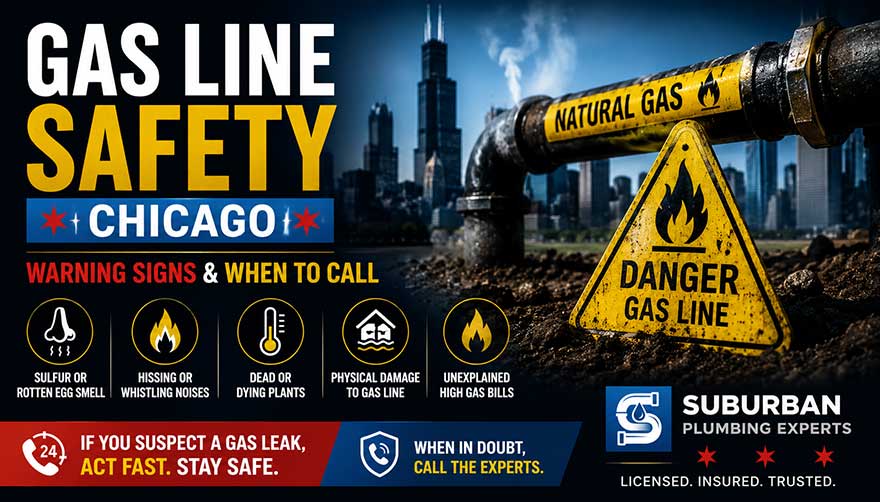
⚠️ If You Smell Gas Right Now — Read This First
Before anything else: if you smell a sulfur or rotten egg odor inside your home right now, do not read this article. Do these five things immediately:
1. Don’t touch any light switches, outlets, or electrical devices. Electrical sparks — including the tiny spark created when you flip a light switch — can ignite gas that has accumulated in an enclosed space.
2. Don’t use your phone inside the house. Take it with you as you leave.
3. Leave the house immediately. Don’t stop to gather belongings. Leave doors open as you exit to help vent the space.
4. Once outside and a safe distance away, call 911 and your gas utility. In the northern suburbs and Chicago, that’s Nicor Gas at 1-888-NICOR-4U. In Chicago and the south suburbs served by Peoples Gas, call 1-866-556-6002. Do not re-enter the building until the fire department and utility company have assessed it and declared it safe.
5. Do not re-enter until cleared by emergency services. Even if the smell seems to have dissipated.
If you smelled something that might have been gas but aren’t sure, or if you’re reading this because you want to understand gas line safety before a problem occurs — continue reading. This guide covers everything Chicago and Chicagoland homeowners need to know.
Why Chicago Homes Have Specific Gas Line Risks
Natural gas powers the majority of Chicago and suburban homes — furnaces, water heaters, stoves, dryers, and in many cases fireplaces and generators all run on gas lines that were installed when the home was built and, in many cases, have never been replaced. In Chicago’s housing stock, that can mean gas lines that are 60, 70, or 80 years old running through walls and under floors throughout the home.
Three specific factors make Chicago-area gas line safety more demanding than most American residential markets.
The Aging Black Iron Pipe Problem
Black iron pipe — the standard residential gas line material through most of the 20th century — is the gas distribution system inside the majority of Chicago bungalows, two-flats, and older suburban homes. Unlike water supply pipes, black iron gas pipe doesn’t corrode from hard water or freeze-thaw cycling in the same way. But it does corrode from age, from moisture exposure in basement and crawl space environments, from external soil contact where buried, and from the thread joint connections where pipe sections connect.
A black iron gas line in a 1955 Chicago bungalow has been through 70 years of Chicago winters, basement humidity cycles, and the cumulative stress of temperature changes on its threaded fittings. The external appearance of the pipe tells you almost nothing about the condition of the threaded connections, the joints, and the interior. A pipe that looks surface-intact may have a joint that’s seeping at rates too low to smell immediately but high enough to create a slow accumulation risk.
The Homeowner Responsibility Line — Where the Utility’s Job Ends and Yours Begins
One of the most important gas safety facts a Chicago homeowner can know is exactly where their responsibility for the gas system begins. Nicor Gas regularly monitors the pipelines up to your meter that deliver natural gas to your home or business for corrosion and leaks. You are responsible for maintaining the lines that begin at the meter and extend to the natural gas-burning equipment in your home or business, yard and any other buildings on your property. You should periodically have your buried gas piping inspected for corrosion and leaks and have repairs made if any unsafe condition is found. Also, any repairs, locating and appliance connector replacements and inspections should only be performed by a plumbing contractor, heating contractor or other qualified professional.
The gas meter is the dividing line. Everything from the street main to your meter is the utility’s responsibility. Everything from the meter into your home — every pipe, every fitting, every flexible connector, every appliance connection — is yours. The utility monitors and maintains their side. Your side requires your action.
This matters practically: Nicor Gas or Peoples Gas will respond to a leak report and address any issue on their side of the meter. They will not repair or replace the gas lines inside your home. That’s licensed plumber territory.
Chicago’s Permit and Licensing Requirements for Gas Work
The Illinois Commerce Commission’s Gas Pipeline Safety Program enforces the Illinois Administrative Code Title 83, which governs gas pipeline safety throughout the state. In practical terms for homeowners: all gas line work in Illinois requires a licensed contractor. In Chicago and most Chicagoland municipalities, gas line work also requires permits and inspections before the work is covered or the gas is restored.
Gas line work is not a gray area like some minor plumbing repairs. It is specifically and definitively not DIY territory in Illinois — and for good reason. An improperly connected gas fitting doesn’t drip water. It accumulates explosive gas.
The Warning Signs — Every Signal Your Gas System Sends
Smell: The Primary Gas Leak Warning
🚨 Rotten Egg or Sulfur Smell
Natural gas in its natural state is odorless. The sulfur compound mercaptan is added specifically to make gas detectable to human senses. The rotten egg smell that indicates gas presence is one of the most important safety engineering decisions in residential energy history — it turns an invisible, odorless hazard into one that most people can detect at concentrations well below dangerous levels.
What the smell indicates: Gas is escaping from somewhere in the gas distribution system — a pipe joint, a flexible connector, a corroded fitting, an appliance connection, or a valve. The smell doesn’t tell you where or how much. It tells you that action is required immediately.
Intensity and location matter: A faint smell that’s only present near a specific appliance, that clears when you move away, and that’s only noticeable occasionally may indicate a small appliance connector leak rather than a main gas line failure. A strong smell throughout a room or the whole house indicates a more significant leak that warrants the immediate evacuation protocol described at the top of this article.
The gas smell you ignore: Many Chicago homeowners report having noticed an occasional faint gas smell that they dismissed or investigated briefly and couldn’t locate. A gas leak that’s too small to pinpoint through smell alone but recurring is exactly the situation that professional leak detection equipment exists to find — pressure testing and electronic detection equipment locates leaks that the human nose can detect but can’t locate specifically enough to address.
Never assume the smell will resolve itself. Gas leaks don’t seal themselves. A joint that’s seeping at a barely-detectable rate today will seep at the same rate next week — or seep faster as the joint’s seal degrades further.
Sound: What Your Gas Lines Say
🚨 Hissing or Whistling Near Gas Lines, Appliances, or the Meter
A hissing or whistling sound from any gas component — the gas meter exterior, the pipe runs in the basement, at an appliance connection, or near a gas shutoff valve — indicates pressurized gas escaping through an opening. This is a higher-urgency warning than a faint smell because audible gas escape indicates a flow rate significant enough to produce sound.
What it means: A fitting, connection, or pipe section is allowing gas to escape at a rate significant enough to produce an audible flow sound. The louder the sound, the larger the flow rate. An audible hiss near any gas component warrants the same response as a strong gas smell — evacuate and call emergency services and the gas utility.
Don’t confuse with: Normal appliance operation sounds — water heaters and furnaces produce various operational sounds that aren’t gas leaks. The distinguishing factor is whether the sound is coming from a gas pipe or connection (hissing = potential leak) versus from an appliance during normal operation cycle.
Visual: What You Can See
🚨 Dead or Dying Vegetation in a Specific Line Across the Yard
A strip of dead grass, wilting plants, or unusually dying vegetation in a line that crosses your yard — particularly running from the street toward your home — can indicate a buried gas line leak beneath it. Natural gas escaping underground displaces oxygen in the soil, creating conditions that kill plant roots in the affected area.
What it means: An underground gas leak is releasing gas into the surrounding soil, depriving plant roots of oxygen. This is most visible in spring and summer when healthy vegetation makes the dead strip conspicuous.
Urgency: High. Underground gas leaks present different risks than indoor leaks — the gas can accumulate in basements, crawl spaces, and enclosed areas before triggering any indoor smell detection. Call your gas utility’s non-emergency line to report the suspected underground leak location.
🚨 Bubbling in Standing Water Near the Gas Line Path
Water that bubbles continuously in a puddle, ditch, or standing water area near the path of your buried gas service line — without any obvious cause like aeration or biological activity — can indicate gas escaping underground and percolating through the water table to the surface.
What it means: Gas from an underground leak is migrating upward through the soil and reaching the surface under standing water, creating a continuous bubble pattern. This is a specific and reliable indicator of an underground gas leak.
Urgency: High. Report to your gas utility immediately.
🚨 Visible Corrosion, Rust, or Physical Damage at Gas Pipe Connections
Accessible gas pipe — typically visible in basements, utility rooms, and at the meter connection — should be inspected visually during any plumbing service visit. Visible rust, significant corrosion, white mineral deposits at fittings, physical damage (bent pipe, cracked fittings), or disturbed pipe joints from nearby work are all indicators of potential gas integrity issues.
What it means: Physical deterioration of the pipe or fittings may be affecting the seal integrity at connections. A fitting with significant exterior corrosion has experienced the same environmental conditions on its interior. A fitting that’s been physically stressed from nearby excavation or renovation work may have compromised its thread engagement.
The basement inspection habit: Any Chicago homeowner in a pre-1970 home should periodically look at the accessible gas pipe in their basement — a five-minute visual inspection for visible rust, damage, or disturbance takes no equipment and provides meaningful early warning.
Physical Symptoms: What Your Body Notices
🚨 Unexplained Headache, Dizziness, Nausea, or Fatigue — Particularly When at Home
Natural gas itself is not directly toxic at low concentrations — it’s primarily methane, which is not poisonous. However, incomplete combustion of natural gas produces carbon monoxide, which is toxic at very low concentrations, and which has no smell, no color, and no taste. Carbon monoxide from a malfunctioning gas appliance — a furnace, water heater, or gas range with a combustion problem — is a medical emergency that produces symptoms before people are aware of the cause.
What the symptoms mean: Physical symptoms that appear when you’re home, improve when you leave the house, and recur when you return are a pattern consistent with low-level carbon monoxide exposure from a malfunctioning gas appliance. This is not a plumbing problem to investigate yourself — it’s a reason to leave the house, get fresh air, seek medical attention if symptoms are significant, and have both the gas appliances and carbon monoxide levels professionally assessed before re-occupying the home.
Every Chicago home with gas appliances should have: Working carbon monoxide detectors on every floor, particularly near sleeping areas. Carbon monoxide detectors are required by Illinois law in all single-family homes with fuel-burning appliances. If your detectors are more than 5 to 7 years old, replace them — CO detector sensors degrade with age.
Performance Signs: What Your Appliances and Bills Tell You
🚨 Pilot Lights That Keep Going Out
A pilot light that goes out occasionally during severe weather may be a draft issue. A pilot light that goes out repeatedly under normal conditions, or that requires frequent relighting, indicates either a problem with the thermocouple or thermopile (the flame safety device) or a gas supply issue — inconsistent gas pressure or a partially blocked gas orifice.
What it means: The flame safety device may need replacement, or the gas supply to the appliance may be inconsistent. Either warrants professional assessment — the flame safety device exists specifically to shut off gas when no flame is present, and a malfunctioning one is a safety component failure.
🚨 Unexplained Gas Bill Increase Without Usage Change
A gas bill that’s meaningfully higher than the same period in the prior year — without changes in household occupancy, weather, or gas appliance use patterns — can indicate a gas leak that’s releasing gas outside of any appliance. Unlike water leaks, a gas meter measures flow regardless of whether the gas reaches an appliance or escapes through a leak. If gas is leaking through a fitting or connection, the meter registers that flow as consumption.
What it means: Gas is flowing from the supply system to somewhere other than your appliances. Combined with any other warning sign, this is a strong indicator of an active leak requiring professional investigation.
The gas meter test: With all gas appliances fully off — pilot lights and standing pilot lights on furnaces and water heaters included — observe the gas meter’s dial. If any dial is moving with all appliances off, gas is flowing somewhere in the system outside of appliance use.
What You ARE and Are NOT Allowed to Do With Gas Lines in Illinois
This is the most important practical section for Chicago homeowners who’ve found online instructions for gas-related work and are considering whether professional service is actually required.
What Illinois Law and Code Prohibit Homeowners From Doing
All gas line work requires a licensed contractor. In Illinois, gas piping work must be performed by a licensed plumber, licensed HVAC contractor, or other appropriately licensed professional. This isn’t a recommendation — it’s a legal requirement enforced through the permitting system and through utility restoration requirements. A gas utility that discovers unpermitted gas work may refuse to restore gas service until the work is permitted, inspected, and approved.
Permits are required for gas line work. In Chicago and virtually all Chicagoland municipalities, any gas piping work beyond appliance connection and disconnection requires a permit. The permit process requires a licensed contractor on the application, an inspection of the work before it’s concealed, and utility notification before gas is restored. Gas line work performed without a permit cannot be inspected — which means it cannot be confirmed as safe.
Appliance connector replacement requires a qualified professional. Flexible connectors — the corrugated metal hoses that connect gas appliances to the rigid gas supply — are a common failure point. They have a recommended service life of typically 5 years and must not be used in concealed spaces, in appliance installations that require the connector to pass through a wall, floor, or ceiling, or in mobile home installations. Nicor Gas is explicit: appliance connector replacements should only be performed by a licensed professional.
Underground gas line work requires call-before-you-dig notification. Before any digging that could affect underground gas lines, Illinois law requires contacting J.U.L.I.E. (Joint Utility Locating Information for Excavators) at 811 to have underground utilities marked. This applies to fence post installation, landscaping, home addition footings — any excavation. An unmarked, unlocated gas line struck by a shovel or excavator produces an immediate emergency.
What Homeowners CAN Legitimately Do
Operate gas shutoff valves in an emergency. Every gas appliance has a shutoff valve — the quarter-turn valve on the gas supply line to that specific appliance. Homeowners can and should shut off individual appliance valves during an emergency or when an appliance needs service. The main gas shutoff at the meter can also be operated by a homeowner in an emergency — typically requires a wrench and turns 90 degrees to close.
Replace batteries in carbon monoxide detectors. Non-gas work related to gas safety.
Report suspected leaks to the utility. Calling the gas utility’s emergency line is appropriate homeowner action that doesn’t require a license.
Disconnect and reconnect a gas appliance connection for appliance replacement — in some jurisdictions. This varies by municipality. In Chicago and many suburbs, even appliance connection work requires a licensed contractor. Check with your local building department before disconnecting a gas appliance yourself.
The Gas Line Work Process — What a Licensed Plumber Does
Understanding what professional gas line service involves helps you evaluate contractor recommendations and know what to ask for.
Gas Line Pressure Testing
Before any gas line repair or replacement, and as a diagnostic service when a leak is suspected but not located, licensed plumbers perform pressure testing of the gas distribution system. The gas supply to the system is shut off, and the line is pressurized with either air or nitrogen to a test pressure. A pressure gauge monitors the system for a specified period. If pressure drops, gas is escaping somewhere in the system — and the rate of pressure drop helps quantify the size of the leak.
Pressure testing is the definitive diagnostic for confirming whether an active gas leak exists in the supply system — and it’s the service that gives you documented confidence that the system is sound after any repair is completed.
Electronic Gas Leak Detection
For locating the specific source of a confirmed or suspected gas leak without opening walls unnecessarily, electronic combustible gas detectors measure ambient gas concentrations with far greater sensitivity than the human nose. A technician moves the detector probe systematically along accessible pipe runs, at fittings and connections, and at appliance connections — identifying the highest concentration points that indicate the leak source location.
This precision matters practically: knowing a leak is at a specific fitting in the basement is the difference between a targeted repair and opening an entire wall section to find a problem that turns out to be at an accessible connection.
Gas Line Repair and Replacement
Specific repairs vary by the nature of the failure:
Fitting and joint repair: A corroded or failed threaded fitting is removed and replaced. Thread compound is applied and the joint is retested after repair.
Flexible connector replacement: Old, corroded, or damaged flexible connectors are removed and replaced with new connectors of the correct type and length for the specific appliance installation.
Section replacement: A corroded or damaged section of black iron gas pipe is cut out and replaced with new pipe or — increasingly in renovation work — with CSST (corrugated stainless steel tubing), a flexible gas line material that’s faster to install and has excellent long-term durability.
Full gas line replacement: In homes where the black iron gas distribution system has aged to the point where multiple fittings and sections need attention, full gas line replacement — removing all existing black iron pipe and replacing with new CSST or black iron — is the appropriate approach. This is analogous to the home repiping decision for water supply lines — addressing the system rather than repeatedly patching individual failure points.
Permits and Inspection
Every gas line repair or replacement in Chicago and suburban municipalities requires a permit. We pull all required permits as part of every gas line service — permit fees are included in the quoted price. The inspection process requires the work to be visible before any walls are closed, and gas service is restored only after the inspection is passed and the utility is notified.
Chicago-Specific Gas Line Factors
Peoples Gas vs Nicor Gas — Know Which Utility Serves You
Chicago and the near south suburbs are served by Peoples Gas. The north and west suburbs are served by Nicor Gas. Ameren Illinois serves some downstate areas. Your utility determines who responds to emergencies, who monitors the supply side of your meter, and what emergency contact number applies to your address. Know your utility before you need them under emergency conditions.
The CSST Bonding Requirement
Corrugated stainless steel tubing (CSST) — the flexible yellow or black jacketed gas line used in many newer homes and in gas line retrofits — requires specific electrical bonding under the National Fuel Gas Code and Chicago Plumbing Code. Improperly bonded CSST is vulnerable to lightning-induced electrical arcing that can perforate the tubing and create a gas leak. Any home where CSST was installed without proper bonding — which was common before the bonding requirement became standard — has a safety deficiency that should be corrected. A licensed plumber can assess whether existing CSST is properly bonded during any gas line service visit.
The Chicago Bungalow Context
Chicago’s bungalow belt — hundreds of thousands of homes built between 1910 and 1940 — has original black iron gas distribution systems that are now 85 to 115 years old. These systems may have been repaired and modified over the decades, creating a patchwork of different-era fittings and connections throughout the gas distribution system. A comprehensive pressure test and professional assessment of the entire gas distribution system is appropriate for any pre-1950 Chicago home that hasn’t had its gas lines professionally evaluated in recent years.
Excavation and the Gas Line
Chicago’s older neighborhoods have underground gas service lines — the pipes running from the street to the meter — that run through soil that has been disturbed by decades of tree root growth, frost heave, and nearby utility and infrastructure work. Any excavation near your home — foundation work, landscaping, fence installation, utility work — that will dig near the gas service line path requires J.U.L.I.E. notification at 811 before breaking ground. A damaged underground gas service line is a utility-side emergency if it’s between the main and your meter, and a homeowner-side emergency if it’s between the meter and your house.
What Gas Line Services Cost in Chicago in 2026
Gas leak detection and pressure testing: $150 to $350 for a standard residential pressure test and electronic leak detection assessment. This is the diagnostic service — it confirms whether a leak exists and locates it before any repair work begins.
Individual fitting or joint repair: $200 to $500 for a targeted repair at a specific identified leak point. Includes testing after repair to confirm the fix.
Flexible appliance connector replacement: $150 to $350 per connector, including the new connector, proper installation, and leak testing after connection.
Gas line section replacement: $400 to $900 for replacement of a specific failing pipe section. Cost varies based on access conditions and section length.
Carbon monoxide detector replacement: $30 to $80 per detector for a quality replacement unit. Some municipalities have specific requirements for detector placement and type — confirm local requirements.
Full residential gas line replacement (black iron to CSST): $2,500 to $8,000 for most Chicago-area homes depending on the number of gas appliances, the distribution layout, and whether any wall opening is required to access existing pipe runs. All permits included.
Frequently Asked Questions: Gas Line Safety in Chicago
I smell a very faint gas smell occasionally but can’t locate it. Is that something to call about? Yes. A faint, intermittent gas smell that you can’t locate is exactly what electronic leak detection equipment is designed to find. The human nose detects mercaptan at very low concentrations — which means you’re smelling a leak that may be too small to pinpoint visually or through smell alone. Call a licensed plumber for pressure testing and electronic detection. A leak that’s small enough to be faint and intermittent today can increase as the failing fitting degrades further.
My gas bill went up significantly this winter. Could that be a gas leak? Possibly, though gas bills are also affected by weather — a colder winter increases heating demand. If your bill increase is disproportionate to the temperature change, or if any other warning signs are present, a pressure test of the gas system is warranted. Run the gas meter test: with all appliances off (including standing pilot lights on older furnaces and water heaters), watch the meter dials for 10 minutes. If any dial is moving with all appliances off, gas is flowing somewhere in the system.
My neighbor had their gas line replaced. Should I have mine checked too? It’s reasonable context. Homes in the same subdivision built at the same time with the same original black iron gas lines have pipes of the same age in the same conditions. A neighbor’s gas line failure doesn’t mean yours will fail immediately — but it’s a meaningful signal that a professional assessment of your gas distribution system is worthwhile.
Can I use Teflon tape on a gas fitting I’m tightening? No. Gas fittings require yellow PTFE tape rated for gas service or a gas-rated pipe thread compound — not standard plumber’s white Teflon tape. And more importantly, tightening a gas fitting yourself without proper equipment, training, and a permit is exactly the category of work that Illinois code requires a licensed professional to perform. What seems like a simple tightening can crack a corroded fitting or stress an adjacent connection.
My gas appliances all work fine. Do I still need to have the gas lines checked? Appliance performance is not a gas line safety indicator. A gas line can have a slowly weeping joint that’s below the threshold for noticeable appliance performance effects while releasing gas into the surrounding space at a rate that gradually accumulates. The absence of appliance problems doesn’t confirm gas line integrity. In a pre-1960 Chicago home with original black iron gas distribution, a professional pressure test and visual inspection every 10 years is appropriate regardless of appliance performance.
Concerned About Your Chicago Home’s Gas Lines? Let’s Assess It Properly.
Licensed, insured, and locally based in Brookfield since 1978. We perform gas line pressure testing, leak detection, repair, and full gas line replacement throughout Chicago and the suburbs. All permits pulled on every job, our own licensed plumbers on every call. If you smell gas right now — leave the house and call 911 first. For non-emergency gas line assessment and service, send us a message and we’ll get back to you fast.
Or call us directly: 708-801-6530 | Open 24/7
—
Suburban Plumbing Sewer Line & Drain Cleaning Experts
Licensed & Insured | Open 24 Hours | Serving Chicago & Suburbs Since 1978
📞 Suburbs: 708-801-6530 | 📞 Chicago: 773-570-2191 | 🚨 Emergency: 708-518-7765