
The Most Important Plumbing Access Point in Your Home — and Why So Many Chicago Homeowners Don’t Have One
If you’ve ever called a plumber for a sewer backup and heard the words “we need to find your cleanout” — and then watched them spend 20 minutes searching your basement and yard without success — you’ve experienced one of the most frustrating and costly realities of owning an older Chicago-area home.
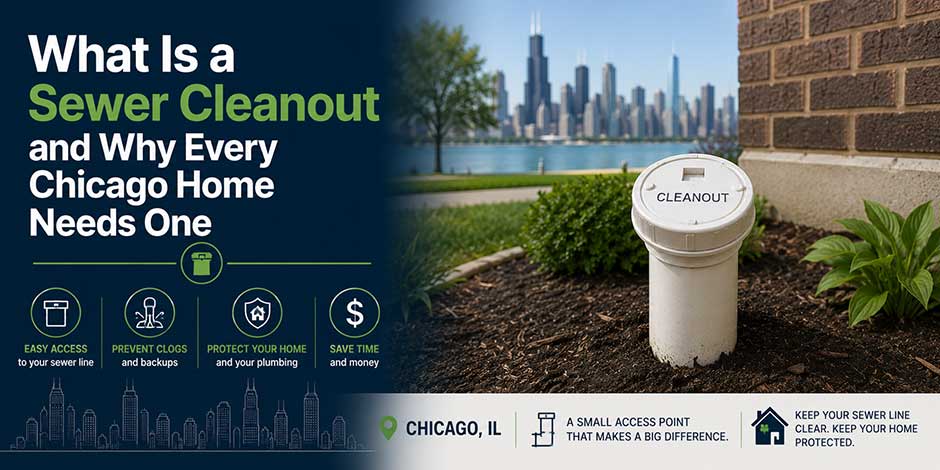
A sewer cleanout is a capped pipe that provides direct access to your building’s main sewer line. It’s the access point that allows a plumber to insert a drain snake or camera into your lateral without removing a toilet, pulling a floor drain cover, or accessing the line through a roof vent. When a cleanout is present and accessible, clearing a sewer backup or running a camera inspection is straightforward. When it isn’t — which describes a significant percentage of Chicago’s older housing stock — every sewer service call becomes more complicated, more time-consuming, and more expensive.
This guide tells you everything Chicago-area homeowners need to know about sewer cleanouts — what they are, where they should be, why so many older homes don’t have them, what the Chicago Plumbing Code requires, what it costs to install one, and why having a properly located cleanout is one of the most cost-effective plumbing investments available for an older Chicagoland home.
What a Sewer Cleanout Actually Is
A sewer cleanout is a vertical or angled pipe — typically 3 to 6 inches in diameter — that connects to your main building drain or sewer lateral and terminates at a threaded cap at or near ground level. The cap is removable, providing a direct opening into the drain line that a plumber can access without opening walls, removing fixtures, or working through indirect access points.
Most cleanouts in Chicagoland homes are made of cast iron or PVC and are located in one of several standard positions: inside the basement floor near the foundation wall, outside the building foundation just below grade, or in the yard along the path of the lateral toward the city main. Some homes have a two-way cleanout — a fitting that allows access in both directions, toward the building and toward the city main — installed near the point where the building drain exits the foundation.
The cleanout cap itself is threaded or plug-type and should be accessible without special tools. A properly installed cleanout cap has a square or hex fitting on top that allows a plumber to remove it with a wrench — and should be opened carefully since a backup condition can mean pressurized sewage behind the cap.
Why the Chicago Plumbing Code Requires Cleanouts — and What It Specifies
Cleanouts are not optional equipment under the Chicago Plumbing Code — they are required components of any compliant building drain and sewer lateral system. According to the Chicago Plumbing Code Section 18-29-708, the requirements are specific:
All building sewers must have cleanouts located not more than 100 feet apart measured from the upstream entrance of the cleanout. For drain lines 4 inches in diameter or less — which describes most residential building drains — the maximum spacing is 50 feet. This means that a 60-foot lateral from foundation to city main connection technically requires at least one cleanout within the first 50 feet of the run.
A cleanout must be installed at each change of direction greater than 45 degrees. Every bend in your building drain or sewer lateral — the 90-degree turn where the drain transitions from horizontal to vertical, or where it changes direction to route around an obstacle — is required to have cleanout access nearby. Changes of direction without cleanout access create locations where blockages concentrate and where access is difficult or impossible without disassembly.
There must be a cleanout near the junction of the building drain and building sewer — the point where the interior horizontal drain transitions to the exterior lateral heading toward the city main. This cleanout must be brought up to finished ground level or basement floor level and must be accessible. An approved two-way cleanout at this location can serve as the required cleanout for both the building drain and building sewer simultaneously.
A cleanout must be provided at the base of each waste or soil stack — the vertical drain pipe that connects upper-floor fixtures to the building drain. In a three-story two-flat, this means cleanout access at the base of the main stack where it transitions to the horizontal building drain.
The practical reality is that these requirements apply to new construction and significant renovations — they don’t retroactively require every older Chicago home to have cleanouts installed. But they do establish clearly why a home without cleanouts is operating outside current plumbing standards, and why adding cleanouts is often required as part of any sewer line repair permit in Chicago and most suburban municipalities.
Why So Many Chicago Homes Don’t Have Them
If cleanouts are required by code and every plumber knows they should be there, why do so many older Chicago-area homes not have them?
The answer is simple: most of Chicago’s housing stock was built before current cleanout requirements were codified in their current form. A bungalow built in 1932, a two-flat from 1940, a ranch from 1955 — these homes were built to the plumbing standards of their era, which were significantly less specific about cleanout requirements than the current code. Retroactive code compliance isn’t required for existing buildings that haven’t undergone significant renovation.
The result is a large percentage of Chicago’s older housing stock with sewer systems that have limited or no cleanout access — and where every service call requires working around that limitation. We access these lines through floor drains, by temporarily removing toilets, through roof vent stacks, or by excavating to the lateral itself. All of these methods work — but all of them add time, complexity, and cost to every sewer service call compared to a home with a properly located cleanout.
There’s also a maintenance history factor. Some older Chicago homes did have cleanouts installed originally — but those cleanouts have been buried during basement finishing projects, covered by concrete poured over the original floor, hidden behind walls during renovations, or simply lost track of over decades of ownership changes. A cleanout that’s present but inaccessible is functionally the same as no cleanout at all.
The Real Cost of Not Having a Cleanout
The financial argument for installing a cleanout is straightforward — but most homeowners don’t calculate it until they’ve experienced several service calls without one.
Every rodding service costs more without a cleanout. Accessing the main line through a floor drain, a toilet removal, or a roof vent adds 30 to 60 minutes to a service call that would take 15 minutes through a properly located cleanout. At current service rates, that’s $75 to $150 in additional labor on every rodding call. For a home that needs annual main line rodding, the added cost over 10 years exceeds the cost of installing a cleanout in the first place.
Emergency service costs more. An emergency sewer backup call at midnight in a home without a cleanout means the plumber has to locate an alternate access point under pressure, with an actively flooding basement. The additional time and complexity of that access situation adds cost to an already expensive emergency call.
Camera inspections cost more and are less accurate. Running a sewer camera through a floor drain or roof vent rather than a dedicated cleanout access point means navigating additional bends and connections before reaching the main lateral. The camera’s position in the lateral is less precise, the footage is harder to interpret, and locating the camera head for precise defect location is more difficult. A camera inspection through a proper cleanout is faster, more accurate, and less expensive than any alternative access method.
The Chicago Private Drain Program requires access. The City of Chicago’s Private Drain Program provides city-funded repair of broken drain tiles under the public way for residential properties of up to four units — at no cost to the property owner — when the conditions are met. One of those conditions is that a licensed sewer contractor must rod and/or perform a video inspection of the drain line. A home without cleanout access makes fulfilling this requirement more complicated and more expensive.
What Sewer Cleanout Installation Costs in Chicago in 2026
The cost of installing a sewer cleanout in a Chicago-area home varies based on where the cleanout needs to be located, what material the existing pipe is made of, and how much access work is required.
Interior cleanout installation — basement floor — $600 to $1,500 for a standard installation where the main building drain is accessible in the basement. This involves saw cutting the basement floor concrete, excavating to the drain, installing a wye fitting and vertical cleanout pipe, bringing the cleanout cap to floor level, and pouring new concrete. The wide range reflects differences in concrete thickness, access conditions, and pipe material.
Exterior cleanout installation — outside the foundation — $800 to $2,000 for a cleanout installed outside the building wall at the point where the building drain exits the foundation. This is often the most valuable location for a cleanout — it provides access to the full lateral run from foundation to city main — and typically requires excavation outside the building footprint rather than concrete work inside.
Two-way cleanout installation — $1,200 to $3,000 for a two-way cleanout at the building drain and building sewer junction. A two-way cleanout provides access in both directions — toward the building’s interior drain system and toward the city main — making it the most versatile access point available and the preferred solution when only one cleanout is being installed.
Multiple cleanout installation as part of a lateral repair or replacement — when a sewer lateral is being repaired or replaced, installing properly located cleanouts as part of the same project adds relatively little cost — typically $300 to $600 per cleanout — because the excavation is already open and the pipe is being worked on anyway. This is the most cost-effective time to add cleanout access if your lateral is being addressed.
Permit fees in Chicago for cleanout installation work that involves connection to the sewer system add $200 to $400 to the project cost. We handle all permit requirements as part of every cleanout installation.
How to Tell If Your Chicago Home Has a Cleanout
Many homeowners have never looked for their cleanout — or don’t know what they’re looking for. Here’s where to check:
In the basement floor — look for a capped pipe fitting set flush with or slightly above the basement floor surface, typically within 10 feet of the front foundation wall on the side of the building facing the street. It may be a round cast iron cap with a square plug, a threaded PVC cap, or an older brass cleanout plug. It may also have been painted over, tiled over, or buried under a layer of additional concrete during a basement renovation.
Outside the building near the foundation — look for a capped pipe emerging from the ground within a few feet of the building’s front foundation wall, on the side facing the street or the direction of the city main connection. This may be a cast iron or PVC cap set just at or slightly above grade. In many Chicago homes, these exterior cleanouts have settled below grade over time and may require some digging to locate.
In the yard along the lateral path — less common in residential applications, but present in some homes as a secondary access point along a longer lateral run. Look for any capped pipe fitting along the path from the front foundation to the street parkway.
On the plumbing drawings — if you have the original building permit drawings or any plumbing renovation records from previous owners, these may show cleanout locations. For Chicago city properties, building permit records are sometimes accessible through the Department of Buildings.
If you can’t locate a cleanout after checking all of these locations, the most reliable next step is to have a licensed plumber assess the home — we can often locate existing but buried or hidden cleanouts, confirm whether any exist in the system, and advise on the best location for a new installation.
When Adding a Cleanout Makes the Most Sense
During a sewer lateral repair or replacement. This is the best time — the excavation is already open, the pipe is being accessed, and adding a cleanout is a fraction of what it would cost as a standalone project. If your lateral is being repaired, ask specifically about adding a cleanout at the same time.
After the second emergency service call. If you’ve called for an emergency sewer backup twice in three years and neither call involved a cleanout, the math on installing one is straightforward. The installation cost is recovered in two to three service calls worth of avoided access complexity.
Before listing your home for sale. A home with documented cleanout access and a recent clean camera inspection is a meaningfully better real estate proposition than one without. Buyers’ attorneys and inspectors in the Chicago market are increasingly savvy about sewer lateral condition — a cleanout that makes future inspection and maintenance easy is a documented asset.
When buying an older Chicago home. A pre-purchase camera inspection that reveals no cleanout access should prompt a conversation with the seller about either installing one before closing or adjusting the price to account for the future installation cost.
Our sewer camera inspection service documents cleanout availability and condition as part of every inspection — so you know exactly what access exists before any service need arises. Our sewer line repair and replacement team installs cleanouts as standalone projects and as part of lateral repair work throughout Chicago and Chicagoland.
Cleanouts and the Broader Picture of Sewer Maintenance
A cleanout doesn’t solve a sewer problem — it makes every sewer service more efficient and less expensive. Think of it as the access infrastructure that makes all other maintenance possible at its full value.
With a properly located cleanout, annual sewer rodding is a 30-minute service call. Without one, it’s a 60 to 90-minute call that costs significantly more. With a cleanout, a sewer camera inspection gives you precise, well-located footage of your entire lateral. Without one, it’s a longer, more complicated process with less precise results.
If your home’s lateral has the kind of aging clay tile or cast iron infrastructure common in Chicagoland’s older neighborhoods — read our neighborhood-by-neighborhood guide to what pipe material is under Chicago homes to understand what your specific community’s infrastructure looks like and what it means for your home — then making that infrastructure as accessible and maintainable as possible is the most practical approach to managing the risk it represents.
And if you’re concerned about what a sewer line repair might cost if the camera finds something significant, read our 2026 Chicago sewer line repair cost guide before getting any quotes — so you know what fair pricing looks like before a contractor puts a number in front of you.
Frequently Asked Questions: Sewer Cleanouts in Chicago
Does my Chicago home have a sewer cleanout?
Many older Chicago-area homes — particularly those built before 1960 — either don’t have cleanouts or have cleanouts that have been buried, covered, or lost during renovations. Check your basement floor near the front foundation wall and outside the building foundation near the street side. If you can’t locate one, a licensed plumber can assess the home and confirm what’s there.
Is a sewer cleanout required by the Chicago Plumbing Code?
Yes — for new construction and significant renovations. The Chicago Plumbing Code requires cleanouts at specific intervals and locations throughout the building drain and sewer lateral system. Older homes built before these requirements were codified in their current form are not retroactively required to add cleanouts — but they may be required as part of any permitted sewer repair or renovation work.
How much does it cost to install a sewer cleanout in Chicago?
A standard interior cleanout installation runs $600 to $1,500. An exterior cleanout near the foundation runs $800 to $2,000. A two-way cleanout at the building drain and building sewer junction runs $1,200 to $3,000. Installing a cleanout as part of a lateral repair or replacement adds $300 to $600 to the project — the most cost-effective timing for the installation.
What’s the difference between a one-way and a two-way cleanout?
A one-way cleanout provides access in a single direction — typically toward the city main. A two-way cleanout provides access in both directions — toward the building’s interior drain system and toward the city main — from a single fitting. A two-way cleanout at the building drain and building sewer junction is the most versatile access point available and the preferred solution when only one cleanout is being installed.
Can I open my own sewer cleanout?
The cap itself is removable with a wrench — but opening a cleanout on a backed-up line can mean pressurized sewage behind the cap. Open slowly and step back. If the line is actively backed up and you’re not sure what’s behind the cap, call a plumber rather than opening it yourself. Once open and empty, a cleanout can be used for basic inspection or to attempt clearing a blockage with a consumer-grade snake — though professional equipment is significantly more effective for main line work.
Does having a cleanout affect my home’s value?
It affects the cost of maintaining the home’s plumbing — which buyers’ attorneys and inspectors increasingly factor into their assessments of older Chicago-area properties. A home with documented cleanout access and a recent clean camera inspection is a more attractive proposition than one without. In a market where sewer lateral condition is a growing focus of real estate due diligence, cleanout access is a meaningful documentation asset.
Need a Cleanout Installed or a Sewer Camera Inspection in Chicago?
We install sewer cleanouts and perform camera inspections throughout Chicago and Chicagoland — with upfront pricing before any work begins. Same-day and next-day scheduling available. Send us a message and we’ll get back to you fast.
Or call us directly: 708-801-6530 | Open 24/7
—
Suburban Plumbing Sewer Line & Drain Cleaning Experts
Licensed & Insured | Open 24 Hours | Serving Chicago & the Suburbs Since 1978
📞 Suburbs: 708-801-6530
📞 West Suburbs: 630-749-9057
📞 Chicago: 773-570-2191
🚨 24/7 Emergency Line: 708-518-7765