
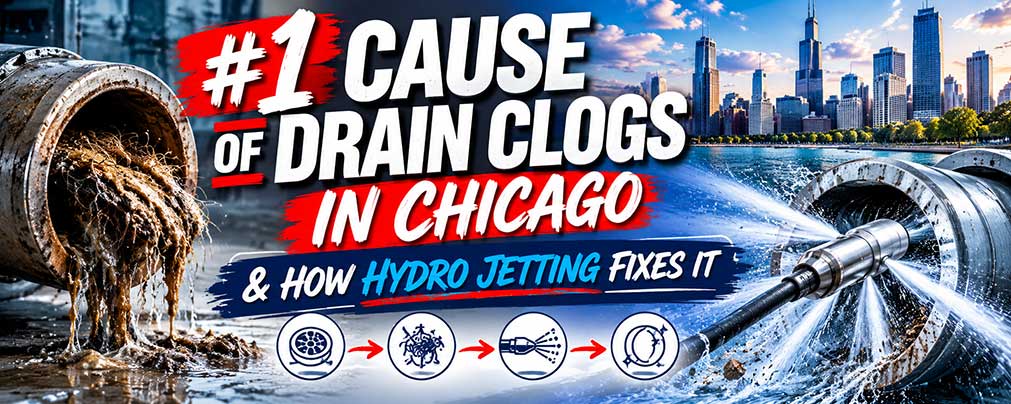
Why Chicago Kitchens Create the Perfect Drain Clog — and Why the Only Permanent Fix Isn’t What Most Homeowners Think It Is
Every Chicago homeowner who has ever stood at the kitchen sink watching water back up knows the frustration. The drain worked fine for months. Then it slowed. Then it stopped. The plumber came, rodded the line, charged $200, and everything was fine again — for about six weeks. Then it backed up again. Same symptoms. Same call. Same result. Repeated, indefinitely, until someone finally asks the question: why does this keep happening? Homeowners dealing with recurring backups and slow kitchen drains can learn more about our professional kitchen sink drain cleaning services and how we permanently remove grease buildup from Chicago drain lines.
The answer is specific, scientific, and almost never fully explained by the contractor who shows up to rod the line again. The #1 cause of drain clogs in Chicago homes isn’t hair, isn’t food scraps, isn’t tree roots, and isn’t any of the reasons that affect drain systems in most other American cities at the same rate. It’s grease — the fats, oils, and grease that Chicago’s food culture produces in remarkable volumes, combined with two Chicago-specific factors that turn ordinary grease into an almost industrial-grade pipe coating. Understanding all three pieces of that combination is the key to understanding why hydro jetting solves it permanently when rodding only solves it temporarily.
Unfortunately, recurring kitchen drain problems are often the result of plumbing mistakes homeowners don’t realize they’re making. From treating drain cleaners as a long-term solution to ignoring slow drains until they become emergencies, many of the most expensive plumbing repairs start with small issues that go unaddressed. Our guide to the Top Chicago Plumbing Mistakes That Cost Homeowners the Most Money explains how these common mistakes turn into major repair bills throughout Chicago and the suburbs.
The EPA’s Finding — Grease Is the #1 Cause of Sewer Blockages in America
The U.S. Environmental Protection Agency has documented this problem extensively. According to TCEQ’s official FOG resource — which directly cites EPA data — grease from restaurants, homes, and industrial sources is the most common cause of reported sanitary sewer system blockages, accounting for approximately 47% of all sewer backups nationwide. That’s nearly half of every sewer backup in America caused by grease. Not tree roots, not pipe failures, not foreign objects — grease.
FOG — the industry term for fats, oils, and grease — poured down kitchen drains accumulates inside sewer pipes. As the FOG builds up, it restricts the flow in the pipe and can cause untreated wastewater to back up into homes and businesses, resulting in high costs for cleanup and restoration. This isn’t a commercial kitchen problem or an industrial problem. It’s a residential kitchen problem — in every American city, in every home where someone cooks regularly. And in Chicago, it’s dramatically worse than the national average for three specific reasons.
Why Chicago Is Worse Than Everywhere Else — The Triple Threat
Chicago’s drain clog problem isn’t just a grease problem. It’s a grease problem amplified by two Chicago-specific factors that combine with FOG to create a drain deposit that is denser, more adhesive, harder to clear, and faster to rebuild than what forms in most other American cities. Understanding these three factors together explains why Chicago homeowners call for drain service more frequently — and why the results of standard drain rodding last a shorter time — than the national average suggests they should.
Factor 1: Chicago’s Food Culture Produces More FOG Per Kitchen Than Almost Any American City
Chicago’s food culture is heavy, fat-intensive, and deeply rooted in cuisines that generate extraordinary FOG volumes. Bacon grease from a Polish breakfast on a Saturday morning. The rendered fat from Italian beef that makes the au jus. Deep-dish pizza cheese — three to four times the volume of thin-crust pizza — with all the oil it releases. The butter that goes into a proper Midwestern Sunday roast. The cooking oil from a fish fry at a parish hall that finds its way down residential drains in the adjacent neighborhood.
This isn’t a judgment of Chicago’s food culture — it’s a description of why the grease loading per residential kitchen drain in Chicago is higher than in cities with lighter culinary traditions. More FOG per household means more grease deposits per foot of drain pipe per month of use. The accumulation rate in a Chicago kitchen drain is simply higher than the national average that most drain service recommendations are calibrated for, especially in older South Side neighborhoods where bungalow-era homes, cast iron plumbing, and heavy cooking patterns create some of the most persistent drain issues in the city, as seen in typical South Side Chicago drain clog patterns and hydro jetting cases.
Factor 2: Chicago’s Hard Water Transforms Grease Into Something Far Worse
This is the factor that most contractors never mention — and it’s the one that makes Chicago’s grease problem categorically different from grease problems in softer-water markets.
Chicago’s municipal water averages 130 to 150 parts per million of dissolved calcium and magnesium — classified as moderately hard to hard. When hot grease-laden water flows through your drain pipes, it carries both the FOG and those dissolved minerals. As the water cools in the drain, two things happen simultaneously: the grease cools from liquid to solid, and the minerals precipitate out of solution and deposit on the pipe walls.
In a soft-water city, cooling grease deposits a relatively soft, waxy coating on the pipe interior — greasy but somewhat removable. In Chicago, the grease deposits and the mineral deposits form together — the calcium and magnesium particles get embedded in the cooling grease, creating a combined deposit that is harder, denser, more adhesive, and more structurally rigid than pure grease deposits. This combined FOG-mineral deposit is what Chicago plumbers mean when they describe a kitchen drain branch that “feels cemented shut” — it’s not just grease, it’s a calcium-reinforced grease matrix that behaves more like scale than like soft clog material.
Rodding punches through this material. Hydro jetting removes it.
While these conditions are especially intense in Chicago, similar drainage issues are also common throughout the surrounding suburbs. For example, Oak Lawn homeowners frequently experience sewer line blockages linked to mature tree-lined streets and heavy seasonal grease buildup, which accelerates drain system failure in much the same way Chicago’s infrastructure does. A detailed breakdown of this local pattern can be found here: Oak Lawn drain cleaning and sewer problems caused by oak-lined streets.
Factor 3: Chicago’s Aging Cast Iron Drain Pipes Create the Perfect Surface for Accumulation
The third piece of the Chicago clog puzzle is the pipe itself. Chicago’s pre-1970 housing stock — the bungalows, two-flats, greystones, and ranches that define most of the city and inner-ring suburbs — has original cast iron drain lines that are now 50 to 80 years old. Cast iron that has corroded internally develops a rough, pitted interior surface that is fundamentally different from the smooth bore of modern PVC pipe.
That rough interior surface is why Chicago’s cast iron drain lines accumulate grease deposits faster, hold them more tenaciously, and rebuild them more quickly after cleaning than modern plastic drain systems. When hot grease-laden water flows through a rough cast iron pipe, the surface roughness creates turbulence that accelerates grease deposition on the pipe walls — the grease catches on the corrosion pits and scale ridges rather than flowing through smoothly. The rough surface anchors the first layer of deposit, which then provides an even rougher surface for the next layer, which anchors the next layer, progressively narrowing the pipe’s effective diameter and creating the increasingly resistant accumulation that Chicago homeowners experience.
In a smooth PVC drain pipe, grease that doesn’t flow through the pipe deposits weakly on a smooth surface and is relatively easily removed. In a rough cast iron drain pipe, grease deposits in the corrosion pits and cannot be dislodged by water flow, by chemical treatment, or by the mechanical action of a drain rod — it can only be removed by the hydraulic scouring action of high-pressure water hitting every surface of the pipe simultaneously.
The Full Picture: What’s Actually Happening Inside Your Chicago Kitchen Drain
Understanding the combined effect of these three factors explains everything about the pattern most Chicago homeowners experience.
Week 1 after a drain cleaning: The drain is fully clear, flow is normal, no symptoms.
Month 1: Hot cooking water carries dissolved minerals and trace grease from normal kitchen use. A thin film begins to deposit on the pipe walls — grease catching in the surface roughness of the cast iron, minerals co-depositing with the grease and hardening the layer.
Month 2: The thin film from the first month has created a slightly rougher internal surface. New grease and mineral deposits accumulate faster because the surface roughness has increased. The effective bore of the pipe is slightly narrowed. Still draining normally.
Month 3 to 4: Accumulation has continued layer by layer. The effective bore has narrowed enough that the drain slows noticeably when large volumes of water run through — the end of dishwasher cycles, the cleanup after a significant cooking session. The homeowner notices the drain is getting slow. This buildup isn’t always limited to grease and mineral deposits. Moisture, food particles, soap residue, and other organic material can also create conditions for biofilm and mold growth inside and around sink drains. If you’re noticing black or pink film around your sink drain along with recurring odors or buildup, our guide to mold in sink drains explains what causes it, why it keeps coming back, and why cleaning the visible surface may not solve the problem.
Month 5 to 6: Accumulation has reached the point where normal kitchen water use produces visible slowdown. A piece of food, a wad of grease from a cooking session, or the buildup from the dishwasher’s fat load produces the final blockage. The drain stops.
This cycle repeats indefinitely — on whatever interval the specific household’s cooking volume and the pipe’s current roughness level produce — until the pipe wall accumulation is addressed at the wall surface rather than just cleared at the center of the pipe.
Why Drain Rodding Doesn’t Break the Cycle
Drain rodding is the right tool for clearing an acute blockage. A steel cable driven through the pipe breaks up the accumulated mass and restores flow. It’s effective, fast, and appropriate for emergency clearing.
What rodding does not do is remove the grease deposits from the pipe walls. The rod cuts through the accumulation — creating a passage through the center of the material — but the material clinging to the pipe walls is largely undisturbed. The fresh surface of each cleared pipe section is now smooth — smooth enough to look normal — but it’s smooth because the surface deposits were compressed and pushed aside by the rod, not removed. Those wall deposits immediately begin accumulating new material on top of what remains.
This is why rodded kitchen drain lines rebuild their clogs on predictable cycles. The wall deposits weren’t cleared — they were temporarily compressed. The rough surface that anchors new accumulation wasn’t removed — it was exposed by the rod and immediately ready to catch the next cooking session’s grease. The calcium-mineral matrix embedded in the existing wall deposits wasn’t dissolved — it remains as the structural anchor for the next layer.
Rodding clears the acute blockage. It resets the timer on the next one. It doesn’t change the timeline.
What Hydro Jetting Actually Does — The Science That Makes It Different
Hydro jetting uses water pressurized to 2,500 to 4,000 PSI — delivered through specialized rotating nozzles that direct high-pressure jets simultaneously forward, backward, and radially across 360 degrees of the pipe wall. The nozzle travels through the pipe as the rotating jets scour every surface of the pipe interior simultaneously.
The physics of hydro jetting at high pressure are fundamentally different from the mechanics of mechanical rodding:
Hydraulic impact force at the pipe wall. At 3,500 PSI, water jets strike the pipe wall surface with force sufficient to dislodge the calcium-mineral matrix embedded in Chicago’s grease deposits — the material that rodding can compress but cannot remove. The hydraulic impact literally fractures and dislodges the hardened deposit from the pipe wall surface.
360-degree simultaneous coverage. A drain rod contacts the pipe from one direction at one point at a time. Hydro jetting nozzles produce a continuous spray pattern that contacts every surface of the pipe interior simultaneously as the nozzle travels through. There are no bypassed surfaces, no untreated walls, no sections of pipe that the treatment doesn’t reach.
Continuous flushing. The high-volume water flow generated by hydro jetting simultaneously dislodges deposits and flushes the dislodged material downstream. As the nozzle travels forward, cut material is continuously flushed away rather than repacking downstream of the nozzle. The pipe is cleaned and the debris is removed in a single continuous operation.
The result. A kitchen drain pipe that has been professionally hydro jetted has an interior surface that’s as close to original condition as physical cleaning can achieve. The grease deposits are gone — not compressed, not pushed through, not temporarily cleared, but removed from the pipe wall surface. The mineral matrix embedded in those deposits is gone. The rough surface that anchors future accumulation has been returned to near-original smoothness.
A pipe that has been hydro jetted starts the next accumulation cycle from a clean baseline. This is especially important in older Chicago neighborhoods where cast iron drain systems, dense housing, and decades of grease accumulation combine to create recurring drainage issues. Homeowners in Logan Square frequently encounter these exact conditions, which we cover in detail in our guide to drain cleaning in Logan Square Chicago and the role hydro jetting plays in breaking the cycle. The next accumulation takes longer to reach clog conditions because it begins from a clean smooth surface rather than from an existing rough deposit that accelerates new accumulation.
This is why homeowners who switch from repeated rodding to annual hydro jetting experience fewer service calls, longer intervals between cleaning, and consistently better drain performance — not because their cooking habits changed, but because the system that was resetting the accumulation timer is now genuinely resetting it rather than just punching a temporary hole.
How Hydro Jetting Works — The Complete Service Process
Understanding the complete hydro jetting service helps homeowners evaluate contractor recommendations and know what to expect from the process.
Step 1: Camera Inspection Before Any Cleaning
A camera inspection before hydro jetting is non-negotiable for two reasons. First, it confirms what’s in the pipe — the nature of the accumulation, the location of specific blockage points, and whether there are structural pipe conditions that should change the approach. Second, it identifies any collapsed sections or severely deteriorated pipe that shouldn’t receive high-pressure jetting — a partially collapsed cast iron section that receives 3,500 PSI water pressure could be driven to complete collapse.
Camera inspection before jetting confirms the pipe can safely receive the pressure and identifies the specific conditions the jetting needs to address.
Step 2: The Hydro Jetting Service
The jetting nozzle is introduced through a cleanout, the basement access point, or the drain opening. At residential kitchen drain service pressure — typically 2,500 to 3,500 PSI — the rotating nozzle is pulled slowly through the drain line. The forward jets cut through any remaining blockage material. The rear and radial jets simultaneously scour the pipe walls and propel dislodged material downstream.
For Chicago kitchen drains with calcium-reinforced grease deposits in aging cast iron, the nozzle may be passed through the affected section multiple times — each pass removing another layer of wall deposit — until the surface roughness reading confirms the wall is clean.
Hot water hydro jetting — where the water is heated before pressurization — is the appropriate treatment specifically for kitchen drains with FOG accumulation. Hot water at high pressure performs two functions simultaneously: the heat liquefies and emulsifies the grease component of the Chicago FOG-mineral deposit, and the pressure then flushes the emulsified grease and dislodged mineral matrix simultaneously. For pure kitchen grease applications, hot water hydro jetting is the optimal treatment.
Step 3: Post-Service Camera Confirmation
After hydro jetting, a camera is run through the cleaned section to confirm the effectiveness of the treatment, identify any remaining accumulation areas that need additional jetting, and document the post-service pipe condition for the homeowner’s maintenance records. The camera confirmation is also the point at which structural findings — joints that need sealing, corroded wall sections that have thinned to concerning levels — are identified and recommended for follow-up repair.
Our sewer camera inspection service and hydro jetting service are available throughout Chicago and the suburbs with same-day scheduling and 24/7 emergency response.
Hydro Jetting vs Rodding — When Each Is the Right Tool
This is not an either/or question. Both tools have specific appropriate applications and both have situations where the other is more appropriate.
Rodding is the right tool when:
- The drain has an acute blockage that needs to be cleared immediately — emergency service, active backup, water standing in the sink
- Camera inspection confirms the pipe is structurally sound and the blockage is material that a rod can clear effectively
- The pipe is confirmed to be in good condition with no significant wall accumulation — routine maintenance on a clean pipe
- Budget is the primary constraint and the homeowner understands that rodding provides temporary rather than lasting results on a Chicago cast iron kitchen drain
Hydro jetting is the right tool when:
- Camera inspection has confirmed significant wall accumulation — the calcium-FOG matrix deposits that characterize Chicago cast iron kitchen drain pipes
- Rodding has been performed more than once in the past 12 to 18 months on the same drain — the recurring service cycle that indicates wall deposits haven’t been addressed
- The drain is performing below expectations despite recent rodding — slow drainage that never fully returns to normal after clearing indicates wall deposits reducing effective bore
- A kitchen drain in a pre-1970 Chicago home is being professionally serviced for the first time in several years — the expectation of significant accumulated wall deposits warrants jetting rather than rodding
- A commercial kitchen or heavy cooking household needs the maximum service interval between professional cleanings
Our drain cleaning services include a pre-service assessment that confirms which method is appropriate for your specific drain’s condition — we don’t recommend hydro jetting when rodding will handle the job, and we don’t recommend rodding when camera inspection shows wall accumulation that only jetting will address.
The Cost Comparison — Repeated Rodding vs Annual Hydro Jetting
This comparison, done honestly, is one of the most compelling arguments for making the switch from reactive drain rodding to proactive hydro jetting maintenance in a Chicago home with cast iron kitchen drain lines.
The repeated rodding scenario: A Chicago kitchen drain that rods out and clogs again every 6 months.
- Annual rodding cost: 2 visits at $250 each = $500/year
- Over 5 years: $2,500 in rodding service alone
- Result at 5 years: The pipe has been rodded 10 times. Wall accumulation is substantial. The pipe’s effective bore has been progressively narrowing. The interval between clogs may be getting shorter.
The annual hydro jetting scenario: A Chicago kitchen drain that’s hydro jetted once per year.
- Annual hydro jetting cost: $450 to $650 per service
- Over 5 years: $2,250 to $3,250
- Result at 5 years: The pipe’s interior surface has been returned to near-original condition annually. Wall accumulation has never had an opportunity to reach the level that produces complete blockages. The drain has performed consistently throughout.
The cost difference between the two approaches over a 5-year period is modest — roughly equivalent — but the functional difference is significant. The rodding approach produces recurring emergency calls, periodic complete blockages, and progressively worsening pipe conditions. The hydro jetting approach produces consistent drain performance and genuine pipe maintenance rather than repeated symptom management.
For the complete breakdown of what drain cleaning costs across every drain type in a Chicago home, see our complete Chicago drain cleaning guide.
Prevention — Reducing the FOG Load Before It Reaches Your Pipes
Professional hydro jetting solves the accumulation problem. These practices slow the rate at which it rebuilds:
Never pour liquid cooking fat, oil, or grease down the drain. Cool it, pour it into a disposable container, and trash it. One session of bacon grease disposal down the drain deposits more FOG into your system than a week of normal dishwashing. This single practice more than any other extends the interval between professional drain cleaning.
Cold water when running the garbage disposal. Counter-intuitive but correct: cold water keeps fat and grease congealed so it travels through the drain as a solid rather than liquifying, coating the pipe walls, and hardening as it cools further down the line.
Scrape plates before rinsing. Food particles are the physical substrate that FOG deposits cling to — less food particle material in the drain means less anchoring material for grease deposits to build on.
Hot water flush after cooking sessions. Running very hot water through the kitchen drain for 30 seconds after each significant cooking session helps push trace grease through before it can deposit on the pipe walls. This doesn’t prevent accumulation — it slows it.
Annual professional kitchen drain service in Chicago homes with cast iron drain lines. Not a suggestion — a maintenance standard. The combination of Chicago’s food culture, hard water, and aging cast iron pipe makes annual kitchen drain service the appropriate preventive interval for most Chicago homes. For the complete maintenance calendar covering every drain type in your home, see our complete Chicago residential plumbing guide. And if your drain keeps clogging even after hydro jetting has been performed correctly — the problem may no longer be the material in the pipe. Our guide to why Chicago drains keep clogging after cleaning covers the 5 pipe conditions that look like drain problems but require pipe repair to solve permanently.
Chicago’s Combined Sewer Context — Why This Matters Beyond Your Kitchen Sink
FOG poured down kitchen drains accumulates inside sewer pipes. As the FOG builds up, it restricts the flow in the pipe and can cause untreated wastewater to back up into homes and businesses, resulting in high costs for cleanup and restoration.
As the MWRD’s Understanding Your Sewer resource explains, Chicago’s combined sewer system carries both stormwater and sanitary waste in the same underground pipes. Kitchen grease that enters Chicago’s residential drain system doesn’t just affect individual kitchen drains — it contributes to the FOG accumulation in the shared infrastructure that the entire neighborhood connects to. A kitchen drain that’s pushing grease into the combined sewer main contributes to the infrastructure conditions that produce the sewer surcharge backup events that flood Chicago basements.
Maintaining clean residential kitchen drain lines — through annual professional hydro jetting in older Chicago homes — is both a private maintenance obligation and a community infrastructure benefit. The grease that your annual jetting removes from your kitchen drain line is grease that doesn’t reach the shared infrastructure. This connection between private drain maintenance and public sewer performance is becoming increasingly important throughout Chicagoland.
Communities such as Forest Park are investing millions in sewer infrastructure improvements designed to reduce flooding and sewer surcharge events, but homeowners still remain responsible for maintaining the private drain and sewer lines that connect their properties to those systems. Our guide to Forest Park sewer backups, drain cleaning, and flood control planning explains how municipal improvements and private-side maintenance work together to reduce flooding risk and protect homes from recurring sewer problems.
The Chicago Home Types Where This Matters Most
Pre-1960 bungalows and two-flats with original cast iron drain systems. These homes have the worst accumulation conditions available — original cast iron pipes with maximum surface roughness, maximum age, and in most cases no professional cleaning history. The kitchen drain in a 1948 Chicago bungalow that’s never been hydro jetted may have a bore that’s been progressively narrowing for 70 years. The first hydro jetting service on a pipe this old frequently removes material that hasn’t moved in decades. If you have this type of home and your kitchen drain has only ever been rodded, annual hydro jetting will be a revelation.
Two-flats where two kitchen drains share one branch line. A two-flat kitchen drain branch receives twice the FOG loading of a single-family home. The service interval for hydro jetting in a two-flat kitchen branch should be compressed compared to a single-family equivalent — annually at minimum, potentially every 8 to 9 months for heavy cooking households.
Homes with active garbage disposal use. Garbage disposals are drain amplifiers — they send more organic material down the drain than hand-scraping plates produces, and that material provides additional substrate for grease deposits to anchor to. Active garbage disposal use in a home with cast iron kitchen drain lines compresses the appropriate service interval.
Older commercial kitchen drain systems. Chicago’s restaurant-dense commercial corridors have the highest FOG loading of any drain system type. Commercial kitchen drains that have only been rodded rather than hydro jetted are operating below design capacity and are subject to health code findings related to drain performance. Our commercial hydro jetting service covers Chicago restaurant and commercial kitchen drain systems throughout the city and suburbs.
Frequently Asked Questions: Drain Clogs and Hydro Jetting in Chicago
My kitchen drain was just rodded last month and it’s already slowing again. Does that mean something is seriously wrong? It means the rod cleared the acute blockage without addressing the wall deposits — exactly the pattern this article describes. A kitchen drain in a pre-1970 Chicago home that clogs monthly or within weeks of rodding has significant wall accumulation that rodding has never touched. Camera inspection followed by hydro jetting breaks the cycle by removing the wall deposits that rodding keeps compressing.
Is hydro jetting safe for old cast iron pipes? Yes — with appropriate pressure selection and camera confirmation that the pipe doesn’t have compromised sections that shouldn’t receive high-pressure treatment. Camera inspection before jetting is precisely the step that identifies any sections requiring modified approach. Standard residential hydro jetting at 2,500 to 3,500 PSI is appropriate for intact cast iron in any condition. What hydro jetting removes from old cast iron pipes is the accumulated deposit — not the pipe itself.
Can I hydro jet my own drains with a rented machine? Consumer-grade pressure washers and rental hydro jetting equipment operate at significantly lower pressures than professional equipment — typically 1,000 to 1,500 PSI versus the 2,500 to 4,000 PSI that professional units deliver. At lower pressures, the hydraulic impact force sufficient to dislodge Chicago’s calcium-mineral grease deposits isn’t achieved. You’ll get water flow through the pipe, which may temporarily clear loose material, but you won’t get the pipe wall cleaning that removes the accumulated deposit. Additionally, consumer equipment doesn’t include the rotating nozzle designs that produce 360-degree coverage. Professional hydro jetting delivers results that consumer equipment can’t match because the pressure, nozzle design, and flow volume are fundamentally different.
How do I know if my drain needs rodding or hydro jetting? The fastest indicator is history. If the drain has been rodded more than once in 18 months, hydro jetting is the appropriate next step — rodding alone hasn’t produced lasting results, which means wall deposits are involved. Camera inspection before any service definitively confirms which approach the specific pipe’s conditions warrant.
Does hydro jetting work for bathroom drains too, or just kitchen drains? Hydro jetting works for every drain type — bathroom sink drains with soap scum and mineral scale buildup, shower drains with hair and soap accumulation, floor drains with sediment, and main sewer laterals with root intrusion and biological buildup. The same principle applies: high-pressure water removes wall deposits that rodding can’t address. For kitchen drains, the FOG-mineral matrix makes hydro jetting most compelling. For other drain types, the appropriate service method depends on the specific accumulation type.
Done With the 6-Week Rodding Cycle? Let’s Actually Solve the Problem.
Licensed, insured, and locally based in Brookfield since 1978. We perform camera inspection, drain rodding, and hot water hydro jetting throughout Chicago and the suburbs — diagnosing the specific pipe condition before recommending any service, and using the right tool for each situation rather than the tool that’s easiest to sell. Written quotes before we start, our own licensed plumbers on every call. Send us a message and we’ll get back to you fast.
Or call us directly: 708-801-6530 | Open 24/7
—
Suburban Plumbing Sewer Line & Drain Cleaning Experts
Licensed & Insured | Open 24 Hours | Serving Chicago & Suburbs
📞 Suburbs: 708-801-6530 | 📞 Chicago: 773-570-2191 | 🚨 Emergency: 708-518-7765