
Water Softener Installation in Chicago, IL for Hard Water Protection
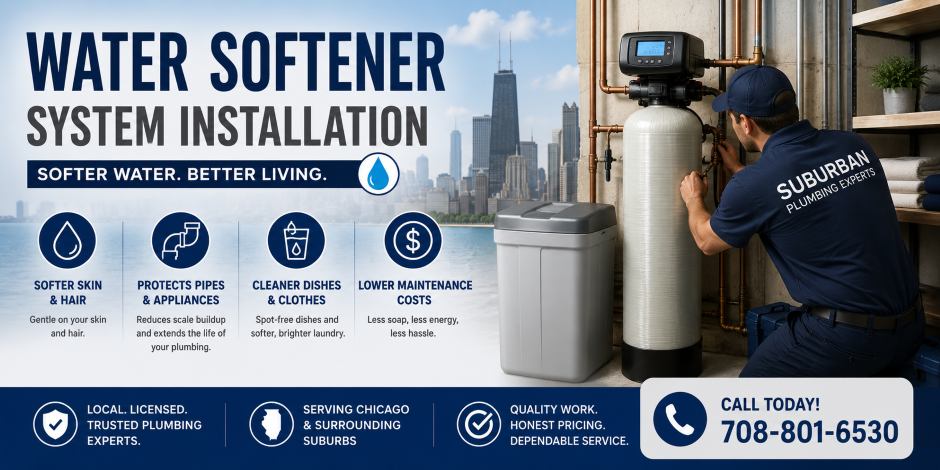
Water softener installation in Chicago can help homeowners deal with the effects of hard water, including mineral scale, water spots, dry-feeling skin, and reduced efficiency from water heaters and appliances. Chicago's water contains calcium and magnesium minerals that can leave deposits throughout your plumbing system and on the fixtures you use every day.
Over time, hard water can contribute to scale buildup inside pipes, water heaters, faucets, showerheads, and appliances. Those deposits can restrict water flow, reduce efficiency, and make cleaning more difficult. If you are constantly dealing with white residue on fixtures or spotting on glassware, your home's water hardness may be the underlying cause.
Suburban Plumbing Experts provides professional water softener installation throughout Chicago and the surrounding Chicagoland suburbs. Our experienced plumbers evaluate your home's water conditions, household usage, and existing plumbing before recommending a properly sized system. We then handle the installation professionally, helping you reduce hard water problems and protect your plumbing, fixtures, and appliances for the long term.
How Hard Water Affects Chicago Homes and Why a Water Softener Helps
Many Chicago homeowners live with hard water without realizing how significantly it can affect their plumbing, fixtures, appliances, and everyday routines. Chicago's water supply comes from Lake Michigan and naturally contains calcium and magnesium, the minerals responsible for water hardness. Hardness levels in the Chicago area commonly fall within the range where mineral scale can become a noticeable problem over time. For a broader look at where Chicagoland's drinking water comes from, how it is treated, and the water quality concerns homeowners should understand, see our Complete Guide to Chicagoland Tap Water.
Hard water usually does not cause an immediate plumbing emergency, but the effects can build gradually. Calcium and magnesium deposits can accumulate inside pipes, restrict water flow, clog faucet aerators and showerheads, and create scale inside water heaters and appliances. We cover these long-term effects in our guide to how hard water damages Chicago-area plumbing.
A properly sized water softener helps address the source of these problems by reducing hardness minerals before they circulate throughout your home's plumbing system. Instead of repeatedly dealing with scale-covered fixtures, water spots, clogged aerators, and mineral buildup inside appliances, a whole-home softening system provides a more comprehensive solution based on your household's water usage.
It is also important to understand what a water softener does and does not treat. A softener is designed primarily to reduce hardness minerals, but it is not a substitute for filtration when the goal is to address chlorine taste and odor, sediment, or specific drinking-water contaminants. Homeowners who want both hardness reduction and improved water filtration can combine a softener with a water filtration system for more complete whole-home water treatment.
6 Hard Water Warning Signs Your Chicago Home Shouldn't Ignore
Hard water problems rarely appear overnight. Instead, mineral buildup gradually affects faucets, showerheads, water heaters, appliances, laundry, and even how your water feels during everyday use. If you are noticing several of the following problems, your home's water hardness may be high enough to justify a professionally installed water softener.
White Scale Around Faucets, Showerheads, and Fixtures
A white, chalky residue around faucets, sinks, showerheads, and glass shower doors is one of the most recognizable signs of hard water. Calcium and magnesium minerals are left behind as water evaporates, creating deposits that can become increasingly difficult to remove.
Water Heater Performance Is Declining
Hard water minerals can accumulate inside a water heater, creating scale and sediment that reduce heating efficiency. As buildup increases, the system may need to work harder to heat water, potentially increasing energy consumption and contributing to premature wear.
Dishes and Glassware Keep Coming Out Spotty
Cloudy glassware, white spots, and a film left behind after washing can indicate that hard water minerals are interfering with your dishwasher and detergents. Softened water can reduce these deposits and help dishes come out cleaner.
Soap and Shampoo Don't Lather or Rinse Normally
Hard water can make soaps and shampoos less effective, leaving some homeowners with dry-feeling skin, dull hair, or a persistent film after bathing. You may also find yourself using more soap or cleaning products to get the same results.
Laundry Looks Dull or Feels Stiff
Hard water minerals can interfere with detergents and leave deposits behind on fabrics. Over time, clothing and towels may look dull, feel stiff, or develop a rough texture despite using the same detergent and washing routine.
Water Flow Is Declining at Fixtures
Mineral deposits can accumulate inside faucet aerators, showerheads, valves, and other smaller plumbing passages. Over time, that buildup can restrict flow and cause noticeable performance problems at individual fixtures.
If several of these warning signs sound familiar, your home's hard water may be doing more than creating an occasional cleaning nuisance. A properly sized water softener can reduce the minerals responsible for scale and help protect your plumbing, water heater, fixtures, and water-using appliances from ongoing buildup.
Salt-Based vs. Salt-Free Water Treatment: Which Is Better for Chicago Homes?
Choosing between a salt-based water softener and a salt-free water conditioner can be confusing because the two systems do not actually perform the same job. Both can help address hard water concerns, but they work differently and produce different results. For Chicago homeowners, the right choice depends largely on your water hardness, plumbing system, household needs, and whether you want to actually remove hardness minerals or simply reduce their tendency to form scale.
Salt-Based Ion Exchange Water Softeners
Salt-based ion exchange systems are the traditional choice for homes dealing with moderate to severe hard water. These systems use resin beads to remove calcium and magnesium from the water through ion exchange, replacing those hardness minerals with sodium or potassium ions.
Because a true water softener removes the minerals responsible for hardness, it can provide the soft-water characteristics many homeowners are looking for. Reducing hardness can also help limit scale buildup on plumbing fixtures, water heaters, dishwashers, washing machines, and other water-using appliances.
Salt-based systems do require ongoing maintenance. Homeowners need to periodically replenish the salt or potassium chloride and allow the system to complete its scheduled regeneration cycles. During regeneration, the resin is cleaned and recharged so it can continue removing hardness minerals from the incoming water.
For Chicago-area homes with significant hard water, a properly sized salt-based softener is generally the better choice when the goal is actually reducing water hardness, improving soap performance, and minimizing mineral scale throughout the home.
Salt-Free Water Conditioners
Salt-free water conditioners take a different approach. Rather than removing calcium and magnesium from the water, these systems condition the minerals so they are less likely to form traditional scale deposits on plumbing surfaces.
Because the hardness minerals remain in the water, a salt-free conditioner does not produce the same results as a traditional water softener. Homeowners may still experience some mineral spotting, and the water will not have the same softened characteristics associated with an ion exchange system.
Salt-free conditioning can make sense for homeowners who want to avoid salt replenishment or who have specific installation or maintenance preferences. However, if your primary goal is to reduce actual water hardness and remove calcium and magnesium from your home's water, a traditional salt-based softener is the more direct solution.
Which Water Treatment System Makes Sense for Your Home?
There is no reason to choose a system based solely on marketing claims. Your home's water hardness, household water usage, available installation space, plumbing configuration, and personal preferences should all factor into the decision.
If your Chicago home has significant scale buildup, spotting, reduced appliance performance, or other signs of hard water, a professional water evaluation can help determine whether a salt-based softener, salt-free conditioner, or another water treatment solution is the right fit.
How to Choose the Right Water Softener Size for Your Chicago Home
Choosing the right water softener involves more than picking a tank based on the size of your house. An undersized system may regenerate too frequently, use more salt and water than necessary, and struggle to keep up with your household's demand. An oversized system can add unnecessary upfront cost without providing a meaningful benefit. At Suburban Plumbing Experts, we evaluate your home's actual water conditions and usage to recommend a system sized for reliable, efficient performance.
Testing Your Home's Water Hardness
We start by evaluating your home's actual water hardness rather than relying solely on regional averages. Chicago-area water is generally hard, but hardness levels can vary between communities and properties. Knowing the actual mineral content of your water helps us determine how much softening capacity your system needs.
Calculating Your Household Water Demand
Your daily water usage is another important part of proper softener sizing. We consider the number of people in your household, bathrooms, water-using appliances, and typical daily usage when determining the system's capacity.
A larger household with multiple showers, frequent laundry, and regular dishwasher use will place significantly more demand on a water softener than a smaller household with lighter water usage.
Determining the Correct Grain Capacity
Water hardness and household demand are used together to determine the appropriate grain capacity for your softener. Proper capacity helps the system operate efficiently and regenerate at appropriate intervals rather than cycling unnecessarily or running out of softening capacity during periods of heavy use.
Correct sizing can also help reduce unnecessary salt and water consumption while providing consistent softened water throughout your home.
Choosing the Right Installation Location
The equipment itself is only part of a successful installation. We also evaluate your home's plumbing layout to determine where the softener can be installed with proper access to the main water line, drain, and required connections.
The installation location should provide enough room for maintenance, salt or potassium chloride replenishment, and future service. Proper placement helps ensure your new water softener operates efficiently and remains accessible throughout its service life.
What to Expect During Your Chicago Water Softener Installation
A properly installed water softener involves more than simply connecting a tank to your home's plumbing. Correct placement, plumbing connections, system programming, drainage, and final testing all affect how efficiently the equipment performs. At Suburban Plumbing Experts, our licensed plumbers follow a detailed installation process designed to ensure your new system is properly configured and ready to provide reliable soft water throughout your home.
In-Home Consultation and Water Hardness Testing
We begin by evaluating your home's water conditions and discussing the hard water problems you've been experiencing. We test the water hardness, review your household's water usage, and inspect the existing plumbing to determine the appropriate installation location.
We also verify access to the main water line and confirm that the required drain and electrical connections are available before installation begins.
Professional Water Softener Installation
Once the installation plan is established, our licensed plumbers connect the softener to your home's main water supply using quality plumbing materials and proven installation methods.
We install the necessary bypass valve and plumbing connections, connect the regeneration drain line, and make sure the system is installed according to manufacturer requirements and applicable local plumbing codes.
System Programming and Performance Testing
After the physical installation is complete, we configure the system based on your home's water hardness and estimated water usage rather than simply leaving the factory settings in place.
We then inspect all connections, check for leaks, verify water pressure, and test the system's operation and regeneration functions. This final testing helps ensure everything is working properly before we consider the installation complete.
Homeowner Walkthrough and Maintenance Guidance
Before we leave, we'll show you how your new water softener operates and explain the routine maintenance it requires. We'll review when to check and replenish the salt or potassium chloride, explain basic maintenance, and answer your questions about operating the system.
Our goal is to make sure you understand your new water softener from day one and know what it needs to continue performing efficiently for years to come.
What Does a Water Softener Installation Cost in Chicago?
The cost of water softener installation in Chicago depends on several factors, including the type of system you choose, the grain capacity required for your household, the complexity of the installation, and your home's existing plumbing configuration. Every home has different water usage patterns and plumbing layouts, which is why there isn't a single price that applies to every installation.
What Determines the Cost of a Water Softener Installation?
- Type of water softener: Traditional salt-based water softeners, salt-free water conditioners, and combination softener and filtration systems have different equipment and installation costs.
- Grain capacity: Larger households with higher water usage generally require higher-capacity systems that can provide enough softened water between regeneration cycles.
- Existing plumbing: The location of your main water line, available installation space, drain access, and any plumbing modifications needed can all affect the total installation cost.
- Additional water treatment: Some Chicago homeowners choose to install whole-home filtration alongside their water softener to address chlorine, taste, odor, sediment, and other water quality concerns in addition to hard water minerals.
Rather than giving you a generic price over the phone, our plumbers evaluate your water hardness, household needs, and existing plumbing before recommending a system. You'll receive a clear, upfront estimate based on your home's actual requirements, so you know what to expect before installation begins.
Keeping Your Water Softener Working Efficiently
A properly installed water softener is relatively easy to maintain, but regular attention is still important for consistent performance. Most salt-based systems require periodic salt or potassium chloride refills along with occasional checks of the equipment and system settings.
How often you need to add salt depends on factors such as your household's water usage, the hardness of your water, and the capacity of your softener. Many homeowners may need to replenish the brine tank every several weeks, although the actual interval can vary from one home to another.
What Your Water Softener Needs
Keeping the brine tank supplied with the appropriate amount of salt or potassium chloride is one of the most important routine maintenance tasks. Homeowners should also periodically check the system for unusual operation, confirm that settings remain appropriate, and watch for changes in water quality or signs that the softener may not be regenerating properly.
During installation, our plumbers explain the maintenance requirements for your specific system and show you how to monitor the salt level and operate the equipment properly.
When Professional Service May Be Needed
If your water suddenly becomes hard again, you notice unusual noises, the system stops regenerating, or salt consumption changes significantly, the softener may need professional attention. Issues involving the control valve, resin bed, brine system, plumbing connections, or programming can affect performance and may require more than a simple salt refill.
Regular maintenance helps your water softener continue reducing hardness minerals throughout your home while protecting plumbing fixtures, water heaters, and water-using appliances from ongoing scale buildup.
If your existing water heater has already been affected by years of hard-water scale, our water heater installation team can evaluate the system and recommend the appropriate solution if replacement is needed.
Why Choose Suburban Plumbing Experts for Water Softener Installation in Chicago
Choosing the right plumbing company is just as important as choosing the right water softener. A properly sized and professionally installed system can help protect your plumbing, water heater, fixtures, and water-using appliances from the long-term effects of hard water.
At Suburban Plumbing Experts, we don't believe in one-size-fits-all recommendations or high-pressure sales tactics. We evaluate your home's actual water conditions, explain your options clearly, and install a system designed around your household's needs.
When you choose Suburban Plumbing Experts, you can expect:
- Serving Chicagoland Since 1978: Homeowners throughout Chicago and the surrounding suburbs have trusted our experienced plumbers for honest recommendations, quality workmanship, and dependable plumbing solutions for decades.
- Free Water Hardness Testing: We test your home's actual water hardness rather than relying solely on regional averages. This helps us recommend a system that matches your specific water conditions.
- Professionally Sized Systems: We consider household size, daily water usage, and water hardness when determining the appropriate grain capacity, helping your system operate efficiently without unnecessary regeneration.
- Licensed and Insured Plumbers: Your installation is completed by experienced plumbing professionals who understand proper water softener connections, system setup, local plumbing requirements, and long-term performance.
- Upfront, Transparent Pricing: You'll receive a clear estimate before work begins, along with straightforward recommendations and no unnecessary upgrades or surprise charges.
- Solutions Tailored to Your Home: Whether a traditional salt-based softener, salt-free conditioner, or combination softener and filtration system makes the most sense, we'll explain your options so you can make an informed decision.
- Complete Installation and Setup: From water testing and system sizing through installation, programming, performance testing, and homeowner education, we handle the process from start to finish.
Our goal isn't simply to install another piece of equipment in your basement. It's to make sure you have the right water treatment solution for your home's hard water conditions and that the system is installed correctly from day one.
Frequently Asked Questions About Water Softener Installation in Chicago
How do I know if my Chicago home needs a water softener?
Many Chicago-area homeowners don't realize they have hard water until they begin noticing its effects throughout the home. Common signs include white mineral deposits on faucets and shower doors, cloudy glassware, soap that doesn't lather well, dry-feeling skin and hair after showering, stiff laundry, and reduced efficiency from water heaters and other water-using appliances. The best way to determine whether your home needs a water softener is with a professional water hardness test. Our plumbers test your home's actual water rather than relying solely on regional averages, allowing us to recommend the right solution for your specific water conditions.
Is a salt-based or salt-free water softener better for Chicago homes?
For many Chicago homes with moderate to high water hardness, a salt-based ion exchange water softener is the most effective option because it removes calcium and magnesium minerals from the water. Salt-free water conditioners work differently by reducing the tendency of hardness minerals to form scale, but they do not actually remove those minerals or produce the same soft-water characteristics. The best choice depends on your home's water hardness, plumbing system, household needs, and preferences, and we'll explain the differences before making a recommendation.
How long does water softener installation take?
Most residential water softener installations can be completed within a few hours when the plumbing is readily accessible and no major modifications are required. Installation time can vary depending on your home's plumbing layout, the location of the main water line, available drain and electrical connections, and the type of system being installed. After installation, we test the system, verify proper operation, and show you how to operate and maintain your new water softener.
Do I need a plumbing permit to install a water softener in Chicago?
Permit requirements can vary between Chicago and individual suburban municipalities. Depending on the location and scope of the installation, local plumbing requirements may apply to the water connections, drain connection, or other modifications. When permitting is required, our team can help determine what applies to your installation and ensure the work is completed in accordance with applicable local requirements.
How often do I need to add salt to my water softener?
Many homeowners refill the brine tank approximately every 6 to 8 weeks, but the actual schedule depends on household size, water usage, water hardness, salt efficiency, and the capacity of your system. During installation, we'll explain how to monitor the salt level, when to refill the brine tank, and what routine maintenance your specific system requires.
Will a water softener remove chlorine, lead, or other contaminants?
A traditional water softener is designed primarily to reduce hardness minerals such as calcium and magnesium. It is not a substitute for a water filtration system designed to address chlorine, lead, sediment, or other specific water quality concerns. PFAS, sometimes called “forever chemicals,” are another water-quality concern that is separate from hard water. Learn more about PFAS in Chicago tap water and what Chicago homeowners should know about these persistent contaminants. If you're interested in improving your home's overall water quality, our water filtration installation services can be combined with a water softener to create a more complete whole-home water treatment solution.
How long does a water softener last?
A quality water softener can provide many years of reliable service when it is properly sized, installed, and maintained. Lifespan varies depending on water conditions, household usage, system quality, and maintenance. Regular salt refills, proper settings, periodic inspections, and timely replacement of components can all help maximize the useful life of your system.
Can a water softener help extend the life of my plumbing and appliances?
Yes. By reducing calcium and magnesium hardness minerals, a water softener can help limit scale formation inside pipes, water heaters, dishwashers, washing machines, faucets, and other water-using equipment. Reducing scale can help maintain water flow, improve efficiency, and reduce mineral buildup that contributes to premature wear over time.
If you're unsure whether a water softener is right for your Chicago home, a professional water hardness test is a good place to start. Testing your actual water allows us to determine whether softening is appropriate and what type and capacity of system best fits your home's needs.
Schedule Water Softener Installation in Chicago Today
If hard water is leaving mineral deposits on your fixtures, reducing water heater efficiency, spotting your dishes, or making cleaning more difficult, a professionally installed water softener can help protect your plumbing system and improve water quality throughout your home. Instead of continually dealing with the effects of hard water, a properly sized softener addresses the minerals responsible for the problem.
At Suburban Plumbing Experts, we test your water, evaluate your plumbing system, and size your water softener based on your home's actual water hardness and household usage. Whether you're replacing an aging system or installing a water softener for the first time, our licensed plumbers provide professional installation, honest recommendations, and upfront pricing.
Ready to reduce hard water problems in your home? Call 708-801-6530 today to schedule your water hardness test and professional water softener installation in Chicago and the surrounding Chicagoland communities.
Schedule Water Softener Installation Now
Suburban Plumbing Sewer Line & Drain Cleaning Experts
⏰ Open 24 Hours
📞 Phone: Suburbs: 708-801-6530 Chicago: 773-570-2191
📧 Email: info@suburbanplumbingexperts.com
🚨 Emergency Hotline: 708-518-7765
Trusted Water Softener System Installation Services Across Chicago & Surrounding Suburbs
Helping Chicago-area homes and businesses reduce hard water problems with professional water softener solutions designed to prevent mineral buildup, protect plumbing, and improve water quality.
Chicago & Suburban Service Area
Serving Chicago, Naperville, Downers Grove, Hinsdale, Oak Brook, Elmhurst, Wheaton, Glen Ellyn, and surrounding Chicagoland communities.
Licensed, Insured & Local Experts
- ✔ Licensed Plumbing Professionals in Illinois
- ✔ Fully Insured Residential & Commercial Service
- ✔ Whole-Home Water Softener Installation
- ✔ Hard Water & Mineral Buildup Solutions
- ✔ Water Softener Replacement Services
- ✔ Code-Compliant Installation & Repairs
- ✔ Experienced with Chicago's Hard Water Challenges
- ✔ Fast Dispatch Across Chicagoland Communities
Trusted by homeowners and property managers across Chicagoland for reliable water softener installation and water quality solutions.