
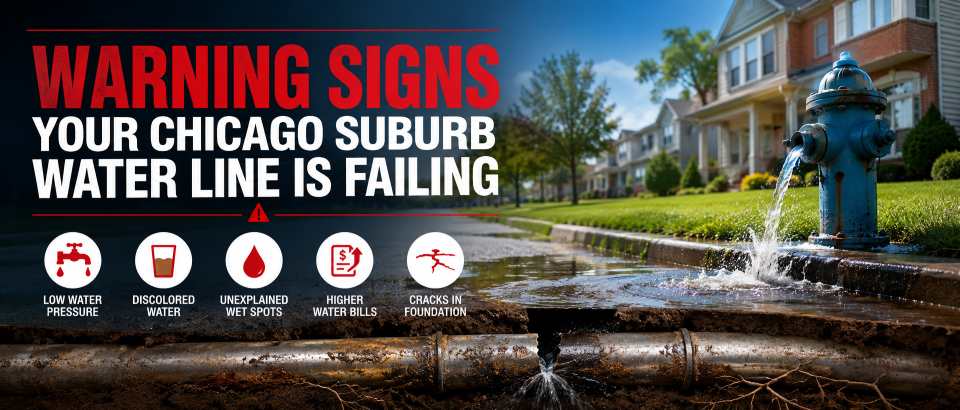
The Complete Symptom Decoder for Chicago and Chicagoland Homeowners Who Want to Find the Problem Before It Finds Them
There is exactly one underground pipe that every drop of water entering your home travels through. It runs from the city water main in the street, under your lawn, under your driveway, through your foundation wall, and connects to everything — every faucet, every shower, the dishwasher, the washing machine, the water heater, the ice maker. When it works, you never think about it. When it fails — slowly, gradually, invisibly — it sends signals that most Chicago suburb homeowners don’t recognize until the failure is complete and the repair bill is significant.
Unlike a water heater that pops and rumbles, or a drain that backs up visibly, a failing water service line is a largely silent deterioration. It happens underground, in a pipe you’ve never seen, that hasn’t been touched since your home was built. And in a Chicago suburb where the pipe is original to a home built in 1955, 1968, or 1985, that pipe has been through five to eight decades of Chicago winters, hard water mineral attack, soil movement, and tree root pressure — all without any inspection and without any maintenance.
The good news: a failing water line almost always sends warning signs before it fails completely. The homeowners who catch these signals early — and understand what each one is telling them — address the problem on their schedule, at a planned cost, without water damage or emergency rates. The homeowners who don’t recognize the signals address it on the pipe’s schedule, which is almost always the worst possible timing.
This guide is the signal decoder. Every warning sign your water service line produces, what each one means, how urgently each one requires attention, and what the escalating cost of waiting looks like for each.
The Chicago Suburb Water Service Line Reality
Before getting into warning signs, you need to understand what your water service line is actually made of — because the material determines the failure mode, the warning signs it produces, and the urgency of replacement.
Galvanized Steel — Pre-1960 Homes
Galvanized steel water service lines are the most common original pipe material in Chicago’s older inner-ring suburb housing stock — Berwyn, Cicero, Oak Park, Riverside, LaGrange, Brookfield, and the similar communities that developed between roughly 1910 and 1960. The zinc coating that gave galvanized pipe its corrosion resistance was designed to last 40 to 70 years. In Chicago’s hard water environment, it lasted toward the shorter end of that range for many homes.
A galvanized service line that’s past its zinc coating life corrodes from the inside out. The interior pipe wall accumulates rust and mineral scale that progressively narrows the effective bore of the pipe. Flow restriction is the primary symptom — not dramatic failure, but gradual, progressive reduction in the water volume the line can deliver. The line also becomes increasingly prone to pinhole failures as corrosion penetrates the pipe wall.
The regulatory dimension: Galvanized service lines that are or were connected downstream of a lead service line must also be replaced under Illinois lead service line replacement requirements. Galvanized pipe downstream of lead service lines can retain lead particles from the degraded lead pipe upstream. If your home has galvanized service line and you’re not certain whether it was ever connected to a lead service line at the main, investigation is warranted.
Lead — Pre-1986 Homes in Many Chicago Suburbs
Lead service lines are present in significant numbers throughout Chicago’s inner-ring suburbs and the city itself. The EPA’s 2024 Lead and Copper Rule Improvements require drinking water systems across the country to identify and replace lead pipes within 10 years. In Illinois, mandatory replacement begins April 15, 2027 — meaning the regulatory clock for lead service line replacement is actively running.
Lead service lines are soft and malleable — they don’t corrode the way galvanized steel does, and they don’t develop the flow restriction that galvanized pipe produces. What they do is leach lead directly into drinking water, particularly after any disturbance to the pipe (water main work, nearby construction, changes in water chemistry). The Illinois EPA’s Lead Service Line Information page is the authoritative resource for Illinois homeowners trying to understand their obligations and options.
If you’re wondering whether your community has a high concentration of lead service lines, see our guide to the Chicago suburbs with the worst lead pipe problems before determining your next steps.
How to tell if you have a lead service line: Find the pipe where it enters your home — at the water meter or where it comes through the foundation wall. Scratch the surface of the pipe with a key. Lead is bright, shiny silver underneath the scratched surface (not gray like galvanized or copper-colored like copper). Lead pipe is also soft — it dents when you press on it. A licensed plumber can confirm the material definitively if you’re uncertain.
Copper — 1950s Through 1990s Homes
Copper became the dominant residential service line material after World War II. Well-maintained copper in good conditions lasts 50 to 70 years. In Chicago’s hard water and soil conditions, pitting corrosion — microscopic interior pits from mineral and chlorine attack — develops at accelerated rates. Homes from the 1960s through 1980s with original copper service lines are now in the age range where pinhole failures begin appearing, and where the cumulative effects of soil movement, freeze-thaw cycling, and hard water have stressed the pipe and its joints.
When copper service lines and interior copper piping begin showing recurring pinhole leaks or widespread corrosion, the issue often extends beyond isolated repairs and becomes a full-system decision. In those cases, homeowners should understand the full scope of options outlined in our complete Chicago home repiping guide.
PEX and Modern Materials — Post-2000 Homes and Renovated Service Lines
Cross-linked polyethylene PEX pipe is the current standard for new water service line work. It’s flexible, freeze-resistant, immune to Chicago’s hard water corrosion, and has an expected service life of 50+ years. If your service line has been replaced in the last 20 years, you likely have PEX and can focus your attention on other warning signs.
The Warning Signs — Every Signal Your Water Service Line Sends
Category 1: What Your Yard Is Telling You
The ground above and around your water service line is one of the most informative places to look for service line problems. These are the signs that something has changed in the underground environment around your pipe.
🚨 Wet Spots in the Yard That Don’t Dry Out
Persistent wet areas in your yard — particularly in the area between the street and your home where the service line runs — that don’t dry out after several dry days are one of the clearest service line failure indicators available. The water has to come from somewhere. If there’s been no rain, no irrigation, and no other obvious water source, the source is almost certainly a leaking underground water line.
What it means: An active leak in the service line is saturating the surrounding soil. Depending on how long the leak has been running and the soil conditions, the wet area may be large or small, and may be offset from the actual leak location — water travels along the path of least resistance, which isn’t always directly above the failure point.
Urgency: High. An active underground water leak is wasting water continuously and softening the soil structure around the pipe. Schedule a professional leak detection assessment immediately. Our leak detection services use acoustic equipment to locate underground service line leaks precisely before any excavation begins.
Ignore it and: The leak volume typically increases as the failure point enlarges under water pressure. Saturated soil around the foundation creates hydrostatic pressure that can affect basement waterproofing. Water bill increases compound with each passing week.
🚨 Unusually Green, Lush Grass in a Specific Strip Across Your Yard
A distinct band of grass that’s noticeably greener, thicker, or more lush than the surrounding lawn — running in a line that roughly corresponds to where the water service line would run from the street to your house — is a classic slow-leak indicator. The leaking water is fertilizing and irrigating the soil immediately above it, producing more vigorous grass growth than the surrounding unwatered areas.
What it means: A slow, chronic leak from the service line that has been running long enough to affect the vegetation pattern. This is a leak that’s been active for weeks or months, not hours.
Urgency: Moderate to high. The leak has been running long enough to affect grass growth, which means it’s been running long enough to significantly impact your water bill and begin affecting the soil structure around the pipe. Professional assessment is warranted before the next billing cycle.
🚨 Sinkholes, Soil Settlement, or Pavement Cracking Near the Service Line Path
Depressions in the soil, sunken driveway sections, or pavement cracking that follows the path of the underground service line indicates subsurface soil erosion — the underground leak has been washing soil particles away from around the pipe, creating voids in the soil that surface pavement and ground are beginning to follow downward.
What it means: An advanced underground leak that’s been active long enough to erode the surrounding soil structure. This is a serious structural concern beyond just the plumbing failure — a void under the driveway or foundation approach is a pavement failure and potentially a foundation concern depending on proximity to the house.
Urgency: High to urgent. A sinkhole or significant settlement near the service line path warrants same-day professional assessment. The void formation process accelerates — what is a small settlement today can be a significant collapse within weeks if the leak continues.
Category 2: What Your Water Is Telling You
The quality of water coming from your taps is a direct reflection of what’s happening inside your service line. Changes in water appearance, taste, or smell that develop gradually over time are often the most reliable early indicators of pipe deterioration.
🚨 Rust-Colored or Brown Water — Especially First Thing in the Morning
Discolored water that appears when you first run a tap after the water has been sitting overnight — and that clears after running the water for 30 to 60 seconds — indicates that the standing water in the service line is picking up rust and mineral particles from corroding interior pipe walls. In galvanized steel service lines, this is one of the clearest indicators of advanced interior corrosion.
What it means: The interior surface of your service line is releasing rust or mineral particles into the standing water. The water clears after running because fresh water from the main is displacing the discolored standing water. The problem is in your service line, not the city’s supply.
Confirm it’s the service line, not internal plumbing: Run only the cold water at the fixture closest to where the service line enters the house. If that water is discolored but cold water at fixtures further from the entry point is clear, the discoloration is coming from the service line. If all cold water throughout the house is discolored, the service line is almost certainly the source.
Urgency: Moderate to high depending on severity. Regular discoloration of drinking water from a galvanized service line is a water quality concern alongside a pipe condition concern. For a complete assessment of when supply pipe replacement is the right call, see our complete Chicago home repiping guide.
🚨 Metallic Taste in Cold Water
A consistently metallic taste in cold water — particularly noticeable in drinking water and water used for cooking — indicates that dissolved metals are present in the water supply to your home. Depending on your pipe material, the metal may be iron (from galvanized pipe), copper (from corroding copper pipe), or most critically, lead.
What it means: Metal is leaching into your drinking water from the service line or from plumbing components. Lead is tasteless — a metallic taste in the water does not confirm lead is absent. The taste you notice may be iron or copper while lead is also present without any flavor signal.
The lead concern specifically: If your home was built before 1986 and you haven’t confirmed your service line material, a metallic taste in cold water is a reason to get the service line material confirmed and to request water testing. The EPA’s Lead and Copper Rule establishes the monitoring and action requirements for lead in drinking water — but homeowner-side testing provides the specific information about what’s in your water at the tap.
Lead isn’t the only water-quality concern Chicago homeowners should understand. PFAS, often called “forever chemicals,” are a separate group of contaminants that cannot be identified by taste, smell, or appearance. If you’re evaluating the overall quality of your home’s drinking water, our guide to PFAS in Chicago tap water explains what these persistent chemicals are and what homeowners should know about them.
Urgency: High if lead service line is suspected or confirmed. Moderate for iron or copper taste from non-lead pipe materials. Either way, water testing before any remediation decision is the right first step. While water testing helps identify what’s happening with your water quality, many Chicago homeowners also choose a whole-home water filtration system to improve taste, reduce unwanted minerals, and provide cleaner water throughout the house. A properly installed water filtration system can be especially beneficial for older homes dealing with hard water, sediment, and concerns about aging plumbing components.
🚨 Particles or Sediment in the Water
Visible particles in tap water — small reddish or brown flakes in galvanized systems, gritty particles in older copper systems, or white mineral particles in any system — are physical evidence that the interior of a pipe is breaking down and releasing material into the water stream.
What it means: The pipe interior is deteriorating to the point of releasing particles. This is an advanced stage of the corrosion process — the pipe wall has degraded sufficiently that material is physically separating from the interior surface and entering the water stream. In galvanized pipe, this indicates the pipe is in its terminal stage of service life.
Urgency: High. Visible particulate in drinking water is a water quality issue, a pipe condition issue, and an appliance concern — particles that reach water heaters, dishwashers, and washing machines accelerate component wear. Service line assessment and replacement planning should be prioritized.
🚨 Cloudy Water That Clears From the Bottom
Water that comes out of the tap looking milky or cloudy but clears gradually from the bottom of the glass upward is almost always dissolved air — a common and generally harmless condition that can result from water pressure changes. However, cloudy water that doesn’t clear, that appears specifically in cold water only, or that is accompanied by other warning signs warrants investigation.
What it means: Dissolved air from pressure changes is the most common cause and is benign. Sediment or particulate matter creating cloudiness that doesn’t settle out is a different situation requiring assessment.
Category 3: What Your Water Pressure Is Telling You
Water pressure changes are among the most commonly noticed service line warning signs — and among the most commonly misattributed. Understanding what each pressure pattern actually indicates helps you direct diagnosis correctly.
🚨 Consistently Low Pressure Throughout the Entire Home
Low pressure at every fixture simultaneously — kitchen, bathrooms, laundry, all on the same level — that has developed gradually over months or years is the primary symptom of a service line that’s progressively restricting flow.
What it means in a galvanized service line: Interior corrosion has accumulated to the point where the effective diameter of the pipe has narrowed significantly. The pipe that was installed as 3/4-inch or 1-inch diameter may now have an effective interior diameter of 1/2 inch or less. The physics are unforgiving — less pipe diameter means less flow capacity means less pressure at every downstream fixture.
What it means in other pipe materials: Scale accumulation from Chicago’s hard water can narrow copper and newer pipe materials over time, though less dramatically than galvanized corrosion. A partial closure of the main shutoff valve or a failing pressure reducing valve can also produce this symptom — check both before assuming a service line problem.
The diagnostic test: Locate your water meter and the shutoff valve near it. Confirm the shutoff is fully open. Attach a water pressure gauge to the hose bib closest to where the service line enters the house and measure static pressure. If pressure at the meter connection is normal but pressure at interior fixtures is low, the restriction is between those two points — inside the house. If pressure is low at the meter connection itself, the restriction is in the service line between the meter and the main.
Urgency: Moderate to high. Progressive pressure loss in a pre-1960 home with original galvanized service line is a strong service line replacement indicator.
🚨 Pressure That Drops Suddenly During Normal Use
Pressure that was acceptable but dropped noticeably over a period of days or weeks — rather than gradually over months or years — can indicate a pipe failure point that has partially collapsed or a significant corrosion event that has shed material into the flow path.
What it means: Something has changed suddenly in the service line rather than gradually. This warrants more urgent assessment than gradual pressure loss — the sudden change suggests an acute failure event rather than progressive deterioration.
Urgency: High. Sudden pressure loss requires professional assessment to identify the cause before the partial failure becomes complete.
🚨 Air in the Lines — Spitting, Sputtering, or Intermittent Flow
Faucets that spit air intermittently — particularly when first opened or when flow rate changes — can indicate a service line with a leak that is drawing air into the pipe on the low-pressure side of the failure point. When the flow velocity changes, the air pocket reaches the fixture and produces the intermittent spitting pattern.
What it means: A leak in the pressurized service line creates a low-pressure zone on the downstream side of the failure. Under certain conditions, that low-pressure zone can draw air inward through the leak point — air that then travels with the water to fixtures. This is a specific indicator of an active service line leak rather than an internal plumbing air issue.
Urgency: High. Air in the lines from an active service line leak indicates a failure point that should be professionally assessed and located immediately.
Category 4: What Your Water Bill Is Telling You
An unexplained water bill increase is one of the first measurable indicators of an underground water line leak — and one that produces financial impact before any visible or physical symptom appears.
🚨 Unexplained Water Bill Spike Without Increased Use
A water bill that’s meaningfully higher than the same period in the prior year — without any change in household occupancy, irrigation activity, or water use patterns — is a primary indicator of an underground leak. The water utility measures every gallon that passes through your meter, and if you’re not using more but you’re being billed for more, the water is going somewhere underground.
What it means: Water is flowing from the service line into the surrounding soil rather than into your home’s plumbing system. The meter registers the flow because the meter is upstream of the leak point — the water passes through the meter, then through the pipe, then exits through the failure point before reaching any fixture.
The water meter test: With all fixtures and appliances off, locate your water meter and observe the low-flow indicator — a small dial or triangle that rotates when water is flowing. If the low-flow indicator is moving with all water use stopped, water is flowing through the meter to somewhere. That somewhere, if there’s no visible indoor leak, is a service line failure.
Urgency: Moderate to high. The meter test confirms whether a leak is active. If the indicator is moving with all water off, professional leak detection is the next step. Our hidden water leak detection services use acoustic equipment specifically designed to locate underground service line leaks before excavation.
Category 5: What Age Alone Is Telling You
🚨 Service Line Age — The Warning Sign That Requires No Symptoms
A galvanized steel service line that’s 60 or more years old is a warning sign regardless of whether it’s currently producing any symptoms. A lead service line is a health concern and a regulatory obligation regardless of whether any water quality symptoms are present. A copper service line that’s 50 or more years old in Chicago’s hard water and soil conditions is approaching the age range where pinhole failures begin appearing at accelerated rates.
Age is not a symptom — it’s a condition. And in Chicago’s older suburban communities, where the housing stock built between 1920 and 1970 still has significant numbers of original service lines, the condition of the pipe is the most important factor in understanding your risk.
What it means: The older your home’s service line, the higher the probability that it’s approaching or past its reliable service life. A pre-1960 home with original galvanized service line has a pipe that is operating on borrowed time — not certainly failing today, but statistically likely to produce significant problems within a planning horizon that makes proactive replacement far more cost-effective than emergency repair.
Urgency: Planning-level urgency. Not an emergency today, but a service line assessment before the next failure event is strongly advisable for any home with a service line more than 50 years old.
The Damage Timeline — What Waiting Actually Costs
The cost of addressing a failing water service line escalates with time in ways that aren’t linear. Understanding the escalation timeline helps quantify the risk of deferral.
Minor leak detected early: Repair or targeted replacement of the failure point. Professional excavation at the failure location, pipe repair or short section replacement, soil restoration. Cost: $1,500 to $4,000 depending on depth and access conditions.
Moderate leak running for weeks: Full service line replacement from meter to house is typically the right call once a leak has been running — the failure point that produced the discovered leak indicates general pipe condition issues throughout the line. Trenchless directional boring or conventional excavation depending on conditions. Cost: $3,500 to $8,000 for most Chicago suburb properties.
Advanced leak with soil erosion and soil void formation: Service line replacement plus soil remediation, pavement repair if a driveway is affected, and potentially foundation assessment if the void has progressed toward the house. Cost: $6,000 to $15,000+ depending on extent of secondary damage.
Complete service line failure — no water to the house: Emergency service, premium rates, expedited scheduling with all the disruption of unplanned work. Plus the water damage cost if the failure produced flooding before it was discovered. Cost: $5,000 to $20,000+ depending on failure type and secondary damage.
Lead service line left in service beyond regulatory deadlines: Potential water quality exposure for household members, particularly children, plus eventual mandatory replacement under Illinois regulatory requirements with no municipality assistance programs available for those who waited. Cost: lead line replacement at full private expense with no rebate or assistance program access.
Repair vs. Replacement — Making the Right Call for Your Chicago Suburb Home
Not every service line warning sign leads to full replacement. Here’s the honest framework:
Repair is appropriate when: The pipe material is copper or a newer material, the home is less than 40 years old, a single isolated failure point is identified and the surrounding pipe shows no significant corrosion or deterioration on camera inspection, and the failure is mechanical rather than corrosion related.
Replacement is appropriate when: The pipe is galvanized steel and is more than 50 years old — the conditions that produced one failure point are present throughout the system. The pipe is lead — regulatory obligation and health concern independent of current performance. Multiple failure points have been identified or repaired in the same pipe. Camera inspection reveals widespread corrosion that makes single-point repair a temporary solution on an end-of-life pipe. Water quality symptoms persist after a single repair because the problem is systemic.
The partial replacement consideration: In some Chicago suburb situations, the most cost-effective approach is replacing only the section of service line from the curb stop to the house — the homeowner-side section — while leaving the utility-side section to the municipal replacement program. This is most relevant for municipalities that are actively replacing the public-side portions of lead service lines. Confirm with your water utility what programs apply to your address before making replacement decisions.
Chicago Suburb-Specific Factors That Accelerate Service Line Failure
Clay soil creates continuous pipe stress. Chicago’s heavy clay soil expands when wet and contracts when dry — seasonal movement that continues for the entire service life of an underground pipe. A service line that’s been through 60 Illinois seasonal cycles has experienced 60 cycles of soil expansion and contraction around it. Joint stress from this movement is one of the primary causes of pinhole failures at service line fittings.
Freeze-thaw cycling reaches deep into Chicago suburbs. Chicago’s average frost depth of 42 inches means underground pipes in the first several feet of soil experience freeze-thaw stress annually. Service line sections that run at less than frost depth — common where the line crosses shallow areas or where frost depth has changed over decades of climate variation — are vulnerable to freeze-related pipe stress.
Tree root growth follows moisture. Mature trees in Chicago’s older suburban neighborhoods have root systems that extend well beyond the visible canopy — and those roots follow moisture gradients. A leaking service line is one of the best moisture sources a tree root can find. Root intrusion into service line joints or failure points can accelerate the failure from a slow drip to a significant flow.
Hard water creates scale inside supply pipes. Chicago’s 130 to 150 PPM mineral content deposits scale inside supply lines over time. In galvanized service lines, this mineral scale combines with rust deposits to create the dense interior accumulation that drives progressive pressure loss. In copper lines, scale deposits at fittings create stress concentrations that accelerate the pitting corrosion process.
For the complete picture of how Chicago’s specific conditions affect every plumbing system in your home — not just the service line — see our complete Chicago residential plumbing guide.
Frequently Asked Questions: Water Service Line Warning Signs in Chicago Suburbs
My water looks fine and pressure is normal but I just found out the house has an original galvanized service line. Do I need to replace it? Not immediately, but proactively planning replacement is the right approach. A galvanized service line that’s 60+ years old in Chicago’s hard water environment is past its expected service life. The absence of current symptoms means it hasn’t failed yet — not that it’s in good condition. A camera inspection of the line from the cleanout or meter gives you specific information about interior corrosion extent and helps you make an informed timing decision rather than a reactive emergency decision.
I had the water main area outside dug up for a different repair and the plumber said my service line looks fine. Does that mean I’m okay? Exterior pipe condition is not the same as interior pipe condition. A galvanized service line can appear structurally intact on the exterior while having significant interior corrosion narrowing the bore. The symptoms that matter — pressure, water quality, wet spots — reflect interior condition more accurately than a visual exterior assessment. If pressure and water quality are both normal and no symptoms are present, you’re likely okay for the near term but the pipe’s age remains the primary risk indicator.
My neighbor on the same street just had their water line fail. Does that mean mine is close to failing too? Possibly. Homes built in the same subdivision at the same time with the same pipe material have pipes of the same age in the same soil conditions. A neighbor’s service line failure is a data point about the condition of your generation of pipes in your specific neighborhood — it’s not a certainty that yours will fail immediately, but it’s a meaningful signal that a proactive assessment is warranted.
How do I find out what material my service line is? Start where the pipe enters your home — at the water meter or where the line comes through the foundation wall. Scratch the surface with a key. Copper is copper-colored underneath. Galvanized is silver-gray. Lead is bright shiny silver and soft enough to dent with pressure. PEX is flexible plastic, usually white, blue, or red. If you can’t access the pipe at the entry point or aren’t certain from visual inspection, a licensed plumber can confirm the material during a service visit. Some Chicago suburb municipalities also maintain service line material records — contact your water utility.
My water pressure has been low for years. Is it too late to fix with a service line replacement? It’s never too late to improve — service line replacement restores full flow capacity regardless of how long the restriction has been developing. The question is whether the low pressure is from the service line or from an interior supply pipe issue. A pressure test at the meter connection vs. an interior fixture distinguishes service line restriction from interior pipe restriction. In a pre-1960 Chicago suburb home with original galvanized service line and original interior galvanized supply lines, both may be contributing — service line replacement addresses the entry point and interior repiping addresses the internal distribution.
Noticed Any of These Warning Signs in Your Chicago Suburb Home?
Licensed, insured, and locally based in Brookfield since 1978. We assess, repair, and replace water service lines throughout Chicago and the suburbs — galvanized, lead, copper, and PEX. Written quotes before we start, permits pulled on every job, our own licensed plumbers on every call. Same-day assessment available. Send us a message and we’ll get back to you fast.
Or call us directly: 630-749-9057 | Open 24/7
—
Suburban Plumbing Sewer Line & Drain Cleaning Experts
Licensed & Insured | Open 24 Hours | Serving Chicago & Chicagoland
📞 Suburbs: 630-749-9057 | 🚨 Emergency: 708-518-7765









