
The Technology That Finds Hidden Leaks, Moisture Damage, and Pipe Failures Without Opening a Single Wall
There’s a category of plumbing problem that the standard inspection misses entirely — hidden leaks behind walls, moisture accumulating under floors, pipe failures inside concrete slabs, and heat loss from aging supply lines that have been slowly failing for months before any visible symptom appears. By the time water stains show up on the ceiling or mold appears at the baseboard, the damage has been building for a long time. The repair bill reflects all of it.
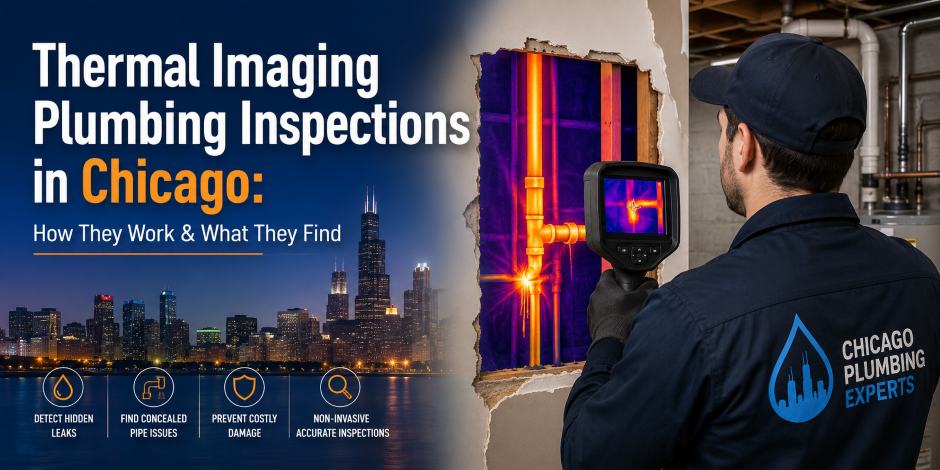
Thermal imaging plumbing inspections change that equation. Using an infrared camera that detects temperature differences invisible to the naked eye, a trained plumber can find active leaks, moisture accumulation, and pipe condition issues behind finished surfaces — without cutting drywall, pulling up flooring, or making a single exploratory hole. What was a guessing game that required destructive investigation becomes a precise, documented diagnosis.
In Chicago’s housing stock — where 60 to 100-year-old pipes run through walls and slabs that have never been opened, where copper pinhole leaks are endemic from hard water and freeze-thaw stress, and where moisture problems develop slowly in poorly ventilated older construction — thermal imaging is one of the most valuable diagnostic tools available. This guide explains exactly how it works, what it finds in Chicago homes specifically, when it makes sense to use it, and what to expect from a professional thermal imaging inspection.
How Thermal Imaging Actually Works
Every object above absolute zero temperature emits infrared radiation — heat energy that is invisible to the human eye but detectable by specialized cameras. A thermal imaging camera captures this infrared radiation and converts it into a visible heat map where different colors represent different temperatures. Warm areas appear as reds and oranges; cool areas appear as blues and purples; and the precise temperature gradient of every surface in the camera’s field of view is captured in real time.
In plumbing applications, this technology exploits a fundamental property of water: it has a high specific heat capacity, meaning it absorbs and retains heat differently than the building materials surrounding it. When water is leaking behind a wall or accumulating under a floor, it creates a temperature anomaly — typically a cool spot caused by evaporative cooling, or a warm spot where hot water is escaping from a supply line. That anomaly appears on the thermal camera as a color difference against the surrounding surface, even when the surface itself looks completely normal to the eye.
The physics is straightforward. A supply line with a pinhole leak releases hot water into the wall cavity. The wet building material cools as the water evaporates. The thermal camera sees a cool zone — shaped differently from the dry surrounding material — precisely where the moisture is accumulating. A plumber trained in thermographic interpretation can identify not just that there’s moisture present, but approximately where in the wall the leak is originating and how extensive the wet area has become.
This is why thermal imaging is described as non-invasive leak detection. The camera reads what’s happening inside the wall from the outside — no openings required for the diagnostic phase. When repair access is eventually needed, it’s targeted and precise rather than exploratory.
What Thermal Imaging Finds in Chicago Homes
Chicago’s specific housing stock and infrastructure conditions create a distinctive set of findings that thermal imaging reveals consistently. Here’s what our inspections document most frequently:
Pinhole leaks in copper supply lines. Chicago’s hard water — with significant calcium and magnesium content — accelerates the pitting and corrosion that produces pinhole leaks in copper pipe. These leaks are typically too small to create visible water damage immediately, but they release moisture continuously into wall cavities and insulation. A pinhole leak behind a bathroom wall can wet the framing, insulation, and drywall over months before any discoloration appears on the surface. Thermal imaging identifies the temperature anomaly at the leak location — typically a cool, irregular patch on the wall surface — before the damage has progressed to visible symptoms.
Slab leaks in homes with concrete foundation slabs. Chicago-area homes built on concrete slabs — particularly ranch homes from the 1950s through 1970s — have supply and drain lines running beneath or through the slab. When those lines develop leaks, the moisture migrates through the concrete and creates temperature differentials at the slab surface. Thermal imaging of the floor can identify the approximate location of a slab leak before any excavation — dramatically reducing the scope of concrete cutting required to access the repair location.
Moisture intrusion behind finished basement walls. Chicago’s clay soil creates hydrostatic pressure against basement foundation walls during wet periods. Moisture that infiltrates through the foundation migrates into wall insulation and framing behind finished drywall. By the time it’s visible, the framing may already have mold growth. Thermal imaging of finished basement walls during or after a wet period shows the temperature differential where wet insulation is affecting the wall surface temperature — revealing moisture intrusion before it’s visible and before mold has established.
Radiant floor heating failures. Homes with radiant heating systems embedded in floors — increasingly common in Chicagoland renovations and custom builds — develop leaks or blockages in the heating lines that are impossible to locate without either opening the floor or using thermal imaging. When a section of radiant floor fails, the thermal pattern of the floor changes — the failed section doesn’t heat as uniformly as the functioning sections, and the anomaly is clearly visible on the thermal camera. What would otherwise require extensive floor demolition to diagnose is located precisely with a camera scan.
Heat loss from aging or damaged supply line insulation. Hot water supply lines that have lost their insulation or that are running through uninsulated wall cavities show up on thermal imaging as heat signatures tracking through the wall. This finding is primarily an energy efficiency issue rather than a leak, but in Chicago’s winter climate it also identifies locations where pipe freeze risk is elevated — supply lines running through insufficiently insulated exterior walls are both energy losers and freeze candidates.
Water heater and boiler connection failures. The connections between water heaters, boilers, and their supply and return lines are common failure points — particularly in older Chicagoland homes where original connections may be decades old. Thermal imaging of the mechanical room and adjacent spaces can identify temperature anomalies at connection points before they become active failures.
When Thermal Imaging Is the Right Tool
Thermal imaging is not always the first diagnostic step — and understanding when it adds value helps you make the right call about when to request it.
Use thermal imaging when:
You have an unexplained water bill increase with no obvious source. A 20% or 30% spike in water usage that doesn’t correspond to any known change in household use is a strong indicator of a hidden leak. Thermal imaging systematically scans the most likely locations — under sinks, behind bathroom walls, at the water heater, along the slab — to find the source without opening walls.
You have visible water staining but can’t identify the source. A water stain on a ceiling or wall tells you water got there — it doesn’t tell you where it came from or whether it’s still active. Thermal imaging identifies whether there’s still moisture present and traces the temperature gradient toward the source.
You’re buying an older Chicago home and want due diligence beyond the standard inspection. A standard home inspection is visual and operational. It doesn’t find moisture inside walls that hasn’t yet created visible damage. A thermal imaging inspection as part of pre-purchase due diligence can reveal hidden moisture issues, insulation failures, and pipe condition problems that no visual inspection would catch.
You have a finished basement and are concerned about moisture intrusion. Chicago’s clay soil and freeze-thaw conditions create hydrostatic pressure that infiltrates foundation walls. If you have a finished basement in an older Chicagoland home, thermal imaging during a wet period is the most reliable way to assess whether moisture is entering behind the finished surfaces.
You have a radiant heating system that’s underperforming. If certain zones of a radiant floor system feel cooler than others without an obvious explanation, thermal imaging of the floor surface maps the heating pattern and identifies failed or blocked sections precisely.
When thermal imaging has limits:
Thermal imaging is a temperature-detection tool, not an X-ray. It identifies temperature anomalies that suggest moisture or pipe conditions — it doesn’t show the pipe itself. In some building configurations — particularly thick concrete slabs, heavily insulated walls, or surfaces with reflective finishes — the thermal signature of a leak may be attenuated or masked. A trained thermographer understands these limitations and communicates them as part of the interpretation.
Thermal imaging also works best when there’s a meaningful temperature differential — either between the moisture and the surrounding material, or between a heated/cooled pipe and the surrounding wall. In conditions where ambient temperature and surface temperature are nearly identical, findings may be less clear. Our inspectors assess conditions before scanning and advise when conditions are optimal for accurate results.
What a Professional Thermal Imaging Inspection Looks Like
Understanding what the inspection process involves helps you know what to expect and how to prepare your home for the best results.
Scheduling and preparation. For moisture detection applications, thermal imaging is most effective when there’s a temperature differential between the inside and outside of the home — either during cold weather or when the HVAC system is running actively. For leak detection specifically, the inspection is most useful during or shortly after a wet period or suspected leak event. We advise on optimal timing when you schedule.
The scan itself. Our plumber-thermographer scans the relevant surfaces systematically with a calibrated infrared camera — walls, ceilings, floors, and mechanical areas depending on the scope of the inspection. The entire scan of a standard single-family home typically takes 60 to 90 minutes. For targeted inspections focused on a specific suspected problem area, the scan may be shorter.
Real-time interpretation. Unlike some inspection technologies that require off-site analysis, thermal imaging interpretation happens in real time — you can see the heat map on the camera display as the scan progresses and ask questions as findings appear. Our plumber explains what each thermal anomaly likely represents and why.
Documented report. You receive thermal images of all significant findings with annotations identifying the location, the nature of the temperature anomaly, and the recommended follow-up action. This documentation is yours to keep — useful for insurance purposes, for real estate transactions, and for tracking any follow-up repairs.
Follow-up repair planning. When the thermal scan identifies a finding that requires repair, we provide a written assessment of the likely cause and a repair recommendation — so you know what comes next before the inspection is over.
Our thermal imaging and leak detection services are available throughout Chicago and all of Chicagoland — with same-day and next-day scheduling available in most areas.
Thermal Imaging vs. Traditional Leak Detection Methods
Understanding how thermal imaging compares to other leak detection approaches helps you make informed decisions about which tool is right for your situation.
Thermal imaging vs. acoustic leak detection. Acoustic detection uses sound amplification equipment to listen for the sound of water escaping a pressurized pipe — the characteristic hiss or gurgle of an active leak. It’s effective for pressurized supply line leaks but less useful for slow weeps, drain line issues, or moisture intrusion that isn’t an active pressurized leak. Thermal imaging detects temperature anomalies regardless of whether the source is pressurized — making it effective for a broader range of moisture problems. The two methods are complementary and sometimes used together for complex leak investigation.
Thermal imaging vs. moisture meters. Handheld moisture meters measure the electrical conductivity of surfaces and building materials, which correlates with moisture content. They’re useful for confirming moisture presence at a specific point but require direct contact with the surface and don’t provide a spatial map of moisture distribution. Thermal imaging scans large areas rapidly and creates a visual map of temperature anomalies — useful for identifying where to probe with a moisture meter for confirmation.
Thermal imaging vs. exploratory demolition. The traditional approach to finding a hidden leak was to open the wall where you thought it might be — and keep opening until you found it. Thermal imaging replaces exploratory demolition with a precise location before any wall is opened. When a repair access hole is needed, it goes exactly where it needs to go rather than wherever seemed most likely.
At a Glance: Thermal Imaging Plumbing Inspections in Chicago
What it is: Infrared camera inspection that detects temperature anomalies revealing hidden leaks, moisture, and pipe conditions behind finished surfaces.
What it finds: Pinhole leaks in copper, slab leaks, moisture behind walls, radiant heating failures, insulation gaps, pipe heat loss.
What it costs: $200 to $400 for a standard residential thermal imaging inspection in the Chicago area. Combined with a full pre-purchase plumbing inspection, typically $400 to $600 total.
How long it takes: 60 to 90 minutes for a standard single-family home scan.
When to use it: Unexplained water bill increase, visible staining with unknown source, pre-purchase due diligence on older homes, finished basement moisture concerns, radiant heating underperformance.
What you get: Annotated thermal images, written findings report, repair recommendations, and video documentation of the inspection.
Does it require opening walls? No — thermal imaging is entirely non-invasive for the diagnostic phase. Repair access, when needed, is precisely targeted based on thermal findings.
Frequently Asked Questions: Thermal Imaging Plumbing Inspections in Chicago
How does thermal imaging find leaks without opening walls?
Thermal imaging cameras detect infrared radiation — heat energy — emitted by all surfaces. When water leaks behind a wall, it creates a temperature differential between the wet area and the surrounding dry material. The camera visualizes this temperature difference as a color anomaly on the heat map, identifying the location of moisture accumulation without any physical contact with the wall surface.
Is thermal imaging accurate enough to pinpoint a leak location for repair?
Yes — when performed by a trained thermographer under appropriate conditions, thermal imaging can locate a leak to within a few inches. This precision allows repair access holes to be made exactly where needed rather than requiring exploratory demolition. In some cases — particularly slab leaks or leaks in dense construction — the thermal signature indicates a zone rather than a point, but even zone-level accuracy dramatically reduces the scope of any required demolition.
How much does a thermal imaging plumbing inspection cost in Chicago?
A standard residential thermal imaging inspection in the Chicago area typically runs $200 to $400 depending on the scope and the areas being scanned. Combined with a full plumbing assessment — water heater evaluation, visible pipe condition assessment, and lead service line check — the total typically runs $400 to $600. Our leak detection and thermal imaging services include a written report with annotated thermal images.
Can thermal imaging find a slab leak?
Yes — slab leaks create temperature anomalies at the slab surface as moisture migrates through the concrete. Thermal imaging of the floor surface can identify the approximate location of a slab leak before any concrete cutting is required. This is one of the highest-value applications of thermal imaging in Chicago-area ranch homes where original supply lines run beneath the slab.
Is thermal imaging useful for pre-purchase home inspections in Chicago?
Extremely — particularly for homes built before 1980 where hidden moisture intrusion, aging copper supply lines, and decades of potential slow leaks may have created conditions that no visual inspection would reveal. A pre-purchase thermal imaging inspection of an older Chicago home is one of the most valuable pieces of due diligence a buyer can do. Read our guide to pre-purchase plumbing inspections in Chicago for the complete picture of what due diligence should cover.
Do I need to do anything to prepare my home for a thermal imaging inspection?
For best results, run your HVAC system for at least an hour before the inspection to create a temperature differential between the inside air and the wall surfaces. Turn off ceiling fans and avoid direct sunlight on the surfaces being scanned during the inspection. If you’re specifically concerned about a moisture problem, scheduling the inspection during or shortly after a wet period produces the clearest thermal signatures of active moisture conditions.
What happens after thermal imaging finds a leak?
Our plumber reviews the thermal findings with you in real time, explains what each anomaly likely represents, and provides a written repair recommendation. For active leaks that require immediate repair, we can schedule service immediately. For pre-purchase findings that require negotiation before closing, we provide the written report and repair estimate you need for price negotiation. Our sewer line repair and leak detection team handles follow-up repairs throughout Chicago and Chicagoland.
Need a Thermal Imaging Plumbing Inspection in Chicago?
We perform thermal imaging inspections throughout Chicago and Chicagoland — with same-day and next-day scheduling, annotated thermal image reports, and follow-up repair services all from one licensed team. Send us a message and we’ll get back to you fast.
Or call us directly: 708-801-6530 | Open 24/7
—
Suburban Plumbing Sewer Line & Drain Cleaning Experts
Licensed & Insured | Open 24 Hours | Serving Chicago & the Suburbs
📞 Suburbs: 708-801-6530
📞 West Suburbs: 630-749-9057
📞 Chicago: 773-570-2191
🚨 24/7 Emergency Line: 708-518-7765