
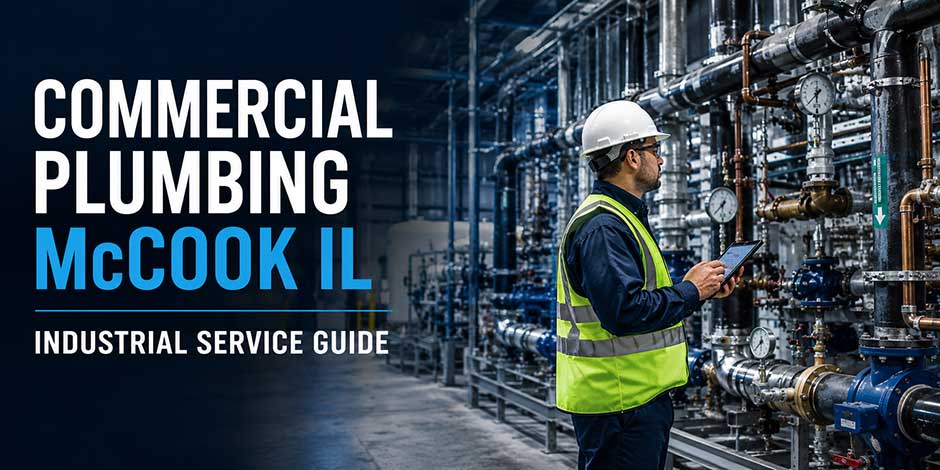
Why the Smallest Municipality in Cook County Has Some of the Biggest Commercial Plumbing Demands — and What Every Facility Manager Needs to Know
McCook, Illinois has 237 residents. That population figure — the lowest of any municipality in all of Cook County — makes McCook sound like a quiet rural hamlet tucked between Chicago suburbs. The reality is the opposite. McCook is one of the most industrially concentrated villages in the Chicago metropolitan area: a 2.61-square-mile community whose land use is dominated not by residential neighborhoods but by manufacturing plants, warehouses, distribution centers, engineering facilities, and logistics operations that together represent a commercial and industrial plumbing demand that dwarfs what its residential population suggests.
Electro-Motive Diesel (EMD) — the facility that has designed and engineered locomotive power systems for major railroads — operates here. UOP, with a history of petroleum refining and chemical processing operations, maintains a presence here. Transportation and warehousing is the dominant employment sector. The village’s internal street network features a grid layout with wide lanes and direct access points specifically designed to accommodate heavy truck traffic. I-294, the Tri-State Tollway, forms the western boundary — positioning McCook as a prime logistics corridor serving the entire Chicago metropolitan distribution network.
The commercial plumbing needs of McCook’s industrial landscape are categorically different from the residential plumbing services that most Cook County plumbers are built around. Floor drain systems handling industrial process waste. Catch basins managing heavy truck traffic runoff. Grease trap systems for facility food service operations. Backflow prevention compliance for industrial water connections. High-volume drain and sewer systems in facilities where a production line stopping because a floor drain backed up costs thousands of dollars per hour. Emergency commercial response that understands the difference between a residential convenience and an industrial operational necessity. For businesses in McCook that require licensed commercial plumbing support for these types of systems, see our commercial plumbing services in Bridgeview guide for detailed service coverage.
This guide covers everything facility managers, property owners, and business operators in McCook need to know about commercial plumbing service in this unique community.
McCook’s Industrial Character — Why Plumbing Here Is Different
The Smallest Village With the Largest Commercial Footprint
McCook’s 237 residents occupy a small residential section of a village whose land use is predominantly commercial and industrial. The Illinois EPA maintains an air quality monitoring site in McCook specifically to track particulate matter from industrial operations — a PM10 and PM2.5 monitoring installation that reflects the regulatory recognition of McCook’s industrial density. Groundwater contamination concerns near the UOP site, stemming from decades of petroleum refining and chemical processing operations, have required ongoing compliance monitoring under Cook County environmental policies.
This industrial history creates specific plumbing service requirements that residential contractors aren’t equipped to handle and that many commercial contractors underestimate. The floor drain in a McCook manufacturing facility has handled decades of industrial process waste, solvent residue, and heavy particulate loading. The catch basins in a McCook logistics center receive runoff from heavy truck traffic that includes diesel fuel, hydraulic fluid, and industrial lubricants. The grease trap in a McCook facility cafeteria serves a workforce eating three shifts per day in a facility that operates around the clock.
The Adjacent Suburban Context
McCook is bordered by Western Springs and LaGrange to the north, Lyons and Riverside to the east, and Brookfield to the northeast — directly adjacent to Suburban Plumbing Experts’ home base since 1978. This geographic position means McCook’s commercial facilities are served by the same Cook County combined sewer infrastructure that serves the surrounding residential communities — with the additional complexity of industrial and commercial discharge requirements that residential lateral connections don’t involve. Commercial properties throughout the surrounding suburbs face their own plumbing demands, from high-use drainage systems and sewer lines to water supply, fixtures, and emergency repairs. Our commercial plumbing services in Oak Lawn, IL provide a look at the commercial plumbing needs and services available to businesses elsewhere in the southwest suburbs.
The Cook County combined sewer system serves McCook commercial and industrial connections the same way it serves residential connections — and the same surcharge backup risk that affects Berwyn and Cicero basements during heavy rain events affects McCook’s below-grade facility systems during the same events. Commercial facilities with below-grade floor drains, below-grade loading dock areas, and below-grade utility connections face the same combined sewer surcharge exposure that drives backwater valve installations throughout Cook County — but at a scale and operational consequence that’s dramatically larger than a residential basement flood.
The Commercial Plumbing Needs of McCook’s Industries
Manufacturing and Heavy Industrial Facilities
Manufacturing facilities in McCook — including the EMD locomotive engineering campus and the various industrial operations that have historically defined the village — have plumbing infrastructure requirements that reflect decades of heavy industrial operation:
Industrial floor drain systems. Manufacturing facility floor drains handle process waste, cooling water, cleaning solution discharge, and in some cases, process fluid residue. These drains are connected to the sanitary or industrial waste system — and the accumulation of industrial debris, scale, and process residue requires professional hydro jetting at pressure levels and flow volumes that residential jetting equipment can’t produce. Industrial floor drain cleaning at McCook facilities requires equipment rated for the specific waste stream characteristics of that facility’s process.
Interceptor and separator systems. Facilities handling petroleum products, lubricants, solvents, or any hydrocarbon-containing waste are required by Cook County and Illinois environmental regulations to maintain properly functioning oil/water separator systems or interceptors before discharge to the combined sewer. A failing interceptor doesn’t just create a plumbing problem — it creates a regulatory compliance violation that can trigger EPA notices of violation and fines. Regular professional cleaning, inspection, and documentation of interceptor performance is a compliance obligation, not just a maintenance preference.
High-volume water supply systems. Manufacturing processes that use water — cooling systems, cleaning systems, process water supply — have supply line requirements that exceed residential capacity. Backflow prevention devices on industrial water connections are required by Cook County and the MWRD to prevent industrial process water from contaminating the potable supply. Annual testing and certification of backflow prevention assemblies is a regulatory requirement for commercial and industrial connections.
Warehouse and Distribution Facilities
McCook’s position on the I-294 corridor makes it a logical location for warehouse and distribution operations serving the Chicago metropolitan logistics market. Warehouse facilities have specific plumbing requirements:
Loading dock drainage. Loading docks receive truck traffic that brings rainwater, road salt, diesel fuel residue, and industrial lubricants onto the dock surface. Floor drain systems at loading dock areas handle this combined runoff and must be maintained clear and functional to prevent flooding of the dock area and the interior facility. A backed-up loading dock drain during a rain event stops receiving operations — the operational cost of a drain failure at an active distribution center can be substantial within hours.
Restroom and breakroom facilities. Large warehouse operations serving multiple shifts have high-demand restroom and breakroom plumbing that accumulates grease, soap scum, and organic material at rates proportional to employee count and shift volume. Annual professional drain cleaning of the high-use fixtures prevents the cumulative accumulation that produces the acute backup events that halt operations at the worst possible moment — during peak shipping periods when the facility is at maximum occupancy.
Catch basin maintenance for heavy truck traffic. Every McCook warehouse property with surface parking, access roads, or truck staging areas has catch basins collecting that surface runoff. McCook’s industrial vehicle traffic — heavy trucks at full load rating — deposits debris, tire rubber, diesel residue, and road material at rates that quickly exceed the capacity of unmaintained catch basins. Our catch basin services cover industrial and commercial catch basin cleaning, inspection, and structural assessment throughout McCook and the surrounding Cook County industrial corridor.
Facility Food Service Operations
Many McCook industrial facilities operate cafeterias, commissaries, or contracted food service operations serving their workforce. These food service operations generate the same FOG (fats, oils, and grease) loading that drives residential kitchen drain problems — but at commercial scale, with commercial-grade grease trap requirements that residential cleaning approaches can’t address.
A commercial grease trap serving a McCook facility cafeteria handling three shifts of industrial workers generates significantly more FOG per day than a restaurant of comparable seating serving lunch and dinner. Commercial grease trap pumping and cleaning at the frequency required by Cook County environmental code, with proper documentation of service, is the compliance baseline for any McCook facility with food service operations. Our commercial drain cleaning services cover McCook’s industrial and commercial facilities throughout the Cook County southwest corridor.
The Catch Basin Picture in McCook — Heavy Traffic, Heavy Accumulation
McCook’s infrastructure was specifically designed for heavy truck traffic — and that design decision has direct implications for catch basin maintenance. Heavy trucks deposit significantly more debris, petroleum residue, and solid material per mile traveled than passenger vehicles. A catch basin on a McCook industrial access road serving daily semi-trailer traffic accumulates material at rates that can require quarterly cleaning rather than the annual cleaning that residential neighborhood catch basins typically need.
The consequences of catch basin failure at a McCook commercial facility go beyond the inconvenience of standing water. A catch basin that’s structurally compromised — broken concrete, failing brick construction, deteriorating frame — creates a void in the pavement surface that can produce pavement failure under truck loading. A heavy truck driving over a failed catch basin creates a liability event that the basin maintenance cost would have prevented.
Annual catch basin inspection and cleaning for McCook commercial and industrial properties — with camera inspection of the basin structure to identify any deteriorating conditions — is the maintenance standard for facilities with heavy vehicle traffic. Our catch basin services include the high-capacity vacuum trucks necessary to clear the heavy debris loads that McCook’s industrial traffic produces, combined with structural inspection that identifies repair needs before they become pavement failures.
For the complete guide to what professional catch basin inspection finds and what each finding means, see our complete Chicago catch basin inspection guide.
Backflow Prevention Compliance — McCook’s Industrial Requirement
Commercial and industrial water connections in Illinois are required to have properly installed, maintained, and annually tested backflow prevention assemblies. The Illinois Plumbing Code and Cook County requirements mandate that cross-connection control programs — the regulatory framework for backflow prevention — apply to any commercial or industrial connection where contamination of the potable supply is a potential risk.
For McCook’s industrial facilities — facilities handling chemicals, petroleum products, cooling systems with chemical additives, process water with any potential contaminant — backflow prevention isn’t optional and it isn’t self-maintaining. Annual testing by a certified backflow tester, with documentation submitted to the water supplier, is the regulatory requirement. A failed backflow prevention assembly discovered in an annual test must be repaired or replaced before the connection can remain active.
McCook facilities that don’t have a current annual backflow prevention testing program are facilities operating out of compliance with Illinois Plumbing Code requirements — and the liability of a potable water contamination event from a failed, untested backflow device is considerably more significant than the cost of the annual test.
Emergency Commercial Plumbing Response in McCook
The operational stakes of a commercial plumbing failure in a McCook industrial facility are fundamentally different from a residential plumbing emergency. When a homeowner’s kitchen drain backs up, the inconvenience is real but the operational consequence is limited. When a floor drain backs up in an active manufacturing line at a McCook facility during the night shift, the operational consequence is production stoppage — and production stoppage in a manufacturing environment has an hourly cost measured in the thousands of dollars.
Commercial plumbing emergency response requires:
24-hour availability with commercial equipment. A residential plumber with a standard rod and a residential hydro jetter can’t handle an industrial drain emergency. Commercial facility floor drains, interceptors, and sewer connections require commercial-grade equipment — high-capacity jetting, industrial vacuum systems, commercial camera equipment — and operators who understand industrial facility access, safety requirements, and the urgency of operational restoration.
Understanding of facility operations. Responding to a commercial plumbing emergency at a McCook manufacturing facility requires understanding which systems can be isolated for emergency repair, which systems require lockout/tagout procedures before plumbing access, and which drains connect to what systems — knowledge that a plumber unfamiliar with industrial operations can’t provide under emergency conditions.
Documentation and compliance. Commercial facilities require documented service records for many plumbing systems — interceptor cleaning records, backflow test documentation, catch basin service records. An emergency plumbing service that doesn’t provide written documentation of work performed creates a compliance gap in the facility’s maintenance records.
Our commercial plumbing services cover McCook and the surrounding Cook County industrial corridor with 24/7 emergency response, commercial-grade equipment, and the documentation standards that industrial facility maintenance records require. For a broader overview of commercial plumbing systems, maintenance planning, common failures, and solutions for Chicagoland businesses, see our complete guide to commercial plumbing in Chicago and the suburbs. For the specific drain cleaning and maintenance issues affecting restaurants, office buildings, warehouses, and industrial properties, see our complete Chicago commercial drain cleaning guide.
What McCook Facility Managers Should Schedule for 2026
Quarterly: Catch basin inspection and cleaning for facilities with heavy truck traffic. Grease trap pumping and service for food service operations.
Semi-annually: Floor drain hydro jetting for manufacturing facilities with high process waste loading.
Annually: Backflow prevention assembly testing and certification. Catch basin structural inspection. Sewer lateral camera inspection for facilities with original infrastructure. Interceptor/separator inspection and performance documentation.
As needed: Emergency drain response, sewer backup investigation, water line assessment, fixture repair and replacement throughout facility.
Frequently Asked Questions: Commercial Plumbing in McCook
Our McCook facility has a grease trap but we’ve never had it professionally serviced. What’s our liability? Unserviced grease traps that allow FOG to pass through to the combined sewer create regulatory exposure under Cook County’s sewer use ordinance and Illinois EPA pretreatment requirements. Beyond regulatory liability, a grease trap that’s beyond capacity and passing FOG downstream creates drain line accumulation that can affect other tenants or facilities on the same sewer connection. Professional service with documentation creates the compliance record that demonstrates responsible operation.
How often should catch basins at a heavy truck facility be cleaned? For McCook facilities with daily semi-trailer traffic, quarterly inspection and cleaning is the appropriate starting point — with frequency adjusted based on what the inspection finds. A catch basin that’s consistently 75% full at a quarterly inspection warrants monthly service. A basin that’s consistently 25% full at quarterly inspection may be adequate at semi-annual service. The frequency should be determined by the actual accumulation rate at your specific facility’s traffic and drainage conditions.
We have a manufacturing process that uses water with chemical additives. What backflow prevention do we need? The specific backflow prevention assembly required depends on the degree of hazard the chemical additive represents to the potable water supply. High-hazard connections (chemicals that would be dangerous to ingest) require reduced pressure zone (RPZ) assemblies. Lower-hazard connections may require double check valve assemblies. A licensed plumber familiar with Illinois cross-connection control requirements can assess your specific connection and confirm the appropriate assembly type and testing schedule.
Need Commercial or Industrial Plumbing Service in McCook? We’re Right Next Door in Brookfield.
Licensed, insured, and based in Brookfield since 1978 — directly adjacent to McCook. We serve McCook’s industrial facilities, warehouses, and commercial operations with commercial-grade drain cleaning, hydro jetting, catch basin service, grease trap maintenance, backflow prevention testing, and 24/7 emergency response. Written quotes before we start, documentation on every service, our own licensed plumbers in McCook on every call. Send us a message and we’ll get back to you fast.
Or call us directly: 708-801-6530 | Open 24/7
—
Suburban Plumbing Sewer Line & Drain Cleaning Experts
Licensed & Insured | Open 24 Hours | Commercial & Industrial Service Throughout McCook & Cook County — Based in Neighboring Brookfield Since 1978
📞 Suburbs: 708-801-6530 | 📞 Chicago: 773-570-2191 | 🚨 Emergency: 708-518-7765