The Complete Guide for Elmhurst Homeowners Who Want to Fix Their Flooding Problem — and Get the City to Help Pay for It
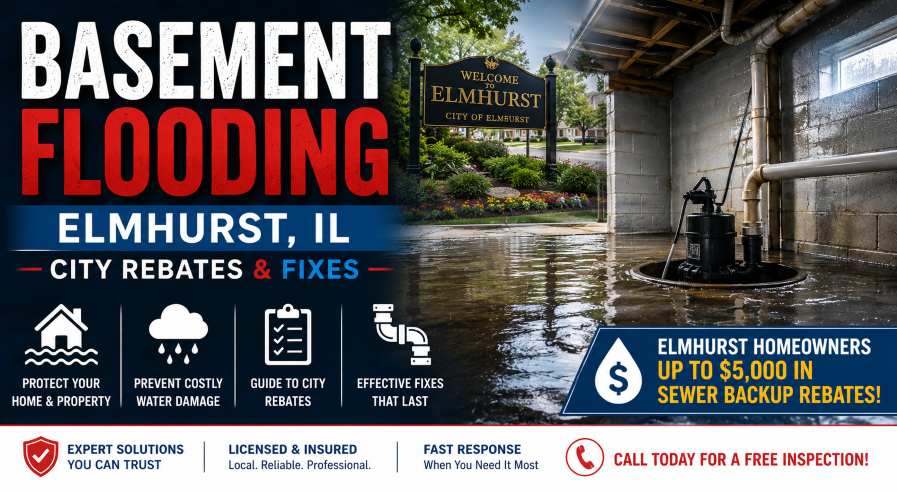
Most Elmhurst homeowners who have experienced basement flooding have done one of two things: called a plumber and paid full price for whatever was installed, or decided the cost was too high and kept living with the problem. What the majority of those homeowners don’t know is that the City of Elmhurst has two active financial assistance programs that reimburse homeowners for exactly the flood control installations that solve sewer backup problems — and together those programs can offset up to $8,000 of the project cost.
The City of Elmhurst’s Cost-Sharing Programs page lists both programs directly:
The Overhead Sewer Program provides 50% cost sharing up to a maximum of $5,000 for installing an overhead sewer system to protect basements from sewer backup. Some modified overhead sewer designs may also qualify.
The Check Valve Reimbursement Program provides 50% cost sharing up to a maximum of $3,000 for installing a check valve system to protect basements from sewer backup during heavy rain or surge events.
That’s up to $8,000 in combined city reimbursement for the two most effective sewer backup flood control solutions available — and both programs are active right now.
The reason Elmhurst has these programs is the same reason the city has been investing $78.8 million in water and sewer infrastructure improvements through 2031: the city’s own infrastructure announcement acknowledges that aging water and sewer infrastructure requires substantial repairs and replacements, with components at the Water Reclamation Facility approximately 30 years old requiring major upgrades. A city that’s investing nearly $80 million in its own aging water and sewer infrastructure understands that residential flooding problems in Elmhurst are real, recurring, and driven by infrastructure conditions that warrant financial assistance for homeowners trying to protect their properties.
If you’ve been putting off flood control installation because of cost, read this article before calling anyone. The city programs may change the calculation significantly.
Understanding Elmhurst’s Flooding Landscape
DuPage County’s Clay Soil and Flat Terrain
Elmhurst sits in DuPage County on the flat, former farmland terrain that characterizes the entire western Chicago suburban corridor. The soil is clay-heavy — poor-draining, expansive when wet, contracting when dry — which creates the two conditions that drive most Elmhurst basement flooding: high seasonal water table that pushes groundwater upward against foundations, and surface water that pools rather than draining quickly into the soil.
The clay soil also creates the seasonal movement that stresses underground pipe joints. Clay that expands in wet conditions and contracts in dry conditions moves the soil around buried sewer laterals continuously — accumulating stress on clay tile pipe joints over decades until those joints develop the gaps that allow root intrusion and groundwater infiltration.
Elmhurst’s Beautiful Tree-Lined Streets — and What They Do Underground
Elmhurst is consistently recognized as one of DuPage County’s most beautiful communities — the mature tree canopy along its residential streets is a genuine quality-of-life asset. Underground, those same trees are the primary source of sewer lateral service demand throughout the city.
The mature trees on Elmhurst’s parkways have root systems that extend 30 to 50 feet from the trunk, actively following the moisture gradient that a leaking sewer joint creates. In Elmhurst’s pre-1975 homes with original clay tile sewer laterals, those joints have been absorbing 50 or more years of freeze-thaw movement — and many have gaps that tree roots have been exploiting for decades. Root intrusion through clay tile lateral joints is the most common sewer service call throughout Elmhurst’s established residential neighborhoods. Many of these same older homes are also at greater risk for frozen and burst water pipes during severe winter weather. Learn more in our Frozen & Burst Pipes in Elmhurst guide.
Elmhurst’s Combined Sewer System
Unlike Woodridge’s separate sewer system, Elmhurst operates on a combined sewer system in many of its residential neighborhoods — the same storm and sanitary waste travel in shared pipes. This is the mechanism that makes the city’s Check Valve and Overhead Sewer programs so relevant: during heavy rain events that overwhelm Elmhurst’s combined sewer system capacity, pressure reverses through residential laterals and surfaces in basements through floor drains. The city is acknowledging this problem explicitly by offering financial assistance for the exact flood control installations that address it.
The Two Flooding Types in Elmhurst — Knowing Which One You Have
Before applying to any city rebate program — and before calling any contractor — understanding which type of flooding you have is the essential first step. Elmhurst homeowners face two distinct flooding mechanisms that require different solutions.
Type 1: Sewer Surcharge Backup
Water — carrying sewage odor — entering the basement through the floor drain, basement toilet, or basement sink during or after heavy rain events. The water source is the city’s combined sewer system backing up under pressure through your lateral. A sump pump cannot stop this. A French drain cannot stop this. A check valve (backwater valve) or an overhead sewer conversion are the two solutions the city’s own rebate programs are designed to fund.
Diagnostic signature: The water smells like sewage. It appears during or after rain events. It comes up through drain openings. The sump pump may be running perfectly at the same time.
Type 2: Groundwater Intrusion
Water entering gradually through the basement slab, floor-wall joints, or accumulating in the sump pit during sustained rain events or spring snowmelt. The source is a rising water table in Elmhurst’s clay-heavy soil creating hydrostatic pressure against the foundation. A properly functioning sump pump with battery backup installation is the primary defense.
Diagnostic signature: The water has no odor. It enters gradually, not suddenly. It correlates with sustained rainfall or snowmelt over hours, not storm-peak intensity. The sump pit fills and the pump activates.
Many Elmhurst homes — particularly older properties in established neighborhoods — face both types simultaneously. Addressing both requires both solutions.
The City’s Two Rebate Programs — Complete Details
Program 1: The Overhead Sewer Program — Up to $5,000
What it covers: The Overhead Sewer Program provides 50% cost sharing up to $5,000 for installing an overhead sewer system that protects basements from sewer backup. Some modified overhead sewer designs may also qualify — contact the City of Elmhurst Public Works Department to confirm whether your specific installation design qualifies.
What an overhead sewer conversion does: As covered in our complete Chicago overhead sewer conversion guide, an overhead conversion reroutes all basement drain connections to a level above the combined sewer main’s surcharge elevation. When the city’s sewer surcharges during a heavy rain event, there is no below-grade connection for the pressure to enter your home — the protection is structural rather than mechanical, requiring no valve, no battery, and no maintenance to function.
The rebate calculation: An overhead sewer conversion in an Elmhurst home typically costs $12,000 to $30,000 depending on basement configuration, number of fixtures, and installation complexity. At 50% reimbursement capped at $5,000, the city’s contribution reduces a $15,000 project to a $10,000 net cost — meaningful financial assistance for the most comprehensive flood protection available.
Who should apply for this program: Elmhurst homeowners who have experienced repeated sewer backup events, who have already had a check valve installed but still experience flooding, who are finishing or renovating a basement and want permanent protection, or who own a two-flat or multi-unit building where recurring basement flooding creates tenant liability.
Application: The Overhead Sewer Program Application is available through the City of Elmhurst Public Works Department. Contact Public Works at (630) 530-3000 before signing any installation contract to confirm program availability, current funding status, and required documentation.
Program 2: The Check Valve Reimbursement Program — Up to $3,000
What it covers: The Check Valve Reimbursement Program provides 50% cost sharing up to $3,000 for installing a check valve system that protects basements from sanitary flooding during heavy rain events or any surge of the main sewer.
What a check valve (backwater valve) does: A backwater valve — installed in the main sewer lateral in the basement floor — allows normal waste flow out of the home but seals automatically when pressure reverses from the city’s surcharging sewer main. The valve’s flap closes against the reverse pressure, physically preventing sewage from entering your home’s drain system during a surcharge event. Our complete sewer backflow prevention service covers backwater valve installation throughout the Elmhurst area with all required permits included.
The rebate calculation: Backwater valve installation in an Elmhurst home typically costs $2,500 to $5,500 installed with permits. At 50% reimbursement capped at $3,000, the city’s contribution reduces a $4,000 installation to a $1,000 to $2,000 net cost — potentially making the installation nearly cost-neutral for some Elmhurst homeowners.
Who should apply for this program: Elmhurst homeowners who have experienced sewer backup through the floor drain during or after heavy rain events and have not yet had a backwater valve installed. This is the appropriate first-step flood control installation for most Elmhurst homes with sewer surcharge exposure — the overhead conversion program is for homeowners who need a more comprehensive or permanent solution.
Application: The Check Valve Reimbursement Program Application is available through the City of Elmhurst Public Works Department. Contact Public Works before installation begins — the reimbursement applies to future installations, not retroactively to work already completed.
Combining Both Programs — Maximum Protection, Maximum Reimbursement
For Elmhurst homeowners with significant sewer backup history or for those finishing basements where complete protection is the goal, the two programs can be used together — installing a check valve as the primary mechanical protection while planning an overhead conversion for permanent protection.
More practically: an Elmhurst homeowner who installs a check valve now (recovering up to $3,000) and later upgrades to an overhead sewer conversion (recovering up to $5,000) captures the full $8,000 in combined program benefits across the two projects. The check valve provides immediate protection while the overhead conversion planning and budgeting proceeds.
Note that the overhead sewer conversion typically makes the check valve unnecessary — the overhead conversion eliminates the below-grade sewer connection that the check valve protects. Discuss with your contractor whether a check valve installation makes sense as a standalone step in your specific situation or whether moving directly to overhead conversion planning is more appropriate.
What the City’s $78.8 Million Investment Means for Your Private-Side Plumbing
The City of Elmhurst is investing $78.8 million in water and sewer infrastructure improvements through 2031 specifically because the public infrastructure is aging and requires substantial repairs. The 2024 water and sewer rate adjustments Elmhurst homeowners are now paying fund this investment.
What the city’s investment does: upgrades the Water Reclamation Facility, addresses aging public mains and sewer infrastructure, and improves the city’s capacity to handle the combined storm and sanitary flows that currently produce the surcharge events that flood residential basements.
What the city’s investment doesn’t do: replace or repair the private sewer laterals running from individual homes to the public mains, address the private-side pipe conditions in Elmhurst’s pre-1975 clay tile lateral housing stock, or install flood control devices in individual homes.
The public investment improves the system your home connects to. The private-side infrastructure — the sewer lateral, the flood control devices, the supply pipes — remains the homeowner’s responsibility. The rebate programs exist specifically because the city recognizes that homeowners need assistance managing the private-side flooding consequences of a shared infrastructure challenge.
The Sump Pump Reality for Elmhurst’s Groundwater Problem
Separate from sewer backup — which the check valve and overhead sewer programs address — Elmhurst’s groundwater conditions require the sump pump to be functioning correctly and equipped with battery backup.
Elmhurst’s clay-heavy soil creates a water table that rises significantly during sustained rain events and spring snowmelt. Every home with a below-grade basement in Elmhurst’s established neighborhoods needs a sump pump managing that groundwater — and in a combined sewer neighborhood where the worst storms coincide with the highest power outage risk, battery backup isn’t optional.
Our sump pump services cover installation, battery backup addition, and replacement throughout the Elmhurst area with same-day and 24/7 emergency response.
For the complete breakdown of sump pumps vs ejector pumps — and when Elmhurst homes with basement bathrooms or laundry need both — see our complete guide to sump pumps vs ejector pumps in Chicago.
The Diagnostic Framework — Which Solution Does Your Elmhurst Home Need?
Does the water smell like sewage? Yes → sewer surcharge backup. Apply for the Check Valve Reimbursement Program immediately. If you’ve already had a check valve and still flood, apply for the Overhead Sewer Program. No → groundwater intrusion. Sump pump assessment and upgrade is the priority.
Where does the water enter? Floor drain or basement toilet → sewer backup regardless of odor. Check valve program applicable. Sump pit, floor slab, wall-floor joint → groundwater. Sump pump territory. Both locations → both mechanisms present. Need both solutions.
When does it happen? Peak storm intensity, fast onset → sewer surcharge indicator. Gradually during or after sustained rain → groundwater accumulation. Both patterns at different events → both mechanisms present.
Have you already had a check valve installed? Yes and still flooding → either the valve is malfunctioning, the surcharge pressure exceeded the valve’s capacity, or flooding is also from groundwater. Assessment needed. Overhead conversion may be the next step and the Overhead Sewer Program applies. No → check valve installation is the first step. Check Valve Reimbursement Program applies.
For the complete framework on which flood control systems actually work for Chicago-area homes — and which expensive solutions are frequently oversold to homeowners who don’t need them — see our complete guide to Chicago flood control systems that actually work.
What Flood Protection Costs in Elmhurst in 2026 — Before and After Rebates
| Solution | Full Cost | City Rebate (max) | Net Cost After Rebate |
|---|---|---|---|
| Check valve / backwater valve | $2,500–$5,500 | Up to $3,000 | $0–$2,500 |
| Overhead sewer conversion | $12,000–$30,000 | Up to $5,000 | $7,000–$25,000 |
| Sump pump with battery backup | $700–$1,500 | No program | $700–$1,500 |
| Combined (check valve + sump) | $3,200–$7,000 | Up to $3,000 | $200–$4,000 |
What Elmhurst Homeowners Should Do Right Now
Step 1: Contact the City of Elmhurst Public Works Department at (630) 530-3000 before signing any flood control installation contract. Confirm current program availability, funding status, and the specific documentation required for reimbursement. Program terms and funding availability can change — confirm directly with the city before any commitment.
Step 2: Diagnose your flooding type using the framework above. The rebate programs cover sewer surcharge solutions — if your flooding is groundwater intrusion, the programs don’t apply but the sump pump solution is significantly less expensive.
Step 3: Get a professional assessment of your specific situation — sewer camera inspection to confirm lateral condition, flood type diagnosis, and a contractor recommendation for which program is most appropriate.
Step 4: Use a licensed contractor who pulls all required permits as part of the installation. The city programs require permitted, inspected work — unpermitted installations don’t qualify for reimbursement.
Our Elmhurst plumbing and sewer services cover the complete range of flood control assessment, installation, and permitting throughout the city with same-day assessment availability.
Frequently Asked Questions: Elmhurst Flood Control and City Rebate Programs
Can I apply for both the Overhead Sewer Program and the Check Valve Reimbursement Program? The programs address different installations — check valve and overhead sewer. Whether both can be used for the same property or on a sequential basis is something to confirm directly with the City of Elmhurst Public Works Department before any installation planning. Contact the city at (630) 530-3000 for program-specific eligibility questions.
Does the city require a specific contractor for the rebate programs? The contractor must be licensed and pull required permits — the work must pass city inspection to qualify. We handle all permitting and inspections as part of every installation. Confirm specific contractor requirements with the city when you apply.
I had a check valve installed last year and it’s already failed. Can I apply for the reimbursement program for the replacement? Reimbursement program details, including whether replacements qualify and what documentation is required, should be confirmed directly with the City of Elmhurst. Contact Public Works to discuss your specific situation.
My Elmhurst home has never flooded but my neighbors have experienced backups. Should I install a check valve preemptively? Preemptive installation before experiencing a backup is a legitimate decision — the combined sewer surcharge that affects your neighbors affects your lateral too. Whether your specific home’s elevation, lateral condition, and connection to the combined sewer creates meaningful surcharge risk is something a professional assessment can confirm. The Check Valve Reimbursement Program applies to proactive installations as well as reactive ones.
What happens to basement toilet and sink use after an overhead sewer conversion? After an overhead conversion, all basement fixtures connect to an ejector pump that forces waste uphill to the new elevated connection. The basement toilet and sink function normally — waste goes to the ejector basin, the pump activates, and discharge travels uphill to the overhead connection. Battery backup for the ejector pump is recommended to maintain full basement fixture functionality during power outages.
Dealing With Basement Flooding in Elmhurst? Let’s Help You Access the City’s Rebate Programs.
Licensed, insured, and serving Elmhurst since 1978. We install check valves, overhead sewer systems, and sump pump upgrades throughout Elmhurst — with all permits pulled, all inspections coordinated, and complete documentation for city reimbursement program applications. Written quotes before we start, our own licensed plumbers on every call. Send us a message and we’ll get back to you fast.
Or call us directly: 630-749-9057 | Open 24/7
—
Suburban Plumbing Sewer Line & Drain Cleaning Experts
Licensed & Insured | Open 24 Hours | Serving Elmhurst & DuPage County Since 1978
📞 Suburbs: 630-749-9057 | 🚨 Emergency: 708-518-7765