
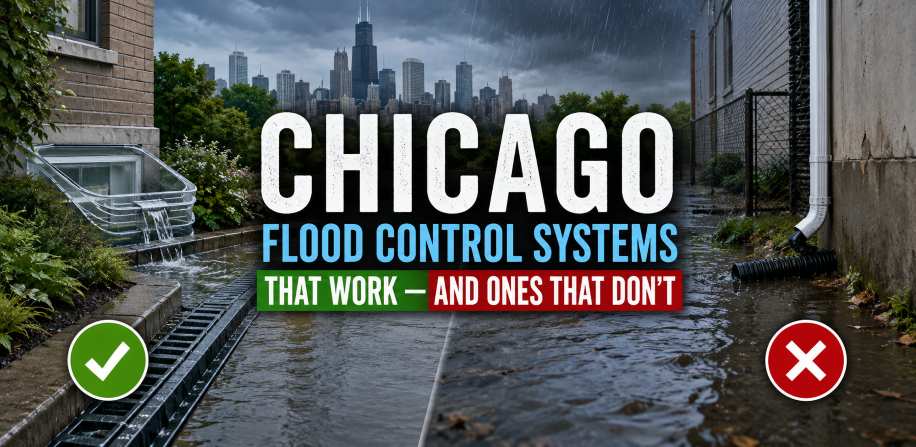
The Honest Guide Chicago Homeowners Need Before Spending $5,000 on the Wrong Solution
Every spring in Chicago, thousands of homeowners make the same expensive mistake. They’ve had a basement flood — sewage backing up through the floor drain, water seeping through the foundation walls, the sump pit overflowing during a storm — and they call a contractor who installs something. A sump pump. A backwater valve. An interior drain tile system. Waterproofing paint. Sometimes they spend $500. Sometimes they spend $15,000. And then the next significant storm arrives and the basement floods again — because the system they installed doesn’t address the type of flooding they actually have.
This is Chicago’s most expensive plumbing mistake. Not the flood itself — the wrong fix for the flood.
The flood control industry in Chicago is full of contractors who specialize in one solution and apply it to every problem. Waterproofing companies that sell interior drain tile to homeowners whose problem is sewer surcharge backup. Sump pump vendors who upgrade equipment for homeowners whose sump pit is working perfectly but whose floor drain is connected to a city sewer that’s overflowing. Handymen who install backwater valves in homes that don’t connect to a combined sewer and therefore have zero sewer surcharge risk. Each of these installations costs real money. None of them solve the actual problem.
This guide is different from every other flood control article written for Chicago homeowners. It tells you what works — specifically, for specific flooding types — and it tells you exactly what doesn’t work, why, and what the contractor who sold it to you may not have explained. By the end, you’ll know exactly which system your home actually needs, which ones are a waste of money for your situation, and how to evaluate any contractor’s recommendation before you sign anything.
The Foundation of Everything: Your Flooding Type Determines Your Solution
Before any conversation about flood control systems makes sense, you must know what type of flooding you have. In Chicago, there are three completely distinct flooding mechanisms — and they have zero overlap in terms of what solves them.
Type 1: Sewer Surcharge Backup Water — typically carrying sewage — enters your basement through the floor drain, basement toilet, or any below-grade fixture during or after heavy rain. The source is the city’s combined sewer system backing up under pressure through your sewer lateral. This water comes from outside your home traveling inward through your drain lines. It smells like sewage. It arrives during peak storm intensity. It has nothing to do with groundwater, your sump pump, or your drainage system.
Type 2: Groundwater Intrusion Water enters your basement through the slab floor, through floor-wall joints, up through the sump pit, or through foundation wall cracks below grade. The source is a rising water table — saturated soil around your foundation creating hydrostatic pressure that pushes water through every available opening. This water is clean or slightly silty. It arrives gradually during sustained rain or snowmelt, not during peak storm intensity.
Type 3: Surface Drainage Failure Water enters your basement through above-grade openings — window wells, foundation wall cracks above grade, improperly graded soil directing surface runoff toward the foundation. The source is surface water that isn’t being directed away from the foundation effectively. This water arrives quickly and correlates with the heaviest rainfall moments rather than building gradually.
The single most important diagnostic question: Does the water have a sewage odor? If yes — Type 1, sewer surcharge. No exceptions. If no — Type 2 or Type 3, continue diagnosing. This one question eliminates the most common and most expensive flood control mistake in Chicago.
According to the MWRD’s Understanding Your Sewer resource, Chicago’s combined sewer system carries both stormwater runoff and sanitary sewage in the same pipes. During heavy rain events, when the system reaches capacity, the pressure that builds in the mains reverses through every residential lateral connected to the main. This is Type 1 flooding — and it requires a completely different solution from Types 2 and 3. If you want a real-world example of how complex sewer system behavior can directly lead to basement flooding in suburban communities, see our breakdown of basement flooding in Bolingbrook, IL and how two different sewer systems in one village create completely different flood risks.
Systems That Actually Work — Matched to the Problem They Solve
What Actually Works for Type 1: Sewer Surcharge Backup
✅ BACKWATER VALVE — The Single Most Effective Solution for Sewer Surcharge
A backwater valve — installed in the main sewer lateral in the basement floor — is a one-way gate. Waste flows out normally during all conditions. When pressure reverses from the city’s sewer main during a surcharge event, the valve’s flap seals shut automatically, physically preventing sewage from entering your home’s drain system. The city’s pressure has no path into your home.
This is the correct, direct, targeted solution for Type 1 flooding. It addresses the mechanism — reverse flow from the city main — with a mechanical barrier that requires no power, no monitoring, and no intervention. When the city’s system surcharges, the valve closes. When pressure normalizes, it opens. Your basement stays dry.
Sewer surcharge behavior can vary significantly across different Chicagoland suburbs depending on how sewer districts are structured and managed. For example, Darien sewer backup and flood control conditions are influenced by multiple sewer districts operating within the city, which can change how pressure builds and how basement backups occur during major rain events.
Cost: $2,500 to $5,500 installed with permits. In many Chicagoland municipalities, rebate programs reimburse $2,000 to $4,000 of that cost — making a backwater valve one of the most cost-effective flood control installations available.
For the complete breakdown of what Illinois law requires for backwater valve installation, what Chicago’s backflow prevention codes specify, and what rebate programs are available in your municipality, see our complete guide to backflow prevention in Chicago.
Our sewer backflow prevention services handle backwater valve installation throughout Chicago and the suburbs — all permits included, same-day assessment available.
✅ OVERHEAD SEWER CONVERSION — The Permanent Solution With No Moving Parts
An overhead sewer conversion reroutes all basement drain lines above the level of the main sewer — above the surcharge threshold. When the city’s system backs up, there’s no below-grade connection for the pressure to enter through. Sewer backup becomes physically impossible, not mechanically prevented. No valve. No battery. No maintenance. If you want a deeper breakdown of how this works, what it costs, and who actually needs it, you can read our full guide here:
Overhead Sewer Conversion in Chicago
This is the right solution for homes with repeated severe sewer backup history, homes with finished basements where backup events cause catastrophic damage, or homeowners who want permanent protection rather than mechanical protection that requires maintenance.
Cost: $12,000 to $30,000 depending on basement configuration and how many below-grade fixtures need to be rerouted. High cost relative to a backwater valve — but zero maintenance cost and zero failure risk going forward. Our overhead sewer services cover full overhead sewer conversion throughout Chicago and the suburbs.
What Actually Works for Type 2: Groundwater Intrusion
✅ SUMP PUMP WITH BATTERY BACKUP — The Primary Defense Against Rising Groundwater
The sump pump removes groundwater that accumulates in the sump pit. Perimeter drain tile — either existing or installed as part of an interior drain system — routes groundwater toward the pit. The pump activates when the pit level rises and discharges the water away from the foundation.
This is the correct solution for Type 2 flooding caused by a rising water table. It directly addresses the mechanism — groundwater accumulation — by actively removing the water before it can reach the basement floor.
The battery backup is not optional in Chicago. The storms that generate the most severe groundwater intrusion are the same storms most likely to knock out power. A sump pump without battery backup is a pump that will fail at the worst possible moment — every time. For the full breakdown of sump pump types, failure signs, and what replacement costs in Chicago, see our sump pump services.
Cost: $400 to $900 for standard replacement, $700 to $1,500 with battery backup, $1,200 to $2,500 for new pit installation.
✅ FRENCH DRAIN / INTERIOR PERIMETER DRAIN TILE — Intercepting Groundwater Before It Reaches the Foundation
A French drain intercepts groundwater before it builds hydrostatic pressure against your foundation walls. Exterior French drains installed at footer depth redirect lateral groundwater movement away from the foundation. Interior perimeter drain tile systems collect water that reaches the foundation wall-floor joint and route it to the sump pit rather than allowing it to accumulate on the basement floor.
French drains address the same groundwater problem as the sump pump but at a different point in the water’s journey — the drain intercepts water before it enters, while the sump pump removes it after it’s accumulated. The two are often installed together for complete protection in high-water-table areas.
Our French drain installation service covers both exterior and interior perimeter drain systems throughout Chicago and the suburbs — tailored for Chicago’s clay soil conditions that require specific gravel selection and filter fabric design.
What Actually Works for Type 3: Surface Drainage Failure
✅ FRENCH DRAIN FOR YARD DRAINAGE — Intercepting Surface Runoff Before It Reaches the Foundation
For surface drainage failures — water pooling in the yard, surface runoff directed toward the foundation, window wells filling with rainwater — a French drain installed in the yard intercepts surface water and redirects it away from the foundation before it finds entry points.
This is a different application of French drain technology from the perimeter drain tile described above. A yard French drain addresses above-grade surface water. A perimeter foundation drain addresses subsurface groundwater. Both use the same technology but solve different problems and are installed at different locations and depths.
✅ WINDOW WELL COVERS AND GRADE CORRECTION
For homes where surface water enters through window wells or through above-grade foundation wall openings created by improper soil grade, physical barriers and grade correction are the appropriate solutions. Proper grading that directs surface runoff away from the foundation at a minimum 6-inch drop over 10 horizontal feet is the building code standard — and it’s the most cost-effective surface drainage solution available when the grade condition is the primary cause.
Systems That Don’t Work — And Why
This is the section most flood control articles never include. These are the solutions that get sold frequently in Chicago but don’t address the actual cause of specific flooding types.
❌ SUMP PUMP FOR SEWER SURCHARGE BACKUP
This is Chicago’s single most common and most expensive flood control mistake. A homeowner experiences sewage backup through their floor drain during a heavy storm. A contractor installs a larger sump pump. The next storm produces another sewage backup. The sump pump is running perfectly.
Why it doesn’t work: The sump pump has zero connection to your sewer lateral. It collects groundwater in its pit and discharges it away from the foundation. Water traveling backward through your drain lines from the city’s surcharging sewer main doesn’t enter the sump pit — it enters through the floor drain, which is connected to the sewer lateral, not the sump pit. These are two separate systems.
A sump pump cannot stop, slow, or mitigate sewer surcharge backup. Not a larger pump. Not a higher-powered pump. Not two pumps. The mechanism is wrong.
❌ FRENCH DRAIN FOR SEWER SURCHARGE BACKUP
A French drain redirects groundwater. It has no connection to and no effect on water traveling backward through your drain lines from the city sewer main. A homeowner whose basement floods specifically from sewer surcharge during heavy rain who installs a French drain will have a well-drained yard and a basement that still floods — because the flooding mechanism is the combined sewer system, not groundwater.
French drains are valuable for Type 2 and Type 3 flooding. For Type 1 sewer surcharge backup, they do nothing.
❌ WATERPROOFING PAINT AND SEALANTS FOR ANY FLOODING TYPE
Waterproofing paint applied to basement walls is the single most commonly oversold and least effective flood control product available. It creates a surface coating that may temporarily reduce minor moisture seepage through porous concrete but provides zero protection against:
- Hydrostatic pressure from a high water table — the water simply finds an unsealed joint or crack and enters there instead
- Sewer surcharge backup — which enters through drain openings, not through wall surfaces
- Surface drainage failure — which enters through above-grade openings, window wells, and improperly graded approaches
A basement with Type 2 groundwater intrusion that gets painted with waterproofing sealant will have painted walls and a wet floor. The hydrostatic pressure that was pushing water through the walls will now push it through the floor-wall joint, through any crack the paint didn’t cover, and through any drain connection. Waterproofing paint treats a symptom — surface porosity — not a cause. The cause is hydrostatic pressure, which requires drainage, not coating.
❌ BACKWATER VALVE ON A HOME WITHOUT COMBINED SEWER EXPOSURE
A backwater valve is the correct solution for sewer surcharge backup in a home connected to a combined sewer system. It’s an unnecessary installation for a home connected to a separate sewer system where storm and sanitary run in separate pipes — because the surcharge mechanism that the valve prevents doesn’t exist in that system.
Many newer suburban municipalities and subdivisions built after the 1980s operate on separate sewer systems. A homeowner in one of these communities who installs a backwater valve based on a contractor’s recommendation without confirming that their property is actually served by combined sewer infrastructure has spent $3,000 to $5,000 on protection they don’t need for the flooding type they have.
Confirm your sewer system type with your municipality’s public works department before installing any sewer-side flood control device.
❌ SINGLE-SYSTEM SOLUTIONS FOR MULTI-SYSTEM PROBLEMS
Many Chicago homes — particularly older properties in transitional neighborhoods on combined sewer systems with clay-heavy soil and finished basements — have more than one flooding type simultaneously. A home with both sewer surcharge backup risk (Type 1) and groundwater intrusion (Type 2) needs both a backwater valve and a sump pump with battery backup. Installing only one addresses only one problem.
The most common presentation of this multi-system problem: a homeowner installs a backwater valve to stop sewer backup. The next storm produces groundwater flooding — the sump pump that was already undersized or aging failed during the storm. The homeowner concludes the backwater valve didn’t work. The backwater valve worked perfectly — it stopped the sewer surcharge. The flooding was from a different mechanism that the backwater valve was never designed to address.
Complete flood protection for a Chicago home with multiple flooding types requires solutions matched to each type. For the complete framework on when you need more than one system and how they work together, see our complete guide to French drains vs sump pumps vs backwater valves.
❌ INSURANCE ENDORSEMENTS AS FLOOD PREVENTION
Sewer backup endorsements on homeowners insurance policies are valuable — they cover the cost of remediation after a backup occurs. They do not prevent backups. A homeowner who adds a sewer backup endorsement to their policy and considers their flood control problem solved has confused financial protection with physical protection. The endorsement pays for cleanup. It doesn’t stop the sewage.
The right approach is both — flood control installations that prevent backups, and insurance endorsements that cover remediation costs in the event that a covered event still occurs. For the complete breakdown of what insurance covers and what it doesn’t in Chicago’s flooding environment, see our complete guide to sewer backups and homeowners insurance in Chicagoland.
The Complete Flood Control Matrix for Chicago Homes
Use this as a quick reference after diagnosing your flooding type:
| Flooding Type | What Causes It | What Works | What Doesn’t Work |
|---|---|---|---|
| Sewer surcharge backup (sewage odor, floor drain, during storm peaks) | City combined sewer reversing through your lateral | Backwater valve, overhead sewer conversion | Sump pump, French drain, waterproofing paint |
| Groundwater intrusion (clean water, sump pit, gradual) | Rising water table, hydrostatic pressure | Sump pump + battery backup, French drain/perimeter tile | Backwater valve, waterproofing paint |
| Surface drainage (window wells, above-grade entry) | Surface runoff directed toward foundation | Yard French drain, grade correction, window well covers | Sump pump, backwater valve |
| Multiple types simultaneously | Multiple mechanisms | Multiple matched solutions | Any single-system solution |
Chicago-Specific Factors That Affect Every Flood Control Decision
Combined sewer coverage is not uniform across the Chicago metro.
Chicago proper and most pre-1980s inner-ring suburbs operate on combined sewers — backwater valve appropriate for sewer surcharge risk. Many newer suburban municipalities have separate sewer systems — sewer surcharge risk is much lower, backwater valve less necessary. Confirm your system type before any installation.
The DuPage County stormwater infrastructure context. The DuPage County Stormwater Management program maintains 17 flood control facilities and 25 stream gauges throughout the county specifically because DuPage’s flat terrain and clay soil create stormwater management challenges that individual homeowners’ systems must work alongside — not independently of.
Homeowners looking for a practical framework to identify their specific flooding source and match it to the correct solution can review our Complete Flood Control Guide for Orland Park, IL.
Clay soil throughout Chicagoland changes French drain design requirements. French drains in Chicago’s clay-heavy soil require specific gravel composition and filter fabric selection that differs from sandy-soil installations. A French drain installed without accounting for clay soil conditions will clog progressively and fail to perform within a few years.
Municipal rebate programs significantly affect the cost calculation. Many Chicagoland municipalities offer rebate programs for backwater valve installation and flood control system improvements — some reimbursing $2,000 to $4,000 or more. Always check with your village hall before signing any flood control contract. The rebate may change which solution is most cost-effective for your situation.
Permits are required for all flood control installations. Backwater valve installation, overhead sewer conversions, sump pump pit installation, and French drain connections to city storm sewers all require permits in Chicago and most Chicagoland municipalities. We pull all required permits as part of every installation.
The Right Sequence: How to Make a Flood Control Decision Without Wasting Money
Step 1: Diagnose your flooding type using the three-type framework above. The sewage odor test is definitive. Where the water enters is highly informative. When it arrives relative to storm intensity is diagnostic.
Step 2: Confirm your sewer system type. Contact your municipality’s public works department and ask whether your address is served by a combined or separate sewer system. This single piece of information determines whether a backwater valve is the solution or an unnecessary expense.
Step 3: Assess whether you have one flooding type or multiple. A home with both sewer surcharge risk and groundwater intrusion needs solutions for both. Addressing only one and hoping the other resolves itself costs more in the long run than addressing both correctly in a single project.
Step 4: Get a professional assessment before any installation. A licensed plumber who assesses your basement’s condition, reviews your flooding history, and confirms your sewer system type before recommending a solution is the baseline standard. A contractor who recommends a solution before completing any assessment is applying a predetermined answer to an undiagnosed problem. If you’re investing in flood protection, it’s also worth learning how modern smart leak detection devices can alert you to water leaks before they become major disasters. Read our guide to Smart Leak Detection in Chicago: What These Devices Actually Do and Whether They’re Worth It..
Step 5: Confirm permit requirements and rebate availability in your municipality. Before signing any flood control contract, check whether the proposed installation requires permits and whether your municipality has a rebate program that applies.
Our flood control systems team provides complete flood control assessments throughout Chicago and the suburbs — diagnosis, system recommendation, installation, permitting, and documentation in a single service relationship.
What Complete Flood Protection Costs in Chicago in 2026
Backwater valve installation: $2,500 to $5,500 installed with permits. Potentially $1,500 to $2,500 net after municipal rebate programs.
Overhead sewer conversion: $12,000 to $30,000. Permanent solution, zero ongoing maintenance cost.
Sump pump replacement with battery backup: $700 to $1,500 installed. The most cost-effective flood control upgrade for homes with existing sump pits.
New sump pit and pump installation: $1,200 to $2,500 installed.
Yard French drain (20-50 linear feet): $1,500 to $4,000.
Interior perimeter drain tile system: $4,000 to $10,000.
Complete flood protection system (backwater valve + sump pump + battery backup): $3,500 to $7,500 for most Chicago homes with both sewer surcharge and groundwater risk.
For a complete breakdown of what each flood control solution costs, what drives prices higher, and how to evaluate contractor quotes, see our basement flooding services page.
Frequently Asked Questions: Chicago Flood Control Systems
A contractor quoted me $15,000 for interior waterproofing. Is that worth it? Interior waterproofing systems — drain tile, sump pit, and sump pump installed along the interior perimeter — are a legitimate solution for groundwater intrusion (Type 2 flooding). They can be effective. The question is whether your flooding is actually Type 2. If your flooding is sewer surcharge backup (Type 1), a $15,000 interior waterproofing system won’t stop it — because the water isn’t coming through your walls, it’s coming through your drain lines. Diagnose your flooding type first. Then evaluate whether the proposed solution matches the diagnosed cause.
My neighbors have backwater valves and still flooded. Do they work? A properly installed, functional backwater valve stops sewer surcharge backup — the mechanism it’s designed to prevent. If your neighbors with backwater valves flooded, the flooding was either from a different mechanism (groundwater, surface drainage) that the valve isn’t designed to address, or the valve experienced a mechanical failure. Backwater valves require periodic inspection and maintenance — a valve that hasn’t been serviced in several years may not seat correctly. This is an argument for valve maintenance, not an argument against valve installation.
The city told me my flooding is their problem to fix. Is that true? The city is responsible for maintaining the public sewer infrastructure in the street right-of-way. Your private sewer lateral — from your foundation to the main — and your home’s internal flood control systems are your responsibility. If the city’s combined sewer main doesn’t have adequate capacity for current storm volumes, that’s a long-term infrastructure issue that municipalities are addressing over time. In the meantime, a backwater valve on your private lateral protects your basement from the surcharge events that occur when the public system reaches capacity. Waiting for the city to solve a system-capacity problem is not a flood control strategy.
Can I install flood control systems myself? Backwater valve installation requires cutting the concrete basement floor, accessing and modifying the main sewer lateral, and permits that require licensed plumber installation. This is not a DIY project. Sump pump replacement in an existing pit is within DIY range for a capable homeowner — the mechanical connection is accessible and the equipment is standard. New pit installation, overhead sewer conversion, and any work involving the main sewer lateral requires a licensed plumber and permits.
Not Sure Which Flood Control System Your Chicago Home Actually Needs?
Licensed, insured, and locally based in Brookfield since 1978. We diagnose your flooding type before recommending any system — and we tell you honestly when a proposed solution won’t solve your specific problem. Written quotes before we start, permits pulled on every installation, our own licensed plumbers on every call. Send us a message and we’ll get back to you fast.
Or call us directly: 708-801-6530 | Open 24/7
—
Suburban Plumbing Sewer Line & Drain Cleaning Experts
Licensed & Insured | Open 24 Hours | Serving Chicago & Chicagoland
📞 Suburbs: 708-801-6530 | 📞 Chicago: 773-570-2191 | 🚨 Emergency: 708-518-7765