
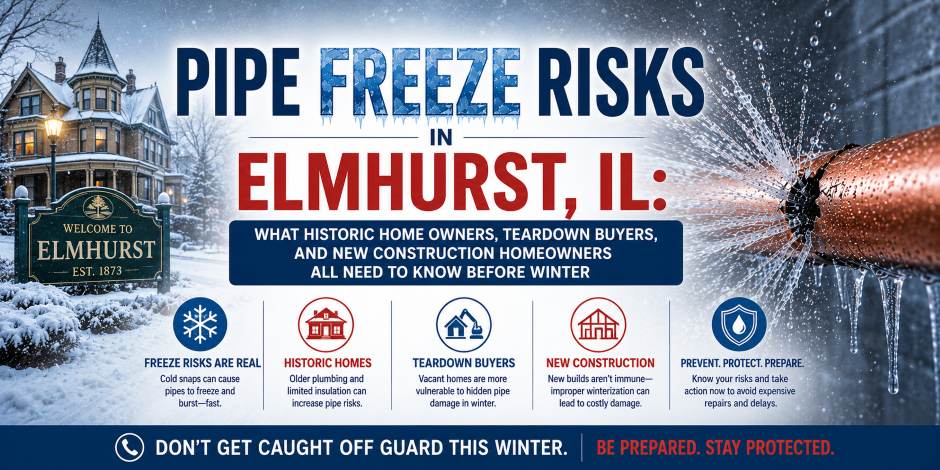
Elmhurst Has Three Completely Different Frozen Pipe Risk Profiles Living on the Same Streets — A Century-Old Victorian Next to a 1957 Ranch Next to a 2019 Teardown Replacement. Each One Has Different Pipe Materials, Different Freeze Vulnerabilities, and Different Damage Potential. Which One Are You?
Elmhurst is a city of approximately 46,000 residents straddling DuPage and Cook counties, 16 miles west of the Chicago Loop and served by two Metra lines that make it one of the most accessible and desirable western suburbs for professional families. Its median household income of $145,374 and the competitive real estate market that has driven one of the most active teardown-and-rebuild waves in the western suburbs reflect a community where the housing stock has been in active transformation for two decades — with large, expensive new homes replacing smaller postwar properties throughout the established neighborhoods, while the historic core near downtown preserves some of the most architecturally significant residential buildings in DuPage County.
The result is a housing stock that is simultaneously among the oldest and the newest in the western suburbs — 100-year-old Victorians and Prairie-style homes in the York-Cottage Hill Historic District, 1940s-through-1960s ranches and colonials in the established residential streets, and 2010s and 2020s new construction teardown replacements on the same blocks. This coexistence of three distinct construction eras in the same neighborhoods creates something no other article in this series has needed to address: three completely different frozen pipe risk profiles operating side by side in the same city, sometimes on the same block, occasionally sharing party walls in attached structures. The 100-year-old Victorian on York Street has different freeze vulnerabilities than the 1958 ranch on the next block, which has different vulnerabilities than the 2019 custom colonial that replaced the ranch two doors down. Understanding which profile applies to your home — and why — is the starting point for every meaningful winter plumbing preparation step.
If you’re already dealing with a frozen or burst pipe situation in Elmhurst or anywhere in Chicagoland, here’s what to do right now and who to call for emergency help: what to do in a frozen or burst pipe emergency in Chicago
Profile One: The Historic Core — Victorians, Prairie-Style Homes, and a Century of Plumbing History
The York-Cottage Hill Historic District and What It Contains
The York-Cottage Hill Historic District in central Elmhurst encompasses over 200 Victorian, Queen Anne, and Prairie-style homes dating from the late 19th and early 20th centuries. These are among the most architecturally significant residential structures in DuPage County — homes that have been carefully preserved or restored by owners who understand their historical importance and who invest in maintaining the character that defines the district. Carl Sandburg lived at 331 S. York Street. Walter Burley Griffin, the Prairie School architect who worked under Frank Lloyd Wright, grew up in Elmhurst. The Glos Mansion, now the Elmhurst History Museum, dates to 1892. This is not generic suburban housing stock. It is genuinely historic architecture — and its plumbing systems reflect that history in ways that create specific and manageable winter risks.
A home in the York-Cottage Hill Historic District built in 1895 or 1905 or 1920 has a century of plumbing history behind it. The supply system in the oldest unrenewed properties contains galvanized steel pipe — in some cases original to the construction, in others installed during mid-century renovations that replaced the original lead service lines and early iron pipe with the galvanized steel that was the residential standard through the 1940s. Galvanized steel at 80 to 100 years old is at end of service life. The internal corrosion that has progressively narrowed its effective diameter also means the pipe wall is significantly thinner at corroded joint faces — the exact points that fail under freeze expansion pressure. The failure pattern in these homes is the same slow-weep-behind-walls pattern we described in the Cicero and Berwyn bungalow guide: hairline fractures at corroded joints that develop behind original plaster and lath walls, accumulate damage for hours or days before reaching a visible surface, and produce disproportionate remediation costs in historically significant buildings where opening walls means navigating preservation requirements and original construction materials that cannot simply be replaced with drywall.
The specific pre-winter assessment for York-Cottage Hill Historic District homes: confirm the supply line material — if the home has never been fully repiped and galvanized steel is present in any section, particularly in the exterior wall cavity runs on north and west-facing walls, that section is a pre-winter attention priority. Add foam sleeve insulation to accessible galvanized sections. Confirm the attic supply line condition if the home has had bathrooms added to upper floors during renovation — the routing choices made during those additions may not have included thermal protection for attic-level supply runs. And address the rim joist insulation in the basement perimeter, where the oldest homes in the district may have original construction with minimal insulation between the basement and the exterior wall base.
The Prairie Path Corridor and the Salt Creek Overlay
The Illinois Prairie Path — the 61-mile trail system that runs through Elmhurst along the former Chicago Aurora and Elgin Railroad right-of-way — passes through the city’s residential fabric and creates a greenway corridor adjacent to which some of Elmhurst’s most desirable residential properties sit. The Prairie Path corridor, with its mature tree plantings and the maintained landscaping of adjacent properties, creates a microclimate along its length that is slightly more humid and in winter slightly more prone to frost ground conditions than the fully paved and built suburban environment away from the corridor.
Salt Creek — the waterway that flows through Elmhurst roughly parallel to the Prairie Path in the western section of the city — is a documented flooding concern. Allied Emergency Services’ Elmhurst documentation identifies basement flooding from Salt Creek overflow and storm water backup as a recurring damage cause for Elmhurst properties near the creek. For properties in the Salt Creek corridor, the burst pipe water damage equation has the same overlay we described for Naperville’s DuPage River corridor properties: a burst pipe interior event during a polar vortex thaw period can occur simultaneously with elevated groundwater from the creek’s thaw surge, compounding interior and exterior water damage in the same 48-to-72-hour window. Our sump pump service covers Elmhurst with battery backup installation specifically important for Salt Creek corridor properties — the power outages that accompany polar vortex events are precisely when sump pump battery backup capacity matters most.
Profile Two: The 1940s–1970s Postwar Core — The Ranches and Colonials Being Watched by Developers
The Housing Stock Under the Most Demolition Pressure
Elmhurst’s postwar residential neighborhoods — the 1940s, 1950s, and 1960s ranches and colonials that fill the residential streets between the historic core and the city’s newer development areas — are the housing stock under the most active demolition pressure in the western suburbs. Real estate listings in Elmhurst routinely describe properties in this era as “teardown opportunity” or “land value” — properties purchased for the lot rather than the structure, with demolition and new construction to follow. Redfin currently shows 13 vintage homes for sale in Elmhurst at a median listing price of $680,000 — many of these will be demolished within 12 to 24 months of sale.
For owners of postwar Elmhurst properties who are not selling — who are living in and maintaining their 1955 ranch or 1963 colonial with no intention of contributing to the teardown wave — the freeze vulnerability profile is the same as comparable construction elsewhere in the series: copper supply lines now 60 to 80 years old in the age range where joint fatigue becomes a freeze event factor, attached garages with supply lines in the wall cavity between the garage and the heated living space, and exterior hose bibs that require specific winterization attention. The additional Elmhurst-specific context: the teardown pressure has driven significant renovation investment in postwar properties whose owners want to improve their homes rather than sell them to a developer — gut-renovated postwar Elmhurst properties frequently have the same cosmetic-over-infrastructure paradox we described in the Wicker Park section, with high-end kitchen and bathroom finishes installed over original supply runs that were never addressed. A 1958 Elmhurst ranch with a $150,000 kitchen renovation has a beautiful kitchen — and 67-year-old copper supply lines in the exterior wall cavities that have been in continuous service through 67 Chicago winters.
The specific pre-winter assessment for postwar Elmhurst homes that have been renovated: confirm whether the renovation addressed the supply line condition in the exterior wall runs, or whether it addressed only the visible finishes. If the renovation crew replaced fixtures, tile, and cabinetry but never pulled a permit for supply line replacement, the original copper is still in the walls behind the new tile. A pre-winter plumbing assessment that includes a condition check on accessible supply line sections in exterior wall cavities — particularly the north and west-facing walls of the home — is appropriate due diligence for any significantly renovated postwar Elmhurst property. Our complete guide to what your home’s age tells you about its plumbing covers the full freeze vulnerability and supply system condition profile for 1940s-1970s DuPage County construction.
Profile Three: The Teardown Replacements — New Construction With Specific Winter Risks Nobody Warned You About
The Elmhurst Teardown Wave and What It Produced
Elmhurst has been one of the most active teardown markets in the western suburbs for two decades — large custom homes built on the lots of demolished postwar ranches, creating a scattered pattern of 2005 through 2025 construction embedded throughout the established neighborhoods. These new homes are large — typically 3,500 to 6,000 square feet on the same 60-to-75-foot-wide lots that previously held 1,200-square-foot ranches — and expensive, with construction values of $600,000 to $1.5 million on sites where the teardown itself cost another $400,000 to $700,000. They are built to contemporary code, with modern PEX supply systems, high-efficiency mechanical equipment, and tight building envelopes. They are not the frozen pipe crisis waiting to happen that a 100-year-old Victorian is. But they are not risk-free — and the specific risks they carry are not the ones most new construction buyers in Elmhurst were told about when they closed.
The Three-Floor Problem in Elmhurst’s Teardown Replacements
Elmhurst’s teardown replacements are typically three stories — a basement, a main floor, and a second floor with bedrooms and full baths — on lots that were originally intended for single-story construction. To fit three floors of living space on a 1,200-to-1,400-square-foot footprint, builders use every vertical inch available, including finished third-floor spaces, bonus rooms above garages, and in some cases finished attic-level bedrooms. Supply lines serving these upper-floor spaces travel a longer vertical distance from the mechanical room in the basement than the original ranch construction ever required — and in the process, they pass through wall sections and floor cavities at the uppermost levels of the home where the thermal conditions are most remote from the basement mechanical room’s heat contribution.
A supply line serving a third-floor bathroom in a 2016 Elmhurst custom home runs from the basement mechanical room up through the interior of the home to a plumbing rough-in at the top of the building. If that supply line, in its uppermost section, passes through a wall cavity adjacent to the exterior of the third floor — which it may, depending on the plumbing rough-in routing decisions made during construction — it is in a location where the thermal conditions approach outdoor temperature during a polar vortex event at the top of the building envelope. The third floor is the highest thermal loss point in any multi-story home, and supply lines in exterior wall cavities at that level have less buffering from the building’s interior heat than supply lines on the first or second floor. This is not a defect in the home — it is a function of the vertical distance and the wall cavity location. But it is a freeze vulnerability that the original home inspection may not have flagged, and that most buyers of Elmhurst teardown replacements have never been told exists.
The Over-Garage Suite: The Highest Freeze Risk in Elmhurst’s New Construction
Many Elmhurst teardown replacements include a finished space above the attached garage — a bonus room, a home office, a fourth bedroom, or a playroom positioned directly above the unheated garage bay. This over-garage space is the highest freeze risk location in the entire Elmhurst new construction housing type, and it is essentially the same pattern as the attic freeze we described for Cicero and Berwyn’s bungalows — but in a 2015 custom home rather than a 1926 bungalow.
The over-garage space in an Elmhurst teardown replacement sits directly above an unheated volume — the garage — and is heated only by the supply registers in the room itself. The floor assembly between the over-garage space and the garage below contains the supply lines serving the space above. If the floor assembly insulation is inadequate, or if the HVAC system that serves the over-garage space is not running continuously — which happens when the room is used irregularly or when the homeowner closes the supply register to reduce heating costs — the floor assembly temperature can drop toward the garage temperature during a polar vortex event. Supply lines in that floor assembly freeze under these conditions, and the burst, when it occurs, delivers water directly into the garage below and through the floor assembly into the over-garage space above simultaneously.
The preventive actions for Elmhurst homeowners with over-garage finished spaces: confirm the HVAC supply register in the over-garage space is fully open and the room is continuously heated during winter, not on a setback or closed. Confirm the floor assembly insulation between the over-garage space and the garage is adequate — if it’s accessible from the garage ceiling, look for insulation batts between the joists. Add pipe sleeve insulation to any supply lines visible in the garage ceiling above. Keep the garage temperature above 32°F during extended cold periods, particularly during polar vortex events — a single space heater thermostatically controlled at 35°F in the garage provides insurance against the entire over-garage pipe freeze scenario for less than $50 in equipment cost.
Three-Car Garage Supply Lines in Large Elmhurst New Construction
Many of Elmhurst’s teardown replacement homes include three-car garages — the same profile we described in Orland Park and Tinley Park for the southwest suburban colonial. The freeze vulnerability is identical: supply lines in the wall cavity between the third bay and the house, serving a laundry room, a powder room, or a second-floor bathroom above the garage. The third bay is the most thermally exposed bay, farthest from the interior-to-garage heat transfer of the shared wall. The supply line in that wall cavity is the highest-probability freeze location in a three-car garage home during a polar vortex event. Inspect that wall cavity, add pipe sleeve insulation to exposed runs, and confirm the garage door threshold seal between the third bay and the house is intact — a gap at that threshold is a cold air pathway to the supply lines in the wall above it.
Ice Dams: The Elmhurst New Construction Problem That Connects to Burst Pipes
Elmhurst’s teardown replacement homes — with their steep-pitched roofs, complex roof lines with multiple valleys and dormers, and the large snow loads that accumulate on three-story structures — are among the highest ice dam risk properties in the western suburbs. An ice dam forms when heat from the upper floors of the home warms the roof deck above insulated attic space, melting the overlying snow, which flows down the roof and refreezes at the colder eave edge — forming an ice dam that blocks meltwater drainage and forces it backward under the shingles and into the building envelope.
Ice dam water intrusion is not a frozen pipe event — it is a roof drainage event. But the damage it produces intersects with frozen pipe damage in two specific ways. First, ice dam water entering the building envelope through the soffit and wall cavity creates the same moisture conditions in the wall as a burst pipe would — wet insulation, saturated drywall, and the 48-hour mold clock that applies to any interior moisture event. Second, in a home where ice dam water has been entering the exterior wall cavity over multiple seasons, the repeated freeze-thaw cycling of the trapped moisture in the wall assembly can damage the supply line run in that cavity — not through a single freeze event, but through progressive mechanical stress on aged pipe sections that have been subjected to localized thermal cycling in the wall. An Elmhurst home with persistent ice dam history on a specific roof section should have the supply lines in the adjacent interior wall cavity inspected as part of any pre-winter assessment — not because the ice dam freezes the pipe directly, but because of what the repeated moisture intrusion may have done to the pipe over time.
When a Pipe Freezes or Bursts in an Elmhurst Home
The response protocol for a frozen or burst pipe in an Elmhurst home follows the sequence that applies throughout this series — with specific considerations for the three different housing profiles that define Elmhurst’s housing stock.
For historic York-Cottage Hill District homes: Do not apply open flame to any supply line in a lath-and-plaster wall. Hairline fractures in galvanized steel joints behind these walls will not announce themselves before they fail — watch for any moisture or discoloration on the wall surface adjacent to where you’re applying heat. Close the main shutoff at the first sign of seepage. Call us for professional thawing in these walls — the electrical thawing method that warms the pipe from the inside without localized surface heat is the correct approach for aged galvanized steel in historic construction.
For postwar ranches and colonials: Locate the freeze in the garage wall, exterior wall cavity, or crawl space, open the affected faucet, and apply gentle indirect heat if the section is accessible. Know where the main shutoff is before the event begins — in a 1958 Elmhurst ranch, it’s typically adjacent to the water meter in the basement utility area.
For teardown replacements: The over-garage space supply lines and the third-floor exterior wall runs are the highest-probability freeze locations. If flow is lost at an upper-floor fixture during a polar vortex event, the frozen section is most likely in the supply run at the highest point it travels — the third-floor wall cavity or the over-garage floor assembly. Call us — these locations typically require professional electrical thawing equipment rather than accessible surface heat application. Our pipe thawing service covers all three Elmhurst housing profiles 24 hours a day. For what to do safely while you wait, our Chicago frozen pipe thawing guide covers the specific warning signs across all pipe materials and construction types.
For a burst pipe in any Elmhurst home: close the main shutoff immediately, open the lowest faucet to drain residual pressure, protect electrical circuits, and document all damage before beginning any cleanup. In Elmhurst’s three-profile housing context — where a burst in a renovated historic home may involve insurance claims touching preservation requirements, and a burst in a teardown replacement may involve the builder’s warranty if the home is recent enough — the documentation step is especially important before anything is disturbed. Our complete guide to what happens after a burst pipe floods your home covers the full post-event sequence.
Pre-Winter Checklist for Elmhurst Homeowners — By Housing Profile
York-Cottage Hill and Historic Core (pre-1940 homes): Identify supply line material in accessible locations. If galvanized steel is present in exterior wall runs or the attic, add foam sleeve insulation to accessible sections and schedule a pre-winter assessment for sections behind walls. Add rim joist insulation in the basement perimeter. Confirm main shutoff valve operates. Disconnect garden hoses and close interior bib shutoffs. If the home has had bathrooms added to upper floors during renovation, confirm those supply runs are thermally protected in the attic or wall sections where they transition from heated to partially heated space.
Postwar ranches and colonials (1940s–1980s): Inspect garage wall supply lines and add sleeve insulation to exposed sections. Confirm garage exterior door threshold seal. Close interior hose bib shutoffs. Schedule irrigation system blowout before mid-October. Confirm main shutoff operates freely. For renovated properties: confirm whether the renovation addressed supply line condition or only cosmetic finishes — if uncertain, schedule a pre-winter supply line assessment.
Teardown replacements (post-2000 new construction): Inspect over-garage space for supply line runs in the floor assembly — add pipe sleeve insulation where accessible and keep the over-garage room continuously heated. Inspect third-floor exterior wall supply runs if accessible. Confirm three-car garage third bay wall supply line condition. Check ice dam history on complex roof sections and have a licensed plumber assess supply line condition in the adjacent wall cavities if ice dam water intrusion has been a recurring issue. Confirm main shutoff valve location and operation — in large new construction homes, this may require confirming which of multiple shutoffs is the main building supply.
Frequently Asked Questions: Frozen and Burst Pipes in Elmhurst
I own a 1908 Queen Anne in the York-Cottage Hill Historic District. What are my most urgent winter plumbing risks?
The three highest-priority items for a 1908 Elmhurst Victorian: first, confirm the supply line material in accessible basement runs and any visible exterior wall sections — if galvanized steel is present and has not been replaced, those sections are end-of-life and the primary freeze risk in the home. Second, confirm the attic supply line condition if any bathroom is served by lines that pass through the attic space — a common routing in homes where upper-floor bathrooms were added after original construction. Third, add rim joist insulation in the basement perimeter if the original construction has minimal insulation between the basement and the exterior wall base. The galvanized supply line concern is both a freeze risk and a water quality concern — if your home has galvanized steel supply lines that have never been replaced, the water flowing through them is passing through a century of internal corrosion scale. A pre-winter assessment that confirms supply line material and condition addresses both issues simultaneously.
My 2017 Elmhurst teardown replacement has a finished bonus room above the garage. Should I be concerned about frozen pipes?
Yes — specifically in the floor assembly between the bonus room and the garage below, and in any exterior wall cavity at the bonus room level that contains supply lines. The over-garage space is the highest freeze risk location in your housing type for the reasons described above: the unheated garage below creates a cold air environment at the floor assembly level, and if the floor assembly insulation is insufficient or the HVAC to the bonus room is not running continuously, the supply lines in that assembly can reach freezing temperature during a sustained polar vortex event. The fix is straightforward: keep the bonus room continuously heated during winter at a minimum of 55°F even when not in use, maintain the garage above 32°F with a thermostatically controlled space heater if needed, and add pipe sleeve insulation to any supply lines visible in the garage ceiling. A pre-winter assessment of the over-garage supply line routing will tell you specifically what is in the floor assembly and whether additional protection is warranted.
I’ve been renovating my 1955 Elmhurst ranch for the last three years. We’ve completely redone the kitchen and both bathrooms. Did the renovation protect me from frozen pipe risk?
Only if the supply lines in the exterior wall cavity runs were specifically addressed during the renovation — and that is a question you should be able to answer from the permit records. A kitchen and bathroom renovation that replaced fixtures, tile, cabinetry, and visible plumbing connections but did not pull a permit for supply line replacement in the exterior wall runs leaves the original 70-year-old copper in place behind the new finishes. The renovation upgraded what you see. The freeze vulnerability is in what you can’t see — the supply runs in the north and west exterior wall cavities that have been through 70 winters and whose solder joints have accumulated 70 thermal cycles of cumulative stress. If you are uncertain whether the supply lines in your exterior wall runs were replaced during the renovation, a pre-winter assessment that checks accessible sections of those runs — in the basement ceiling where they emerge from the wall, or in the utility space adjacent to the kitchen — will confirm what you have before the next polar vortex event does.
My Elmhurst home is near Salt Creek. How does that affect my burst pipe damage risk?
It adds a second water intrusion mechanism that can operate simultaneously with a burst pipe event during the polar vortex thaw period. A polar vortex event is followed by a rapid warm-up — a common weather pattern in northeastern Illinois. During that thaw period, a burst pipe inside the home can occur at the same time that elevated groundwater from Salt Creek thaw surge is pressing against the foundation from outside. The combination of interior water from a burst pipe and exterior hydrostatic pressure from elevated groundwater produces a moisture condition in a Salt Creek corridor property that is more severe and slower to resolve than either mechanism alone. For properties in the Salt Creek corridor, a battery-backup sump pump is not an optional accessory — it is the tool that handles the exterior groundwater during the thaw period when the power outage from the polar vortex event is most likely to have compromised primary sump pump function. Confirm sump pump function and battery backup capacity before polar vortex season, not after.
Frozen or Burst Pipe in Elmhurst? We Know All Three Housing Profiles — Victorian, Postwar Ranch, and Teardown Replacement — and What Winter Does to Each One.
Licensed, insured, and serving Elmhurst since 1978. We handle frozen pipe thawing with professional electrical thawing equipment for all three Elmhurst housing profiles, burst pipe repair in historic lath-and-plaster construction, galvanized steel supply line assessment and replacement, over-garage supply line insulation and heat tape installation, three-floor supply line freeze assessment in new construction, sump pump service and battery backup for Salt Creek corridor properties, ice dam moisture assessment in complex-roofline new construction, pre-winter plumbing assessments for all three housing eras, and complete residential plumbing service throughout Elmhurst. Emergency line answered 24/7.
Emergency line: 708-518-7765 | Main line: 630-749-9057 | Open 24/7
—
Suburban Plumbing Sewer Line & Drain Cleaning Experts
Licensed & Insured | Open 24 Hours | Serving Elmhurst Since 1978
📞 Elmhurst: 630-749-9057 | 🚨 Emergency: 708-518-7765









