
The Complete Guide for Chicago and Chicagoland Homeowners Who Want to Know Exactly What’s in Their Basement — and Whether It’s Enough
Walk into almost any Chicago bungalow, two-flat, or suburban ranch built before 1990 and you’ll find at least one pump in the basement. Many homes have two — and the homeowners living above them can’t always tell you which one does what. The terms get used interchangeably at hardware stores, by well-meaning neighbors, and sometimes even by contractors who should know better. A sump pump gets called an ejector pump. An ejector pump gets called a sump pump. Someone replaces one with the other and wonders why their basement bathroom suddenly has a problem.
These are not the same device. They serve completely different purposes, handle completely different types of water, and are not interchangeable under any circumstances. Getting them confused doesn’t just create maintenance headaches — it can result in a basement full of sewage, a code violation, or a failed pump at the worst possible moment.
This guide covers everything Chicago homeowners need to know: exactly what each pump does, what water it handles, when your home needs one versus the other, when you need both, what Illinois and Chicago code requires, what failure looks like for each, and what they cost in the 2026 Chicago market. By the end you’ll know precisely what’s in your basement, whether it’s the right configuration for your home, and what to do if it isn’t.
The Core Difference — Two Pumps, Two Completely Different Jobs
Before anything else, here’s the distinction that everything else builds on:
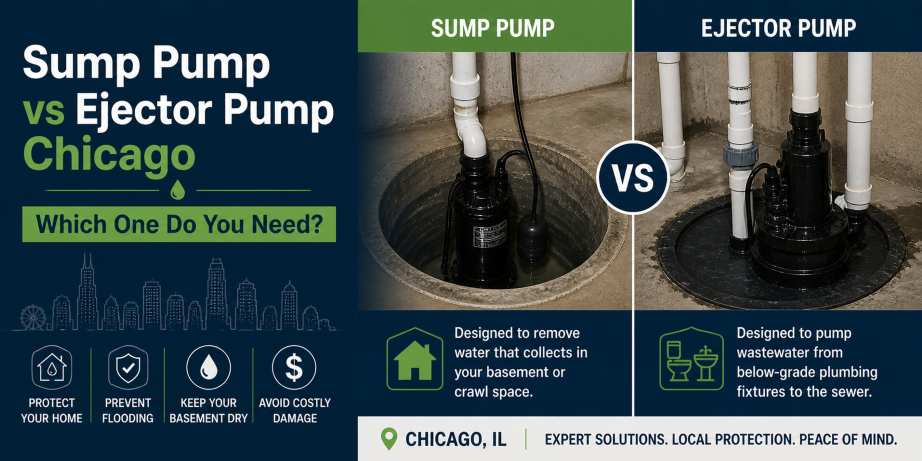
A sump pump removes groundwater. It sits in a pit — the sump basin — at the lowest point of your basement floor. When groundwater accumulates in that pit from subsurface seepage, rising water table, or perimeter drain tile routing water toward the pit, the pump activates and pushes that water up through a discharge line and away from your foundation. The water it handles is relatively clean groundwater. It has no connection to your sewer lines, your floor drain, or your home’s wastewater system.
An ejector pump removes wastewater from below-grade plumbing fixtures. It sits in a sealed pit — the ejector basin — and receives waste from basement toilets, basement sinks, basement laundry connections, and any other fixture located below the level of the home’s main sewer line. When waste accumulates in the basin, the pump activates and forces it upward through a discharge pipe that connects to the main sewer line above grade, where gravity carries it the rest of the way to the city sewer. The water it handles contains sewage and solid waste — it is specifically designed for this and a sump pump is not.
That’s the entire distinction. One pump handles clean groundwater from below. The other handles wastewater from below-grade plumbing. Neither does the other’s job. Neither is a substitute for the other.
Why Chicago Homes Are Particularly Likely to Need Both
In most parts of the country, a homeowner either has a sump pump or a basement bathroom — not typically both. Chicago is different, and understanding why helps clarify why so many Chicagoland homes need both systems functioning simultaneously.
Chicago’s flat, clay-heavy terrain creates persistent groundwater pressure. Much of the Chicago metropolitan area — particularly the suburban ring that developed rapidly from the 1950s through the 1990s — sits on former farmland with clay-heavy soil and a high seasonal water table. Clay drains poorly. The water table rises significantly during spring snowmelt and summer rain events. This creates hydrostatic pressure against basement foundations and drives groundwater into sump pits at a rate that requires active mechanical removal. Almost every home with a below-grade basement in Chicagoland needs a sump pump.
Chicago’s housing stock has extensively finished basements. Chicago’s bungalows, two-flats, and suburban ranch homes have some of the highest rates of finished basement space in the country. Basement bathrooms, basement laundry rooms, and basement kitchenettes are extremely common in the older housing stock. Every one of those below-grade fixtures requires an ejector pump to function — there’s no gravity path for the wastewater to travel uphill to the main sewer line.
Illinois plumbing code requires ejector systems for below-grade fixtures. This isn’t optional. Illinois Administrative Code Section 890, which governs all plumbing installations in the state, requires that all plumbing fixtures located below the outside grade discharge into a sealed, vented sump basin from which waste is lifted by automatic ejector pumping equipment. The Chicago Plumbing Code Section 18-29-712 establishes specific requirements for sump pit dimensions, pump capacity, check valve installation, and venting for ejector systems within the city limits. A basement bathroom plumbed to drain by gravity — bypassing an ejector system — is a code violation in Illinois regardless of whether it drains adequately under normal conditions.
The result of all three factors is that a significant percentage of Chicago-area homes rely on both a sump pump for groundwater control and an ejector pump for below-grade wastewater — and both systems must function properly to keep basements dry, safe, and code-compliant. For a deeper look at how these challenges are playing out at the local level, explore our guide to Plumbing and Flood Control in Palos Heights, which breaks down separate sewer systems, aging copper infrastructure, wooded lot conditions, and other factors shaping basement plumbing across the suburbs.
Sump Pumps: What They Do, When You Need One, and What Failure Looks Like
How a Sump Pump Works
The sump pit is typically an 18-inch diameter, 24 to 30-inch deep basin set into the basement floor, usually in a corner or along the perimeter wall. Perforated drain tile running around the interior perimeter of the foundation routes groundwater toward the pit. Water accumulates in the pit until it rises to the level of the float switch — typically set at 8 to 12 inches — at which point the pump motor activates and pushes the water up through a discharge pipe, typically 1.5-inch diameter PVC, through the wall or up through the floor, and out to the yard, alley, or storm drain connection.
The float switch is the critical control component. A float that’s stuck in the down position means the pump never activates — and water fills the pit and eventually the basement. A float that’s stuck in the up position means the pump runs continuously — burning out the motor within hours. Float switch failure is one of the most common sump pump failure modes and one of the most preventable with annual inspection.
What a Sump Pump Does NOT Do
This point is so important that we’ve written an entire article about it — why your sump pump can’t stop a sewer backup in Chicago. But the short version: a sump pump has zero connection to your sewer lines. It cannot stop, slow, or mitigate water coming backward through your floor drain from the city’s sewer system during a surcharge event. These are two completely different water sources handled by two completely different systems. Thinking your sump pump protects you against sewer backup is one of the most common and most costly misconceptions among Chicago homeowners.
When Your Chicago Home Needs a Sump Pump
You need a sump pump if:
Your basement has ever taken on water that entered through the floor-wall joint, up through the slab, or accumulates in a pit during or after rain events or snowmelt. This is groundwater intrusion driven by hydrostatic pressure or a high water table — exactly what a sump pump is designed to address.
Your basement has a sump pit already installed — which indicates a previous owner or builder determined groundwater management was necessary for that property.
Your home sits in an area with clay soil, high seasonal water table, or a history of groundwater issues — which describes the majority of Chicagoland residential properties.
You have interior or exterior perimeter drain tile installed — the drain tile collects groundwater and routes it to the pit, which is useless without a functional pump to remove it.
Sump Pump Failure Signs Every Chicago Homeowner Should Know
Unusual noises during operation. A healthy sump pump hums when running. Rattling, grinding, clanking, or labored motor sounds indicate mechanical problems — a damaged impeller, debris in the pump housing, or a motor bearing failure. Don’t wait for silence to confirm the pump has stopped working.
Pump runs continuously without shutting off. The float switch is stuck in the activated position, the pit is filling faster than the pump can discharge, or the discharge line has a backflow problem allowing pumped water to return to the pit. Any of these requires immediate attention.
Pump never runs despite wet conditions. Float switch failure, loss of power to the outlet, tripped GFCI, or dead battery in a battery backup unit. Test your sump pump quarterly by pouring a bucket of water into the pit — the pump should activate within seconds.
Visible rust or corrosion on the pump body. Indicates the pump is well past its service life. Sump pumps typically last 7 to 10 years in Chicago’s environment of frequent cycling and hard water mineral exposure.
Water in the basement despite a running pump. The most urgent finding — the pump is running but the basement is still flooding. This almost always means the flooding is coming from a different source than groundwater: sewer surcharge backup through the floor drain, which a sump pump cannot address. Diagnosis is critical before any repair decision.
Our sump pump services cover installation, replacement, battery backup installation, and emergency repair throughout Chicago and the suburbs — same-day and 24/7 emergency response available.
The Battery Backup Issue — Non-Negotiable in Chicago
Chicago’s worst flooding events almost always coincide with power outages. The exact storms that generate the most groundwater pressure — the events when you need your sump pump most — are the events most likely to knock out power. A sump pump without battery backup is a pump that will fail at the worst possible moment, every time.
A battery backup sump pump system is not an upgrade for Chicago homeowners — it’s the baseline. Either a dedicated battery backup unit installed alongside the primary pump, or a combination primary/battery backup unit. The additional cost of $300 to $800 installed is the most cost-effective flood protection investment available to any Chicago homeowner with a basement.
Ejector Pumps: What They Do, When You Need One, and What Failure Looks Like
How an Ejector Pump Works
The ejector basin is a sealed, airtight pit — typically 18 to 24 inches in diameter — set into the basement floor. It receives waste from all below-grade plumbing fixtures: basement toilets, basement sink drains, basement laundry drain connections, basement floor drains in finished spaces. The basin is sealed and vented through a vent stack to prevent sewer gases from entering the basement living space.
When waste accumulates in the basin to the level of the float switch, the pump activates and forces the waste — including solids — up through a 2-inch discharge pipe that connects to the main drain stack above the level of the main sewer line. A check valve on the discharge pipe prevents waste from flowing backward into the basin when the pump shuts off. From the connection point above grade, gravity carries the waste to the city sewer through the normal drain path.
The ejector pump is specifically designed to handle solids — toilet paper, human waste, food particles from sink drains. This is why it cannot be substituted with a sump pump, which is designed only for relatively clean water and will fail rapidly if it receives solid waste. If you want to understand what happens when an ejector pump actually fails — including cleanup costs, replacement pricing, and insurance coverage — here’s a detailed breakdown on why ejector pumps fail in Chicago.
What an Ejector Pump Does NOT Do
An ejector pump has no groundwater function. It doesn’t protect against basement flooding from a rising water table. It doesn’t remove water that seeps through foundation walls. It handles only the wastewater from the specific fixtures connected to its basin — nothing more.
Additionally, an ejector pump is not a substitute for a backwater valve. If the city’s sewer system surcharges during a heavy rain and pressure travels backward through your sewer lateral, that pressure can travel right past the ejector pump’s check valve and into your basement through any drain that connects to the main lateral rather than to the ejector basin. The ejector pump and the backwater valve address different aspects of basement flood protection and both may be necessary in older Chicago homes.
When Your Chicago Home Needs an Ejector Pump
You need an ejector pump if:
Your home has any plumbing fixture below the level of the main sewer line — basement bathroom, basement laundry, basement sink, basement floor drain in a finished space. Under Illinois law, these fixtures must connect to an ejector system. There is no code-compliant alternative for a home that isn’t served by an overhead sewer.
Your basement is finished with a bathroom or laundry room. By definition, these fixtures are at or below grade and require ejector pump service.
You’re adding a basement bathroom, laundry, or wet bar to an existing finished basement. The ejector system must be sized for the fixtures being added and must be permitted and inspected.
Ejector Pump Failure Signs Every Chicago Homeowner Should Know
Sewage odors in the basement. The sealed basin lid or vent connection has failed, allowing sewer gases to escape into the basement living space. This is a health concern — sewer gas contains hydrogen sulfide and methane — and requires immediate attention.
Slow drainage from multiple basement fixtures simultaneously. When one fixture drains slowly, the problem is usually in that fixture’s branch line. When multiple basement fixtures drain slowly at the same time, the ejector basin is approaching capacity or the pump is losing efficiency. This is the early warning before a complete failure.
Gurgling sounds when basement fixtures drain. Air is being displaced by rising waste in the basin — the basin is filling faster than the pump is clearing it, or the pump is intermittently failing to activate.
Wastewater backing up into the basement floor drain or basement sink. The ejector pump has failed or the basin is completely full — waste has nowhere to go and is traveling backward through the lowest available drain connection. This is the emergency condition requiring immediate service call.
Pump cycles on and off rapidly. Short cycling indicates the pump is working but something is preventing it from fully clearing the basin — usually a check valve failure that’s allowing discharged waste to return to the basin, or a partial discharge line blockage.
Our ejector pump services cover installation, repair, and replacement throughout Chicago and the suburbs — same-day scheduling and 24/7 emergency response available. For a complete breakdown of ejector pump warning signs, troubleshooting steps, and what replacement involves, see our ejector pump replacement guide.
When You Need Both — The Complete Chicago Basement Protection Picture
The scenario that describes the majority of Chicago-area homes with finished basements: you need both a sump pump and an ejector pump, and they serve completely separate functions. Here’s what a properly protected Chicago basement looks like when both systems are present and functioning:
The sump pump sits in its pit in the corner or along the perimeter wall. It handles groundwater from the surrounding soil — the water that would otherwise seep up through the slab or in through foundation wall joints. Its discharge line exits the home and drains away from the foundation.
The ejector pump sits in its sealed basin, connected to the basement bathroom toilet, sink, and laundry. It handles all wastewater from those fixtures and pumps it up to the main drain stack. Its discharge line connects to the main sewer drain stack above grade.
The battery backup on the sump pump ensures that a power outage during a storm doesn’t eliminate groundwater protection at the exact moment it’s needed most.
The backwater valve — if installed — prevents city sewer surcharge from traveling backward through the main lateral into the basement during heavy rain events. For a complete picture of how the backwater valve fits into the full flood protection system alongside the sump and ejector pumps, see our complete flood control systems page.
None of these four components does the other’s job. A home with all four is protected against groundwater intrusion, below-grade wastewater drainage failure, power outage during storms, and sewer surcharge backup. Removing any one of them leaves a gap in protection. Homeowners comparing these systems in more detail can read our full guide to Chicago flood control systems that actually work — and ones that don’t, including how sump pumps, ejector pumps, backwater valves, and overhead sewer systems perform during real Chicago flooding events.
The Most Common Mistakes Chicago Homeowners Make With These Systems
Mistake 1: Replacing an Ejector Pump With a Sump Pump
This happens more often than it should. A homeowner’s ejector pump fails and someone — a handyman, a non-licensed contractor, or the homeowner themselves — installs a sump pump in the ejector basin because it was what was on hand or what was cheapest. Within weeks, the sump pump fails from exposure to solid waste it wasn’t designed to handle. More significantly, the basement bathroom is now improperly plumbed — sewage that should be pumped uphill to the sewer may be finding alternative paths that create serious sanitation and structural problems.
Ejector pumps must be replaced with ejector pumps. They are built differently — sealed housing, solids-handling impellers, discharge pipe sizing — and are not interchangeable with residential sump pumps.
Mistake 2: Assuming a Sump Pump Protects Against Sewer Backup
Covered at length above and in our dedicated article on the subject — but worth repeating because the consequences of this misconception are so significant. A sump pump running perfectly during a heavy rain provides zero protection against sewage coming up through your floor drain from the city’s surcharging sewer main. These are different water sources, different pathways, and different solutions. If you’ve experienced sewage backup through your floor drain and your sump pump was running at the time, the sump pump was doing exactly what it was designed to do — it just wasn’t designed to address the problem you had.
Mistake 3: Ignoring the Battery Backup Until the Pump Has Already Failed
The time to install battery backup is not after the pump fails during a storm and the basement floods. It’s before that moment. Battery backup installation is a planned service that costs a fraction of water damage remediation. Every Chicago homeowner whose basement flood protection depends on a sump pump should have battery backup installed before the next storm season.
Mistake 4: Flushing Non-Approved Items Through Basement Fixtures
Ejector pumps are more susceptible to clogging than gravity-drain systems because they have to pump waste uphill against pressure. “Flushable” wipes — which don’t actually break down — are the most common cause of ejector pump clogs in Chicago residential systems. Dental floss, feminine hygiene products, paper towels, and cotton swabs are also frequent culprits. The smaller diameter of ejector discharge pipes compared to main drain lines means these items clog the ejector system before they’d cause problems anywhere else.
Mistake 5: Skipping Annual Inspection Because Nothing Has Gone Wrong Yet
Both sump pumps and ejector pumps are mechanical devices with float switches, impellers, and motors that wear over time. An annual inspection — testing the float switch, checking the check valve, confirming discharge line clearance, and assessing the motor’s operational condition — costs very little and is the only reliable way to know whether the pump will work when it matters. A pump that hasn’t been inspected in three years may have a partially corroded float arm that fails to activate under load, or a check valve that’s stuck partially open allowing constant backflow — neither of which is obvious until the system fails during a storm.
What Each System Costs in Chicago in 2026
Sump Pump Costs
Standard sump pump replacement (submersible, existing pit): $400 to $900 installed. Includes pump, float switch, and check valve. If the pump is more than seven years old or has failed once already, replacement before the next storm season is the right call.
Sump pump with battery backup system: $700 to $1,500 installed. The non-negotiable configuration for Chicago homes that depend on the pump for basement protection.
New sump pit and pump installation (no existing pit): $1,200 to $2,500. Includes concrete cutting, pit excavation, basin installation, pump, discharge line, and concrete restoration.
Combination primary and battery backup unit: $1,000 to $2,000 installed. The most comprehensive single-unit solution for Chicago storm conditions.
Ejector Pump Costs
Standard ejector pump replacement (existing basin): $500 to $1,200 installed. Includes pump, check valve, and float switch. Ejector pumps typically cost more than sump pumps due to their more complex design and solids-handling requirements.
New ejector system installation (new basin, pit, and pump): $2,000 to $4,500. Includes concrete cutting, basin installation, pump, discharge pipe connection to main drain stack, vent connection, and concrete restoration.
Ejector pump with battery backup: $800 to $1,600 installed. While less commonly discussed than sump pump battery backup, ejector battery backup is valuable for homes where the basement bathroom is heavily used and power outages would create immediate problems.
Complete System Costs (Both Pumps)
For a Chicago home that needs both systems installed from scratch — new sump pit, new ejector basin, pumps for each, battery backup on the sump, and all connections — the complete installation typically runs $4,000 to $8,000 depending on basement configuration, concrete conditions, and the complexity of the drain connections.
For Chicago homes near flood-prone areas or with a history of basement flooding, a complete flood protection assessment is the right starting point before any installation decision. Our basement flooding services team assesses every component of your basement’s water management situation before recommending scope of work.
Chicago-Specific Considerations
The combined sewer system adds a third protection layer many Chicago homes need. Even homes with properly functioning sump and ejector pumps can experience basement flooding from sewer surcharge — the condition where heavy rain overwhelms the combined sewer system and pressure travels backward through residential laterals. The backwater valve is the device that addresses this specific risk. For Chicago homes in combined sewer service areas — which includes most of the city and many inner-ring suburbs — the complete protection picture is sump pump + ejector pump + backwater valve. Our sewer backflow prevention services handle backwater valve installation throughout Chicagoland.
Overhead sewer conversions eliminate the ejector pump requirement. An overhead sewer conversion reroutes all basement drain lines to discharge above the surcharge level, eliminating both the need for an ejector pump and the risk of sewer surcharge backup simultaneously. It’s a more extensive and more expensive project than an ejector pump installation — typically $12,000 to $30,000 — but it’s a permanent solution that removes all mechanical pump dependency from the basement wastewater system. For homes with a history of severe or repeated basement flooding, overhead sewer conversion is worth serious consideration.
Many Chicagoland municipalities offer rebate programs for flood control installations including backwater valves and ejector pump systems as part of flood control upgrades. Before signing any installation contract, call your village hall and ask specifically whether a rebate program applies to your address. Some suburban municipalities reimburse $2,000 to $4,000 or more toward qualifying flood control installations. Homeowners in DuPage County communities dealing with repeated sewer backups and storm flooding should also read our guide on basement flooding and sewer backup solutions in Elmhurst, including information on the city’s flood control rebate programs and common causes of recurring backups.
Frequently Asked Questions
I have one pump in my basement. How do I know which one it is? Location and connection tell you. A sump pump sits in an open or lightly covered pit with no sealed lid — water enters the pit freely from the surrounding soil through the gravel base or perforated drain tile. Its discharge line carries relatively clean water to the exterior. An ejector pump sits in a sealed, airtight basin with a bolted or gasketed lid — the seal prevents sewer gas from escaping into the basement. Its discharge line connects upward to the main drain stack inside the basement. If the basin has drain pipes entering it from toilets or laundry connections, it’s an ejector system.
My basement doesn’t have a bathroom. Do I still need an ejector pump? Only if you have other below-grade fixtures — a utility sink, a laundry drain, or a floor drain in a finished space that’s connected to the sanitary system rather than to the sump pit. If your basement has no fixtures below grade at all, you don’t need an ejector system. If you’re considering adding a basement bathroom in the future, the ejector system needs to be part of the project — not an afterthought.
Can I put a floor drain in my basement that connects to the sump pump rather than the sewer? Floor drains in unfinished utility basements are sometimes connected to the sump pit rather than the sanitary system — this is acceptable for a utility floor drain in many municipalities. However, any floor drain in a finished basement space, or any drain receiving sanitary waste, must connect to the sanitary system through an ejector system. Routing sanitary waste to a sump pit and discharging it to the yard is a code violation and a serious environmental hazard.
My ejector pump runs constantly. What’s causing it? The most common causes are a check valve that’s failing — allowing discharged waste to flow back into the basin, causing the pump to reactivate immediately — or a float switch that’s stuck in the activated position. A pump that runs constantly will burn out its motor within hours or days. This is an urgent service situation, not a watch-and-wait situation.
How long do these pumps last in Chicago? Sump pumps in Chicago’s cycling-intensive environment — multiple activations per rain event, hard water mineral exposure, frequent power fluctuations — typically last 7 to 10 years. Ejector pumps, which handle more demanding waste streams but cycle less frequently than sump pumps in most homes, typically last 8 to 12 years. Both should be inspected annually and replaced proactively before failure rather than after.
If I replace my ejector pump can I upgrade to a higher horsepower unit? Yes, within limits — a more powerful pump is appropriate if your household has added fixtures or usage has increased significantly since the original installation. However, an oversized ejector pump creates its own problems — it cycles too quickly to build adequate pressure for effective discharge, which is a condition called short cycling that accelerates motor wear. Sizing should match the basin capacity and the fixture load. Our team assesses the right sizing for your specific configuration as part of every ejector pump replacement.
Not Sure What’s in Your Basement — or Whether It’s Working?
Licensed, insured, and locally based in Brookfield since 1978. We assess sump pumps, ejector pumps, battery backup systems, and complete flood control configurations throughout Chicago and the suburbs. Written quotes before we start, permits pulled on every job that requires them, our own licensed plumbers on every call. Send us a message and we’ll get back to you fast.
Or call us directly: 708-801-6530 | Open 24/7
—
Suburban Plumbing Sewer Line & Drain Cleaning Experts
Licensed & Insured | Open 24 Hours | Serving Chicago & Chicagoland
📞 Suburbs: 708-801-6530 | 📞 Chicago: 773-570-2191 | 🚨 Emergency: 708-518-7765