
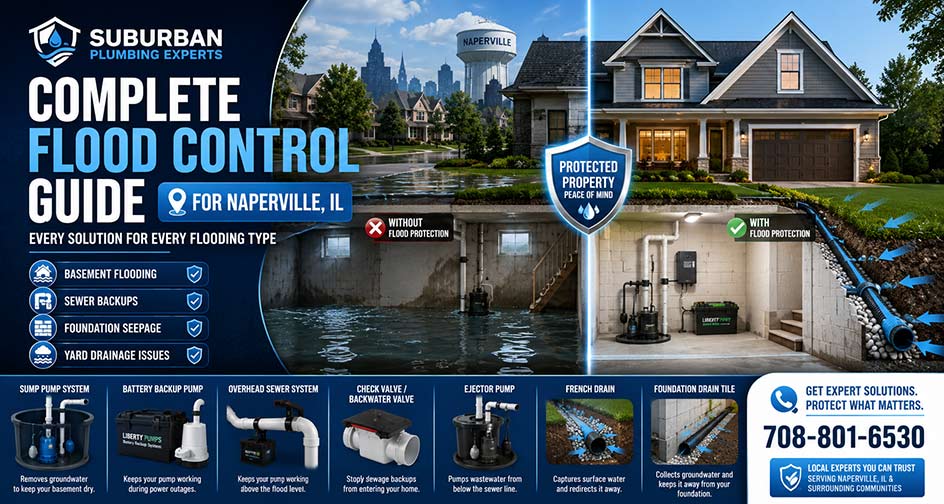
The Article That Replaces Every Generic Flood Control Guide — Written Specifically for Naperville’s Separate Sewer System, Its Cross-County Housing Stock, and the Flooding Patterns That Have Driven Demand for Real Flood Control in This Community for Decades
Most flood control articles written for Chicago-area homeowners could have been written for any suburb in any state. They describe sump pumps, backwater valves, and French drains in ways that are equally meaningless in Naperville, Skokie, and Aurora. Naperville is not a generic Chicago suburb. It has a separate municipal sewer system — not a Cook County combined sewer. It has the City of Naperville’s own 75% backflow device reimbursement program — one of the most generous in Illinois. It sits across two counties, DuPage and Will, with different soil conditions and different flooding profiles. And its housing stock, built overwhelmingly between 1970 and 2005, has its own specific aging curve with its own specific failure points arriving right now.
This guide is written for Naperville specifically. It gives every Naperville homeowner the exact diagnostic information, the exact solution match, and the exact financial leverage this community offers that no other guide will tell you about.
Part One: Understanding Naperville’s Flooding Context — How It’s Fundamentally Different from Cook County
The single most important fact about flood control in Naperville — the fact that every other guide ignores — is that Naperville does not have a Cook County combined sewer. That distinction changes almost everything about how flooding works here and what solutions actually address it.
Naperville Has a Separate Sewer System — And That Changes Everything
In Cook County communities like Orland Park, Evergreen Park, and Cicero, sanitary sewage and stormwater travel in the same underground pipes. During heavy rain, those combined mains surcharge and reverse into basements through floor drains. The water smells like sewage because it is sewage — a predictable consequence of a combined system under peak load.
Naperville’s sanitary sewer system is separate from its stormwater system. Sanitary waste travels in dedicated sanitary mains to the Springbrook Water Reclamation Center. Stormwater travels in a separate network of storm sewers, detention basins, and overflow routes managed by the City’s Stormwater Management Plan. The flooding mechanisms in Naperville homes are different because the infrastructure is different.
What this means practically: floor drain backup in Naperville during heavy rain is not the same event as floor drain backup in a Cook County combined sewer community. In Naperville, floor drain backup during intense rain is caused by the sanitary sewer main surcharging when stormwater infiltrates the sanitary system — through cracked laterals, improper connections, and aging infrastructure. The City of Naperville has been actively fighting this problem through its lateral lining program since 1998 and its reimbursement program since 1981. The mechanism is different from Cook County combined sewer surcharge, the solution is the same category (backwater valve), but the financial landscape for getting it installed is dramatically better here than anywhere in Cook County.
The DuPage River Watershed — Why Naperville’s Clay Soil Flooding Is a Real and Separate Problem
Naperville sits in the West Branch DuPage River watershed, on glacially deposited clay soils that extend across virtually the entire city. This pattern is explained in detail in this guide to Naperville basement flooding causes and how they develop. The City of Naperville itself acknowledges on its Yard Drainage and Flooding page that ponding for 24 to 72 hours after rain events is not unusual in many areas, specifically because of clay soil’s poor drainage characteristics. The West Branch DuPage River runs through the heart of the city; DuPage County operates Fawell Dam and other flood control infrastructure specifically to manage the watershed’s flooding risk.
For Naperville homeowners, these clay soils create a groundwater flooding problem entirely independent of sewer surcharge. When sustained rain saturates already-dense clay soils, the water table rises. Hydrostatic pressure builds against basement foundations. Water enters through floor slab joints, wall-floor joints, and the sump pit. A backwater valve has no effect on this mechanism whatsoever. A properly sized sump pump with battery backup is the correct response — and in Naperville’s clay soil environment, battery backup is not a luxury. It is the difference between a dry basement and several inches of water every time a storm knocks out power.
Proper exterior grading and runoff management also play a major role in preventing this type of groundwater intrusion. Homeowners can better understand how to redirect runoff away from the foundation in this guide to ways to direct water away from your house, which complements sump pump protection in Naperville’s clay soil environment.
The Two-County Split — DuPage vs. Will County Naperville
Naperville is one of the few Illinois municipalities that spans two counties — DuPage to the north and west, Will County to the south along the city’s expanding edge toward Plainfield. This matters for flooding because soil conditions, subdivision drainage design, and local stormwater infrastructure differ between the two. DuPage County Naperville sits on the more established clay-heavy terrain with the mature DuPage River watershed context. Will County Naperville — the newer subdivisions built from the late 1990s through the 2010s along Route 59’s southern corridor — has its own soil and drainage profile. If your address puts you in the 60564 or 60565 zip code near the Plainfield border, you are in a different flooding environment than a 60540 address near downtown, and your flood control plan should reflect that difference. When in doubt about your county, check your property tax bill — it will identify DuPage or Will County clearly.
Naperville’s Sewer Lining Program — What It Does and Doesn’t Do for You
The City of Naperville has been lining residential sanitary sewer laterals since 1998 in targeted areas — including the Cress Creek neighborhood and other zones identified as high-infiltration contributors. This work genuinely reduces stormwater infiltration into the sanitary system, which reduces the frequency and severity of surcharge events in the lined areas. You can check the City of Naperville’s Residential Sanitary Sewer Lining Program to see if your neighborhood has been included.
What the lining program does not do is install flood control protection in your home. A lined lateral that connects to a surcharging sanitary main still allows surcharge pressure to enter your basement through the floor drain if no backflow prevention device is installed on your side of the connection. The City’s lateral lining reduces the probability of surcharge. A backwater valve in your basement eliminates the path for surcharge to enter your home. Both are valuable. Only one of them is the City’s job. The other one is yours.
Part Two: The Three Naperville’s — Why Your Neighborhood Determines Your Flooding Profile
Naperville’s median construction year is 1990. The vast majority of the city’s housing stock is between 25 and 55 years old in 2026 — squarely in the range where original sump pumps are failing, sewer laterals are showing age, and drainage systems that worked adequately for 20 years are beginning to show their limits.
Old Naperville — Downtown, Riverwalk Area, Pre-1970 Homes (60540)
The oldest residential neighborhoods in Naperville — the blocks surrounding downtown, the historic homes along the Riverwalk corridor, and the established streets east of the DuPage River — contain the city’s most aging infrastructure. Homes built before 1970 in Naperville have clay tile sewer laterals now 55 to 70 years old. In this era of Naperville construction, the sewer lateral condition is the foundational unknown. A sewer camera inspection of these laterals is not optional — it is the first diagnostic step before any other flood control decision is made.
Boom-Era Naperville — 1970 Through the Late 1990s Subdivisions
The largest portion of Naperville’s housing stock was built during the city’s suburban expansion from the mid-1970s through the late 1990s — neighborhoods like Brookdale, Acorn Hill Estates, the Ashbury area, and the dozens of subdivisions that grew up along Book Road, Route 59, and 95th Street. These homes carry an increasingly urgent problem: their original mechanical systems are aging out simultaneously. A sump pump installed in a 1982 Naperville ranch is anywhere from 25 to 44 years old in 2026. The rated service life of a quality submersible sump pump is 7 to 10 years. If you own a 1975–2000 Naperville home and your sump pump has never been replaced, that pump is the single highest flood risk in your house right now.
New-Era Naperville — 2000s and 2010s Subdivisions (Route 59 Corridor South, Will County)
The newest Naperville subdivisions have modern PVC laterals, newer sump systems, and were designed with contemporary stormwater detention requirements. Their primary flood vulnerability is that they sit on the same DuPage River watershed clay soils as the rest of the city. For these homeowners, the primary questions are: Is the sump pump sized appropriately for this property’s specific clay soil infiltration rate? Is there battery backup? Is the sump discharge routed away from the foundation in a way that doesn’t re-infiltrate?
Part Three: The Complete Flooding Diagnosis — Six Questions That Tell You Exactly What You Have
This is the section every other flood control guide skips. They describe flooding types abstractly. This guide gives you specific questions with specific answers that determine exactly which flooding type you have — before you call any contractor and before you spend any money.
Question 1: Does the water smell like sewage?
Yes → Sanitary sewer surcharge backup. Your Naperville sanitary sewer main has surcharged during a heavy rain event and reversed pressure through your floor drain. A backwater valve is the solution. A sump pump will not help. And critically: you likely qualify for the City of Naperville’s 75% reimbursement program. Do not sign a contract with any contractor before you call the Water Service Center at (630) 420-6137 to confirm your eligibility.
No → Continue to Question 2.
Question 2: Where exactly does the water enter?
Through the floor drain or basement toilet → Even without sewage odor, this entry point suggests the sanitary sewer lateral connection. A sewer camera inspection of the private lateral is the next step.
Through the floor slab, wall-floor joint, or the sump pit → Groundwater intrusion from a rising water table pressing through Naperville’s clay soils. Continue to Question 3.
Through window wells or above-grade wall openings → Surface water. Your grading or drainage is directing surface water toward the house. Continue to Question 4.
From multiple locations simultaneously → You likely have multiple flooding mechanisms. Answer all remaining questions and plan for multiple solutions.
Question 3: When does the water appear relative to rain timing?
During peak rain intensity, quickly → Sanitary sewer surcharge indicator even if no sewage odor is immediately apparent. Backwater valve assessment.
Hours after rain stops, or during sustained multi-day rain → Rising water table indicator. Sump pump territory. This is the most common groundwater flooding pattern in Naperville’s clay soil environment.
During spring snowmelt regardless of rain → Groundwater from snowmelt. Sump pump territory. The combination of frozen ground that cannot absorb meltwater and rising DuPage River watershed conditions makes spring one of Naperville’s two highest-risk flooding periods.
After completely dry weather → Active lateral leak or municipal main issue. Sewer camera inspection first.
Question 4: What does your yard do during heavy rain?
Pools extensively and drains slowly → The City of Naperville acknowledges that ponding for 24 to 72 hours is normal in clay soil areas. But when pooling is adjacent to the foundation, that standing water creates hydrostatic pressure. French drain or grade correction needed.
Runoff visibly directed toward foundation from neighbor’s yard or sloped lot → Lateral groundwater and surface drainage from off-property sources. French drain upslope of foundation.
Drains relatively quickly → Yard drainage is functional. Basement flooding is probably groundwater rising from below or a lateral issue.
Question 5: Is your sump pump running during the flooding?
Yes, running but overwhelmed → The pump is undersized for your property’s infiltration rate, or it’s aging and no longer performing at rated capacity. A 25-year-old sump pump in Naperville’s clay soil environment is not moving the water volume its nameplate suggests. Pump assessment and replacement needed.
Not running — power was out → Battery backup is the immediate priority. The storm that produces Naperville’s worst groundwater flooding is the same storm that knocks out power.
Not running — pump is present but didn’t activate → The float switch may have failed, the pump motor may have seized, or the discharge line may be frozen or blocked. Assessment and replacement before the next storm event.
No sump pump present → Groundwater management is entirely absent. In a Naperville home on clay soil with any finished basement space, this is a flooding event waiting for a weather trigger.
Question 6: How old is your home and has the sewer lateral ever been camera-inspected?
Pre-1980 and never camera-inspected → Your clay tile lateral has unknown condition after 45 to 70 years of service. Camera inspection is the foundational diagnostic step before any other flood control decision.
1980–2000 and sump pump never replaced → The lateral is probably PVC and likely in acceptable structural condition, but the original mechanical systems are at or well past service life. Sump pump assessment is the priority.
Post-2000 → Modern infrastructure. Primary concerns are sump pump sizing, battery backup, and yard drainage design integrity.
Part Four: The Complete Solution Guide — Every Answer Matched to Every Flooding Type
Solution A: Backwater Valve — For Sanitary Sewer Surcharge Backup
A one-way check valve installed in the main sewer lateral in the basement floor. Allows normal household waste to flow out. Seals automatically when sanitary sewer pressure reverses during a surcharge event.
This is the most common sewer-related flooding type in pre-1990 Naperville homes, and the flooding type that the City’s 75% reimbursement program is specifically designed to address. Before signing any contract, contact the City of Naperville Water Service Center at (630) 420-6137 to confirm reimbursement eligibility. A valve installed without a permit does not qualify for the City’s reimbursement program.
Cost: $2,500 to $5,500 installed with permits — before the City’s 75% reimbursement reduces your net cost substantially for qualifying installations.
Our sewer backflow prevention services cover the complete backwater valve installation process throughout Naperville.
Solution B: Overhead Sewer Conversion — Permanent Sewer Surcharge Protection
A structural rerouting of every below-grade drain connection in the home to a level above the sanitary sewer main’s surcharge elevation. Rather than relying on a mechanical check valve, the overhead conversion eliminates the below-grade drain path entirely. This is the right solution when you’ve had repeated severe flooding events despite a backwater valve, or when you’re finishing a basement and want permanent protection before investing in a finished space.
Note: The City’s reimbursement program covers backflow prevention devices, not overhead sewer conversions. The overhead conversion provides superior permanent protection but at greater cost, without the reimbursement offset available for a backwater valve installation.
Cost: $12,000 to $30,000 depending on basement configuration, number of fixtures, and installation complexity.
Our overhead sewer services cover the full conversion throughout Naperville.
Solution C: Sump Pump With Battery Backup — For Groundwater Intrusion
A submersible pump in a pit below the basement floor that activates when groundwater rises to a float level. Battery backup activates when power is lost — maintaining pump function during storm-related outages.
This is the primary flooding mechanism for the majority of Naperville’s 1980s and 1990s homes where clay soil groundwater pressure is the dominant flooding driver. Battery backup in Naperville is not a luxury — it is a functional necessity. The same storms that produce peak groundwater pressure are the storms most likely to knock out power.
Cost: $700 to $1,500 installed for replacement with battery backup. $1,200 to $2,500 for new sump pit and pump installation where no existing system is present.
Our sump pump services cover installation, battery backup, and 24/7 emergency replacement throughout Naperville.
Solution D: French Drain — For Surface Drainage and Yard Pooling
A perforated pipe system installed in a stone-filled trench that intercepts surface water and lateral groundwater before they reach the foundation. French drains in Naperville’s clay-heavy soil demand appropriate gravel selection, filter fabric specification, and discharge planning that accounts for clay’s slow drainage characteristics. Our French drain and drainage tile installation services in DuPage County clay soil environments are designed specifically for these conditions.
Cost: $1,500 to $4,000 for a 20 to 50 linear foot yard French drain. $3,000 to $8,000 for perimeter foundation drainage at footer depth.
Solution E: Sewer Camera Inspection — The Foundation of All Other Decisions
For any pre-1985 Naperville home before any flood control installation decision is made. The camera inspection is what makes every subsequent decision accurate. A clay tile lateral from a 1968 Naperville home near downtown with root intrusion at multiple joints is a lateral that provides additional backflow pathways beyond the primary floor drain connection. A camera inspection identifies those conditions and lets us plan the right combined scope of work.
Cost: $200 to $450 — the single highest-return diagnostic investment available to any Naperville homeowner who hasn’t had a camera-confirmed lateral assessment.
Part Five: Naperville’s 75% Reimbursement Program — Everything You Need to Know
The City of Naperville has operated a backflow prevention reimbursement program since 1981 — one of the longest-running and most generous municipal flood control assistance programs in Illinois. As of 2026, the program reimburses 75% of the approved installation cost for qualifying backflow prevention devices.
Who qualifies: City of Naperville wastewater customers who have experienced a sanitary sewer backup caused by a surcharged sanitary sewer system during intense rainfall — confirmed by the City as a wastewater/sanitary sewer issue.
The process — in the correct order:
Step 1: Contact the Water Service Center at (630) 420-6137 to report the backup and confirm it was caused by a sanitary sewer surcharge. Do not authorize any work before this confirmation.
Step 2: Apply for the program and receive City approval. Do not schedule any work before you have written City pre-authorization.
Step 3: Obtain three written quotes from licensed plumbers. The City will pre-authorize one of the quotes.
Step 4: Schedule and complete the installation with the authorized contractor.
Step 5: Submit proof of payment to the City. The City reimburses 75% of the approved quote amount.
The financial reality: A backwater valve installation that costs $3,500 becomes an $875 out-of-pocket expense after the 75% City reimbursement. No other community in the Chicago area offers this level of financial assistance for flood control. Naperville homeowners who install a qualifying backwater valve without going through the reimbursement process first are leaving thousands of dollars on the table.
Part Six: The Decision Matrix — Symptom to Solution
| Flooding Symptom | Primary Solution | Do NOT Install |
|---|---|---|
| Sewage odor, floor drain backup during rain | Backwater valve — call City first for reimbursement | Sump pump upgrade |
| Sewage odor, floor drain backup year-round | Sewer camera inspection first, then lateral repair | Nothing until camera confirms cause |
| No odor, slab or wall-floor joint seepage | Sump pump + battery backup | Backwater valve |
| No odor, sump pit fills and overflows | Pump replacement sized for clay soil infiltration | Overhead sewer |
| No odor, water enters through window wells | Grade correction + window well covers | Interior drain system |
| No odor, yard pools near foundation | French drain sized for clay soil | Backwater valve |
| Multiple entry points, mixed or no odor | Camera inspection first, combined solution after | Any single solution without complete diagnosis |
| Sump pump is original from 1975–2005 | Proactive replacement before next storm season | Running the original pump one more season |
Part Seven: The Mistakes That Cost Naperville Homeowners the Most Money
Mistake 1: Missing the 75% Reimbursement Before Signing a Contract
A Naperville homeowner has sewage backup, calls a plumber, signs a contract for a $3,800 backwater valve installation, and the work is completed. They then discover the City reimburses 75% of qualifying installations — but the reimbursement program requires City pre-authorization before work begins. Cost of this mistake: $2,850 that stayed in the contractor’s pocket rather than being reimbursed by the City of Naperville. Every Naperville backwater valve installation we perform begins with confirmation of reimbursement eligibility — it is the first conversation, not an afterthought.
Mistake 2: Installing a Sump Pump for Sanitary Sewer Surcharge Backup
The most expensive flood control error in the Chicago area. A homeowner whose basement floods through the floor drain with sewage odor installs a new $1,200 sump pump. The next significant rain, the basement floods again. The sump pump has no connection to the sanitary sewer lateral that the surcharge entered through. The correct solution — a backwater valve, potentially with most of its cost covered by the City’s reimbursement program — was never installed. The diagnosis question is simple: does the water smell like sewage? If yes, it’s a sewer problem, not a groundwater problem.
Mistake 3: Skipping Camera Inspection Before Any Installation in a Pre-1985 Home
A 1973 Naperville home gets a backwater valve installed without a preceding camera inspection. Six months after valve installation, the lateral backs up from root mass that has occluded the pipe. Camera inspection before valve installation would have identified the root entry points and allowed for targeted hydro jetting at the same mobilization — one comprehensive visit instead of two separate expensive service calls.
Mistake 4: Running a 20+ Year Old Sump Pump Through One More Season
Naperville’s boom-era housing stock contains an enormous number of original-equipment sump pumps that are between 25 and 50 years old in 2026. Proactive pump replacement at the end of its service life costs $700 to $1,500. Emergency pump replacement during or after a flooding event costs more — and follows thousands of dollars in water damage to a finished basement.
Mistake 5: Connecting the Sump Pump Discharge to the Sanitary Sewer
This is a code violation in Naperville. The City of Naperville explicitly prohibits sump pumps from being connected to the sanitary sewer or the basement floor drain. A sump pump discharging directly to the sanitary system is contributing to the exact overload problem that causes basement backups throughout the neighborhood. This will surface as a disclosed defect in any real estate transaction.
Mistake 6: Waiting Until a Flooding Event to Make Decisions
Every flood control decision made under pressure — after a flood has occurred, during remediation, with a contractor standing in the basement — is a decision made at the worst possible leverage point. The homeowner who uses this guide during a dry period, gets a camera inspection, contacts the City to understand reimbursement eligibility, gets multiple quotes, and makes a planned decision on their own timeline pays less and gets more.
Part Eight: The Complete Naperville Flood Control Maintenance Calendar
Every Month: Check the sump pit level and confirm the float activates the pump correctly — pour a bucket of water into the pit and watch the pump cycle. Pour water down any infrequently used floor drains to maintain the P-trap water seal.
Before Spring: Confirm the sump pump is operational before snowmelt season — late February through March is Naperville’s first peak flood risk window. Test battery backup under load. Clean the inlet screen on the sump pit. Confirm the sump discharge line is clear.
Before Summer Storm Season: Check window well covers and clear accumulated debris. Confirm yard drainage paths are clear. Verify no new landscaping or construction has altered drainage patterns on your lot.
Before Winter: Confirm above-grade sump discharge is not routed through a section that will freeze during cold weather — a frozen discharge line during a January thaw event produces pump failure without any mechanical problem. If freezing conditions do cause pipe damage or a burst line, it’s often part of a larger winter failure pattern — see our guide on frozen and burst pipes in Naperville for how these situations develop and what warning signs homeowners miss before a break occurs.
Every Year: Test the backwater valve if installed — confirm the flap moves freely, the valve body is clear of debris, and any bypass pump activates correctly. Have the sump pump professionally assessed if it’s more than 5 years old. Battery backup units should be replaced every 3 to 5 years regardless of apparent condition.
Every 3 to 5 Years: Camera inspect the sewer lateral for pre-1975 Naperville homes with clay tile laterals near mature trees. Every 5 to 7 years for PVC laterals in post-1985 construction.
Every 7 to 10 Years: Sump pump replacement proactively regardless of apparent operational condition. If the pump has been running under elevated load in Naperville’s clay soil environment, the 7-year mark is the appropriate replacement threshold.
Part Nine: Naperville Flood Control and Home Value
Naperville consistently ranks among Illinois’s most valuable residential markets. With median home values well above the Chicago metro average, the financial stakes of documented flood control — or the absence of it — are proportionally higher here than in most suburban communities.
A Naperville home without flood control that has flooded: A disclosed backup history without documented remediation and installation of preventive flood control is a transaction complicator at any price point. Buyers at Naperville’s price levels conduct thorough pre-purchase inspections with specialists who understand what clay soil conditions and sanitary surcharge risk look like in a DuPage County inspection report.
A Naperville home with documented flood control and City reimbursement records: A permitted, inspected backwater valve installation with service records and the City’s reimbursement paperwork is a transactional asset — specific, documented evidence of a proactive homeowner who addressed a known risk with the cooperation of the City’s own protection program.
A pre-1985 Naperville home without a camera-inspected lateral: This is one of the most consistently flagged items in buyer due diligence for older Naperville homes. A seller who has already done a camera inspection and has a clean report is in a substantially better position than one who hasn’t — and a seller who has also completed the City reimbursement program for a qualifying backwater valve has removed the most common buyer concern entirely.
The Complete Naperville Action Plan — What to Do Right Now
If you’ve never flooded and your home is pre-1985: Schedule a sewer camera inspection to establish baseline lateral condition. If the camera shows conditions that warrant a backwater valve, call the City at (630) 420-6137 before installation to confirm reimbursement eligibility.
If you’ve flooded once with sewage odor: Call the City of Naperville Water Service Center at (630) 420-6137 immediately to report the backup and initiate the reimbursement program application. Do not sign a contract with any contractor before you have City pre-authorization.
If your sump pump is more than 7 years old and original to a 1975–2000 Naperville home: Replace it proactively and add battery backup before the next storm season. This is the single highest-return flood protection action available for Naperville’s boom-era housing stock.
If you’ve flooded through the slab or wall-floor joint with no sewage odor: Get a sump pump assessment — pump capacity, float switch function, battery backup status, discharge routing.
If you’ve flooded multiple times despite a backwater valve: A complete system assessment — valve condition, lateral condition, sump pump condition — is the next step. Our Naperville plumbing and sewer services cover every solution with same-day assessment availability.
Frequently Asked Questions: Flood Control in Naperville
Naperville isn’t on the Cook County combined sewer, so why does my floor drain still back up during heavy rain?
Because Naperville’s separate sanitary sewer still surcharges during intense rain events. In Naperville, the surcharge is caused by stormwater infiltrating the sanitary system through cracked laterals, illegal sump connections, and aging infrastructure throughout the collection system. When intense rain overwhelms the system’s capacity, the pressure reverses — and if you don’t have a backwater valve, it enters through your floor drain. The solution is the same as in a combined sewer community. The financial assistance to install it in Naperville is dramatically better.
I’m in Will County Naperville near the Plainfield border. Does the City’s reimbursement program apply to me?
The reimbursement program applies to City of Naperville wastewater customers — customers who pay their water and sewer utility bill to the City of Naperville, regardless of whether the property is in DuPage or Will County. Call the Water Service Center at (630) 420-6137 to confirm your specific eligibility. Some newer Will County Naperville addresses may be on different utility service areas.
The City lined my sewer lateral in the Cress Creek program. Does that mean I don’t need a backwater valve?
The lateral lining reduces stormwater infiltration through your lateral into the sanitary system — but it does not install flood protection inside your home. A lined lateral that connects to a surcharging main still allows that surcharge to enter your basement through the floor drain if no backwater valve is installed. The lining is the City’s contribution to the system-level problem. The backwater valve is your contribution to protecting your specific property.
My sump pump ran continuously during the last major storm and still couldn’t keep up. Is a bigger pump the answer?
Maybe — but sizing alone isn’t always the problem. Before installing a higher-capacity pump, assess: Is the existing pump actually performing at its rated capacity, or is it an aging unit running at degraded efficiency? Is the discharge line properly sized and unobstructed? Is the pit large enough to allow effective cycling? Our assessment process addresses all of these questions before recommending a specific pump specification.
Ready to Get Your Naperville Flood Control Right the First Time?
Licensed, insured, and serving Naperville and DuPage County since 1978. We diagnose your specific flooding type before recommending any solution — and for every qualifying Naperville sewer backup case, we walk you through the City’s 75% reimbursement program as the first step. Send us a message and we’ll get back to you fast.
Or call us directly: 630-749-9057 | Open 24/7
Serving Naperville, IL
Your Local Plumber — Serving DuPage County Since 1978
Suburban Plumbing Experts serves Naperville and all of DuPage County — licensed, insured, and available 24/7 for flood control installations, sewer camera inspections, sump pump service, and emergency response. We know the City’s reimbursement program and we walk every qualifying Naperville customer through it.
- 📞630-749-9057 — Naperville
- 🚨708-518-7765 — 24/7 Emergency Line
- 🕐Open 24 Hours · 7 Days a Week · 365 Days a Year
- ⭐4.9★ Rated · 350+ Google Reviews — See what your neighbors are saying









