
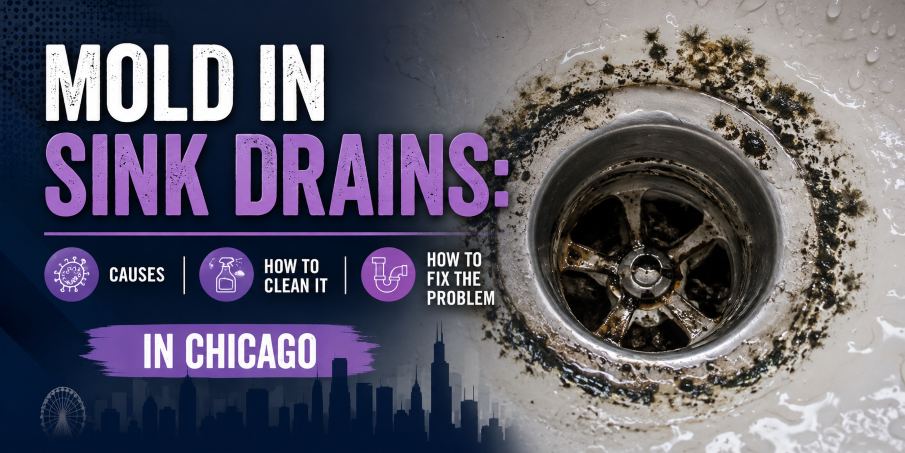
That Black or Pink Ring Around Your Drain Isn’t Just Gunk — It’s Mold, and It Keeps Coming Back Because Cleaning the Visible Part Doesn’t Fix What’s Feeding It. Here’s What Causes It, How to Clean It Safely, and When It’s Actually a Plumbing Problem.
Mold in a sink drain is one of those problems almost everyone has seen and almost no one thinks about until the smell shows up. A dark ring at the drain opening, a slick film just below the strainer, a musty odor that a splash of bleach only knocks back for a week — it’s easy to treat as a cosmetic annoyance instead of what it actually is: a moisture and organic-buildup problem that, left alone, keeps regenerating itself. This page covers why mold grows in sink drains in the first place, what actually kills it versus what just hides it, and the point where the real fix stops being a bottle of cleaner and starts being a plumbing issue — from a slow-draining trap to a garbage disposal that’s feeding it food waste around the clock. It’s the starting point for our full drain cleaning services.
Why Mold Grows in a Sink Drain in the First Place
Mold needs three things to grow: moisture, an organic food source, and a surface it can cling to without being disturbed. A sink drain offers all three constantly. The trap and the first few inches of pipe below the strainer almost never fully dry out between uses, and the same soap film, grease, food particles, and skin oils that cause ordinary drain clogs are exactly what mold feeds on. Add the fact that this section of pipe sits in the dark and gets scrubbed far less often than the visible sink basin, and you have a small, self-sustaining ecosystem right under the strainer.
The two most common types people notice are a black film, typically Cladosporium or a similar dark mold thriving on the organic buildup coating the pipe walls, and a pink or orange slime that’s actually not a true mold at all but a bacteria called Serratia marcescens — it behaves the same way, spreading fastest in a damp, nutrient-rich drain, and gets treated with the same cleaning approach. Either way, what you’re seeing at the strainer is usually just the visible edge of a coating that extends further down into the trap than a quick wipe reaches.
Chicago’s climate and older housing stock both play a role here more than most homeowners realize. Humid summers keep bathroom air moist for longer stretches, which slows how quickly a sink and its trap dry out between uses, and many older Chicago-area homes still run galvanized or older cast iron drain lines whose interior walls have grown rougher with age — a rough interior surface holds organic film more readily than smooth modern PVC, giving mold and buildup more places to anchor. None of that means mold is inevitable in an older home, but it does mean the same amount of use tends to produce buildup faster than it would in a newer fixture with modern piping.
How Long It Actually Takes for Mold to Take Hold
Mold doesn’t need weeks of neglect to establish itself — under the right conditions, visible colonization can begin within 24 to 48 hours of a surface staying consistently damp, which is part of why a drain that’s cleaned every week or two can still develop a persistent ring. A sink that’s used multiple times a day, especially a kitchen sink handling food prep and dishwashing, rarely gives the trap enough uninterrupted dry time to break that cycle on its own. This is also why a vacation home, a guest bathroom, or any sink that sits unused for stretches and then gets occasional heavy use is often where the strongest odor and most visible growth shows up — long dry periods followed by bursts of moisture and organic material are close to ideal conditions for it.
How to Clean Mold Out of a Sink Drain
For a surface-level buildup — the kind most kitchen and bathroom sinks develop from routine use — cleaning at home is usually enough, provided it actually reaches past the visible ring. Remove the strainer or stopper and scrub it separately, since buildup collects on its underside where it’s never seen. Use a bottle brush or a flexible drain brush to physically scrub the inside of the pipe as far down as it will reach, since the point of scrubbing is mechanical removal, not just chemical contact. A baking soda and vinegar flush loosens organic buildup without the health risks of stronger chemicals, and a wet-dry vacuum or plunger can help dislodge what a brush can’t reach. Follow with hot water to rinse loosened debris further down the line.
On the question of bleach specifically: the EPA’s guidance on mold cleanup is that the use of a biocide that kills organisms such as mold, chlorine bleach for example, is not recommended as a routine practice during mold cleanup, and the agency’s cleanup guidelines instead point toward scrubbing hard surfaces with detergent and water first. That’s especially relevant in a drain, where bleach’s effectiveness drops sharply once it contacts the organic grease and soap film mold is actually growing in — it can bleach the visible color out of a colony without removing the buildup underneath, which is why the ring so often looks gone for a few days and then comes right back.
If a strainer-level cleaning routine stops working — the film returns within days instead of weeks, the odor doesn’t clear, or the mold appears well below where a brush can reach — that’s usually a sign the buildup has moved past what a scrub-and-flush routine can address, and it’s worth a professional look at the trap and drain line rather than repeating the same cleaning cycle indefinitely.
If the odor smells more like rotten eggs or sewage rather than musty or organic buildup, the cause may be a plumbing or sewer-gas problem instead. See our guide to sewer odors in Chicago homes to learn what to check.
DIY Cleaning vs. Calling a Plumber
Most first-time mold rings and mild odors are genuinely a DIY job — a thorough scrub of the strainer and the reachable section of trap, followed by a hot water flush, resolves the majority of cases people notice on their own. Where DIY starts to fall short is depth and diagnosis: a home brush or a store-bought drain snake typically reaches only a foot or two into the line, while the buildup feeding a persistent mold problem often sits further down, past the trap and into the branch line, where household tools simply can’t reach. A plumber’s equipment — motorized augers, drain cameras, and hydro jetting — reaches significantly further and can actually confirm what’s causing the recurrence instead of guessing.
There’s also a point where DIY chemical use becomes counterproductive rather than just ineffective. Repeated use of strong drain chemicals or full-strength bleach in an attempt to permanently kill recurring mold can degrade older pipe joints and seals over time, particularly in the galvanized and cast iron lines common in older Chicago homes, turning a cosmetic mold problem into a corrosion problem. If you’ve cleaned a drain two or three times in as many weeks and the mold keeps returning at the same pace, that’s the point to call a professional rather than reaching for a stronger chemical.
When It’s Not Really a Mold Problem — It’s a Slow Drain
Mold that keeps regenerating almost always traces back to standing water: a drain that empties slowly leaves the trap and lower pipe wet for hours instead of minutes, which is exactly the condition mold needs to keep colonizing. If your sink drains slowly, gurgles, or leaves standing water for any length of time, the moisture behind the mold problem isn’t going away no matter how often the visible ring gets scrubbed. Our kitchen sink drain cleaning service clears the grease, food buildup, and soap scum that both slow a drain down and feed mold growth in the same visit, which is usually the more permanent fix compared to treating the surface symptom on repeat.
Garbage Disposals: A Constant Food Source for Mold
A garbage disposal doesn’t remove food waste from your drain system — it grinds it into smaller pieces and sends it into the same pipe the mold is growing in, which means a disposal that’s used daily is effectively feeding a mold colony fresh organic material around the clock. A disposal that smells bad even after running, or one that’s leaking or humming instead of grinding properly, often has buildup packed into the grinding chamber and splash guard that a sink-drain cleaning alone won’t reach. Addressing that buildup directly, and running the disposal with cold water for a few extra seconds after grinding — rather than shutting it off immediately — helps flush residual food further down the line where it’s less likely to sit and feed new growth.
Bathroom Sinks: Hair and Soap Scum Are the Difference
Bathroom sink mold tends to have a different cause than kitchen sink mold — less grease, far more hair, soap scum, and toothpaste residue, all of which trap moisture against the pipe wall the same way grease does in a kitchen drain. A slow-draining bathroom sink is one of the most common places we find a hair-and-soap mass sitting just below the trap, holding water against the pipe long after the sink itself looks empty. Our bathroom sink drain cleaning service clears that buildup along with the moisture it’s trapping, rather than just addressing what’s visible at the strainer.
What Deeper Mold and Buildup Actually Requires
When mold and the organic buildup underneath it extend well past the trap — coating the inside of the drain line further than a brush, plunger, or store-bought snake can reach — the right tool changes. Hot water hydro jetting uses pressurized water to scour the full interior wall of the pipe rather than just punching a hole through whatever’s blocking flow, which removes the grease and organic coating mold actually grows on instead of leaving a thin layer behind for it to recolonize. For a home or business with a recurring odor or visible growth that keeps returning despite regular cleaning, a hydro jetting service paired with a drain camera check is usually what finally breaks the cycle, since it removes the food source rather than just the current colony. For a deeper look at how hot water hydro jetting removes grease, scale, and organic buildup from inside drain lines, see our guide to hot water hydro jetting for Chicago-area drain cleaning.
Health Considerations: When to Take It More Seriously
For most people, a small amount of mold in a sink drain is an unpleasant nuisance rather than a medical emergency, but it isn’t nothing. The CDC’s guidance on mold and health notes that mold exposure can cause a stuffy nose, sore throat, coughing or wheezing, burning eyes, or skin rash for some people, and that those with asthma or a mold allergy may have more severe reactions. That’s worth keeping in mind for anyone in the household with respiratory sensitivities, and it’s part of why the EPA’s own cleanup guidance leans toward mechanical removal with detergent and water over relying on strong chemical disinfectants in a space as enclosed and frequently used as a kitchen or bathroom sink.
Commercial Kitchens and Multi-Unit Properties
Mold in a sink drain isn’t just a residential annoyance — in a restaurant, food service kitchen, or multi-unit residential building, it’s a sanitation issue that health inspectors specifically look for, and one high-volume sink can develop the problem far faster than a household fixture. Our commercial drain cleaning services cover the grease trap cleaning, hydro jetting, and camera inspection work that a high-traffic commercial kitchen actually needs to keep drain lines from becoming a recurring mold and odor source between routine cleanings.
Preventing Mold From Coming Back
Once a drain is actually clear of buildup, keeping it that way is mostly about breaking the conditions mold needs rather than any single product. A weekly hot water flush — letting the tap run hot for 30 to 60 seconds — helps prevent grease and soap film from setting into a coating the way cooler water allows. Running the bathroom fan or cracking a window during and after showers cuts down on the ambient humidity that keeps a nearby sink trap from fully drying between uses. Leaving the strainer out to air-dry after cleaning, rather than immediately capping the drain again, gives the trap a real chance to dry rather than staying damp under a closed stopper. And for kitchen sinks specifically, scraping food into the trash before it goes down the disposal — rather than relying on the disposal and water flow to carry everything away — reduces how much organic material the drain has to process every day.
None of these steps replace a professional cleaning once buildup has already accumulated past what routine maintenance reaches, but they meaningfully extend the time between cleanings and reduce how quickly a treated drain regrows the problem.
Frequently Asked Questions
Is the pink slime in my drain actually mold?
Not technically — that pink or orange film is usually a bacteria called Serratia marcescens rather than a true mold, but it grows for the same reason mold does: standing moisture and an organic food source in a drain that isn’t fully drying out between uses. It’s cleaned the same way, and it comes back for the same reason true mold does if the moisture and buildup behind it aren’t addressed.
Is it safe to use bleach on mold in my sink drain?
Bleach can lighten or remove the visible color on hard, non-porous surfaces, but the EPA does not recommend it as a routine mold cleanup method, and its effectiveness drops significantly once it contacts organic grease and soap buildup — which is exactly what coats the inside of a drain. Scrubbing the buildup out mechanically, then flushing with hot water, generally does more to actually remove the problem than bleach alone.
Why does the mold in my drain keep coming back after I clean it?
If cleaning only reaches the visible ring at the strainer, the organic coating and moisture further down the trap and pipe are untouched and will keep feeding new growth. A slow-draining sink compounds this by keeping the trap wet longer than normal, which is why a drain that’s cleaned regularly but never actually cleared of buildup tends to regrow mold on a predictable cycle.
Can a smelly garbage disposal be a mold problem?
Often, yes. A disposal grinds food into smaller particles rather than removing it from the drain system, and buildup packed into the grinding chamber or splash guard creates the same warm, damp, organic-rich environment mold needs. If the odor persists after running and cleaning the disposal, the buildup is usually deeper than a surface wipe can reach.
How often should I clean my sink drain to prevent mold?
A weekly hot water flush and a monthly strainer scrub is enough to prevent mold in most households, though a heavily used kitchen sink or a bathroom with poor ventilation may need more frequent attention. If mold reappears faster than that despite regular cleaning, it’s usually a sign of buildup further down the line than routine maintenance can reach, not a sign you’re not cleaning often enough.
Can mold in a sink drain spread to other parts of the house?
Mold itself generally stays confined to the damp environment it’s growing in, but scrubbing a moldy drain can release spores into the air, and those spores can settle elsewhere in the home if the space isn’t ventilated during cleaning. Running an exhaust fan and keeping the area ventilated while cleaning reduces that risk considerably.
Mold or Odor Coming From a Sink Drain in Chicago?
Licensed, insured, and serving Chicago and Chicagoland since 1978. We handle kitchen and bathroom drain cleaning, garbage disposal repair, hydro jetting, and camera inspections — residential, commercial, and multi-family properties alike.
Suburbs: 708-801-6530 | Chicago: 773-570-2191 | Open 24/7
—
Suburban Plumbing Sewer Line & Drain Cleaning Experts
Licensed & Insured | Open 24 Hours | Serving Chicago & Chicagoland Since 1978
📞 Suburbs: 708-801-6530 | 📞 Chicago: 773-570-2191