
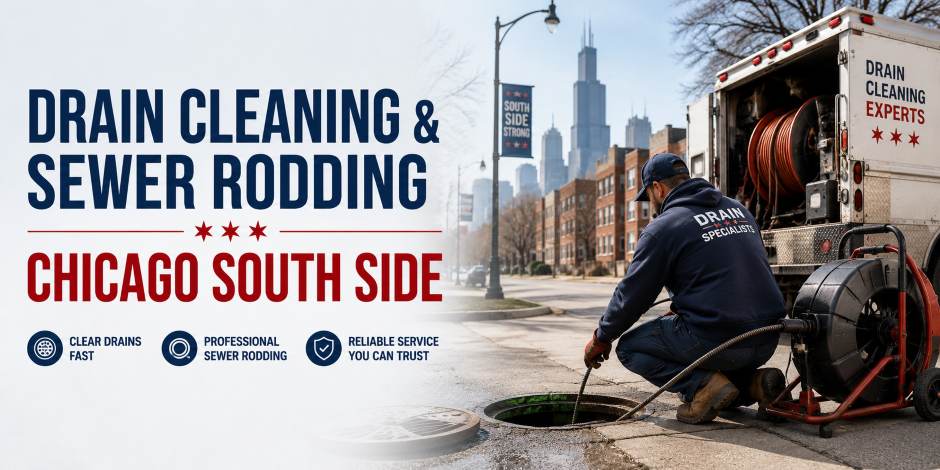
The Complete Guide for South Side Homeowners Who Want to Know Why Their Drains Keep Backing Up — and What Actually Fixes It
If you live on Chicago’s South Side and you’ve been dealing with recurring drain problems — the kitchen drain that backs up every couple of months despite repeated rodding, the two-flat floor drain that surcharges during every significant storm, the slow bathroom drain that cleaning never seems to permanently resolve — you’re dealing with a combination of conditions that is genuinely unique to this part of the city. Not unique to Chicago. Unique to the South Side.
Three specific factors combine in Chicago’s South Side neighborhoods that produce drain cleaning demand more intense, more frequent, and more resistant to temporary solutions than almost any other residential area in the metropolitan Chicago market. These three factors — the bungalow belt’s aging cast iron drain infrastructure, the South Side’s unmatched food culture and the FOG loading it produces, and the mature tree canopy that has been targeting clay tile lateral joints for 80 to 100 years — are why South Side plumbers stay busy, why one-time rodding services keep getting called back, and why hydro jetting exists as a permanent solution to a problem that temporary clearing never resolves.
This guide explains all three. What’s happening in your South Side drains. Why rodding alone keeps producing temporary results. Why hydro jetting breaks the cycle. And what the right service approach looks like for each South Side neighborhood’s specific conditions.
Factor One: The Bungalow Belt — The Most Concentrated Cast Iron Drain System on Earth
Chicago’s South Side contains one of the largest concentrations of pre-1940 brick bungalows in North America. Beverly, Morgan Park, Chatham, Bridgeport, Back of the Yards, South Shore, Gage Park, West Lawn, Brighton Park — the residential fabric of the South Side is defined by the Chicago bungalow: the one-and-a-half story brick homes built between 1910 and 1940 that represent the architectural signature of working-class Chicago homeownership.
These homes are magnificent — solidly built, architecturally coherent, deeply embedded in the identity of South Side Chicago. They also have original cast iron drain lines that are now 85 to 110 years old.
Cast iron drain lines at this age in Chicago’s hard water environment have a specific interior condition that drives everything about South Side drain cleaning. Chicago’s Lake Michigan water at 130 to 150 parts per million of dissolved minerals — calcium and magnesium specifically — has been running through these cast iron pipes every day for 85 to 110 years. The dissolved minerals deposit on the interior pipe wall surface. The pipe surface corrodes from within, producing a progressively rougher interior texture. That rough texture catches and anchors grease, debris, and mineral deposits more aggressively than a smooth newer pipe surface — creating the accumulation dynamics that produce the South Side’s recurring drain backup cycle.
A 1928 Bridgeport bungalow’s kitchen drain pipe is not just old — it’s a rough, corroded, scale-lined surface that accumulates grease and mineral deposits at a rate dramatically higher than a modern PVC drain pipe in a newer home. The pipe diameter has been progressively narrowing from interior accumulation for nearly a century. Standard rodding punches through the current obstruction. It doesn’t remove the wall deposits that created the conditions for that obstruction and will create the next one. Within weeks to months, the accumulation rebuilds on the same rough surface — producing the same backup, requiring the same rod, in an indefinite cycle. This same pattern appears throughout many of Chicago’s older neighborhoods, where dense housing, aging drain infrastructure, and decades of buildup create chronic drain problems that simple cleaning methods rarely solve. Our guide to drain cleaning in Logan Square explains how these conditions developed and why hydro jetting is often the long-term solution for recurring backups.
This is the bungalow belt drain cleaning reality: not a plumbing failure, not a homeowner error, but the predictable consequence of century-old cast iron drain infrastructure in a hard water city. Understanding it is the first step toward addressing it correctly.
Factor Two: South Side Food Culture — The Highest FOG Loading Per Kitchen in Chicago
The EPA and MWRD both document that fats, oils, and grease — FOG — are the leading cause of residential drain blockages, responsible for nearly half of all sewer backups. And if there’s one thing the South Side of Chicago does better than anywhere else in the city, it’s food. Heavy, fat-intensive, gloriously rich food that has defined South Side community culture for generations.
The Beverly and Morgan Park Irish tradition: Sunday roast beef, corned beef and cabbage, butter and cream sauces that have been a part of Beverly’s Irish-American community since the neighborhood’s original development. A post-mass Sunday dinner on South Western Avenue produces a cooking grease load that would challenge the drain system in any home — and in a 1935 Beverly bungalow with original cast iron drains, it produces the conditions for the next drain backup.
The Bridgeport and Canaryville Polish and Lithuanian legacy: Kielbasa rendered in its own fat. Stuffed cabbage with pork. Pierogies pan-fried in butter. The cooking traditions of Bridgeport and Canaryville — where Polish and Lithuanian communities put down roots in the late 19th and early 20th centuries alongside the stockyards workers — are fat-intensive cooking traditions that produce the kitchen grease loading that, combined with 100-year-old cast iron drain lines, creates the most challenging drain cleaning conditions in the city.
The Back of the Yards and Pilsen cooking culture: Back of the Yards takes its name from the Union Stock Yards that operated nearby until 1971. The neighborhood that fed the world’s largest meatpacking operation has a food culture built around the heaviest available proteins — and the cooking of those proteins produces the animal fat and grease loading that has been running down Back of the Yards kitchen drains for generations.
The Chatham and South Shore African American culinary tradition: Southern cooking carried north by the Great Migration — fried chicken, collard greens cooked with fatback, sweet potato pie with butter crust, catfish rendered in oil. The African American cooking traditions that enriched South Side culture through the 20th century produce kitchen drain FOG loads that are among the highest of any residential cooking tradition.
The Little Village and Pilsen Mexican tradition: Carnitas cooked in lard. Chicharrón in its own fat. Tamales with masa mixed with lard. The Mexican cooking traditions concentrated in Little Village and Pilsen are built around the fat-intensive ingredients that produce outstanding food and challenging kitchen drain conditions.
None of this is a criticism of South Side food culture — it is, in the most literal sense, some of the greatest food in America. But every kitchen drain on the South Side carries the evidence of that cooking. The grease that doesn’t leave through the stove hood enters the drain. In a century-old bungalow kitchen with original cast iron drain lines, that grease deposits, accumulates, hardens, and narrows the drain. It is the most direct possible connection between food culture and plumbing maintenance.
Factor Three: The South Side’s Famous Tree Canopy and What It Does Underground
Beverly and Morgan Park are famous throughout Chicago for their tree-lined streets — the mature elms, oaks, and maples that make these South Side neighborhoods some of the most beautiful in the city. Bridgeport’s established parkway trees. Hyde Park’s century-old campus canopy. South Shore’s established residential tree cover.
These trees are genuinely beautiful. They are also, underground, among the most aggressive root systems in Chicago — and they have been targeting the moisture inside aging clay tile sewer lateral joints for 80 to 100 years.
Here’s the specific South Side sewer lateral story: virtually every pre-1960 South Side bungalow has a clay tile sewer lateral that was installed when the home was built. A 1926 Beverly bungalow has a clay tile lateral that is now 100 years old. That lateral has experienced 100 Chicago winters of freeze-thaw cycling — 8,000 to 10,000 individual freeze-thaw stress events. The joints between clay tile sections, which were sealed with mortar or simply butted together at installation, have been moving incrementally with each of those stress cycles. After 100 years, most of those joint gaps are open enough to admit tree root filaments.
The mature parkway trees in Beverly, Morgan Park, and Bridgeport have root systems that extend 40 to 60 feet in every direction from the trunk. In South Side neighborhoods where parkway trees were planted alongside the original bungalow development 80 to 100 years ago, those root systems have had 80 to 100 growing seasons to find the warm, nutrient-rich moisture inside every clay tile lateral joint within their radius.
The result is the pattern that Beverly and Morgan Park homeowners know well: annual sewer rodding to clear the root mass, followed by regrowth through the same open joint, followed by the same backup on the same 10-to-12-month schedule. The rod cuts what grew through the joint. The joint remains open. The same tree’s root system — larger and more vigorous than the previous year because it now has an established path — grows back through the same gap.
This is the South Side sewer lateral maintenance cycle in its most common form. And like the kitchen drain cycle, it has a permanent answer — joint sealing at the identified entry points after camera inspection confirms their specific location — rather than just a temporary one.
Rodding vs Hydro Jetting — The Right Tool for Each South Side Drain Problem
Understanding which service addresses which South Side drain condition is the difference between spending money that breaks the cycle and spending money that continues it.
Homeowners in nearby South Side suburbs experience many of these same plumbing challenges, especially communities with older housing stock, aging sewer infrastructure, and mature tree-lined streets. Evergreen Park, located directly southwest of Chicago’s South Side neighborhoods, has many homes with similar drain, sewer, and flood control concerns. Our guide to plumbing, sewer, and flood control in Evergreen Park explains the most common issues homeowners face and the solutions available for protecting their properties.
When South Side Homeowners Need Sewer Rodding
The active backup: A South Side kitchen drain, main lateral, or floor drain that is actively backed up needs rodding first. The steel cable with a cutting head breaks through the root mass or grease accumulation, restores flow, and provides immediate relief. Rodding is the right emergency response — fast, effective for clearing the acute blockage, and appropriate for the immediate problem.
Root mass reduction before hydro jetting: In South Side clay tile laterals with significant root intrusion, mechanical root cutting with a rod reduces the root mass to a manageable volume before hydro jetting flushes it completely. The rod does the mechanical work; the jetter flushes the results. The sequence produces better lasting outcomes than either service alone in heavy root intrusion situations.
Simple drain clogs with confirmed clean pipe: For a South Side drain that has been camera-confirmed to be structurally sound with minimal wall accumulation — a pipe in good condition that has a specific organic blockage — rodding addresses the blockage without the additional investment of hydro jetting. Our sewer rodding service is available throughout the South Side with same-day and 24/7 emergency response.
When South Side Homeowners Need Hydro Jetting
The recurring kitchen drain in a pre-1940 bungalow: If the kitchen drain has been rodded more than twice in 18 months, the problem is wall deposits, not blockage material. Hot water hydro jetting at 2,500 to 4,000 PSI scours the pipe wall surface — removing the calcium-reinforced grease matrix that rodding compresses but never removes. The first hydro jetting service on a 100-year-old South Side bungalow kitchen drain frequently removes accumulation that has been building since the 1940s. The result is a pipe interior close to original condition that accumulates new material much more slowly because the surface is smooth rather than rough.
After root cutting — flushing cut material and cleaning pipe walls: Hot water hydro jetting following sewer rodding in a South Side clay tile lateral accomplishes two things that rodding alone can’t: it flushes every fragment of cut root material downstream rather than leaving it to accumulate downstream of the cut point, and it scours the biological deposit and scale from the pipe wall simultaneously. The combination produces a genuinely clean pipe rather than a temporarily cleared one.
Before sewer camera inspection: A sewer camera inspection of a South Side clay tile lateral should be performed on a clean pipe — not through accumulated debris and root material. Hydro jetting before the camera run clears the lateral sufficiently to allow the camera to see the pipe wall condition, joint locations, and structural findings that determine every subsequent decision.
Commercial South Side properties: Back of the Yards restaurants, Bridgeport taverns, Hyde Park food service — commercial kitchens anywhere produce FOG loading that residential service intervals can’t address. Commercial hydro jetting at appropriate intervals keeps commercial drain systems in compliance with Cook County health code standards and prevents the acute backup events that stop operations. For the complete commercial drain cleaning picture throughout Chicago’s South Side commercial corridor, see our commercial drain cleaning services.
The Two-Flat Reality — Why South Side Two-Flat Drains Are the Hardest Working in Chicago
The South Side two-flat is an institution — the ownership structure that generations of South Side families used to build wealth, provide housing for family members, and maintain their presence in their neighborhoods. A South Side two-flat kitchen drain doesn’t handle one household’s FOG loading. It handles two households’ FOG loading through one drain system.
The math is straightforward: two kitchens, two families cooking heavy South Side food, both sets of drain waste flowing through one aging cast iron drain branch in a 1924 bungalow conversion. The FOG accumulation rate on a South Side two-flat kitchen drain branch is double what a single-family bungalow produces — on a pipe system that’s the same age and the same original construction.
South Side two-flat owners on the annual rodding cycle should be on a semi-annual professional kitchen drain cleaning schedule. The FOG loading from two households exceeds what an annual service interval can manage on cast iron drain lines at this age. The compressed interval isn’t excessive maintenance — it’s the mathematically appropriate response to twice the FOG loading through one pipe.
For the complete explanation of how FOG, hard water, and cast iron combine to produce Chicago’s most common drain clog pattern — and why hydro jetting breaks the cycle that rodding alone never does — see our complete guide to the #1 cause of drain clogs in Chicago homes.
Neighborhood-by-Neighborhood — The South Side Drain Cleaning Picture
Beverly and Morgan Park
Beverly and Morgan Park are the South Side’s most tree-dense neighborhoods — and their combination of pre-1940 housing stock, 80-to-100-year parkway trees, and affluent homeowner investment in finished basements creates the most acute sewer lateral maintenance demand on the South Side.
The Beverly ridge — the glacial moraine that runs north-south through Beverly and Morgan Park — gives these neighborhoods their distinctive rolling topography. But it also creates differential soil settlement conditions around buried laterals as the ridge’s varied soil profile shifts over decades. Camera inspection of Beverly and Morgan Park laterals consistently finds not just root intrusion but associated joint offset from this differential settlement — the physical displacement of clay tile sections that creates the internal ledges described in our guide to why Chicago drains keep clogging after cleaning.
Bridgeport and Canaryville
Bridgeport’s housing stock — dense, close-knit two-flats and bungalows dating from the 1900s through the 1940s — is among the oldest continuously occupied residential fabric in Chicago. Bridgeport’s housing stock — dense, close-knit two-flats and bungalows dating from the 1900s through the 1940s — is among the oldest continuously occupied residential fabric in Chicago. Homeowners dealing with recurring backups, slow drains, and aging sewer infrastructure can learn more about our drain cleaning, sewer service, and plumbing in Bridgeport, Chicago and the solutions available for older Bridgeport homes. The drain cleaning demands in Bridgeport reflect that age: 100-to-120-year-old cast iron drain lines, clay tile laterals approaching the same age, and the double FOG loading of two-flat living with Polish and Mexican cooking traditions.
Canaryville — south of Bridgeport, named for the canaries that allegedly flocked to the stockyards refuse — has similar housing character with similar drain conditions. The stockyards legacy isn’t just historical: the cooking traditions that developed alongside the meatpacking industry survive in the kitchens of the neighborhood’s long-term residents, producing the FOG loading that makes Canaryville’s drain cleaning demand consistent.
Back of the Yards
Back of the Yards was the neighborhood that Upton Sinclair documented in “The Jungle” — the industrial residential community that housed the Union Stock Yards workforce. The neighborhood’s current character — predominantly Mexican and African American, dense with two-flats and bungalows from the early 20th century — carries the housing stock of that industrial era along with the cooking traditions that have evolved through successive waves of community.
Back of the Yards kitchen drains handle the FOG loading from carnitas in lard, tamales with masa and fat, chicken cooked in oil, and the heavy cooking that feeds densely populated two-flat households. The cast iron drain lines those kitchens connect to are 80 to 110 years old. The combination produces the acute drain cleaning demand that makes Back of the Yards one of the busiest residential drain service areas on the South Side.
Hyde Park
Hyde Park’s housing stock spans a wider range than Bridgeport or Beverly — from Victorian-era greystones near the University of Chicago to mid-century apartment buildings to newer construction on the lakefront. The older housing stock in Hyde Park’s established residential blocks has the same cast iron drain and clay tile lateral conditions as every other pre-1940 South Side neighborhood. The University of Chicago’s institutional facilities have commercial drain cleaning demands that reflect the food service operations of a major research university.
South Shore and Chatham
South Shore and Chatham represent the South Side’s predominantly African American neighborhoods with housing stock spanning the 1920s through the 1960s — bungalows and two-flats in South Shore, larger single-family homes in Chatham. The Southern cooking tradition carried north by the Great Migration’s landmark Chicago settlements in these neighborhoods produces kitchen drain FOG loading that is among the highest per kitchen in the city.
South Shore’s proximity to the lake creates specific groundwater conditions that affect lateral and drain performance alongside the kitchen drain and root intrusion issues common throughout the South Side.
The Complete South Side Drain Service Approach
For the recurring kitchen drain backup in a pre-1940 bungalow or two-flat: Hot water hydro jetting is the service that breaks the cycle. Schedule annually for single-family bungalows. Schedule semi-annually for two-flats with two active kitchens. Our hydro jetting service covers the South Side with same-day availability.
For the annual sewer rodding cycle on a clay tile lateral: Camera inspection after the next rodding service identifies the specific root entry joints. Joint sealing or targeted pipe lining at those joints is the step that converts the annual cycle to a multi-year maintenance interval rather than a 10-month cycle. Our sewer camera inspection service is available throughout South Side Chicago neighborhoods with same-day scheduling.
For the combined sewer floor drain backup during storms: The Cook County combined sewer backup that South Side bungalow floor drains experience during heavy rain events is a different mechanism from drain clogs — it requires a backwater valve, not a drain cleaning service. For the complete explanation of why these two problems require completely different solutions, see our complete Chicago drain cleaning guide.
For the pre-purchase assessment of a South Side bungalow: If you’re buying a pre-1940 South Side bungalow and haven’t had a sewer camera inspection, you’re taking on an unknown lateral condition with 100 years of Chicago winters behind it. The $250 camera inspection is the most important due diligence investment available before closing on a South Side historic home.
What South Side Homeowners Should Do Right Now
If your kitchen drain has been rodded more than twice in the past 18 months: Switch to hot water hydro jetting. The rodding cycle is managing the symptom. Jetting addresses the wall deposits that keep recreating it.
If you own a two-flat: Compress your kitchen drain service interval. Two kitchens through one cast iron drain system warrant semi-annual professional cleaning rather than annual.
If your sewer has been rodded annually for years: Schedule a camera inspection after the next rodding service. Identify the specific root entry joints. Get quotes for joint sealing or targeted lining. Break the annual cycle rather than continue it indefinitely.
If you haven’t had a sewer camera inspection in your current ownership: Schedule one. A pre-1940 South Side clay tile lateral with unknown condition has had 85 to 110 Chicago winters. What the camera finds determines every maintenance and repair decision from here forward.
Frequently Asked Questions: Drain Cleaning and Sewer Rodding on Chicago’s South Side
My kitchen drain was hydro jetted last year and it’s already slowing again. Did it not work?
Hydro jetting cleaned the wall deposits to near-original condition. New accumulation begins immediately — from the same FOG sources that created the original deposits. The question is the rate of rebuild. If the drain is slowing again after 8 to 12 months, the service interval needs to be compressed. In a South Side two-flat with heavy cooking, semi-annual hot water hydro jetting may be the appropriate maintenance interval. The pipe condition after jetting is genuinely better — the rebuild rate reflects your household’s specific FOG loading, not a jetting failure.
My Beverly bungalow sewer has been rodded every year for 10 years. Is there an alternative?
Yes — and the alternative is specific to your lateral’s condition. A sewer camera inspection after this year’s rodding identifies the root entry joint locations. Targeted sealing or lining at those specific joints closes the pathways the roots are using. The annual cycle isn’t the only option — it’s what happens when the entry points are never addressed. One targeted repair investment typically breaks a cycle that has been recurring annually for years.
I have a South Side two-flat. Should both units share the same drain cleaning service?
Yes — the drain system is shared infrastructure. One professional hot water hydro jetting service cleans the shared kitchen drain branch and main lateral for both units simultaneously. The cost is per service call, not per unit — making it more efficient than trying to service each unit’s drain independently. The two-flat owner’s drain service is the landlord’s maintenance responsibility: the service protects both the rental unit and the property investment.
South Side Drain Problems? Let’s Break the Cycle — Not Just Clear It One More Time.
Licensed, insured, and serving Chicago’s South Side since 1978. We perform hot water hydro jetting, sewer rodding, sewer camera inspection, and complete drain service throughout Beverly, Morgan Park, Bridgeport, Hyde Park, Back of the Yards, Chatham, South Shore, and every South Side neighborhood — understanding what 100-year-old cast iron drains, South Side food culture, and decades of root pressure actually require. Written quotes before we start, our own licensed plumbers on every call. Send us a message and we’ll get back to you fast.
Or call us directly: 773-570-2191 (Chicago) | Open 24/7
—
Suburban Plumbing Sewer Line & Drain Cleaning Experts
Licensed & Insured | Open 24 Hours | Serving Chicago’s South Side Since 1978
📞 Chicago: 773-570-2191 |🚨 Emergency: 708-518-7765