
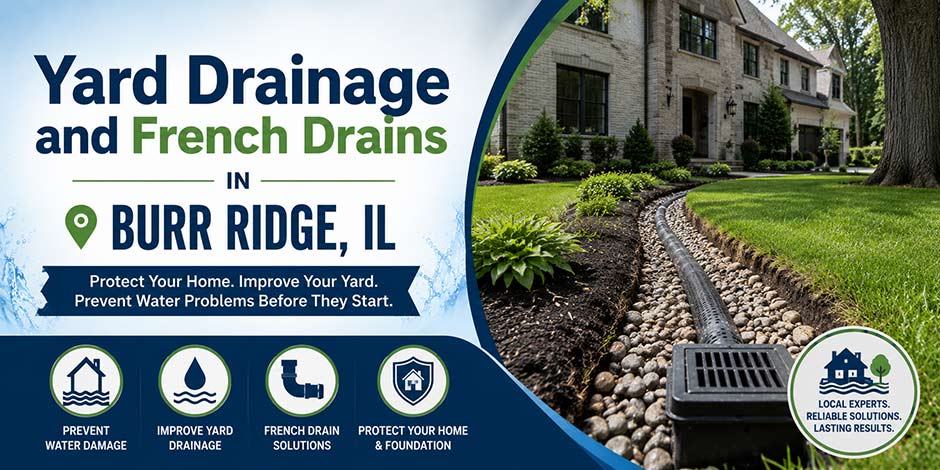
Why Burr Ridge’s Rolling Terrain, Two Active Watersheds, and Wooded Lots Create Yard Drainage Challenges No Flat Suburb Has to Deal With
Burr Ridge is genuinely different from virtually every other community in our service area — and that difference shows up most clearly in the yard drainage picture. While flat Cook County suburbs deal with water that has nowhere to go, Burr Ridge deals with something more complex: water that has somewhere to go, and that somewhere is frequently someone else’s property, a drainage easement, a creek tributary, or a basement at the bottom of a slope.
The Village of Burr Ridge’s own Public Works Department is currently managing proactive maintenance of sanitary lines and critical lift stations specifically in the Arrowhead Farms, Chasemoor, and Highland Fields subdivisions — named neighborhoods where the village has identified infrastructure that needs active attention. That’s not a sign of neglect. It’s a sign of a community built on terrain that puts real demands on drainage infrastructure at every level, public and private.
This guide covers the private side of that drainage picture — the yard drainage conditions specific to Burr Ridge’s terrain, its two active watershed plans, and what French drain installation actually looks like on the wooded, sloped, large-lot properties that define this community.
Two Watersheds, One Village — What That Actually Means for Burr Ridge Homeowners
Most Chicago-area suburbs sit in one watershed. Burr Ridge sits in two — and DuPage County has formal, adopted watershed management plans for both of them specifically identifying flooding and drainage problems throughout Burr Ridge.
The Flagg Creek Watershed Plan covers Burr Ridge, Willowbrook, Hinsdale, Clarendon Hills, and Westmont—a plan adopted by DuPage County specifically to address flooding problems and eliminate severe drainage issues throughout the watershed.
The Sawmill Creek Watershed Plan — and its 2025 addendum focused on the Marion Hills area — also includes Burr Ridge as a named affected community. The Sawmill Creek watershed covers approximately 12.5 square miles in the southeastern corner of DuPage County. DuPage County’s own documentation confirms that frequent overtopping of Sawmill Creek due to poor conveyance and lack of storage causes residential flooding throughout this watershed.
What this means for individual Burr Ridge homeowners: You live in a community where two separate county-level watershed management bodies have formally documented flooding and drainage challenges and adopted remediation plans. That’s not theoretical risk — it’s documented, planned-for, ongoing work at the regional level. The public side of those watersheds is the county’s responsibility. The drainage on your specific lot — how your yard manages the runoff from your roof, your driveway, your neighbor’s uphill property — is yours.
The Elm Street Culvert Project — What Active Village Infrastructure Work Signals
The Village of Burr Ridge, with funding from U.S. Representative Sean Casten and DuPage County, is actively replacing a large damaged culvert on Elm Street just south of Elm School. The project — in progress now in 2025 — replaces an old, damaged metal pipe with a large double-box culvert to reduce road flooding and includes native plant restoration of the streambank.
Additionally, the village re-applied to the Illinois EPA’s Green Infrastructure Grant Opportunities (GIGO) Program for a Flagg Creek channel restoration project at Stevens Park — incorporating native habitat planting and natural channel characteristics specifically to improve water quality and stormwater management in the Flagg Creek watershed.
These are not small, routine maintenance items. They are significant capital investments in drainage infrastructure specifically because Burr Ridge’s creek and culvert systems are under real, documented pressure from development runoff and watershed conditions. The same conditions driving these public projects are the conditions affecting the drainage on individual Burr Ridge properties — particularly those near Flagg Creek, near Sawmill Creek tributaries, and on the wooded slopes that make Burr Ridge what it is.
What Makes Burr Ridge Yard Drainage Genuinely Different
The Valparaiso Moraine — Rolling Terrain That Creates Real Drainage Gradients
Burr Ridge sits on the Valparaiso Moraine — the glacial ridge that gives the western DuPage County communities their distinctive rolling topography. Unlike the flat terrain of Cook County’s inner suburbs, Burr Ridge lots have actual grade — elevation changes between the uphill property line and the downhill property line that create directional water flow across the lot.
This topography creates yard drainage conditions that don’t exist on flat ground:
Upslope water from neighboring properties. A Burr Ridge homeowner at the low end of a natural grade doesn’t just drain their own lot — they receive drainage from everything uphill of them. A neighbor who reroutes their downspouts, adds a pool deck, or installs a patio that changes drainage patterns can send significantly more water across the property line than the natural grade produced before. A French drain intercepting that flow before it reaches your foundation addresses the actual source rather than managing the symptom.
Grade differentials toward the foundation. Many Burr Ridge homes were built with grade that slopes toward the foundation over time — either from original construction that didn’t allow adequate fall away from the house, or from decades of landscaping and soil settlement that has gradually reversed the original drainage grade. Water that once flowed away from the foundation gradually begins directing toward it. The result isn’t sudden flooding — it’s the slow, progressive groundwater infiltration that a properly installed French drain or foundation perimeter drain addresses by intercepting the flow before it reaches the wall.
Wooded lot drainage on clay-heavy DuPage soil. Burr Ridge’s wooded character — one of the defining features of communities along this moraine corridor — means mature trees with root systems that have been intercepting and competing with yard drainage for decades. Compacted soil beneath established tree canopies drains more slowly than open soil. Leaves and organic material that accumulate in low areas hold moisture and slow surface drainage. The combination of clay-heavy DuPage County soil, established tree root networks, and the shading that slows evaporation creates yard drainage challenges specific to Burr Ridge’s specific landscape character.
The Large Lot Reality — More Drainage Surface, More Drainage Complexity
Burr Ridge’s average lot is substantially larger than the typical Cook County suburb. A larger lot means more surface area collecting rain, more distance between the downspout and the property line, and more opportunities for surface water to accumulate in the middle of the lot before it reaches any drainage infrastructure at the property edge. A French drain system on a Burr Ridge lot isn’t just a linear trench along a wall — it often needs to intercept water at multiple points across a large yard before that water has the chance to accumulate against the foundation or cross into a neighbor’s property.
Many of these same drainage challenges exist throughout the southwest suburban Palos communities, where larger lots, mature trees, clay soils, and changing grades frequently create standing water and foundation drainage problems. Homeowners interested in comparing drainage solutions can also review our Yard Drainage and French Drains in Palos Hills, Palos Heights, and Palos Park guide for additional insight into French drain design, yard grading, and long-term water management strategies.
Choosing the right professional for this type of installation is just as important as the system itself. Not all contractors approach drainage correctly, and improper installation can actually make water problems worse. This is why it’s important to understand why hiring a licensed plumber matters for drainage systems — especially when comparing plumbing professionals to landscapers for French drain installation: Why You Should Hire a Licensed Plumber Not a Landscaper for French Drain Installation in Chicago
The Flagg Creek Water Reclamation District — The Separate Taxing Body Most Residents Don’t Fully Understand
The village’s own Public Works page is specific about this: the Flagg Creek Water Reclamation District is a separate taxing body. The village cannot accept payments or enrollment forms for their services, and payments go to a different address entirely. If you have a sewer service question in Burr Ridge, calling the village may result in being redirected to the Flagg Creek District at (630) 323-3299, or to DuPage County Sanitary depending on which part of the village your address falls in.
This matters for yard drainage specifically because the storm sewer infrastructure — the inlets, the pipes, the outfalls — may be managed by different entities depending on your specific subdivision and location within the village. Before any yard drainage project that connects to or discharges near a storm sewer inlet, knowing which entity maintains that infrastructure is part of the permit and coordination picture.
The French Drain — What It Actually Does on a Burr Ridge Property
A French drain is a gravel-filled trench with a perforated pipe that intercepts groundwater and surface runoff before it accumulates against your foundation, pools in the low point of your yard, or crosses onto a neighbor’s property. Understanding installation quality and cost expectations is critical before starting any project, because not all drainage contractors follow the same engineering standards or pricing structure.
Like any drainage system installed underground, a French drain requires ongoing attention to maintain reliable performance. Burr Ridge properties present unique maintenance challenges due to wooded lots, mature tree roots, clay-heavy DuPage County soils, and seasonal soil movement. Professional French drain cleaning and maintenance in Chicagoland can help identify sediment buildup, reduced water flow, and drainage issues before they lead to system failure.If your existing drain tile needs cleaning, our guide to drain tile cleaning costs in Chicago explains what affects the price and what homeowners can expect to pay.
Homeowners should also understand what goes into a properly designed system and how costs vary across Chicagoland conditions — this breakdown explains French drain installation cost in Chicagoland and what factors actually drive pricing: French Drain Installation Cost in Chicagoland What Homeowners Need to Know.
In Burr Ridge’s sloped, wooded, large-lot environment, the French drain does specific work that it doesn’t need to do on a flat suburban lot:
Intercepts upslope drainage flow. A French drain installed across the uphill side of a Burr Ridge home — between the slope that’s directing water toward the house and the foundation itself — acts as a barrier that captures that flow and reroutes it to a lower-resistance discharge path before it ever reaches the wall. This is the most common installation scenario on Burr Ridge’s moraine-adjacent sloped lots.
Manages the low-point pooling in large wooded yards. Burr Ridge’s large lots often have a natural low point in the middle of the yard — a shallow depression where water accumulates after rain events and sits for 24 to 48 hours before slowly draining into the clay-heavy DuPage soil. A French drain positioned at or near that low point provides an engineered drainage path that removes water actively rather than relying on the clay soil to eventually absorb it.
Protects finished basements in high-value homes. As we covered in our complete Hinsdale flood control guide, the premium finished basements typical in this corridor change the math on drainage investment significantly. The same calculation applies in Burr Ridge: a French drain installation that costs $2,000 to $5,000 is a different proposition when what’s in the basement includes custom millwork, home theater equipment, or wine storage worth multiples of the installation cost.
Manages foundation perimeter groundwater during wet seasons. On Burr Ridge’s moraine terrain with DuPage County’s clay-heavy soil, the water table during wet spring periods and after significant rain events creates hydrostatic pressure against basement foundations at the same time surface water is accumulating. A perimeter foundation drain — essentially a French drain system installed at footer depth around the foundation perimeter — manages this groundwater pressure by providing a lower-resistance path for the water to follow rather than continuing to build pressure against the wall.
Our French Drain Work in Burr Ridge — What the Job Record Shows
Our team has documented French drain installation work in Burr Ridge directly — placing drainage systems to redirect water away from properties and reduce yard flooding on Burr Ridge’s specific terrain. This isn’t a hypothetical application of a generic product to a market we don’t know. We understand how DuPage County’s clay soil behaves, how the Valparaiso Moraine’s grade differentials direct drainage, and how the Flagg Creek and Sawmill Creek watershed conditions show up in individual lot drainage problems.
We’ve also completed French drain and yard drainage installation in Oak Brook — Burr Ridge’s neighboring community with similar topographic and soil conditions — providing further documented experience in this specific terrain type. Homeowners interested in seeing how these same drainage challenges affect nearby properties can also review our Yard Drainage and French Drains in Oak Brook and Oak Brook Terrace guide.
Our French drain design for Burr Ridge properties accounts for:
- Actual site grade and flow direction, confirmed by a site visit
- Soil permeability in DuPage County clay (which requires appropriate gravel selection and filter fabric to prevent premature clogging)
- The discharge point — where the captured water actually goes — which must reach a lower-resistance outlet (storm sewer inlet, daylight outlet at a property edge, or catch basin) without crossing onto a neighbor’s property at greater volume than before
- Village permit requirements — any drainage work that affects water flow off the property may require review through the Village of Burr Ridge Community Development Department
For the complete framework on how French drains work, when they’re the right solution vs a sump pump or other drainage approach, and what the installation process looks like, see our complete French drain installation guide.
The Permit Question — What Burr Ridge Requires Before Drainage Work Begins
Like its neighbor Hinsdale, the Village of Burr Ridge has specific requirements for drainage work that affects surface water flow. Before any French drain, regrading, or drainage installation project that could alter how water moves across or off your property, contact the Village of Burr Ridge Community Development Department to confirm what review and permitting is required.
The Village’s own sewer page advises residents to contact them before calling a plumber for sewer issues — so they can determine if the issue is in the village system or on private property. The same principle applies to drainage: understanding whether your drainage problem is a private lot issue, a shared drainage easement issue, or a connection to the village’s storm sewer infrastructure determines who does what and what permits are needed before any work starts.
A contractor who begins drainage work on a Burr Ridge property without confirming the permit requirements with Community Development is exposing you to potential stop-work orders, retroactive permit fees, and in the most serious cases, required removal of unpermitted drainage work. We pull every required permit as part of every drainage installation we perform in Burr Ridge.
What Burr Ridge Homeowners With Yard Drainage Problems Should Do Right Now
If your yard pools after every rain and stays wet for 24 to 48 hours or more: This is the classic DuPage County clay-heavy soil drainage condition. The soil is absorbing water slower than the rain delivers it. A site visit to assess the grade, the accumulation point, and the discharge options is the first step — not an immediate installation decision.
If water appears to be coming from uphill neighbors or a sloped grade toward your foundation: A French drain intercepting upslope flow is the most targeted solution for this specific condition. The interception point — between the slope and the foundation — determines how much of the upslope drainage it captures and how much protection it provides.
If your finished basement shows any signs of seepage at the wall-floor joint or through the floor slab: The source may be surface drainage, groundwater, or both. Correctly diagnosing which mechanism is driving moisture intrusion before installing any drainage system is the step that prevents the wrong-system mistake — spending on surface drainage when the problem is groundwater, or vice versa.
If you live in Arrowhead Farms, Chasemoor, or Highland Fields: The village’s current infrastructure maintenance in your subdivision is worth a direct conversation with Public Works to understand what work is happening and what implications it may have for private lot drainage.
Before any drainage work that modifies how water leaves your property: Contact the Village of Burr Ridge Community Development at (630) 654-8181 to confirm permit requirements.
Frequently Asked Questions: Yard Drainage in Burr Ridge
My neighbor uphill just installed a large patio and now my yard floods after every rain. Who is responsible?
Illinois common law and DuPage County drainage ordinances impose a general obligation on property owners not to artificially increase drainage onto neighboring properties beyond natural conditions. A newly installed impervious surface — patio, driveway expansion, pool deck — that directs additional runoff onto your property may be the basis for a drainage dispute. The Village of Burr Ridge Engineering staff can review the situation and advise on whether the upstream drainage change violates local ordinance. From a practical standpoint, a French drain intercepting the flow before it reaches your foundation addresses the damage regardless of how the neighbor situation resolves.
Is a French drain the same thing as a sump pump? Do I need both?
No — they address different water sources. A French drain intercepts surface runoff and lateral groundwater before it reaches the foundation. A sump pump removes groundwater that has already entered the basement through the foundation. In Burr Ridge’s terrain, a home with significant upslope drainage pressure AND groundwater intrusion through the foundation may genuinely need both — the French drain intercepting the surface flow that contributes to the problem, and the sump pump managing what gets through regardless. Our complete guide to sump pumps vs ejector pumps in Chicago covers the distinction in detail.
The village is doing active stormwater work in my subdivision. Should I wait for that before addressing my yard drainage?
No — the village’s infrastructure work addresses storm sewers, culverts, and public drainage systems. Private lot drainage is your responsibility regardless of what the village does with the public infrastructure. In fact, improvements to the public storm sewer system can sometimes increase the gradient that private lot drainage needs to overcome — making private drainage improvements timelier, not less so, when public work is nearby.
Yard Drainage Problem in Burr Ridge? Let’s Start With an Honest Site Assessment.
Licensed, insured, and serving Burr Ridge since 1978. We’ve installed French drains and yard drainage systems throughout Burr Ridge and the surrounding DuPage County corridor — understanding the Valparaiso Moraine terrain, the Flagg Creek and Sawmill Creek watershed conditions, and what DuPage County clay soil actually requires for effective drainage design. Written quotes before we start, permits on every job, our own licensed plumbers in Burr Ridge on every call. Send us a message and we’ll get back to you fast.
Or call us directly: 630-749-9057 | Open 24/7
—
Suburban Plumbing Sewer Line & Drain Cleaning Experts
Licensed & Insured | Open 24 Hours | Serving Burr Ridge & DuPage County Since 1978
📞 Burr Ridge: 630-749-9057 | 🚨 Emergency: 708-518-7765