
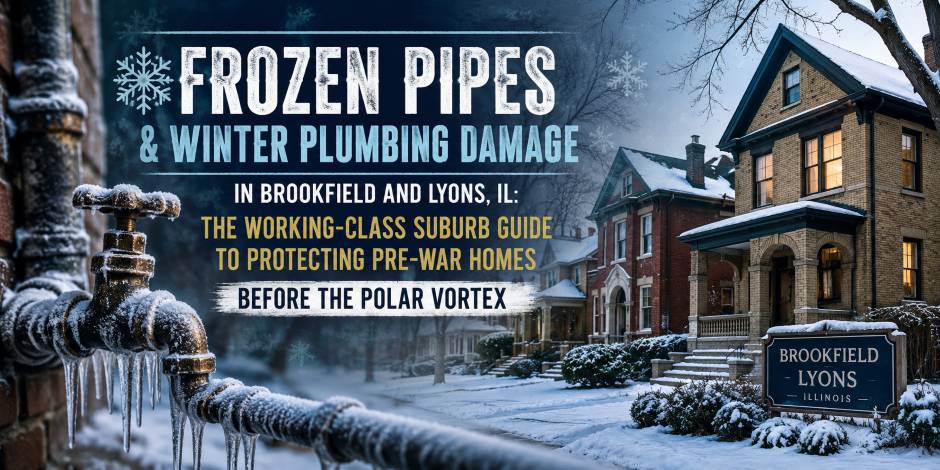
Brookfield Was Founded in 1889 to Offer Suburban Living at Working-Class Prices. Lyons Was Incorporated in 1888 at the Chicago Portage. Both Communities Were Built Affordably, Quickly, and to the Standards of Their Era — Which Means Thinner Walls, Shallower Basements, and Supply Systems That in Thousands of Homes Have Never Been Assessed, Let Alone Replaced.
Brookfield, Illinois was not built for the professional class. When Samuel Eberly Gross — a Chicago real estate developer who would eventually build more than 10,000 homes for working-class families across the Chicago area — opened his Grossdale subdivision in 1889, he was offering something specific: suburban living at prices that a tradesman, a factory worker, or a clerk on the Chicago, Burlington & Quincy Railroad could actually afford. The homes Gross built were modest by design — small lots, practical layouts, affordable materials, and construction methods that prioritized cost over thermal performance. “Grossdale” was renamed Brookfield in 1905, and the development that Gross started continued through the 1920s, 1930s, and into the postwar period as the village filled in around the Brookfield Zoo, which opened in 1934 and anchored the community’s identity for a century.
The result is a village with a median construction year of 1952 and 31.8 percent of homes built before 1940 — one of the oldest housing stocks in this entire series. Those pre-1940 homes were built to working-class construction standards: 2×4 exterior wall framing with minimal insulation by contemporary measures, shallow basements that in the oldest properties barely clear 6 feet of headroom, gravity-fed heating systems that were converted from coal to forced air at some point in the mid-20th century with varying degrees of rigor, and supply systems in galvanized steel or early copper that in many homes have been in continuous service since installation. They are solid homes — Gross built well even affordably, and the materials of the era were durable. But “durable” and “thermally protected” are different qualities, and in the pre-1940 Brookfield bungalows and Cape Cods that define the village’s residential character, the difference between those two qualities is the frozen pipe event that has never happened yet but that a polar vortex of sufficient severity will eventually find.
Lyons, Brookfield’s neighbor immediately to the west, was incorporated in 1888 at the site of the Chicago Portage — the half-mile strip of land where Louis Joliet and Father Marquette portaged their canoes between the Des Plaines River and the Chicago River’s south branch in 1673, a crossing point that Louis Joliet was the first to propose connecting with a canal. Lyons has a median construction year of 1959, with 25.8 percent of homes built before 1940 — a housing stock that is slightly newer than Brookfield’s but that shares the same working-class construction profile, the same Cook County combined sewer infrastructure, and the same population of never-assessed supply systems in pre-war bungalows and Cape Cods that define both communities’ residential fabric.
Together, Brookfield and Lyons represent the working-class side of the western Cook County suburban corridor — communities that were built to be affordable, that have been maintained by working-class and middle-class homeowners for a century, and that have a pipe infrastructure story that no generic suburban plumbing guide has told honestly. This article tells it.
The winter plumbing challenges facing these older homes are not limited to frozen pipes alone. Aging galvanized supply lines, poorly insulated pipe runs, shallow basement conditions, sump pump failures during freeze-thaw cycles, and sudden burst pipe events are all part of the broader winter plumbing risk profile across Chicagoland. Our complete guide to winter plumbing emergencies in Chicagoland explains the full range of cold-weather plumbing threats homeowners should understand before extreme temperatures arrive.
The Construction Standards That Built Brookfield and Lyons — and Why They Matter in a Polar Vortex
Thin Walls and Shallow Basements: The Affordable Construction Profile
The homes that S.E. Gross built in Grossdale and that subsequent developers built in Brookfield through the 1930s were constructed to the standard of affordable working-class suburban housing of their era. That standard produced specific construction characteristics that are directly relevant to winter plumbing vulnerability a century later.
Thin exterior wall assemblies. Pre-1940 affordable construction in the Chicago area used 2×4 exterior wall framing with whatever insulation was standard and affordable at the time of construction — which in the 1900s through 1930s was often very little. Cellulose insulation, mineral wool batting, or in many cases simply an air space between the exterior sheathing and the interior plaster were the thermal barrier between the supply lines in the wall cavity and the outside air. The thermal resistance of these original wall assemblies is a fraction of what contemporary building code requires. In a Brookfield bungalow built in 1928, the effective insulation value between a supply line in the exterior wall cavity and the outside air may be R-5 or less — adequate to prevent freezing in a normal Chicago winter, inadequate to prevent freezing during a polar vortex event that holds exterior temperatures at minus 15°F for 36 hours.
Shallow basement profiles. The affordable construction of Gross’s era and the decades that followed produced basements that were shallower than contemporary suburban basements — in many pre-1940 Brookfield and Lyons homes, the basement floor is only 5.5 to 7 feet below grade rather than the 8 to 9 feet common in postwar and contemporary construction. The practical implication for frozen pipes: the supply line that enters the foundation through the basement wall, at the lowest point of the foundation, is closer to the frost penetration depth in a shallow basement than in a deep one. In a severe polar vortex event that drives frost penetration deeper than normal, the service line entry point through a shallow foundation wall may experience frost conditions that a deeper foundation would not. This is one of the reasons pre-war Brookfield and Lyons homes have higher service line freeze risk than equivalent-era homes with deeper basements in other communities.
Gravity-heat-to-forced-air conversions. Many pre-war Brookfield and Lyons homes were originally heated by a gravity furnace — the large, octopus-shaped cast iron furnace that heated air through a central plenum and distributed it through oversized floor ducts without a blower. These systems were converted to forced-air gas furnaces at various points from the 1940s through the 1970s. The conversion process in many homes involved connecting a new forced-air furnace to the existing large-diameter duct network — which was not designed for the airflow characteristics of a forced-air system. The result in many converted homes is uneven heat distribution, with some exterior wall areas receiving less heat circulation than others. Rooms or wall sections with inadequate heat circulation from a converted gravity system are the locations where supply lines are most likely to reach freeze-risk temperature during a hard cold event. In a pre-war Brookfield home with an original gravity duct converted to forced air, the coldest wall section in the house may not be the obvious north wall — it may be a wall section that was poorly served by the original large-bore duct network and hasn’t received adequate heat circulation since the conversion.
The WWII Pipe Material Problem — What Was Put in the Walls Between 1942 and 1946
One of the most underappreciated infrastructure facts about homes built during World War II is what happened to pipe materials during the war years. Supply demands during WWII restricted access to iron, steel, and copper for residential construction — these materials were prioritized for the war effort. The restriction spurred the development and use of alternative piping materials in residential construction during the war years, including early plastic pipe and galvanized pipe produced from recycled or lower-grade steel with different metallurgical characteristics than pre-war galvanized.
In Brookfield and Lyons, homes built between approximately 1942 and 1946 may contain supply pipe from this transitional period — material that is neither the pre-war galvanized steel of the 1920s and 1930s nor the postwar copper that became the standard after 1946. This wartime-era pipe is now 79 to 83 years old. Its metallurgical characteristics are less predictable than pre-war galvanized or postwar copper, and its internal corrosion condition after 80 years of service is genuinely unknown without inspection. For any Brookfield or Lyons homeowner in a home built between 1940 and 1948 that has never had a plumbing assessment, the supply line material and condition is not something that can be assumed — it needs to be confirmed. Our drain cleaning service for both communities includes a supply system condition observation on every residential service call — if we’re in the home and the pipes are accessible, we tell you what we see.
The Pre-War Supply System — What’s Still in the Walls of Both Communities
Galvanized Steel: The Dominant Pre-1945 Supply Material
The pre-1940 and early postwar housing stock in both Brookfield and Lyons was plumbed primarily with galvanized steel supply lines — threaded steel pipe coated with zinc to resist corrosion, the residential standard through the 1940s. Galvanized steel in a 1929 Brookfield bungalow is now 96 years old. The internal corrosion that has built up over that period — the progressive narrowing of the effective pipe diameter from mineral scale accumulation and oxidation of the zinc coating interior — is significant. In many Brookfield and Lyons homes with original galvanized supply lines, the effective flow diameter of the supply pipe has been reduced to 50 to 70 percent of its original specification, which is why older homes in these communities characteristically have noticeably lower water pressure at fixtures toward the end of the supply run than at fixtures nearer the main.
For frozen pipe purposes, the critical characteristic of aged galvanized steel is what the corrosion has done to the pipe wall at threaded joint faces. The galvanized coating is thinnest at the cut threads, and internal oxidation concentrates at those thread faces over decades. After 80 to 90 years of corrosion, the effective wall thickness at a threaded joint face in a Brookfield bungalow’s original galvanized supply line may be significantly less than the original specification — and less than the remaining pipe wall in the straight sections between joints. When freeze expansion pressure is applied to a joint face with reduced effective wall thickness, the failure threshold is lower than anywhere else in the supply run. These joint face failures don’t announce themselves with a dramatic spray — they produce the slow seep behind original plaster walls that accumulates damage for hours before emerging at the visible wall surface. In a home where the original plaster is still in place, that slow seep behind the plaster is the beginning of a restoration project, not just a plumbing repair.
For Brookfield and Lyons homeowners with original galvanized supply lines: the question before this winter is not whether the galvanized steel will eventually need replacement — it will. The question is whether a proactive replacement before a polar vortex event causes a burst is less expensive and disruptive than an emergency replacement after one. Our repiping service covers both Brookfield and Lyons with galvanized steel assessment and targeted or whole-home copper or PEX replacement — giving you documented supply system condition and a definitive answer about whether the original galvanized is still serviceable or whether replacement is warranted before next winter.
The Bungalow Attic Supply Line — The Same Pattern as Cicero and Berwyn
Both Brookfield and Lyons have a significant concentration of Chicago-style bungalows in their pre-war housing stock — the same bungalow type we covered in depth in our Cicero and Berwyn article, with the half-story attic above the main floor where supply lines rise through an essentially unheated cavity to serve a second-floor or half-story bathroom. In Brookfield’s pre-war bungalows, this attic freeze pattern is the highest-probability freeze location — supply lines in the half-story attic space that is thermally isolated from the heated main floor by the original ceiling construction, unheated by any HVAC register in most homes, and reaching near-outdoor temperatures during extended polar vortex cold events.
If your Brookfield or Lyons home is a pre-war bungalow with a half-story attic and you have never inspected the attic supply lines, that inspection is the single most important pre-winter action available to you. Access the attic before mid-November. Find the supply lines. Confirm whether they are galvanized steel or copper. Add foam sleeve insulation to every accessible section. Add heat tape to any section that is close to the roof deck or in the coldest zone of the attic space. Increase the attic floor insulation if it is at original construction levels — in a Brookfield bungalow from 1929, that insulation may be original cellulose or mineral wool at R-5 or less, providing minimal buffering between the heated main floor below and the attic cold above.
The Rim Joist — A Critical Freeze Location in Both Communities’ Shallow Basements
In pre-war Brookfield and Lyons homes with shallow basements, the rim joist — the framing member that caps the foundation wall and supports the first-floor framing above — sits closer to grade level than in deeper-basement construction, meaning the section of foundation wall below the rim joist has less soil cover and potentially less frost protection than in homes with deeper basements. Supply lines that run horizontally in the basement ceiling along the perimeter — the branch lines that feed first-floor kitchen and bathroom fixtures on the exterior walls — pass through or adjacent to the rim joist zone, which in a shallow-basement pre-war home can be the coldest section of the basement during a hard polar vortex event.
The fix is the same as in any home with rim joist freeze exposure: rigid foam insulation cut to fit between each joist bay at the rim joist location, sealed with spray foam at the edges. In a shallow-basement Brookfield or Lyons bungalow, this improvement eliminates what may be the most significant freeze location in the home at a materials cost of under $100 and a half-day of basement work. For homes where the basement headroom is truly limited — under 6.5 feet, which exists in some of the oldest Brookfield properties — this work requires crouching and careful cutting but is entirely within DIY capability for a motivated homeowner, or a fast service call for a plumber who regularly works in these homes.
The Lyons Geography — The Chicago Portage, the Des Plaines River, and Salt Creek
Where Two Rivers Almost Touched — and What That Means Today
Lyons sits at the Chicago Portage — the half-mile strip of land that historically separated the Des Plaines River watershed from the Chicago River’s south branch, and that Joliet and Marquette crossed by canoe portage in 1673. The Illinois and Michigan Canal was eventually built here in 1848 to connect what the portage had previously required human effort to cross. The Sanitary and Ship Canal replaced that connection in 1900. What this geography means today: Lyons is bounded on its east and south by the Des Plaines River and its adjacent forest preserve corridor, with Salt Creek entering the Des Plaines River just south of the village at the Lyons-Countryside boundary. The confluence of these two watercourses immediately adjacent to Lyons creates a flooding profile for the village that is shaped by two separate watershed systems simultaneously.
For Lyons homeowners near either waterway — the Des Plaines River corridor along the eastern village edge, or the Salt Creek drainage area in the southern sections — the burst pipe thaw event and the river surge event can occur in the same 48-to-72-hour window, exactly as we described for Riverside, Naperville, and Elmhurst’s river corridor properties. A polar vortex freeze followed by a rapid warm-up raises both the Des Plaines and Salt Creek levels and elevates groundwater throughout the Lyons watershed while the same warming temperatures trigger thaw-period burst pipe events in supply lines that cracked during the freeze. The interior water from the burst pipe and the exterior hydrostatic pressure from rising waterway-adjacent groundwater compound each other in the basement of any Lyons property near either corridor. Our sump pump service covers Lyons with battery backup installation specifically important for waterway-adjacent properties — the power outages that accompany polar vortex events are precisely when groundwater rises and precisely when sump pump battery backup capacity matters most.
The Brookfield Zoo Corridor — Low-Elevation Properties Near Flagg Creek
Brookfield’s eastern sections, adjacent to the Brookfield Zoo and the low-elevation areas near Flagg Creek which flows through that corridor, have a groundwater and flooding profile that is different from the village’s higher-elevation interior streets. Properties in the low-lying sections near the zoo corridor — where the natural drainage from the surrounding moraine terrain converges before reaching Flagg Creek — experience elevated groundwater during significant thaw events that properties on Brookfield’s higher-elevation streets don’t encounter. For these lower-elevation Brookfield properties, the same combined burst-pipe-and-rising-groundwater scenario applies as for Lyons’ river corridor properties: confirm sump pump function and battery backup before polar vortex season, not during the thaw event that tests both simultaneously.
The Never-Assessed Supply System — The Central Problem in Both Communities
Why These Two Communities Have the Highest Proportion of Unassessed Pipe in the Series
Throughout this series, we have made pre-winter supply line assessments available as a recommendation to homeowners in communities with aging housing stock. In Brookfield and Lyons, that recommendation carries more weight than in any other community in the series — because the combination of housing age, original construction quality, working-class homeowner demographics, and the specific economic history of both communities has produced a higher proportion of homes with supply systems that have never been formally assessed than in the professional-class western suburbs we’ve also covered.
In Hinsdale or Burr Ridge or Naperville, a homeowner in a $1.4M Victorian or a $2M estate home has both the financial resources and the personal inclination to schedule professional assessments of major home systems — because the financial consequences of deferred maintenance in those homes are visible and acute. In a $280,000 Brookfield bungalow or a $250,000 Lyons Cape Cod, the calculus is different. The homeowner may have owned the home for 30 years and never had a reason to think about the supply lines in the attic or the galvanized steel in the north wall cavity — because the home has never had a frozen pipe, because the previous polar vortex events didn’t push past the threshold of what the original construction can handle, and because there has never been a specific reason to spend money on a system that appears to be working.
That calculus changes with the supply system’s age and with the increasing intensity and frequency of polar vortex events in the Chicago area. A galvanized supply line in a 1931 Brookfield bungalow that has survived previous winters at its current condition is not a pipe that is safe — it is a pipe that has not yet encountered an event severe enough to push it past its failure threshold. The February 2021 polar vortex, which held Cook County temperatures below zero for more than 36 consecutive hours, pushed past that threshold for thousands of Chicago-area homes. Brookfield and Lyons are in Cook County. Their pre-war bungalows sit in the same thermal conditions as every other pre-war Cook County bungalow. The question for both communities’ homeowners is not whether the supply system will eventually be tested — it is whether the assessment and preparation happens before the polar vortex arrives, or whether the polar vortex provides the test results instead.
A sewer camera inspection of the main lateral is also appropriate for any pre-1960 home in both communities that has never been inspected. The combined sewer context of both villages — connected to the MWRD interceptor, with clay tile laterals in the oldest properties — means that a thaw event that triggers combined sewer surcharge is the second flooding mechanism that operates simultaneously with a burst pipe thaw event. Knowing your lateral’s condition before winter tells you whether backflow protection is warranted. Our sewer camera inspection service covers both Brookfield and Lyons with same-day scheduling and written condition reports that form the basis for every drainage infrastructure decision — whether that’s a backwater valve, a spot repair on a sewer line, or confirmation that the lateral is sound and no action is needed this season.
Specific Freeze Vulnerabilities by Housing Type and Era
Pre-1940 Bungalows and Cape Cods — The Highest Freeze Risk in Both Communities
The pre-1940 housing stock that defines both communities’ architectural character carries the highest frozen pipe risk profile of any homes in either village. Galvanized steel supply lines in thin-walled exterior cavities with original or minimal insulation, half-story attic supply runs in essentially unheated spaces, shallow basements with rim joist cold zones, and gravity-converted heating systems with potential dead zones in peripheral wall sections — these conditions coexist in thousands of Brookfield and Lyons bungalows and Cape Cods that have been in continuous residential use for 85 to 100 years without a formal supply system assessment. If your home falls in this category, schedule a pre-winter assessment before mid-November. The assessment identifies the specific vulnerable locations in your specific home’s construction and gives you actionable insulation and protection steps that are meaningful for your property — not the generic advice that applies to any suburb.
1940s–1960s Postwar Ranches and Split-Levels
The postwar construction in both communities — particularly the 1940s through early 1960s ranches that filled in remaining lots after WWII — used copper supply lines as the standard material. Copper in these homes is now 60 to 80 years old and in the age range where thermal cycling fatigue at solder joints is the primary freeze vulnerability factor. The freeze locations are the same as for comparable construction throughout the series: garage wall supply lines in the section between the unheated garage and the heated living space, exterior wall cavity runs on the most wind-exposed walls, and hose bib supply lines that are not properly winterized. Confirm the garage wall supply line insulation, close interior hose bib shutoffs before the first hard freeze, and confirm the main shutoff operates freely. Our water heater services covers both communities for the water heater maintenance that the postwar construction era’s heating equipment age requires — a water heater in a 1958 Lyons ranch that hasn’t been flushed in three or more years has accumulated mineral sediment from Cook County’s moderately hard water supply that reduces efficiency, increases energy consumption, and shortens remaining tank life.
1960s–1980s Construction
The later construction in both communities — filling in the remaining parcels through the 1960s and 1970s and into the early 1980s — has copper supply systems that are 45 to 65 years old and in the age range where joint assessment is appropriate pre-winter due diligence. For any Brookfield or Lyons home from this era with attached garages: the garage wall supply line check is the priority. For homes from this era that have been partially renovated — new kitchens or bathrooms installed over the original supply rough-in without supply line replacement — confirm whether the renovation addressed the supply line runs or only the fixture-level connections. The cosmetic-over-infrastructure pattern we described for Elmhurst’s postwar ranches applies equally to Brookfield and Lyons homes from this era.
When a Pipe Freezes or Bursts in Brookfield or Lyons
The Response Protocol — With Specific Attention to Original Plaster Construction
For pre-1940 Brookfield and Lyons homes with original plaster and lath walls: do not apply open flame to any supply line behind the original plaster. The construction of these walls — narrow lath strips with decades of accumulated dust and dried paint layers — is combustible in a way that contemporary drywall is not. A hair dryer on low setting, moved continuously along accessible sections from the faucet end toward the frozen section, is the correct thawing approach for accessible supply lines in these homes. For supply lines behind plaster walls, in the attic floor cavity, or in the shallow rim joist zone: call us. Our pipe thawing service covers both Brookfield and Lyons with professional electrical pipe thawing equipment that warms the frozen run from the inside uniformly, without localized surface heat that concentrates stress on aged galvanized joints or starts fires in original plaster wall cavities.
Know where your main shutoff is before the polar vortex arrives. In a pre-war Brookfield or Lyons bungalow, the main shutoff is typically in the basement adjacent to the water meter near the front foundation wall. In a shallow-basement home, it may be in an awkward location that requires knowing exactly where to look — which is why locating it on a dry weekday afternoon is infinitely preferable to searching for it at 2 a.m. with water coming through a ceiling. Label it. Tell every adult in the household where it is.
For a burst pipe event in either village: close the main shutoff immediately, open the lowest accessible faucet to drain residual pressure, protect electrical circuits near any water, and document all damage before any cleanup begins. For the complete post-event sequence — what happens in the 72 hours after the burst, how to manage insurance documentation for a pre-war home with original construction materials, and what to tell the remediation contractor before they start opening walls — our complete guide to what happens after a burst pipe floods your home covers the full process. For emergency repair right now: our Chicago emergency plumbing guide page — or a quick call to 708-518-7765 — is answered by a licensed plumber around the clock for both Brookfield and Lyons.
Pre-Winter Checklist for Brookfield and Lyons Homeowners
Pre-1940 bungalows and Cape Cods (highest priority): Access the attic and inspect supply lines — add foam sleeve insulation and heat tape to exposed sections. Insulate the basement rim joist at the perimeter. Identify supply line material — if galvanized steel is present in any exterior wall cavity section, assess and consider proactive replacement. Identify whether the heating system was converted from gravity and whether any wall sections have inadequate heat circulation from the original duct network. Locate and test the main shutoff valve. Disconnect all garden hoses. Close interior hose bib shutoffs.
1940s–1950s WWII and postwar construction: Confirm the supply line material — for homes built between 1942 and 1946, the pipe material may be transitional-era material that warrants specific assessment. Inspect garage wall supply lines. Add sleeve insulation to exposed sections. Confirm main shutoff operates. Schedule water heater service if not done in the past three years.
1960s–1980s ranches and split-levels: Inspect garage wall supply lines and add insulation. Confirm interior hose bib shutoffs. Disconnect all garden hoses. Schedule irrigation system winterization before mid-October. For renovated homes: confirm whether supply line runs in exterior wall cavities were addressed during renovation.
All homes in both communities: Schedule a pre-winter sewer camera inspection for any pre-1960 home that hasn’t had the lateral assessed in five years — the combined sewer surcharge risk during thaw events makes lateral condition knowledge a winter preparation item. For waterway-adjacent properties in Lyons near the Des Plaines River or Salt Creek, and for low-elevation Brookfield properties near Flagg Creek: confirm sump pump function and battery backup capacity.
Frequently Asked Questions: Frozen and Burst Pipes in Brookfield and Lyons
My Brookfield bungalow was built in 1929. I’ve never had the supply lines assessed. Where do I start?
Start in two places: the basement and the attic. In the basement, look at the supply lines where they are accessible — the main run from the meter, the branch lines in the basement ceiling going to first-floor fixtures. Identify the material: galvanized steel is recognizable by its grayish metallic color and threaded connections; copper is reddish-brown. If you see galvanized steel anywhere, that is your highest-priority assessment item. In the attic, find the supply lines serving any second-floor or half-story bathroom fixtures — these are the highest freeze-probability location in a Chicago bungalow of this era. If the attic supply lines are galvanized steel with no insulation, that is a pre-winter action item this season. A pre-winter plumbing assessment by a licensed plumber covers both locations in a single visit, identifies the material and condition of accessible supply sections, and gives you a specific recommended action list for your specific home — not a generic recommendation for an abstract 1929 bungalow.
My Lyons home is within a few blocks of the Des Plaines River. Is the flooding risk relevant to my frozen pipe preparation?
Yes — specifically for the thaw period that follows a polar vortex freeze event. A polar vortex that causes supply lines to freeze is followed, typically within 48 to 72 hours, by a warming period that raises the Des Plaines River level and elevates groundwater throughout the adjacent watershed simultaneously with the temperatures that trigger burst pipe events in supply lines that cracked during the freeze. For a Lyons property near the river corridor, both events can occur in the same window — interior water from a burst pipe combined with exterior hydrostatic pressure from rising groundwater. Confirm your sump pump function and battery backup capacity before polar vortex season. A sump pump that loses power during the polar vortex event provides no protection during the thaw when you need it most. Battery backup isn’t optional for river-adjacent Lyons properties — it is the tool that handles the event that is most likely to compound into your worst water damage outcome.
I’ve heard that homes built during WWII have unusual pipe materials. My Brookfield home was built in 1944. Should I be concerned?
Specifically yes — for the reason described above. Wartime supply restrictions on iron, steel, and copper meant that homes built between approximately 1942 and 1946 may contain supply pipe from a transitional period with less predictable metallurgical characteristics than pre-war galvanized or postwar copper. A 1944 Brookfield home that has never had its supply line material confirmed is operating with unknown pipe in its walls. The assessment is straightforward — a licensed plumber can identify the material in accessible sections in a single visit. If the material is original transitional-era pipe, the assessment also covers condition: whether the pipe shows signs of corrosion, whether wall thickness at threaded joints appears adequate, and whether proactive targeted replacement is appropriate before next winter. Unknown pipe condition in 80-year-old supply lines is not a comfortable position to be in when the polar vortex forecast appears.
I own a rental property in Lyons — a two-flat built in 1948. What’s my biggest frozen pipe risk as a landlord?
Three items, in order of probability. First: the attic supply lines if the building has a half-story attic or bathroom supply runs that pass through any unheated attic space. These are the freeze events that happen at 3 a.m. when your tenant calls and you have to respond immediately while water runs through the ceiling of the first-floor unit. Second: the heating system’s ability to maintain adequate temperature throughout the building during a polar vortex multi-day cold hold — if one unit’s heating is inadequate, supply lines in that unit’s exterior walls can freeze while the other unit’s are fine. Cook County’s minimum heat standard for occupied rental units is 68°F during heating season. If the building’s heating system struggles to maintain that in either unit during a hard cold event, supply line freeze risk in exterior wall cavities of the under-heated unit is real. Third: the main water shutoff location — make sure you and every tenant knows where it is. A burst pipe in a two-flat where no one can find the shutoff produces twice the damage before the flow stops.
Frozen or Burst Pipe in Brookfield or Lyons? We Know These Pre-War Bungalows, Their Galvanized Steel Supply Lines, Their Shallow Basements, and What a Polar Vortex Does When It Finally Finds the Pipe Nobody Has Checked in 80 Years.
Licensed, insured, and serving Brookfield and Lyons since 1978. We handle frozen pipe thawing with electrical equipment for aged galvanized steel in plaster construction, burst pipe repair in pre-war and postwar homes, galvanized steel supply line condition assessment and full or targeted repiping, bungalow attic supply line insulation and heat tape installation, rim joist insulation assessment, sewer camera inspection for pre-winter lateral condition documentation, sump pump service and battery backup for Des Plaines River and Salt Creek corridor properties, water heater service, and complete residential plumbing throughout both communities. Our Brookfield plumber service and Lyons plumber service cover both communities year-round. Emergency line answered 24/7 — 708-518-7765.
Emergency line: 708-518-7765 | Main line: 708-801-6530 | Open 24/7
—
Suburban Plumbing Sewer Line & Drain Cleaning Experts
Licensed & Insured | Open 24 Hours | Serving Brookfield & Lyons Since 1978
📞 Brookfield/Lyons: 708-801-6530 | 🚨 Emergency: 708-518-7765