
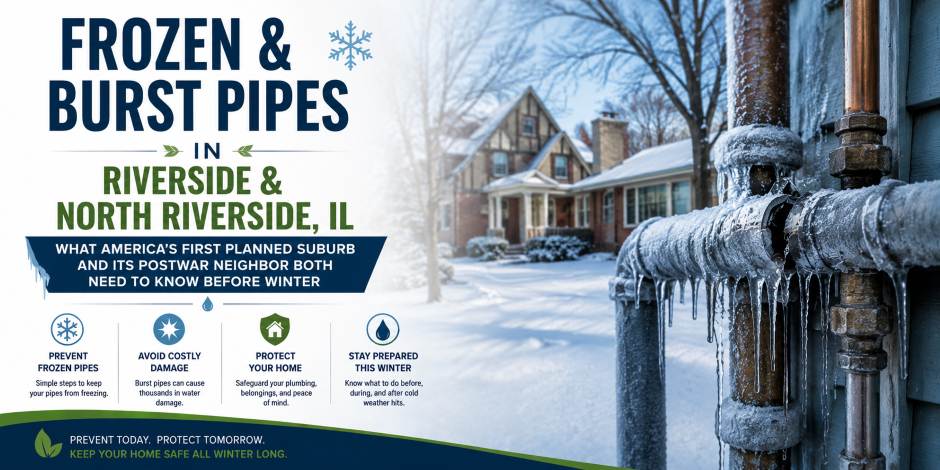
Frederick Law Olmsted Designed Riverside’s Streets to Curve With the Landscape — Which Means Every Home Sits at a Different Compass Orientation, Every Exterior Wall Faces a Different Direction, and Every Frozen Pipe Risk Profile Is Unique to That Specific Lot. Here’s How to Read Your Own.
Riverside is not like other Chicago suburbs. Designed in 1869 by Frederick Law Olmsted and Calvert Vaux — the same partnership that designed Central Park — it was designated a National Historic Landmark in 1970 as the first planned suburb in the United States. Olmsted’s design rejected the Chicago grid entirely: streets curve with the natural contours of the Des Plaines River valley, lots follow the curves, and individual homes sit at angles to north, south, east, and west that change from block to block and sometimes from lot to lot on the same block. A home on Forbes Road may face northeast. The home directly across from it may face northwest. The home two lots down may face almost due east. None of them shares the conventional relationship between street-facing wall and compass orientation that defines virtually every other suburb in this series.
For frozen pipe purposes, this matters in a way that is unique to Riverside — and that no generic suburban plumbing guide has ever addressed. The cold winter wind in the Chicago area blows primarily from the northwest. In a conventional grid-plan suburb, every home’s north and west exterior walls face approximately the same direction, and the advice to insulate supply lines in north and west wall cavities applies consistently across the neighborhood. In Riverside, the wall that faces the prevailing winter wind varies by lot. On one block, the front-facing wall may be the most wind-exposed. On the adjacent block, the rear-facing wall may be the northwest exposure. The correct frozen pipe risk assessment for a Riverside home requires knowing which wall faces the prevailing northwest winter wind on that specific lot — and acting on that knowledge, not on a generic “check your north wall” recommendation that may not apply to your home’s actual orientation.
North Riverside sits immediately north of Riverside, incorporated in 1926 as a separate village on the commercial and residential strips along Cermak Road and Harlem Avenue. Where Riverside is an architecturally curated National Historic Landmark, North Riverside is a practical, compact community of roughly 6,500 residents built primarily in the postwar 1950s and 1960s on a conventional grid. The two villages share a border, share Cook County infrastructure, and share the Des Plaines River flooding overlay that affects properties near the river in both communities — but they have different housing stock profiles, different construction eras, and different frozen pipe risk patterns that make this article cover genuinely distinct ground for each community.
Riverside: America’s First Planned Suburb — and What 150 Years of Housing History Means for Winter Pipes
The Housing Stock — Four Distinct Construction Eras in One Village
Riverside’s residential development occurred in four identifiable waves that produced four distinct pipe material and freeze vulnerability profiles, all coexisting within the village’s 1.5-square-mile footprint.
The earliest homes — the Victorians, Italianates, and Queen Anne structures from the 1870s through the 1900s — sit on the original large lots nearest the Des Plaines River and the Olmsted-designed parkways. Frank Lloyd Wright, Louis Sullivan, and Daniel Burnham designed homes in Riverside. These are genuine architectural landmarks, and their plumbing infrastructure reflects the era of construction: in the oldest unrenewed properties, original galvanized steel supply lines that are now 100-to-120 years old, cast iron interior drain stacks of equivalent vintage, and the shallow basement profiles common in late 19th century construction that place supply line runs closer to frost-penetration depth than deeper basement construction does. These homes carry the same freeze-and-high-consequence damage profile we described for Hinsdale’s Robbins Park District — historic interior construction, original plaster walls, and period woodwork that make water damage remediation a preservation project rather than a standard restoration call.
The 1920s and 1930s wave — the period of Riverside’s greatest residential growth, when the population grew from 2,532 to 7,935 — produced the bungalows, Colonial Revivals, English Cottages, and Dutch Colonials that define the residential streets away from the original river-adjacent mansions. This era’s supply systems are galvanized steel in the oldest unrenewed properties and early copper in homes that have been partially updated. The 1920s bungalow in Riverside has the same attic freeze vulnerability as the Cicero and Berwyn bungalows we covered in article #4 — the half-story attic above the main floor where supply lines rise through an essentially unheated space to serve a second-floor or half-story bathroom. In Riverside’s 1920s bungalow stock, that attic freeze condition exists in a building whose street-facing orientation may be any compass direction, depending on the specific lot in Olmsted’s curvilinear plan.
The postwar 1940s and 1950s construction — built on the remaining parcels as the village was “almost entirely developed” by 1960 — produced the ranches and split-levels that filled in between the earlier construction. These homes have copper supply systems now 65 to 80 years old, the attached or detached garage configurations common to postwar construction, and the exterior wall cavity freeze vulnerability in north and west-facing walls that affects the same era throughout this series.
A small wave of 1960s and 1970s construction, primarily on the few remaining parcels and some subdivision of older large lots, rounded out the village’s housing stock with the materials of that decade. These are the youngest and best-protected supply systems in the village, though at 45-to-60 years old they are now in the age range where solder joint fatigue begins to affect freeze failure thresholds.
The Olmsted Orientation Problem — How to Read Your Own Home’s Freeze Risk
Because Riverside’s curvilinear streets were specifically designed to avoid the Chicago grid, individual homes sit at almost any compass orientation depending on their specific lot position in the plan. The consequence for frozen pipe risk assessment is that the standard advice — insulate the supply lines in the north and west exterior wall cavities — must be translated into the actual wall that faces northwest on your specific property before it is actionable.
Here is how to do that translation in 60 seconds. Stand in your front yard and face the street. Use your phone’s compass or a physical compass to determine which compass direction the street runs. If the street runs east-west and you face north to look at your home, your front wall faces south — the least freeze-vulnerable orientation. If the street curves and you face northwest to look at your home, your front wall faces southeast — the rear wall faces northwest and is your most wind-exposed exterior surface. In Olmsted’s plan, the curving streets produce exactly this kind of lot-by-lot variation, which is why a homeowner on Nuttall Road may have completely different freeze-vulnerable wall locations than a homeowner on Scottswood Road two blocks away.
Once you have identified which exterior wall of your home faces northwest — the direction the prevailing polar vortex wind approaches from — that wall’s supply line cavity runs are your highest freeze priority. Insulate those runs. Confirm the insulation level in that wall cavity is adequate. Add heat tape to any supply line section in that wall cavity that cannot be adequately insulated from the accessible interior. This is the frozen pipe preparation advice for Riverside homeowners specifically — not the generic version that ignores the Olmsted orientation variable.
The Des Plaines River Thaw Surge — The Compounding Event
The Des Plaines River enters Riverside at 31st Street and flows through the western section of the village — the same river corridor that Olmsted incorporated into his design as a natural parkway and that the Riverside Golf Club occupies along its bank. The river is a documented flooding concern: on August 24, 2007, the Des Plaines flooded by over 9 feet; on September 14, 2008, the river flooded after the area received more than 10 inches of rainfall over two days. The Des Plaines River at Riverside is monitored by a USGS gauging station specifically because the river’s behavior at this location is consequential for the surrounding residential community.
The specific winter relevance: a polar vortex freeze event is typically followed by a rapid warming period — a warm front replacing the cold air mass within 48 to 72 hours. During that thaw period, the accumulated snow and ice in the Des Plaines watershed melts rapidly and flows to the river, raising river levels and elevating groundwater in the surrounding floodplain simultaneously with the warming temperatures that trigger thaw-period burst pipe events in supply lines that cracked during the freeze but held under ice pressure. For properties near the river corridor in Riverside — the streets adjacent to the golf course, the Maplewood Road cul-de-sac above the retaining walls at the river’s edge, and the parkway-adjacent lots in the western section of the village — a burst pipe thaw event can occur during the same 48-to-72-hour window as a Des Plaines River surge event. Interior water damage and exterior hydrostatic pressure from rising groundwater in the same event window is the most damaging scenario for any Riverside riverside property.
Our sump pump services cover Riverside with battery backup installation specifically relevant for river corridor properties — the power outages that accompany polar vortex events are precisely when sump pump battery backup matters most, and precisely when river corridor groundwater is rising. Our overhead sewer service covers Riverside for homeowners who want permanent protection against the combined sewer surcharge backup that compounds flooding events in this combined sewer community — eliminating the mechanism rather than blocking it mechanically.
North Riverside — The Postwar Village and Its Specific Winter Plumbing Profile
A Different Community, a Different Construction Story
North Riverside is a compact village of approximately 6,500 residents on roughly one square mile between Cermak Road and the North Riverside Park Mall corridor along Harlem Avenue. It was developed primarily in the postwar 1950s and 1960s — a conventional grid-plan community whose housing stock is almost entirely ranches and small colonials from that era. Unlike Riverside’s sweeping architectural variety, North Riverside’s residential character is defined by the workingman’s postwar suburban home: well-built, practical, and now 60 to 70 years old with copper supply systems in the age range where thermal cycling fatigue at solder joints is the primary freeze vulnerability factor.
The freeze risk profile in North Riverside’s housing stock is more uniform than Riverside’s because the housing era is more uniform — and because the grid plan means north and west exterior wall orientations are conventional and consistent across the village. The supply lines in the north and west exterior wall cavities of a 1958 North Riverside ranch are where the freeze risk concentrates, and addressing those wall cavity runs is the primary pre-winter action for the majority of North Riverside homeowners. The specific additional vulnerability in North Riverside’s postwar stock: a number of homes in the village have basement conversions or lower-level additions that were built on crawl spaces or partial foundations that are more thermally exposed than the main basement. Supply lines serving converted lower-level spaces — a basement bathroom added during a 1970s or 1980s renovation, a laundry room relocated to a converted crawl space — may run through spaces with less frost protection than the original construction provided for the main supply system.
Lead Service Lines in North Riverside and Riverside — What Both Communities’ Homeowners Need to Know
Both Riverside and North Riverside have pre-1986 housing stock that was constructed with lead service lines — the water supply pipe connecting the street main to the home’s interior meter. Chicago required lead service lines by code until 1986, and the surrounding suburbs used lead through the same period. Cook County’s communities, including both villages, have a significant concentration of lead service lines still in service. In North Riverside’s 1950s and 1960s housing stock, the probability of a lead service line is high in any home that has not had a confirmed replacement with copper.
Lead service lines have a specific frozen pipe vulnerability that differs from copper: lead is ductile and deforms under freeze expansion pressure rather than fracturing cleanly. An older lead service line that has been in service for 65-plus years in Cook County’s frost-penetration soil conditions is significantly less ductile than new lead — it has been work-hardened by decades of pressure cycling and thermal movement. When a deep frost event penetrates to the frost-depth of the service line and freezes the lead pipe, the deformation that occurs can permanently narrow the pipe’s cross-section, reducing water pressure to the home even after the pipe thaws. It can also fracture — producing a service line leak that may not be immediately visible because it is below grade.
For both Riverside and North Riverside homeowners who have not confirmed their service line material: check Cook County’s service line material records or call your local water department. If your service line is confirmed lead, the frost-depth freeze vulnerability is one of several reasons — alongside the documented health effects of lead in drinking water — to schedule replacement before next winter rather than after. Our lead service line replacement service covers both Riverside and North Riverside with full permit coordination, boring or open trench as site conditions require, and interior meter connection from the new copper line. Illinois is actively expanding its lead service line replacement programs — contact your village’s public works department to confirm whether any local assistance or cost-sharing is currently available before hiring a contractor.
The Shared Infrastructure Context — Combined Sewer and the MWRD
Both Riverside and North Riverside are served by combined sewer systems that connect to the MWRD interceptor — the same combined sewer infrastructure context we covered in our catch basin guide for both communities. The winter relevance of the combined sewer is specific: when a burst pipe event releases water into a basement in either village, the remediation process involves water removal and drying in a structure that connects to a combined sewer. If the burst pipe event coincides with a sewer surcharge event — which can occur during the rapid thaw following a polar vortex, when large volumes of snowmelt simultaneously enter the combined system — the remediation situation involves both the burst pipe water from above and the potential for combined sewer backup from below in the same basement.
A homeowner in either village who experiences a burst pipe event during a rapid thaw following a polar vortex cold period should be aware that the floor drain in the basement may be under surcharge pressure from the combined sewer simultaneously with the interior water from the burst pipe. This is not a reason to avoid calling a plumber — it is a reason to be aware that the basement floor drain may be the source of a second water entry mechanism during the remediation period, and that a backwater valve on the lateral is the appropriate protection against that second mechanism. Our sewer backflow prevention service covers both villages — and our existing catch basin guide for Riverside and North Riverside covers the full combined sewer surcharge picture in depth for anyone who wants to understand both the winter and year-round flooding context for these communities.
The Pre-Winter Pipe Condition Assessment — Why Both Villages Benefit From a Camera Inspection Before Winter
Throughout this series, we have recommended pre-winter plumbing assessments for homes with aging supply systems. For Riverside and North Riverside, we add a recommendation that is specific to the pipe age and Des Plaines River context: a sewer camera inspection of the main lateral before winter is appropriate for any pre-1970 home in either village that has not had its lateral camera-inspected in the past five years.
The reason the lateral inspection is relevant to a winter guide is the combined sewer surcharge timing described above: a burst pipe thaw event that coincides with a combined sewer surcharge event in a home with a compromised lateral — one with significant root intrusion or joint separation — creates a situation where the combined sewer back-pressure enters the basement at the same time as the burst pipe water. The lateral condition determines how severe that second mechanism is. A fully camera-documented lateral with known root intrusion at specific joints and a known overall condition profile allows a homeowner to make an informed decision about backwater valve installation before the winter event — rather than discovering the lateral condition during the worst possible combination of circumstances. Our sewer camera inspection service covers both Riverside and North Riverside with same-day scheduling and written condition reports — providing the baseline documentation that informs every flood control and winter plumbing preparation decision.
Specific Freeze Vulnerabilities by Home Type in Both Communities
Victorian and Early 20th Century Riverside Homes (Pre-1920)
The oldest Riverside homes — the Victorians, Italianates, and early Prairie-style homes on the river-adjacent streets — have the highest freeze risk and the highest remediation consequence of any properties in either village. Galvanized steel supply lines in the exterior wall cavities, original plaster and lath wall construction, cast iron interior drain stacks that are now a century old, and the Olmsted orientation variable that means the most wind-exposed wall may be any of the four exterior faces depending on lot position. Pre-winter assessment for these homes must specifically identify the lot’s northwest-facing wall, confirm supply line material and condition in that wall’s cavity, and add pipe sleeve insulation and heat tape to any galvanized section in an exposed cavity. Where galvanized steel supply lines remain in an older Riverside home, replacing those sections proactively — before a freeze event forces emergency replacement in a water-damaged wall — is the appropriate long-term action. Our repiping service covers Riverside’s older housing stock with supply system condition assessment and targeted or whole-home repipe depending on the scope of aged material found.
1920s–1940s Riverside Bungalows and Revival-Style Homes
The dominant era of Riverside’s housing stock carries the bungalow attic freeze vulnerability we described in the Cicero and Berwyn article — but with the Olmsted orientation variable applied to every lot. Before addressing the attic supply line condition, confirm which exterior wall of the home faces northwest. That wall’s attic-level supply line run is the combined highest-risk location: the attic thermal isolation from the heated living space below, plus the northwest wind exposure at the attic level where there is less building mass to buffer the exterior temperature. Add attic floor insulation, foam sleeve insulation on attic supply line sections, and heat tape on any section that cannot be adequately insulated. The interior door to the attic stair should be sealed against cold air transmission from the attic space above.
Postwar Riverside and North Riverside Ranches and Split-Levels (1945–1970)
The postwar construction in both villages shares the copper supply system at 55-to-80 years old, the attached or detached garage freeze vulnerability, and the exterior wall cavity concentration of freeze risk in the most wind-exposed walls. For North Riverside specifically, confirm the compass orientation of the home using a phone compass — and in North Riverside’s conventional grid, the north and west walls are the standard freeze priority. For Riverside’s postwar homes on the curvilinear streets, the same Olmsted orientation check applies. Confirm garage wall supply line condition, add sleeve insulation to exposed sections, and confirm the interior hose bib shutoff valve exists and is functional.
When a Pipe Freezes in Riverside or North Riverside
The response sequence for a frozen pipe in either community follows the same steps as throughout this series — with specific attention to the construction type that defines the affected section. For Riverside’s oldest homes with galvanized steel supply lines in original plaster and lath walls: do not apply open flame. Use a hair dryer on low, moved continuously along the accessible pipe section, or call us for professional electrical pipe thawing that warms the frozen run uniformly from the inside without localized surface heat that concentrates stress on aged galvanized joints. For postwar homes with copper supply systems: gentle indirect heat application is appropriate for accessible sections. For inaccessible sections in wall cavities in either community: our pipe thawing service and burst pipe repair service covers both Riverside and North Riverside with 24-hour response.
Know where your main shutoff is before the polar vortex arrives. In Riverside’s oldest homes, the main shutoff may be in a location specific to the original construction — adjacent to the original meter installation, which in pre-1920 construction may be in the basement in a location that subsequent renovations have made less accessible. In North Riverside’s postwar ranches, the shutoff is typically in the basement utility room adjacent to the meter. If you are not certain where yours is, locate it now, confirm it operates freely, and label it. The main shutoff is not the tool you want to be searching for at 2 a.m. during a polar vortex thaw when the ceiling is wet.
When a Pipe Bursts — The Combined Sewer Awareness
When a pipe bursts in Riverside or North Riverside, close the main shutoff immediately, open the lowest faucet to drain residual pressure, protect electrical circuits near any water, and document all damage before cleanup begins. For a complete step-by-step breakdown of emergency actions before help arrives, see our guide on emergency steps for a burst pipe in Riverside, IL. The combined sewer awareness specific to both villages: if the burst occurs during or after a significant storm or snowmelt event, be aware that the basement floor drain may be under combined sewer surcharge pressure simultaneously with the interior water from the burst pipe. Do not assume all the water in the basement is from the burst pipe — check the floor drain for signs of backup (water level at or above the drain grate, sewage odor) as a separate mechanism assessment. Two sources of water in the basement during the same event require two separate responses, not one.
For the complete post-burst response — including emergency shutoff steps, preventing additional damage, protecting your home during extreme cold, and understanding what happens after a winter plumbing failure — our complete guide to winter plumbing emergencies in Chicagoland covers the full process homeowners need to know before, during, and after a frozen pipe or burst pipe event.
For the 72-hour sequence after a burst pipe floods your home, including insurance documentation and remediation contractor coordination, see our complete guide to what happens after a burst pipe floods your Chicago home. For emergency repair right now: our 24/7 emergency guide is helpful — a fast emergency plumber can be reached at 708-518-7765 — and is answered by a licensed plumber around the clock for both Riverside and North Riverside.
Pre-Winter Checklist for Riverside and North Riverside Homeowners
Step one for every Riverside homeowner: Determine your home’s compass orientation using a phone compass. Identify which exterior wall faces northwest. That wall is your primary frozen pipe priority — not the generic “north wall” that applies to grid-plan suburbs. All subsequent pipe insulation and heat tape recommendations apply first to supply line runs in that specific wall cavity.
Pre-1920 Riverside homes: Identify supply line material in accessible locations. Add foam sleeve insulation to every accessible galvanized section in the northwest-facing wall cavity. Add rim joist insulation at the basement perimeter. Consider proactive repiping of aged galvanized sections before a freeze event forces emergency access behind original plaster. Confirm main shutoff location and operation.
1920s–1940s Riverside bungalows: Access the attic and inspect supply lines. Identify the northwest-facing wall’s attic-level supply run. Add foam sleeve insulation and heat tape to that section. Increase attic floor insulation if it is at original construction levels. Seal the interior attic access door against cold air transmission.
Postwar homes in both villages (1945–1975): Inspect garage wall supply lines and add sleeve insulation. Confirm interior hose bib shutoff operates. Check garage interior door threshold seal. Disconnect garden hoses from all exterior bibs. Confirm main shutoff operates. For river corridor properties: confirm sump pump function and a battery backup is installed on your sump pump. For any home with a lead service line: schedule confirmation and replacement assessment before next winter.
All homes in both villages: Schedule irrigation system winterization before mid-October. Disconnect all garden hoses. Consider a pre-winter sewer camera inspection of the main lateral if the home is pre-1970 and has not been inspected in five years — the combined sewer surcharge risk during thaw events makes lateral condition knowledge a winter preparation item, not just a summer maintenance consideration.
Frequently Asked Questions: Frozen and Burst Pipes in Riverside and North Riverside
My Riverside home was designed in 1924 in an English Cottage style. I’ve identified that my rear wall faces northwest. Are the supply lines in that rear wall at risk?
Yes — and specifically because your rear wall is the northwest-facing exposure, the supply lines in that wall cavity are in your home’s most wind-exposed location during polar vortex events. In a 1924 English Cottage, those supply lines are likely galvanized steel at 100 years old, in a wall cavity with the insulation standards of 1924 between the pipe and the exterior sheathing. That combination — aged pipe in a wind-exposed cavity with minimal thermal protection — is the highest freeze-risk location profile in the series. Inspect the rear wall supply lines from the basement where they emerge from the wall plane, add foam sleeve insulation to every accessible section, and schedule a pre-winter assessment that specifically covers that rear wall cavity condition before polar vortex season.
I live near the Des Plaines River in Riverside. During the polar vortex thaw last year, my basement had water — was it from a pipe or from the river?
Both mechanisms can produce basement water in a river-adjacent Riverside property during a polar vortex thaw — and they can occur simultaneously. The diagnostic distinction: sewage-odored water entering through the basement floor drain is combined sewer surcharge backup — the MWRD system is surcharging and pressure is reversing through your lateral. Clean water entering through the foundation walls, window wells, or the base of the foundation slab is groundwater intrusion from elevated river-adjacent water table. Water from a burst supply line enters through a ceiling or wall penetration adjacent to the failed pipe section — not through the floor drain or the foundation. Identifying the entry point and the odor tells you which mechanism or combination you are dealing with. If you experienced unexplained basement water during last year’s polar vortex thaw and haven’t diagnosed the source, a camera inspection of the lateral combined with a plumber walk-through of the basement is the diagnostic step that identifies whether sewer backup protection — a backwater valve or overhead sewer — is appropriate for your specific situation.
I own a postwar ranch in North Riverside built in 1961. I’ve been told I might have a lead service line. Should I be worried about it in winter?
Yes — both as a freeze concern and as a year-round health concern. A 1961 North Riverside home built before lead service lines were banned in 1986 almost certainly has a lead service line if it hasn’t been replaced. The freeze concern is the frost-depth vulnerability of aged lead pipe and the permanent cross-section narrowing that can result from a freeze event in a lead line. The health concern is the daily lead exposure from water that has passed through a lead pipe — which is a continuous risk regardless of season. Schedule a service line material confirmation with your local water department or use Cook County’s records. If it is confirmed lead, schedule a replacement assessment this fall. The freeze risk gives the replacement urgency for winter; the health concern makes it a year-round priority regardless.
I have a 1929 Riverside bungalow and I’ve never inspected the attic supply lines. Is this urgent before winter?
Very urgent — for the same reason described for Cicero and Berwyn bungalows in this series. A 1929 Riverside bungalow has supply lines rising through the half-story attic space in an essentially unheated cavity. Those supply lines have been through 96 Chicago winters, and the Olmsted orientation variable means the specific thermal exposure of that attic space depends on which direction your home faces — if your northwest wall is the street-facing wall or an end wall, the attic supply run on that side is in the most wind-exposed section of the building. Access the attic before mid-November, find the supply lines, confirm they are galvanized or copper, add foam sleeve insulation to every accessible section, and add heat tape to any section that is close to the roof deck on the northwest-facing side. This is a 90-minute investment. The burst pipe event it prevents — in a home with original plaster walls and period woodwork — is measured in tens of thousands of dollars of remediation cost.
Frozen or Burst Pipe in Riverside or North Riverside? We Know the Olmsted Plan, the Des Plaines River Overlay, and What 100-Year-Old Supply Lines in Original Plaster Walls Actually Look Like From the Inside.
Licensed, insured, and serving Riverside and North Riverside since 1978. We handle frozen pipe thawing with electrical equipment appropriate for aged galvanized steel in historic plaster construction, burst pipe repair in pre-war and postwar homes, galvanized steel supply line assessment and repiping, lead service line replacement with full permit coordination, sewer camera inspection for pre-winter lateral condition assessment, overhead sewer installation for permanent combined sewer backup protection, sump pump service and battery backup for Des Plaines River corridor properties, backwater valve installation, and complete residential plumbing throughout both communities. Emergency line answered 24/7 — 708-518-7765. Our Riverside plumber service and North Riverside plumber service cover both communities year-round.
Emergency line: 708-518-7765 | Main line: 708-801-6530 | Open 24/7
—
Suburban Plumbing Sewer Line & Drain Cleaning Experts
Licensed & Insured | Open 24 Hours | Serving Riverside & North Riverside Since 1978
📞 Riverside/North Riverside: 708-801-6530 | 🚨 Emergency: 708-518-7765