The Complete Guide for Chicago and Chicagoland Homeowners Who Are Done With Partial Solutions That Keep Failing
If you’re reading this article, you’ve probably already spent money on your basement flooding problem. A backwater valve — maybe two. A new sump pump with battery backup. Interior waterproofing. A French drain. And yet, during the last significant storm, the basement flooded again. The floor drain backed up. The smell returned. The cleanup began again.
You’re not doing anything wrong. You haven’t hired bad contractors. The products themselves work exactly as designed. The problem is that you’re applying partial solutions to a fundamental problem with your home’s drain configuration — and no partial solution can permanently fix a fundamental problem.
That fundamental problem is this: your home’s basement drains, basement toilet, basement laundry, and floor drains are connected to the city’s sewer system at or below the level of the sewer main. When that main surcharges under heavy rain — when the combined storm and sanitary waste in Chicago’s shared sewer system exceeds the system’s capacity — the pressure has nowhere to go but backward through every residential lateral connected to it. Your basement drain is the lowest point on that pressure path. The sewage finds it every time.
A backwater valve closes a mechanical gate against that pressure. A sump pump removes groundwater that has nothing to do with that pressure. An interior waterproofing system manages water that enters after the pressure has already won. None of these fix the fundamental configuration. They manage it. They resist it. They provide mechanical barriers against it. And sometimes — when the storm is large enough, the pressure great enough, or the valve doesn’t seat correctly — those barriers don’t hold.
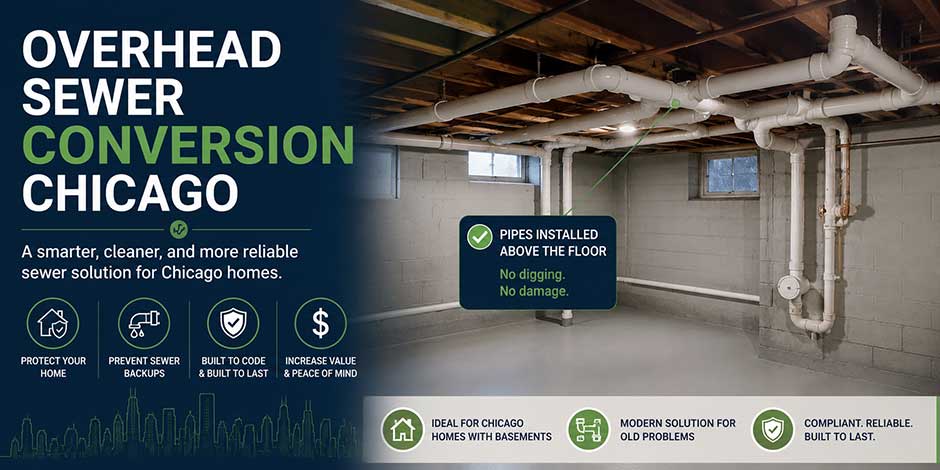
An overhead sewer conversion changes the fundamental configuration. It is not a barrier. It is not a mechanical device. It is a structural rerouting of your home’s entire below-grade drain system to a level above the sewer main — a level that surcharge pressure physically cannot reach. When the city’s sewer surcharges after an overhead conversion, there is no path for that pressure to enter your home. Not because a gate closed. Not because a valve engaged. But because the connection point no longer exists below the surcharge level.
This is the difference between managing a problem and eliminating it.
What Overhead Sewer Conversion Actually Is
The phrase “overhead sewer” is often misunderstood — it sounds like something that runs overhead, like a pipe across the ceiling. It doesn’t. The name refers to the elevation relationship between your home’s drain system and the public sewer main in the street.
The Standard Configuration — What Most Chicago Homes Have
In a standard below-grade sewer configuration — which describes the vast majority of Chicago homes and most inner-ring suburban homes — the basement floor drains, basement toilet, laundry drain, and ejector pump are all connected to the sewer system at or below the level of the city’s sewer main in the street. Waste from these fixtures flows by gravity down to the lateral and out to the main. This configuration works perfectly under normal conditions.
Under surcharge conditions — when the city’s combined sewer main is overwhelmed by heavy rain and the pressure in the main exceeds the pressure in the lateral — wastewater travels backward through your lateral and into your basement through the lowest available opening. In most Chicago homes, that’s the floor drain.
The Overhead Configuration — What an Overhead Conversion Creates
An overhead sewer conversion reroutes every below-grade drain connection in your home to discharge above the elevation of the city sewer main — typically at a point 2 to 3 feet above the basement ceiling, in the first-floor subfloor space. Waste from basement fixtures no longer flows down to the sewer — it flows up to a point above the surcharge level, then travels by gravity horizontally to the main stack, and exits through the building drain at that elevated level.
The result: the connection between your home’s drain system and the city sewer main is now above the level that surcharge pressure can reach. When the combined sewer surcharges, the pressure in the main rises — but it cannot travel backward to your home’s drain system because your drain system no longer connects to the main below that pressure level. The surcharge elevation ceiling and your drain connection point simply don’t intersect.
This is why an overhead conversion is called a permanent solution while a backwater valve is called a protective device. The backwater valve fights the pressure. The overhead conversion removes the connection that the pressure was using.
The Chicago Combined Sewer System — Why This Problem Exists Here
Understanding the overhead sewer conversion requires understanding the system it protects against. The City of Chicago’s own flood control guidance acknowledges the fundamental challenge: Chicago initiated its inlet control valve system (called the ‘Rainblocker’ program) as one facet of a multi-dimension concept for addressing sewer surcharge in the city’s combined sewer neighborhoods.
As the MWRD’s Understanding Your Sewer resource explains, Chicago’s combined sewer system carries both stormwater and sanitary sewage in the same pipes. During normal conditions this works. During heavy rain events that exceed system capacity, the combined pipe fills and the pressure that builds has to go somewhere. For the millions of Chicago properties with below-grade connections to this system, that somewhere is backward through residential laterals.
The City of Chicago’s flood control and sewer backup resources acknowledge the range of flood protection options available to Chicago homeowners — from backwater valves and overhead conversions to the city’s Rainblocker program — recognizing that different situations call for different levels of protection. For homeowners who have exhausted the partial-solution options, the overhead conversion is the permanent step that the city’s own resources identify as the comprehensive fix.
The challenge is that Chicago’s combined sewer system serves the city and 51 surrounding communities. The MWRD’s Tunnel and Reservoir Plan — the Deep Tunnel — has dramatically reduced the frequency and severity of combined sewer overflows. But the Deep Tunnel doesn’t eliminate surcharge events. It reduces them. For the homes that still experience backup after the Deep Tunnel, the problem isn’t that the public system is inadequate — it’s that the private drain configuration creates vulnerability that persists even when the public system is substantially improved.
The same principle is playing out across many suburban communities as municipalities invest heavily in sewer infrastructure improvements while homeowners remain responsible for the private side of their drainage systems. In Forest Park, for example, the Village’s ongoing sewer separation efforts are helping reduce combined sewer pressures, but homeowners still need to understand how private sewer laterals, flood control systems, and backup prevention measures fit into the larger picture. Read our guide on Forest Park sewer backup, drain cleaning, and flood control planning to see how public infrastructure projects and private property protection work together.
Many western suburban homeowners are discovering the same issue firsthand as aging sewer systems struggle during heavier rain events. In Elmhurst, for example, the city now offers major flood control rebates for qualifying homeowners installing approved sewer backup prevention systems. Our complete Elmhurst basement flooding and sewer backup guide explains how the rebate program works, what causes repeat flooding, and which long-term solutions are actually worth the investment.
Similar challenges exist throughout Chicago’s inner-ring suburbs where aging combined sewer infrastructure and low-lying neighborhoods create elevated flood risks during heavy rain events. Homeowners in Berwyn face some of the highest sewer backup and basement flooding exposure in Northeast Illinois due to a combination of dense development, historic drainage infrastructure, and recurring surcharge conditions. Our detailed guide on sewer backup and flood control in Berwyn explains why the city remains particularly vulnerable and what long-term protection options homeowners should consider.
Overhead Sewer vs Backwater Valve — The Honest Comparison
This comparison is the one most Chicago homeowners need most and receive least clearly from contractors. Here’s the honest assessment.
What a Backwater Valve Does Well
A properly installed, properly maintained backwater valve is an effective flood control installation for most Chicago homes experiencing sewer surcharge backup. For a homeowner whose basement floods two or three times per decade during extreme storm events, a backwater valve provides meaningful protection at a cost of $2,500 to $5,500. It’s not a permanent structural fix — it’s a mechanical defense — but for moderate surcharge exposure, the cost-to-protection ratio is excellent.
When a Backwater Valve Is Not Enough
High-frequency surcharge exposure. For Chicago homes in areas where the combined sewer system surcharges significantly during routine heavy rain events — not just extreme storms but any substantial rainfall — a backwater valve is fighting a battle it engages multiple times per year. Mechanical devices under frequent stress experience wear, require maintenance, and can fail. A valve that engages four times per year carries more failure risk than one that engages once in five years.
Severe surcharge pressure. A backwater valve has a pressure rating — it’s designed to hold against expected surcharge pressure within design parameters. In areas where surcharge events are particularly severe — near combined sewer system pinch points, in low-elevation neighborhoods, near high-capacity collector sewers — the pressure events may exceed the valve’s design parameters.
Complete basement functionality requirements. When a backwater valve is engaged — when the valve is sealed against surcharge pressure — no wastewater can exit your home through the lateral. This means during a surcharge event, while the valve is sealed, basement toilets, laundry facilities, and sinks connected to the lateral cannot be used. For a household with a basement bathroom that members use regularly, a backwater valve means periodic loss of basement bathroom access during storms. An overhead conversion eliminates this restriction because the basement fixtures discharge above the surcharge level through the ejector system, which remains functional regardless of what’s happening in the main.
Previously flooded homes with significant damage history. For a homeowner who has experienced multiple basement flooding events, paid multiple remediation bills, and has a basement that’s been rebuilt once or more, the economics shift toward permanent protection. The cost of one more significant flooding event — drywall, flooring, contents, remediation — may exceed the cost difference between a backwater valve and an overhead conversion.
Multi-unit buildings. In Chicago’s two-flats and three-flats, a basement flooding event affects multiple tenants, their possessions, and potentially their habitability. For a building owner managing rental units, the liability and operational exposure from recurring flooding events creates a different cost calculation than a single homeowner’s.
The Cost Comparison Decision Point
Backwater valve: $2,500 to $5,500 installed. Annual maintenance recommended. Mechanical device with service life of typically 10 to 20 years with proper maintenance. May engage multiple times per year in high-surcharge areas.
Overhead sewer conversion: $12,000 to $30,000 installed. No ongoing mechanical maintenance. No moving parts. No battery. No failure mode for the protection itself. Service life equals the life of the plumbing system.
The break-even calculation: if a homeowner has experienced basement flooding damage costing $5,000 to $10,000 per event, two significant flooding events after a backwater valve installation approaches the cost of an overhead conversion — without the permanence. For homeowners who have already had significant flooding events, the forward-looking cost calculation frequently favors the overhead conversion.
What Overhead Sewer Conversion Actually Involves
The Scope of Work — What Changes
An overhead conversion is a major plumbing project that reconfigures every below-grade drain connection in the home. Understanding the scope helps set realistic expectations about timeline, disruption, and cost.
All below-grade drain connections are rerouted. Every drain that currently connects below the surcharge level — basement floor drains, basement toilet and sink if present, laundry drain, ejector pump discharge — is disconnected from the existing below-grade connection and rerouted to connect at the new above-grade connection point. This involves opening walls, ceilings, and in some cases floors to access the existing drain runs and route the new ones.
The new connection point is typically in the first-floor subfloor. The overhead connection — where your home’s drain system now enters the main stack — is established at a height above the sewer main’s surcharge level, typically 2 to 3 feet above the basement ceiling in the first-floor joist space. This requires new horizontal drain runs through that joist space to reach the main stack.
Ejector pump installation is required for all basement fixtures. This is the most important design element that homeowners frequently don’t understand about overhead conversions: basement fixtures in an overhead system cannot drain by gravity anymore, because the waste must travel uphill to reach the new elevated connection point. Every basement toilet, sink, and laundry drain now discharges into an ejector basin — a sealed pit with a pump that forces waste uphill to the overhead connection. The ejector pump is now the functional equivalent of what gravity used to provide.
Below-grade floor drains are typically capped or converted to emergency-only drains. After an overhead conversion, the basement floor drains that previously connected to the below-grade system are either capped — sealed permanently so they no longer provide drainage — or converted to emergency drain connections for the ejector basin. A capped floor drain still prevents sewage from backing up through it, but it also can no longer drain standing water from the basement floor during a water heater failure or other water emergency. This is a significant functional change that homeowners need to understand before committing to the project.
All work requires permits in Chicago and Chicagoland municipalities. Chicago’s Department of Water Management requires permits specifically for overhead conversions, and every suburb has its own permit requirements for the work. We pull all required permits as part of every overhead sewer installation — permit fees are included in the quoted price.
The Installation Timeline
An overhead sewer conversion is typically a 2 to 5 day project depending on the complexity of the home’s existing plumbing configuration, the number of basement fixtures being rerouted, and the accessibility of the first-floor joist space where the new connection runs.
Day 1 to 2: Existing below-grade connections are cut and capped. New drain rough-in begins through the basement walls and first-floor joists to establish the overhead connection runs.
Day 2 to 3: Ejector basin installation — pit excavation in the basement floor, basin installation, pump installation, discharge connection to the new overhead drain run.
Day 3 to 5: Connection of all rerouted fixtures to the new ejector basin, testing of the complete system, verification of all connections, permit inspection scheduling.
Water service to the home is maintained throughout the project. The home is functional — with reduced or modified basement fixture access — during the installation. Full basement fixture restoration, including access to basement toilet and laundry, is restored when the ejector system is tested and confirmed.
The Ejector Pump — The New Heart of Your Basement Plumbing
After an overhead conversion, the ejector pump becomes the most important mechanical component in your basement plumbing system. Understanding what it does, what it requires, and what happens if it fails is essential for any homeowner considering an overhead conversion.
What the Ejector Pump Handles Post-Conversion
Every basement fixture — toilet, sink, laundry drain — now discharges to the ejector basin. The pump activates when waste in the basin rises to the float level and forces it uphill through a 2-inch discharge pipe to the overhead connection in the first-floor joists. The pump handles solids as well as liquid — basement toilet waste, laundry water, sink water — because the ejector pump is specifically designed for this type of material.
Battery backup for the ejector pump is strongly recommended. The storms that drive sewer surcharge events are the same storms most likely to knock out power. After an overhead conversion, the overhead drain protects the basement from sewer backup regardless of power status — the structural protection doesn’t require electricity. But the ejector pump that allows you to use the basement toilet and laundry during a storm does require power. Battery backup on the ejector pump maintains full basement fixture functionality during storm power outages.
For the complete guide to what ejector pumps do, how they differ from sump pumps, and what failure signs to watch for, see our complete guide to sump pumps vs ejector pumps in Chicago. Our ejector pump services handle installation, service, and replacement of ejector systems throughout Chicago and the suburbs.
Who Actually Needs an Overhead Conversion — and Who Doesn’t
The overhead sewer conversion is a significant investment. Making the right determination about whether it’s the appropriate solution for your specific situation is the most important part of the decision.
Overhead Conversion Is the Right Call When:
You’ve already had a backwater valve installed and still experienced flooding. This is the clearest indicator. A properly installed backwater valve that failed during a surcharge event — either because the pressure exceeded the valve’s capacity, the valve didn’t seat correctly, or the surcharge entered through a path other than the valve-protected connection — indicates that mechanical protection at the below-grade connection level isn’t sufficient for your surcharge exposure.
You’ve had multiple significant flooding events with documented property damage. If two or more significant basement flooding events have produced damage requiring professional remediation, the forward-looking cost of continuing partial-solution management approaches the cost of a permanent conversion.
More homeowners across Chicago and the surrounding suburbs are reaching the same conclusion after experiencing repeated sewer backups and costly basement flooding. Learn why so many property owners are choosing permanent flood protection in our guide, Why Homeowners Are Installing Overhead Sewer Systems in Chicagoland.
You’re renovating a finished basement and want permanent protection. Installing a finished basement in a Chicago home without overhead conversion means finishing over a vulnerability. A flooded, newly finished basement is significantly more expensive to remediate than an unfinished one. Overhead conversion as part of a basement renovation makes the protection cost part of the renovation budget rather than a separate emergency expense.
You have a two-flat or multi-unit building. The operational and liability exposure of recurring basement flooding in a rental property creates a different cost calculation. For a building owner managing tenants, an overhead conversion is a capital improvement that protects both the property value and the tenancy.
Your basement is at particularly low elevation relative to the street. Homes where the basement floor is significantly below the street level have inherently greater surcharge exposure than homes with basements closer to grade. The lower the basement relative to the sewer main, the more aggressively surcharge pressure will pursue the below-grade connection.
Overhead Conversion Is NOT the Right Call When:
Your flooding is groundwater intrusion, not sewer surcharge. An overhead conversion does absolutely nothing for groundwater — water entering through the slab, through wall-floor joints, or through foundation wall cracks. Confirming your flooding type before any flood control investment is the essential first step. For the complete framework on distinguishing flooding types and matching solutions, see our guide to Chicago flood control systems that actually work.
You’ve never had a backwater valve and your surcharge exposure is moderate. For a home that’s experienced sewer backup two or three times in ten years during extreme events, a backwater valve is the appropriate first step. An overhead conversion for moderate, infrequent surcharge exposure may be more protection than the exposure warrants given the cost differential.
Your home doesn’t have a finished basement and you don’t use basement fixtures regularly. If your basement is an unfinished utility space with no bathroom, no laundry, and limited stored contents, a properly installed backwater valve that prevents sewage backup may provide adequate protection at a fraction of the overhead conversion cost.
Overhead Sewer Conversion and Chicago’s Two-Flat — A Special Case
Chicago’s enormous stock of two-flat and three-flat buildings presents a specific context for overhead sewer conversion that building owners should understand. In a two-flat where the ground-floor unit’s plumbing extends into or below the basement level, a sewer backup event affects a tenant’s living space — not just the landlord’s storage area. The property management, liability, and tenant relations implications of recurring sewage backup in a rental unit are significant.
An overhead conversion in a Chicago two-flat or three-flat protects both the building owner’s investment and the tenants’ habitability. As a capital improvement to the building, it typically adds value that is recoverable in the property’s assessed value and marketability. For building owners who have experienced tenant displacement from flooding events, the cost of temporary relocation, remediation, and tenant relations repair may have already approached the cost of permanent protection.
What Overhead Sewer Conversion Costs in Chicago in 2026
The cost range of $12,000 to $30,000 covers significant variation based on several factors that are specific to each home’s configuration.
Factors that push toward the lower end of the range:
- Simple existing below-grade plumbing with few fixtures to reroute
- Accessible first-floor joist space that allows easy overhead run installation
- No finished basement walls or ceilings that need to be opened and restored
- Single-unit home (not a multi-unit building)
- No complications with the existing lateral connection
Factors that push toward the higher end:
- Complex below-grade plumbing configuration with multiple drain runs
- Finished basement walls and ceilings that require opening, routing, and restoration
- Deep basement requiring longer ejector discharge runs
- Multi-unit building where multiple basement configurations need coordination
- Older homes where the existing drain system requires significant reconfiguration before the overhead connection can be established
- Permit and inspection complications from previous unpermitted work
What’s included in the complete project scope: Disconnection and capping of all existing below-grade connections, all new drain rough-in for overhead runs, ejector basin installation, ejector pump installation and testing, permit fees, permit inspection, and confirmation testing of the complete system. Concrete restoration after ejector basin installation and any drywall work required to access drain runs are typically separate line items.
Our overhead sewer services include a complete assessment of your home’s existing plumbing configuration before any quote is provided — we don’t estimate overhead conversion costs without understanding what your specific home’s configuration requires.
Frequently Asked Questions: Overhead Sewer Conversion in Chicago
After an overhead conversion, can I still use my basement bathroom during a storm? Yes — but with the ejector pump. The basement toilet, sink, and laundry after conversion all drain to the ejector basin. The pump forces that waste uphill to the overhead connection. During a storm, the ejector pump can be running simultaneously with heavy rainfall — as long as the pump has power, basement fixtures function normally. Battery backup for the ejector pump is strongly recommended to maintain this functionality during storm power outages.
Will an overhead conversion fix my sump pump flooding too? No. The overhead conversion addresses sewer surcharge backup only — water that was entering your basement through the drain connections from the city’s combined sewer system. It has no effect on groundwater intrusion, which is what the sump pump addresses. Homes with both sewer surcharge and groundwater intrusion need both an overhead conversion and a properly functioning sump pump with battery backup.
How long does an overhead conversion last? The overhead drain configuration itself is permanent — it’s plumbing pipe in the walls and joists, with no moving parts and no mechanical components to fail. The ejector pump, like any mechanical device, has a service life of 8 to 12 years and will need replacement at intervals. But the structural protection of the overhead configuration doesn’t depend on the ejector pump functioning — the overhead drain path physically cannot be reached by sewer surcharge pressure regardless of whether the ejector pump is operational.
Does my insurance cover basement flooding after an overhead conversion? Standard homeowners policies typically exclude sewer backup damage — which is the type of flooding that overhead conversions prevent. Sewer backup endorsements on homeowners policies cover remediation costs after a backup event. After an overhead conversion, sewer backup is physically prevented, so the endorsement becomes a backstop rather than a primary coverage vehicle. Discuss your specific policy language with your insurer after any flood control installation to understand how your coverage picture changes.
Does Chicago require a permit for overhead sewer conversion? Yes. In Chicago, overhead conversion work requires a permit from the Department of Water Management. In suburban municipalities, the permit requirements vary by village. We handle all permits as part of every overhead conversion project — you don’t need to contact the municipality separately.
My neighbor had an overhead conversion done. The crew was only there for one day. Is that normal? A one-day overhead conversion in a Chicago home is possible for a simple configuration with minimal basement fixtures, no finished basement, and straightforward access to the first-floor joist space. It is not typical for a home with a finished basement, multiple below-grade fixtures, or a complex existing drain configuration. Be cautious of any contractor who quotes a single-day timeline without having assessed your specific home’s configuration in detail — the scope of an overhead conversion is determined by what’s in your specific basement, not by a one-size-fits-all timeline.
Ready to Stop Managing Your Basement Flooding and Start Permanently Fixing It?
Licensed, insured, and locally based in Brookfield since 1978. We assess your home’s specific configuration, confirm your flooding type, and provide a complete overhead sewer conversion quote based on what your home actually requires — not a generic estimate. All permits included, our own licensed plumbers on every job, written quotes before we start. Send us a message and we’ll get back to you fast.
Or call us directly: 708-801-6530 | Open 24/7
—
Suburban Plumbing Sewer Line & Drain Cleaning Experts
Licensed & Insured | Open 24 Hours | Serving Chicago & Chicagoland Since 1978
📞 Suburbs: 708-801-6530 | 📞 Chicago: 773-570-2191 | 🚨 Emergency: 708-518-7765