
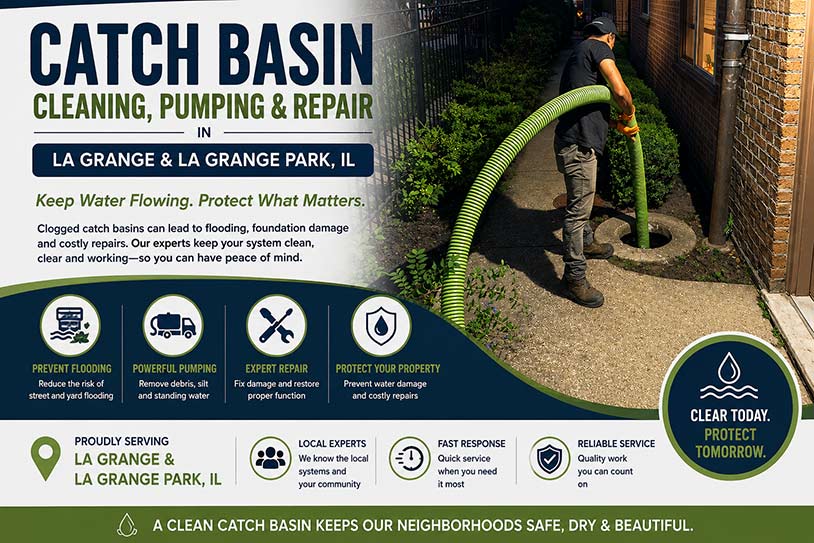
Both Villages Are Investing Millions in Public Flood Infrastructure. La Grange’s Public Works Crews Deploy Specifically to Clear Catch Basins Before Every Major Storm. The Private Catch Basins on Your Property Are Your Responsibility — and Most of Them Haven’t Been Cleaned in Years.
La Grange and La Grange Park are two of the more proactive communities in the western suburbs when it comes to public-side flood mitigation. La Grange maintains 72 miles of combined, storm, and sanitary sewers and runs an engineering-driven flood mitigation program that divides the village into distinct drainage basins — the South Basin south of 47th Street, with its six documented depressional areas that accumulate floodwater during high-intensity rain events, and the North Basin north of 47th Street, now the subject of a comprehensive stormwater modeling study by Christopher Burke Engineering. The Village’s Storm Preparation and Response protocol deploys Public Works personnel specifically to clear public catch basins before every significant predicted storm event. La Grange also maintains a Sewer Backup Prevention Grant Program that opened its FY 2026–27 cycle on May 1, providing 50% reimbursement up to $5,000 for overhead sewer installations.
La Grange Park is equally active. Approximately 90 percent of its sewer system is combined, the Village has invested millions in stormwater improvements and green infrastructure, and its ongoing Central Area Sewer Separation Project is converting combined sewer sections to separated infrastructure — a capital investment that directly reduces the surcharge pressure on the combined system that drives basement flooding in the Village’s core residential neighborhoods. La Grange Park also runs its own Sewer Backup Prevention Program, currently accepting FY 2026–27 applications, providing the same 50% reimbursement up to $5,000 for overhead sewers. The Village requires downspout disconnections as a condition of the program and has implemented a Downspout Disconnection Program across the village to reduce clear water entry into the combined sewer system.
What neither village’s program, budget, or personnel addresses is the private catch basin on your property. That structure — wherever it sits on your lot — is entirely your maintenance obligation. La Grange Public Works crews clear public street inlets before storms. They do not enter private properties to clear private drainage structures. La Grange Park Public Works maintains the public sewer system; the Village’s own sewer documentation states plainly that property owners are responsible for their individual systems from the point where the home or business connects to the Village sewer main. The private catch basin that intercepts runoff from your rear yard, your driveway, or your garage area sits squarely on the property owner’s side of that line.
This guide covers what La Grange and La Grange Park property owners need to know about their private catch basins — what makes these two specific communities’ private drainage conditions distinct from other western suburbs, what cleaning and pumping involves, what structural failure looks like in properties of this vintage, what repair and rebuilding requires, and how your private catch basin connects to both villages’ active flood mitigation efforts in ways that matter for your property specifically. If you’re trying to determine whether your basin needs cleaning, pumping, or repair, our guide to Catch Basin Cleaning vs. Pumping vs. Repair: Which Does Your Property Need? breaks down the differences and the warning signs that point to each service.
What Makes La Grange and La Grange Park Different — The Infrastructure Context That Changes the Catch Basin Conversation
The Combined Sewer and the Depressional Area Problem
La Grange’s combined sewer was built to handle the precipitation patterns and development density of its construction era — primarily the 1920s through the 1950s. The village’s own documentation describes the result with unusual candor: “The occurrence of high-intensity rain events has increased in recent years. These events generate stormwater that exceeds the capacity of the Village’s sewer system, which can result in flooded basements, overland flooding, and flooding on private property.” The South Basin, south of 47th Street, has been the focus of the village’s largest capital infrastructure investment — the 50th Street Storm Sewer project that has faced years of engineering, litigation delay with Hanson Quarry in McCook, and MWRD permitting complexity. That project is designed to drain six specific depressional areas where stormwater pools during significant events because the existing combined system cannot move it quickly enough.
A depressional area is exactly what its name describes: a low-elevation zone where water collects during storms because the surrounding grades direct runoff toward it and the drainage infrastructure beneath it cannot convey that volume quickly enough during peak events. In La Grange’s South Basin, these six depressional areas span east to west across the village south of 47th Street. If your property sits in or drains toward one of these areas, you are in the highest flood-risk zone in the village — and every ounce of private-property stormwater management that keeps your lot’s runoff out of the combined system during a storm event directly reduces the load on the drainage infrastructure that serves your zone. A clean, functioning private catch basin is not a luxury maintenance item in this context. It is the private-side parallel to what the village’s $10 million infrastructure investment is attempting on the public side.
La Grange Park’s flooding profile is driven by the same combined sewer capacity mechanism, compounded by Salt Creek — the regional stormwater outfall that borders the community’s western edge and that serves as the receiving waterbody for multiple upstream communities’ drainage. La Grange Park’s own officials have described this directly: stormwater and flooding are regional watershed issues, and increased runoff from throughout the Salt Creek watershed affects flooding conditions across the region. A heavy storm that pushes Salt Creek toward capacity affects drainage conditions in La Grange Park neighborhoods near the creek corridor regardless of what La Grange Park’s own sewer system does — and catch basins in those neighborhoods are working against both the combined sewer surcharge from below and the elevated receiving water conditions from the Salt Creek drainage chain above.
Both Villages Name Catch Basin Clearing as a Core Flood Response Tool
La Grange’s Storm Preparation and Response protocol — published on the village website and implemented before every predicted significant storm — lists catch basin clearing as a primary pre-storm action: “If a storm event is predicted, personnel are deployed to clear catch basins and conduct street sweeping operations to reduce potential sewer blockages. Personnel will continue catch basin clearing efforts throughout a rain event when feasible.” The village specifically identifies blocked street inlets as the cause of street flooding during significant events, and explicitly instructs residents not to remove catch basin lids themselves — that function belongs to Public Works crews working the public infrastructure.
La Grange Park’s sewer operations page makes the parallel statement about its own maintenance program: regular street sweeping, catch basin cleaning, and CCTV inspections are the tools the village uses to maintain the public sewer system. Both villages, in their own documentation, identify blocked catch basins as a direct contributor to the flooding that affects residential properties during heavy storm events.
The implication for property owners in both communities is direct: if both villages understand catch basin clearing as consequential enough to deploy personnel specifically for that purpose before major storm events, the private catch basin on your property — the one nobody from the village is coming to service — deserves the same attention on the private side that the village applies on the public side. Both villages are doing their part on the infrastructure they own. The private catch basin is the property owner’s parallel obligation.
The Housing Stock: Late Victorian Through Mid-Century, With a Tree Canopy to Match
La Grange’s residential core was developed primarily between the 1890s and the 1950s — a housing stock that reflects the village’s identity as one of the original Metra-served western suburbs, with a historic downtown, architecturally significant residential streets, and property values that put La Grange consistently among the higher-priced communities in Cook County. The Victorian, Craftsman, Prairie-influenced, and Colonial Revival homes that define the neighborhood between La Grange Road and Waiola Avenue, and the mid-century ranches and colonials that fill the South Basin neighborhoods, all share one characteristic relevant to private drainage infrastructure: they were built in an era when residential catch basins were standard practice, they sit on lots with mature tree canopy, and most of them have private drainage structures that are 50 to 100 years old.
La Grange Park’s residential stock runs similarly vintage — Craftsman bungalows and two-flats in the older sections near 25th Avenue and La Grange Road, mid-century ranches and colonial revivals through the interior of the village, and a consistent tree canopy whose root systems have been growing into every below-grade joint gap and clay pipe crack within reach for decades. La Grange Park’s own rear yard drainage documentation explicitly identifies root intrusion into private service lines as the primary culprit for sewer backups in the village. That same root pressure that compromises lateral pipes compromises catch basin outlet pipes and masonry walls by exactly the same mechanism.
Private Catch Basins in La Grange and La Grange Park — Where They Are and Who Owns Them
Where Private Catch Basins Typically Appear
In both La Grange and La Grange Park’s residential housing stock, private catch basins appear in several characteristic locations. Rear yard catch basins — positioned at the low point of the back yard, typically adjacent to the rear garage or in the yard drainage path — are the most common residential installation and intercept rear yard runoff before it reaches the garage foundation or the alley. Driveway catch basins, set flush in concrete or asphalt driveways, intercept surface runoff from the driveway before it reaches the garage apron or the public sidewalk. Below-deck or under-porch catch basins in older La Grange homes collect water that would otherwise pond against the structure’s foundation in areas where the covered grade is sloped toward the building.
In both villages’ pre-1960 housing stock, a common installation connects the kitchen drain to an outdoor catch basin before the combined line enters the main lateral — a pattern that consistently produces misdiagnosed service calls when the outdoor basin fills with grease accumulation and the kitchen drain backs up indoors. Homeowners in both communities have spent years managing what they believe is an interior drain problem, paying for annual interior sewer rodding that provides temporary relief, when the actual source is an outdoor catch basin 30 to 50 feet from the building that hasn’t been serviced in years. Our drain cleaning service for La Grange and La Grange Park includes lateral tracing on every kitchen backup call — if the drain exits the building to an outdoor basin, we find it before recommending any interior work.
The Responsibility Line — Private Property, Private Obligation
La Grange Park’s sewer operations documentation states the responsibility framework directly: “The Property Owner is responsible from their residence’s sanitary system including the point where the home or business connects to the Village sewer main.” La Grange’s sewer services documentation aligns with this — 72 miles of public sewer infrastructure is public responsibility; the lateral from the home to the main, and every drainage structure on the private lot, is the homeowner’s. Any catch basin on your property is yours to maintain, regardless of whether it connects to the same combined system that the village’s public catch basins serve. The public catch basin in the street gutter is the village’s asset. The private catch basin in your rear yard is yours.
For La Grange and La Grange Park homeowners who want to verify whether a specific drainage structure on their property is public or private infrastructure, the test is simple: if it sits within the public right-of-way — in the parkway, the curb line, or the street — it is public. If it sits on the private lot, from the property line inward, it is private. In cases where the location is ambiguous, contact La Grange Public Works at 708-579-2328 or La Grange Park Public Works at 708-354-0225 for clarification before assuming responsibility or before assuming the village will service it.
Catch Basin Cleaning and Pumping — What It Involves and What a Complete Service Includes
The Sump: Why Full Cleaning Matters More Than Pumping Alone
A catch basin’s engineering purpose depends entirely on its sump — the section of the chamber below the outlet pipe’s invert elevation. The sump is where heavier sediment, grit, and debris settle out of stormwater before the water flows through the outlet pipe and into the lateral. It is a passive sediment trap. When the sump fills — through seasons of accumulated debris — the effective sediment-trapping capacity of the basin goes to zero, and the material that would have settled in the sump now passes directly into the outlet pipe behind the basin. That material accumulates in the outlet pipe, reduces flow area, and eventually produces the blocked outlet condition that turns a functioning basin into a structure that holds water permanently.
Pumping extracts the liquid content above the compacted sediment pack — standing water and the suspended material that hasn’t yet settled. It is a partial service that leaves the compacted sump material in place. Full cleaning extracts the compacted sump material through vacuum extraction and mechanical agitation of the settled pack, restoring the basin sump to its design depth. A fully cleaned basin with a restored sump provides significantly more service life between cleanings than a pumped-only basin with a partially refilled sump. We flush and rod the outlet pipe on every cleaning call to confirm the basin drains freely — because a clean basin with a blocked outlet pipe functions no better than a full one, and the outlet pipe condition is what determines whether the service actually accomplished anything for drainage performance. If your catch basin still drains slowly after cleaning, a professional catch basin inspection with a camera inspection of the outlet pipe can identify hidden problems such as root intrusion, joint separation, structural damage, or a collapsed outlet line.
For La Grange and La Grange Park’s pre-1960 housing stock, where catch basins may be 50 to 80 years old and have been accumulating decades of material, the first cleaning of a long-neglected basin frequently requires both vacuum extraction and manual work to remove the compacted layer at the sump bottom. This is the cleaning call that restores a basin that has been functioning at minimal capacity for years to something approaching its original design performance. For our complete catch basin cleaning and pumping service in La Grange and La Grange Park, see our catch basin cleaning services page — vacuum truck on every call, outlet pipe flush included, written condition assessment after every service.
How Often Should La Grange and La Grange Park Catch Basins Be Cleaned?
Annual cleaning is the correct minimum for residential catch basins in both communities, and the specific conditions in both villages argue for that minimum rather than a more relaxed two-year schedule. La Grange’s mature tree canopy — the elms and oaks along historic residential streets and the younger canopy that has grown above the mid-century ranch neighborhoods — drops leaf and debris loads into rear yard and driveway catch basins every fall that can partially fill a sump in a single season. La Grange Park’s maximum 50% impervious surface coverage requirement for residential properties means that the graded areas of these lots are actively directing surface runoff toward catch basins rather than dispersing it across lawn area, increasing the debris load per basin per season. Both communities’ clay soil conditions — standard for the Des Plaines and Salt Creek watershed geology — mean catch basins sit in perpetually moist soil that accelerates the freeze-thaw deterioration of masonry walls when any crack or joint gap provides moisture access.
Properties in La Grange’s documented South Basin depressional areas — the neighborhoods south of 47th Street that the village has identified as experiencing the most significant flooding impacts — should treat annual catch basin cleaning as non-negotiable pre-storm-season maintenance. These properties are in the highest-consequence drainage zone in the village. Catch basin capacity reduction in this zone during a significant event contributes directly to the overland flooding that the village’s 50th Street project is designed to address on the public side. For properties with kitchen drain connections routing to outdoor catch basins, semi-annual service — spring and fall — is appropriate given the grease loading that accumulates in those basins at rates standard stormwater basins don’t experience.
Structural Failure in La Grange and La Grange Park Catch Basins — What to Look For and What Each Condition Requires
Why Pre-1960 Catch Basins in These Villages Show Structural Problems
The aging masonry catch basins in La Grange and La Grange Park’s pre-1960 residential properties face three compounding deterioration mechanisms that newer suburban catch basins don’t experience at the same intensity: root pressure from mature tree canopies whose root systems have been growing toward moisture sources for 50 to 80 years; freeze-thaw cycling in clay-heavy soil that retains moisture against masonry walls through the winter cycle rather than draining away; and in La Grange’s South Basin depressional areas, periodic exposure to elevated groundwater and surface water ponding that applies sustained hydrostatic pressure against basin walls from the outside during and after major storm events. Freeze-thaw damage is one of the leading reasons older masonry catch basins in Chicagoland begin to crack, shift, and fail structurally. If you’re wondering exactly what winter does to these systems and what to inspect once the snow melts, read our guide to how Chicago’s winters destroy catch basins and what to look for each spring. Any one of these mechanisms, operating alone, produces gradual masonry deterioration over decades. All three operating together in the same structure accelerate the deterioration to the point where a catch basin that was sound at construction now shows multiple structural conditions simultaneously.
For La Grange Park’s older housing stock near the Central Area sewer separation corridor, the sewer work itself — though public infrastructure — creates temporary ground disturbance that can accelerate soil settlement near adjacent private drainage structures. If your property is near an area where La Grange Park has recently performed sewer work, inspect your catch basin lid for settlement and your basin walls for new cracking at the next service call.
The Structural Conditions — What Each One Means and What It Costs
Deteriorated mortar joints are the earliest structural finding in brick or block catch basins — the joint bond has failed, gaps have opened, and moisture is infiltrating. The walls are otherwise intact and in position. This condition responds well to targeted tuckpointing: removing deteriorated mortar to sound depth, repacking with hydraulic cement or appropriate mortar, and applying a crystalline waterproofing or hydro-seal coat on the interior wall surface. Identified and addressed early, tuckpointing at $800 to $1,800 prevents every more expensive option below it. Ignored through two or three more Chicago winters in La Grange’s clay soil, the same joint gaps become wall displacement that costs three to four times as much to repair. For the complete breakdown of what catch basin repair costs in the Chicagoland area, our catch basin cost guide covers residential and commercial repair pricing across Cook County.
Cracked or spalled concrete walls in poured-concrete basins are repaired by routing the crack, filling with hydraulic cement or polyurethane injection, and applying crystalline waterproofing to the interior. Single-crack repair is straightforward and appropriate for isolated stress cracks. Multiple radiating cracks, or cracks with visible soil infiltration through the crack faces, indicate the wall section is approaching the threshold where repair is less cost-effective than partial rebuild.
Partial wall collapse or significant displacement requires partial rebuild: removing the failed masonry section, reconstructing to the original basin dimensions, and waterproofing the new construction to integrate with the remaining sound wall. Cost: $1,800 to $4,000 depending on the extent of the failed section and excavation requirements. In La Grange’s South Basin, where seasonal ponding applies exterior water pressure against basin walls during major events, partial rebuild should include a granular drainage blanket around the reconstructed section to relieve hydrostatic pressure against the new masonry.
Full structural failure — walls collapsed inward, basin shape deformed, soil infiltration throughout — requires complete excavation and rebuild: removing the failed structure, constructing a new basin with precast concrete or new masonry, proper waterproofing, and outlet pipe connection restoration. Full rebuild of a standard residential catch basin in La Grange or La Grange Park: $3,000 to $7,000 depending on depth, access, and whether the outlet pipe is being replaced as part of the scope. Our catch basin repair service covers the full range from targeted tuckpointing through complete rebuild — written condition assessment before any scope recommendation, written quote before any work begins.
Sunken or misaligned lid and frame is the surface symptom of progressive wall settlement — the ground around the lid has subsided as soil migrated inward through compromised walls. The visible depression around the lid perimeter is the physical record of how much soil has already entered the basin. In La Grange’s South Basin depressional areas, where major storm events periodically pond surface water over these structures, a sunken lid that allows direct surface water entry into the basin dramatically increases the water load entering the drainage system at that point — the opposite of what a catch basin is supposed to do. Repair: $1,200 to $3,500 depending on wall findings during excavation.
Root-blocked or disconnected outlet pipe produces the condition most visible to property owners: a basin that holds water permanently between rain events, develops odor from stagnant water decomposing organic material, and in warmer months breeds mosquitoes. In both La Grange and La Grange Park’s mature tree canopy environment, root intrusion in the outlet pipe is a routine camera finding on service calls for basins that haven’t been serviced in years. Outlet pipe clearing with a hydro-jet root-cutting setup, or repair of a disconnected outlet pipe connection, runs $500 to $2,500 depending on method required. Our hydro jetting service handles root-blocked catch basin outlet pipes throughout both communities with the same equipment used for lateral root intrusion clearance — high-pressure root-cutting nozzle, complete root flush, outlet confirmed clear before we leave the property.
The Downspout Disconnection Programs — What They Mean for Private Catch Basins
Both La Grange and La Grange Park actively work to eliminate downspout connections to the combined sewer system. La Grange Park’s Downspout Disconnection Program requires that downspouts be disconnected from the combined sewer and redirected to discharge to grade — to the yard, to a splash pad, or to a rain barrel or rain garden — rather than directly into the combined system. La Grange’s Sewer Backup Prevention Grant Program requires downspout disconnection as a condition of grant eligibility. The shared logic: every gallon of roof stormwater that enters the combined sewer during a rain event is a gallon of capacity that could have handled sanitary flow. Removing clear water from the combined system preserves that capacity and reduces the surcharge pressure that drives basement flooding.
Here is where the private catch basin intersects with the downspout disconnection requirement in ways many property owners don’t anticipate. In both communities, some older homes have downspouts that were historically plumbed into an outdoor catch basin, which then connected to the combined sewer lateral. When a property owner disconnects the downspout from the direct combined sewer connection — as both village programs require — the downspout discharge may need to be rerouted. If it is rerouted to an outdoor catch basin that then exits to a storm lateral rather than the sanitary combined system, the basin remains in the drainage chain but is now serving a permissible function. If the catch basin itself connects to the combined sewer, the downspout has been disconnected from one path and reconnected to the same system by a different route — which defeats the purpose of the disconnection requirement.
Understanding the routing of your outdoor catch basin’s outlet pipe — whether it connects to the storm system, the combined sewer, or the sanitary lateral — matters for both grant program compliance and for actual drainage performance. A camera inspection of the outlet pipe routing answers this question definitively. Our sewer camera inspection service covers both La Grange and La Grange Park with same-day scheduling — if your catch basin’s outlet pipe routing is unknown, a camera through the outlet from inside the basin is the fastest way to confirm it before making any decisions about downspout connection or disconnection.
La Grange and La Grange Park: Two Plumbing Service Areas, One Commitment
We have been serving both communities since 1978. Our La Grange plumber service page covers the full range of residential and commercial plumbing, sewer, and drainage services we provide throughout the village — from catch basin service and sewer camera inspection to flood control installations, drain cleaning, sump pump service, and water heater replacement. Our La Grange Park plumber service page covers the same comprehensive service for La Grange Park homeowners and businesses, including familiarity with the Village’s Sewer Backup Prevention Program requirements, the Central Area Sewer Separation Project’s ongoing work, and the permit and inspection process for flood control installations in the village.
For catch basin work specifically — cleaning, pumping, structural assessment, repair, or rebuild — we serve both communities with same-day scheduling for routine service and 24/7 emergency response when a blocked or failed catch basin is contributing to an active drainage emergency. Every catch basin service call in both communities includes the outlet pipe flush and written condition assessment that converts a basic pump-out into a complete service with a documented record of basin condition.
Seasonal Catch Basin Maintenance for La Grange and La Grange Park Properties
Spring (March through April): The priority cleaning window for both communities. Winter accumulation — grit, sand, leaf debris, and grease that has thickened in cold temperatures — sits in the sump through the winter and is most completely removed before the spring storm season begins. For properties in La Grange’s South Basin depressional areas, spring cleaning before the May 1 grant program opening date makes sense for a specific practical reason: if the cleaning reveals structural conditions that require repair, you can assess the repair scope, understand whether the basin condition is related to the broader flooding exposure, and make informed decisions before committing to other drainage investments. The catch basin condition informs the flood control decision.
Post-storm inspection (any significant storm event): After any storm that produces street flooding, overland ponding, or basement issues in either village, check your catch basin through the grate within 48 hours. If water is still visible in the basin 48 hours after the storm — the sump should have drained by then — the outlet pipe has partially blocked from debris mobilized by the storm or was already compromised before the event. Schedule service before the next event adds volume to an already-impaired structure. La Grange Public Works asks residents to submit a Flooding Event Report Form after significant flood events — if you’re doing that, note your private catch basin condition as part of your documentation.
Fall (October through November): Post-leaf-drop cleaning for properties with significant deciduous canopy above the catch basin drainage path. La Grange’s historic residential streets have some of the heaviest leaf drop of any western suburb. A catch basin cleaned in the spring that has received a full summer and fall season of leaf accumulation — particularly an oak-canopy property where the heavy, waxy leaves are slow to decompose — should be serviced again before winter freezes the basin and compacts the debris under ice. The La Grange Patch reported that 1.4 inches of rain in under 30 minutes was enough to cause reported home flooding, partly because storm grates were clogged with drought-fallen leaves before Public Works crews could clear them. Private catch basins face the same leaf-loading dynamic without any public crew response.
Pre-winter structural check (November through December): A recently cleaned, empty catch basin in late fall is the clearest view of wall condition you’ll have until next spring. Cracks, displaced mortar joints, frame settlement, or bowed walls visible now can be scheduled for repair before winter’s freeze-thaw cycling widens whatever is already there. In La Grange Park’s ongoing Central Area Sewer Separation Project corridor, checking for any new ground settlement near private drainage structures after the construction season ends is particularly relevant — major excavation near a property can affect the soil stability around private below-grade structures.
Frequently Asked Questions: Catch Basin Service in La Grange and La Grange Park
La Grange Public Works clears catch basins before storms. Does that include my property’s catch basin?
No — La Grange Public Works clears public street inlets in the right-of-way as part of its storm preparation protocol. The village’s own Storm Preparation and Response page is explicit that Public Works personnel manage public infrastructure during storm events. Private catch basins on residential and commercial properties are the property owner’s maintenance responsibility. The village also specifically asks residents not to remove catch basin lids themselves — that instruction applies to public street inlets for safety reasons. Private catch basins on your property are a different matter: accessing and servicing your own drainage infrastructure through a licensed contractor is the appropriate approach, not removing public street lids.
My La Grange Park rear yard floods after every significant rain. Could a neglected catch basin be contributing?
Yes — and it’s one of the first things to check. La Grange Park’s rear yard flooding documentation explicitly notes that rear yard flooding is a common village issue and identifies the drainage path management as a private-property responsibility. A rear yard catch basin that is full of sediment, has a blocked outlet pipe, or has a structurally compromised wall that allows it to hold water rather than drain it, contributes directly to the rear yard ponding that property owners experience. The basin was positioned specifically to intercept rear yard runoff — when it stops functioning, that runoff pools in the yard instead of entering the drainage system. A catch basin cleaning and outlet pipe flush confirms whether the basin is the source or whether the rear yard flooding has a different origin. That diagnostic call costs $300 to $500. The rear yard drainage engineering that La Grange Park provides guidance on through its Rear Yard Drainage documentation is the next step if the catch basin proves sound but flooding persists.
My kitchen drain in my La Grange Park home backs up during storms but not dry weather. Could an outdoor catch basin be the cause?
Very likely — this is the pattern that consistently points to an outdoor catch basin connected to the kitchen drain line in both villages’ pre-1960 housing stock. Under normal dry-weather conditions, the kitchen drain flows adequately through a partially accumulated basin and a partially blocked outlet pipe. During a storm, when the combined sewer surcharges slightly and the outdoor basin receives additional stormwater load simultaneously with the kitchen’s drainage demand, the marginal capacity disappears and the backup surfaces indoors. The fix isn’t interior rodding — it’s cleaning the outdoor basin and clearing the outlet pipe. We trace the kitchen drain line on every call where the backup pattern suggests outdoor basin involvement. If the line exits to an outdoor basin, that’s our starting point — not the stack inside the building.
I’m in La Grange’s South Basin area south of 47th Street. Does the village’s 50th Street project mean I don’t need to worry about my catch basin?
No — the 50th Street project is a public-side infrastructure investment that improves the combined sewer system’s capacity to convey stormwater from the South Basin depressional areas. It does not replace the private drainage structures on your property or eliminate the private maintenance obligation for those structures. When the 50th Street project is constructed, the additional public capacity it provides will reduce the frequency and severity of overland flooding in the South Basin — but a private catch basin that’s full of sediment with a blocked outlet pipe will still contribute stormwater to your property and to the public system rather than routing it efficiently. Private maintenance and public infrastructure investment operate in parallel, not in sequence. The South Basin context makes private catch basin maintenance more consequential, not less — because the public investment in that drainage zone only realizes its full benefit when the private drainage network it serves is functioning at capacity too.
How do I know if my catch basin needs cleaning, repair, or both?
The field check: lift or look through the grate 48 hours after a rain event. Water still in the basin = outlet pipe blockage or structural failure. Water drained, basin clear = normal function, schedule routine cleaning. For structural assessment: look at the lid frame alignment with the surrounding surface — a frame that’s settled below grade indicates wall deterioration below. Look through the grate for soil against the walls — debris and sediment are normal; actual soil infiltration through wall gaps is a structural finding. Cracking visible through the grate, a sewage odor from a basin that shouldn’t connect to the sanitary system, or a soft spot in the driveway or yard surface around the lid frame are all repair indicators. When in doubt: clean first, assess after. You cannot assess wall condition accurately through sediment and standing water. The cleaning exposes the condition; the assessment determines the repair scope.
Need Catch Basin Cleaning, Pumping, or Repair in La Grange or La Grange Park? We Know Both Villages’ Infrastructure, Grant Programs, and Drainage Zones — and We’ve Been Serving Both Communities Since 1978.
Licensed and insured for La Grange and La Grange Park. We handle residential and commercial catch basin cleaning and pumping, outlet pipe rodding and hydro jetting, structural assessment and written condition reports, mortar joint repair and tuckpointing, concrete crack repair, frame and lid replacement, partial and full catch basin rebuild, kitchen drain lateral tracing, downspout routing confirmation, and complete plumbing service throughout both communities. Vacuum truck on every pumping call. Written condition report on every service. Written quotes before any repair work begins. Emergency response available 24/7.
Or call us directly: 708-801-6530 | Emergency: 708-518-7765 | Open 24/7
—
Suburban Plumbing Sewer Line & Drain Cleaning Experts
Licensed & Insured | Open 24 Hours | Serving La Grange & La Grange Park Since 1978
📞 Lagrange/La Grange Park: 708-801-6530 | 🚨 Emergency: 708-518-7765