
The Complete Guide for Chicago and Chicagoland Homeowners and Property Managers Who Want to Know What Winter Actually Does Underground
Every spring in Chicago, the same concerns come up for thousands of homeowners and property managers across Cook and DuPage County. After the final frost melts, someone steps outside, looks at the catch basin in the driveway, and notices something is not quite right. The grate may sit lower than it did before winter. A crack may have appeared around the concrete frame. Water may drain slower than it used to, even though the basin was recently cleaned.
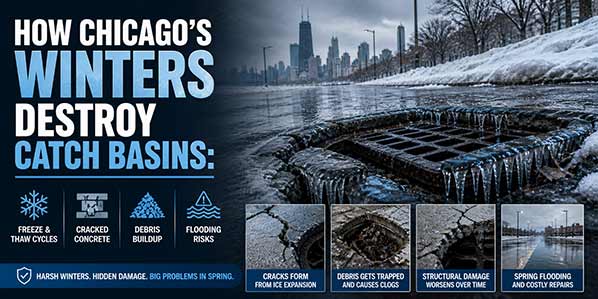
These problems rarely happen overnight. They develop gradually over the course of a Chicago winter as repeated freezing and thawing cycles put constant stress on underground drainage systems. While homeowners are focused on snow removal and icy conditions, moisture freezes inside cracks, expands, and slowly weakens the concrete, surrounding soil, and structural components of the catch basin. Because most of the system is buried underground, much of the damage remains hidden until spring exposes the effects of months of winter stress.
This guide explains what Chicago homeowners and property managers need to know about winter catch basin damage, including how freeze-thaw cycles affect concrete catch basin systems, why Chicago’s winter conditions create unique challenges, what signs of damage to look for in the spring, how to evaluate the condition of your system, and what steps to take before heavy spring rains put additional pressure on a compromised drainage system.
Why Chicago Winters Are So Destructive to Underground Infrastructure
Before getting into catch basins specifically, it’s worth understanding what makes Chicago’s winter climate particularly damaging to any concrete structure — above or below ground.
The destruction mechanism isn’t cold. Sustained cold — the kind Minneapolis experiences for weeks at a time — is actually less damaging to concrete than the condition Chicago specializes in: repeated temperature oscillation across the freezing threshold.
Water expands approximately 9% when it freezes. Concrete is a porous material that absorbs moisture. When water that has been absorbed into concrete pores and cracks freezes, that 9% expansion generates hydraulic pressure against the surrounding concrete matrix — pressure that incrementally widens existing cracks and creates new ones. When the temperature rises above freezing and the ice thaws, the water contracts — but the crack it created doesn’t close completely. The next freeze creates more pressure against a slightly wider crack. The cycle repeats.
What makes Chicago particularly destructive is the frequency of this oscillation. According to National Weather Service data cited by Delta Masonry & Tuckpointing’s freeze-thaw research, the Chicago metropolitan area experiences an average of 80 to 100 freeze-thaw cycles per winter season — compared to approximately 10 per year in Atlanta and 40 to 60 in New York City. Chicago’s position near Lake Michigan creates frequent temperature oscillations: a 45-degree afternoon followed by a 25-degree night is a cycle, and when this happens multiple times per week from November through March, the cumulative stress on saturated concrete is severe.
The Great Lakes Integrated Sciences and Assessments program (GLISA) confirms that Illinois is one of the states with the highest frequency of freeze-thaw cycling nationally — with the damage mechanism well-documented across transportation, infrastructure, and building systems throughout the region.
For a catch basin — a concrete structure partially buried in soil, constantly exposed to moisture from rain, groundwater, and snowmelt — 80 to 100 freeze-thaw cycles per winter is relentless. Each cycle is another increment of crack widening, joint loosening, and structural weakening. After five or ten winters without intervention, what started as a hairline crack has become a significant structural deficiency.
The Five Ways Chicago Winters Specifically Damage Catch Basins
1. Freeze-Thaw Crack Propagation in Basin Walls
The most common and most predictable form of winter catch basin damage. Concrete catch basin walls absorb moisture continuously — from the water that flows through the basin, from the surrounding soil, and from infiltration through any existing surface defects. When temperatures drop below freezing, that absorbed moisture expands inside the concrete matrix.
In a new catch basin with no existing cracks, this expansion is accommodated by the concrete’s internal air void structure. In an older basin — and most Chicago residential catch basins are at least 20 to 30 years old — the concrete has already been through hundreds of freeze-thaw cycles and has existing microcracks. Water migrates into those microcracks, freezes, and widens them. The wider crack captures more water in the next rain event, which freezes again and widens it further. This progressive crack propagation is the mechanism behind what looks like “sudden” crack development in the spring — the crack was there all winter, but ice was holding it closed. When the final thaw comes in March or April, the ice melts and the full width of the damage is visible for the first time.
In brick-constructed catch basins — more common in older commercial properties in Chicago and inner-ring suburbs — mortar joint failure is the primary finding rather than concrete cracking. Mortar is more porous and less durable than brick, and it’s the first component to show freeze-thaw damage. Deteriorated mortar joints allow water infiltration directly into the basin wall, which accelerates the cycle.
2. Frost Heave and Frame Settlement
The soil surrounding a catch basin doesn’t stay still during winter. As ground temperatures drop below freezing, moisture in the soil freezes and expands — a phenomenon called frost heave. Chicago’s frost depth averages 42 inches, meaning the freeze front penetrates deeply into the soil around buried structures, creating significant upward and lateral pressure.
A catch basin that’s embedded in soil experiencing frost heave is being pushed and pulled from multiple directions simultaneously. The basin itself may be pushed upward or tilted. The concrete frame around the grate opening may shift relative to the basin body below it. The connections between the basin and its outlet pipe may be stressed by differential movement.
When the ground thaws in spring, this movement partially reverses — but not completely. Each winter’s heave leaves the basin slightly more displaced from its original position. Over years of repeated heave cycles, a catch basin that was installed perfectly level can develop a significant tilt, a misaligned frame, or a separated outlet pipe connection — all without any single dramatic failure event.
The visible result in spring is a grate that sits noticeably lower or higher than the surrounding pavement, a frame that rocks when walked on, or a depression in the pavement around the basin where the soil settlement has followed the displaced structure downward.
3. Outlet Pipe Joint Stress and Separation
The outlet pipe — the pipe that carries water from the basin to the storm sewer system — connects to the basin at a joint that must remain watertight and structurally sound to maintain drainage function. That joint is exactly the point where winter stress concentrates.
Frost heave moves the soil around the basin and around the outlet pipe — but not necessarily in the same direction or by the same amount. Differential movement between the basin and the pipe creates shear stress at the connection joint. Over multiple winter cycles, this stress causes the mortar or sealant at the joint to crack and eventually fail, allowing the pipe to shift relative to the basin.
A shifted outlet connection has two consequences: it allows soil infiltration — fine soil particles migrate into the gap and into the pipe, accumulating as a blockage at the joint — and it reduces the effective diameter of the outlet by creating a misalignment that water must navigate around. Neither of these consequences is visible from the surface. Only camera inspection of the outlet pipe reveals what’s happened at the joint.
In older Chicago properties where the outlet pipe is original clay tile or concrete pipe, this joint movement can also crack the pipe itself — a more significant failure that requires excavation and pipe replacement rather than just joint sealing.
4. Road Salt and Deicing Chemical Penetration
Chicago applies significant quantities of road salt and deicing chemicals to streets, driveways, and parking areas every winter. That salt doesn’t stay on the surface — it dissolves in meltwater and runs directly into catch basins. Over a Chicago winter, a catch basin in a driveway or parking lot accumulates significant chloride loading from deicing runoff.
Chlorides penetrate concrete through the same pore structure that allows water absorption. Once inside the concrete, chlorides cause two types of damage. First, they lower the freezing point of pore water — water that would otherwise freeze and expand at 32 degrees remains liquid at lower temperatures, then freezes with increased force when temperatures drop further. Second, chlorides initiate corrosion of any reinforcing steel in the concrete structure, which eventually causes the concrete to crack and spall from the expanding corrosion products.
The surface expression of chloride-induced deterioration is concrete spalling — flaking or scaling of the concrete surface, typically first appearing on horizontal surfaces like the basin floor and the area around the frame. What looks like minor surface deterioration is the leading edge of a process that progressively destroys concrete from the surface inward.
5. Ice Bridging and Outlet Restriction
When temperatures are consistently below freezing for extended periods — which Chicago experiences multiple times each winter — water inside the catch basin can freeze, forming an ice bridge across the outlet pipe opening. This ice bridge prevents drainage during subsequent rain or snowmelt events, causing water to pool on the surface above the basin.
More significantly, ice that forms inside the outlet pipe itself can crack the pipe from the inside out — the same expansion mechanism that damages pipe walls, but occurring inside the pipe rather than in the concrete matrix. Cast iron outlet pipes in older Chicago properties are particularly vulnerable because their interior surfaces are already rough from corrosion, providing surfaces where ice can anchor and exert maximum expansion force against the pipe walls.
Ice blockages also trap debris behind them — organic material, sediment, and fine particles that would normally flush through the outlet during flow events accumulate behind the ice dam and form a dense blockage that persists after the ice thaws. The basin appears functional when the ice is present, but the underlying blockage causes drainage failure at the first spring rain.
Spring Assessment: What to Look For After the Last Frost
The window between the last hard frost and the first significant spring rain is the ideal time for catch basin assessment in Chicago — typically late March through April depending on the year. Here’s a systematic walkthrough of what to check and what each finding indicates.
Surface Inspection — What You Can See Without Tools
Grate and frame position. Stand back and look at the grate relative to the surrounding pavement. It should be at or very close to pavement grade — slightly below is acceptable to allow water entry, significantly below indicates settlement. A frame that’s tilted or rocking when you step on the grate indicates frost heave movement that hasn’t fully resolved after thaw.
Pavement condition around the basin. Look for depression, cracking, or soft spots in the pavement within two to three feet of the basin frame. Settlement in the surrounding pavement usually indicates soil migration — either the basin walls have developed a leak that’s allowing soil to move into the basin, or the outlet pipe joint has failed and soil is migrating into the pipe network, creating a subsurface void that the pavement above eventually follows downward.
Visible cracks in the frame or visible concrete around the basin. In basins where the concrete frame is visible above grade, look for cracks that weren’t present last fall. Fresh cracks — those with lighter, cleaner edges — developed during the winter. Cracks with darker, weathered edges are older.
Grate condition. Cast iron grates can crack under vehicle loading during winter when ice makes the grate more brittle. A cracked grate is a trip hazard and a vehicle damage risk — it also allows larger debris to bypass the basin and enter the drain system directly.
Basin Interior Assessment — What You Can See Through the Grate
With a flashlight and the grate in place, you can assess the sump level and visible interior condition without opening the basin.
Sump level. If you can see the water surface inside the basin is near the grate, the sump is approaching or at capacity. This is the most common spring finding — winter accumulation has filled the basin significantly.
Ice or frozen material. In early spring, some basins still contain partially frozen material — an ice-debris mixture that has thawed at the surface but remains frozen below. This condition requires professional pumping to remove, as the material is too dense for standard vacuum extraction until fully thawed.
Visible wall cracks from above. In some basins, cracks in the upper portion of the walls are visible through the grate opening with a flashlight. Any crack that appears to penetrate the full wall thickness — where you can see daylight or soil behind it — requires immediate professional assessment.
Drainage Performance Test
After a rain event in early spring, observe how quickly the basin drains standing water from the surrounding pavement. Normal drainage — water clearing from around the grate within 15 to 30 minutes of rain ending — indicates the outlet pipe is functioning. Drainage that takes several hours, or water that pools around the basin and doesn’t drain at all, indicates an outlet restriction that developed over winter.
This performance test is the most practical diagnostic available without professional equipment. A basin that was draining normally last fall but drains poorly in spring has developed a winter problem — most likely outlet pipe ice bridging debris, frost heave joint movement, or an outlet pipe crack that’s now allowing soil infiltration.
What to Do After Your Spring Assessment
If the Basin Appears Structurally Sound and the Sump Needs Cleaning
Schedule a professional cleaning — vacuum truck extraction of accumulated winter material — before the spring rain season begins in earnest. Most Chicago residential catch basins that were cleaned in the past year will have accumulated a manageable volume of winter sediment that restores to full capacity with standard cleaning.
To understand exactly what the cleaning process involves, how debris buildup affects drainage performance, and why routine maintenance matters long-term, homeowners can also review our guide to Chicago catch basin cleaning and why it matters.
Our catch basin cleaning services are available throughout Chicagoland with same-day scheduling in spring — our busiest service season, so booking early gets you ahead of the post-winter rush.
If You’ve Found Cracks, Settlement, or Structural Concerns
Don’t defer. The damage will worsen through the spring rain season as water infiltrates existing cracks and the next freeze-thaw events — which can occur in Chicago well into April — continue the expansion cycle. A crack that’s addressable with mortar repair or joint sealing in April becomes a structural reconstruction problem by fall.
For a complete breakdown of what each type of structural finding means and what repair approaches are appropriate, see our complete Chicago catch basin inspection guide. Our catch basin repair services cover the full range of structural conditions — from minor mortar repointing to complete basin reconstruction.
If Drainage Performance Has Deteriorated
A drainage performance test that reveals significantly slower discharge than last year indicates an outlet pipe problem that cleaning won’t address. Camera inspection of the outlet pipe — run from the basin opening through to the storm sewer connection — identifies exactly what’s happened over winter: ice-bridging debris accumulation, frost heave joint movement, or pipe cracking. Our storm drain cleaning and repair services include outlet pipe camera inspection and hydro jetting to clear winter accumulation and assess structural condition.
If You’re Finding Problems for the First Time
For homeowners who have never had their catch basin professionally inspected, spring is the right time to establish a baseline. A professional inspection documents the current condition — wall integrity, outlet pipe condition, sump depth measurement — and gives you a starting point for understanding what your specific basin needs on an ongoing basis. Many Chicago homeowners who think their catch basin is fine discover during a first professional inspection that the outlet pipe has years of accumulated root intrusion or that wall cracks have been progressing unobserved for multiple winters.
Once you know the condition of the basin, the next question is what type of service it actually needs. Our guide to catch basin cleaning vs. pumping vs. repair explains the differences between these services and how to determine which approach makes sense for your property.
A Practical Spring Maintenance Calendar for Chicago Catch Basins
Late March — Surface Assessment As soon as the ground has thawed and you can safely walk the property, do the surface inspection described above. Note grate position, pavement condition around the basin, and any visible cracks. This takes five minutes and tells you whether you need professional attention before scheduling a cleaning.
April — Professional Cleaning and Inspection Schedule cleaning before the heavy spring rain season. April cleaning removes winter accumulation and restores the basin to full capacity going into the highest-demand months. A professional cleaning visit also includes visual inspection of the basin interior and outlet — catching any winter damage findings while the basin is open and empty.
April/May — Outlet Pipe Camera Inspection (if needed) If your spring drainage performance test reveals slower discharge than normal, schedule outlet pipe camera inspection immediately. Don’t wait until June when the heaviest rain events arrive. Knowing what’s in the outlet pipe before the rain season means you can address it on a planned timeline rather than as an emergency.
May — Address Any Structural Findings Mortar repairs, joint sealing, frame resetting, or outlet pipe section replacement are all best scheduled in May — after the ground has fully thawed and settled, before summer construction schedules fill up, and before the rain season puts the system under full load.
October/November — Pre-Winter Inspection and Cleaning A fall cleaning removes summer’s accumulation of organic material — leaf debris, sediment, and biological growth — before it freezes in place over winter. A basin entering winter with a clean sump and structurally sound walls handles freeze-thaw cycling significantly better than one with existing cracks or a partially filled sump. Fall is also the time to address any structural findings from the summer inspection cycle before winter freezes the mortar and makes repairs impractical.
How to Protect Your Catch Basin From Future Winter Damage
Understanding what causes the damage points directly toward what prevents it.
Keep the sump clean going into winter. A catch basin sump filled with debris and sediment going into winter is a basin with far less tolerance for freeze-thaw stress. The debris holds moisture against the basin walls and outlet pipe connection — exactly the moisture that freeze-thaw cycling converts into structural damage. An empty sump allows winter precipitation to drain freely rather than accumulating as a frozen mass that exerts sustained pressure on the basin interior. Fall cleaning before freeze-up is the single most cost-effective winter protection measure available.
Address cracks immediately when discovered. A hairline crack discovered in spring should be sealed before the next winter. The same crack left unsealed will be significantly wider by the following spring — and may be through-wall by the spring after that. The cost of sealing a hairline crack with hydraulic cement is minimal. The cost of structural reconstruction after a crack has propagated to full wall failure is not. Catch basin repair costs scale dramatically with how long structural damage is deferred.
Keep grates clear of compacted debris. A grate packed with compacted leaves and debris prevents winter precipitation from draining into the basin and instead pools on the surrounding surface — where it eventually freezes, thaws, and the meltwater refreezes around the basin frame. This surface ice accelerates frost heave movement of the frame and creates ice bridging conditions at the grate opening. Clearing grate debris before winter freeze-up takes minutes and meaningfully reduces ice accumulation stress on the frame and upper basin structure.
Consider riser installation for deep basins. In older Chicago properties where catch basin lids are buried significantly below grade — common in driveways where asphalt has been overlaid multiple times over decades — the basin is inaccessible without excavation, which means inspection and cleaning happen less frequently than they should. Riser installation brings the access point to grade, making every future service call faster, cheaper, and more likely to happen on schedule. A basin that’s easy to access gets serviced regularly. A basin that requires digging to reach gets deferred until there’s a problem.
Commercial Properties: Higher Stakes, Same Damage Mechanism
Everything described above applies to commercial catch basins — but the consequences of winter damage are amplified by the scale and liability exposure of commercial properties.
A residential catch basin that fails causes a flooded driveway. A commercial catch basin that fails in a parking lot causes standing water that damages pavement, creates slip-and-fall liability, disrupts customer access, and in Chicago’s freeze-thaw environment, can create an ice sheet that persists through multiple freeze-thaw cycles as a sustained hazard.
Commercial property managers should perform the same spring assessment described above — but across every basin on the property, with documented findings for each. For a complete breakdown of why Chicago commercial parking lots flood, what the liability picture looks like, and what a full catch basin and storm drain maintenance program costs in 2026, see our guide to why Chicago parking lots flood.
Frequently Asked Questions: Winter Catch Basin Damage in Chicago
My catch basin has a crack in it. Did it definitely happen this winter? Not necessarily — cracks in catch basin walls are often progressive, meaning they began in a previous winter and have widened incrementally over multiple seasons. What you’re seeing in spring may be this winter’s increment of widening on a crack that’s been developing for years. The distinction matters less than the action: a crack of any age needs to be assessed for depth and repaired before the next winter cycle makes it worse.
The grate in my driveway is several inches below the pavement now. Is that a catch basin problem or a pavement problem? Both are possible. If the basin itself has settled due to frost heave or subsurface void formation, the grate will be below grade because the basin has dropped. If the pavement around the basin has heaved upward while the basin stayed relatively stable, the grate will appear lower because the surrounding surface has risen. A professional assessment can distinguish between these scenarios — the repair approach is different for each.
I found what looks like rust staining around my catch basin frame in spring. What does that mean? Rust staining around a cast iron frame indicates that the frame is corroding — typically because deicing salt runoff from the adjacent pavement is concentrating around the frame opening and accelerating oxidation. Surface rust on a structurally sound frame is addressable with rust treatment and sealing. Rust staining accompanied by cracking of the concrete immediately around the frame may indicate that embedded reinforcing steel within the concrete is corroding and expanding — a more significant structural concern.
Can I pour RockSalt or deicing chemicals directly into my catch basin to prevent ice buildup? No — and for two reasons. First, concentrated salt or chemical deicers applied directly to catch basin concrete will dramatically accelerate the chloride-induced deterioration described earlier. Second, most Chicago-area municipalities prohibit introducing chemicals directly into storm drainage systems due to environmental regulations. Keep deicing products on the surface pavement and away from the basin opening.
My catch basin was cleaned last fall and cleaned again this spring but it’s still draining slowly. What’s going on? If two cleanings haven’t resolved slow drainage, the problem isn’t in the sump — it’s in the outlet pipe. Root intrusion, frost heave joint movement, or an ice-bridging debris accumulation downstream of the basin are all winter findings that cleaning doesn’t address. Camera inspection of the outlet pipe is the diagnostic step that identifies what’s actually blocking discharge.
How do I know if winter damage to my catch basin is covered by homeowner’s insurance? Standard homeowners policies generally cover sudden and accidental damage — a pipe that burst, a tree that fell. Gradual deterioration from freeze-thaw cycling is typically considered a maintenance issue rather than a covered event, meaning structural repairs are usually out-of-pocket. The practical implication is that staying ahead of catch basin maintenance is a financial priority — the cost of routine cleaning and minor repairs is consistently less than emergency repair or full replacement after deferred maintenance catches up.
Ready for Your Spring Catch Basin Assessment in Chicago?
Licensed, insured, and locally based in Brookfield since 1978. We clean, inspect, and repair catch basins throughout Chicago, Cook County, and DuPage County — residential and commercial. Same-day spring scheduling available, 24/7 emergency response, written condition reports on every visit. Send us a message and we’ll get back to you fast.
Or call us directly: 708-801-6530 | Open 24/7
—
Suburban Plumbing Sewer Line & Drain Cleaning Experts
Licensed & Insured | Open 24 Hours | Serving Chicago & Chicagoland
📞 Suburbs: 708-801-6530 | 📞 Chicago: 773-570-2191 | 🚨 Emergency: 708-518-7765