
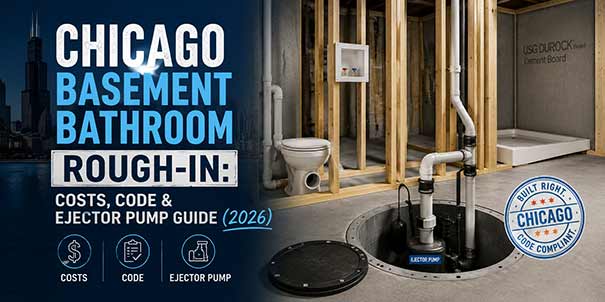
The Complete Guide for Chicago and Chicagoland Homeowners Who Want to Add a Bathroom Below Grade — Without the Surprises
If you own a Chicago bungalow, a ranch in Oak Lawn, a two-flat in Berwyn, or a split-level in Downers Grove, there’s a very good chance you’ve thought about finishing the basement. And if you’ve thought about finishing the basement, you’ve thought about adding a bathroom down there — because a basement without a bathroom is a basement that still sends everyone upstairs at the worst possible moment.
What most homeowners discover when they start asking questions is that a basement bathroom isn’t just a plumbing job. It’s a project that touches permits, code compliance, sewer system configuration, structural considerations, and a set of decisions that are very hard to undo once concrete gets poured back over them. The ejector pump question alone — whether you need one, what size, where it goes, and what happens if it fails — is something most contractors gloss over until you’re already mid-project.
This guide gives you the complete picture before you talk to a single contractor: what a basement bathroom rough-in actually involves in Chicago’s specific environment, what the City of Chicago and suburban municipalities require from a code standpoint, what it realistically costs, and why the ejector pump isn’t an afterthought — it’s the centerpiece of the entire project. For a deeper breakdown of toilets, drains, shower systems, leak risks, and real-world costs, you can explore our complete Chicago bathroom plumbing guide for 2026.
Why Basement Bathrooms Are More Complicated in Chicago Than Most Places
The fundamental challenge with a basement bathroom anywhere is gravity. Your home’s drain system works by gravity — waste flows downhill through your lateral to the city sewer main. When your basement floor sits below the level of that sewer main, gravity stops working in your favor, and waste has to be pumped up before it can flow out.
In Chicago and the inner-ring suburbs, this problem is compounded by two local realities that don’t apply in most Sun Belt markets.
Chicago’s combined sewer system. Unlike newer cities where storm water and sanitary sewer run in separate pipes, Chicago operates a combined sewer system in many neighborhoods — meaning storm runoff and sanitary waste share the same underground pipe. During heavy rain events, that combined system surcharges — the pipe fills with water faster than it can drain, and that water backs up toward the lowest entry point in your home. For a basement bathroom without proper backflow protection, that entry point is the floor drain or the toilet. The backflow prevention question isn’t optional when you’re adding a basement bathroom in Chicago — it’s the first conversation you need to have.
The depth of existing laterals in older housing stock. Homes built between 1920 and 1960 — which describes the majority of Chicago’s established neighborhoods and inner-ring suburbs — were built with sewer laterals at depths that made sense for the plumbing of that era. In many cases, that depth puts the existing lateral at or below your basement floor elevation, which changes the ejector pump equation significantly. What works in a 1995 Naperville ranch may not work the same way in a 1948 Cicero bungalow.
Understanding these Chicago-specific dynamics before you start is what separates a basement bathroom plumbing project that goes smoothly from one that requires tearing out freshly poured concrete six weeks in.
What a Basement Bathroom Rough-In Actually Involves
“Rough-in” refers to the stage of the plumbing project where all the drain lines, vent connections, and supply lines are installed and positioned before any walls are closed or concrete is poured. It’s the foundational layer that everything else — the finish tile, the fixtures, the drywall — is built on top of.
For a basement bathroom, the rough-in is where most of the real work happens. Here’s what it actually includes.
Breaking the concrete floor. Unless your basement has an existing drain rough-in that happens to be in exactly the right position for your new bathroom layout, adding a toilet and shower to a basement almost always requires cutting and removing a section of the concrete floor to access the drain system below. Concrete saws, jackhammers, and careful excavation of the soil beneath the slab are the starting point for virtually every basement bathroom project in Chicago’s older housing stock. The concrete gets poured back after the drain work is complete — but the cutting and breaking is the labor-intensive first step.
Installing the drain lines. The toilet drain, the shower drain, and the sink drain all need to be positioned precisely below where those fixtures will sit, connected to the drain system at the right slope (typically ¼ inch per foot of run), and tied into either the existing lateral (if gravity allows) or the ejector pit (if it doesn’t). Getting the slope right matters enormously — too flat and you get slow drains and buildup; too steep and liquids outrun solids, leaving debris in the pipe.
The ejector system. For most Chicago basement bathrooms, an ejector pump system is not optional. The ejector pit — a buried basin, typically 18 to 24 inches in diameter — collects waste from the basement bathroom fixtures. When the pit fills to a set level, the ejector pump activates and pumps the waste up to the height of the existing drain line, where gravity takes over and carries it to the sewer. The ejector pit needs to be properly vented (to prevent sewer gas from entering the living space), correctly sized for the fixtures it serves, and accessible for maintenance. Our ejector pump services page covers the full scope of what’s involved in selecting, installing, and maintaining an ejector system in a Chicago basement.
Venting. Every drain fixture needs a vent — a connection to the atmosphere that prevents siphoning, allows drain flow, and keeps sewer gases out of the living space. In a basement bathroom, venting is frequently the most complex part of the rough-in because running new vent pipes from the basement to above the roofline requires routing through walls, floors, and sometimes finding creative paths around existing structure. The International Plumbing Code and Chicago’s local amendments have specific requirements for vent pipe sizing and connection points that a licensed plumber needs to know cold before the rough-in begins.
Backflow protection. Given Chicago’s combined sewer dynamics, adding a backflow preventer — specifically an overhead sewer configuration or an inline check valve on the ejector discharge — is something any competent plumber working in this market should be raising with you before work begins. The sewer backup services and flood control systems pages explain the options in detail. A basement bathroom that drains perfectly under normal conditions but backs up during every heavy rain isn’t finished — it’s a liability.
Chicago and Suburban Code Requirements You Need to Know
Chicago operates under its own building code — the Chicago Building Code — which adopts the International Plumbing Code with local amendments. The suburban municipalities in Cook, DuPage, and Will counties each have their own permit requirements, though most follow the Illinois Plumbing Code closely.
Here’s what you need to know from a code compliance standpoint before anyone breaks ground.
A permit is required. A basement bathroom addition is a permitted project everywhere in Chicagoland — no exceptions. That permit means plan review, inspection at the rough-in stage (before concrete is poured back), and a final inspection when the project is complete. Any contractor who suggests skipping the permit is offering to create a problem you’ll discover at the worst possible time — typically when you try to sell the home and the unpermitted work shows up on the disclosure, or worse, when the ejector pump fails and your insurance company asks to see the permit.
Licensed plumber requirement. The City of Chicago requires that all plumbing work be performed by a City of Chicago licensed plumber. The suburban municipalities have their own licensing requirements, but virtually all of them require a licensed plumber for work of this scope. Illinois state plumbing license is the minimum baseline; municipal licenses are additional requirements in many jurisdictions.
Ejector venting requirements. The ejector pit must be covered with a gastight lid and vented independently to the outdoors or tied into the building’s main vent stack above the highest fixture. The vent cannot terminate inside the building. This is a code requirement and a practical necessity — sewer gas in an enclosed basement is a health hazard and potentially an explosion risk.
Minimum fixture clearances. The IPC requires minimum clearances around toilet fixtures (15 inches from centerline to any obstruction on each side, 21 inches of clear space in front), minimum shower dimensions (30 inches in any direction), and specific drain sizing requirements for each fixture type. These clearances have to be reflected in the rough-in positioning — getting them wrong means fixtures that don’t pass inspection and concrete that has to come up again.
Backwater valve requirements. Many Chicago-area municipalities now require or strongly incentivize the installation of backwater valves on homes in flood-prone areas. Some offer rebates through the Metropolitan Water Reclamation District of Greater Chicago (MWRD) for homeowners who install qualifying flood control equipment. If you’re adding a basement bathroom in a home that’s had backup history, adding a backwater valve as part of the project isn’t just smart — in some municipalities, it may be required.
Why the Ejector Pump Is the Most Important Decision You’ll Make
We’ve mentioned the ejector pump several times already, and that’s intentional — because in our experience running basement bathroom projects across Chicagoland, the ejector pump is the component that most homeowners understand least and that creates the most problems when it’s sized, positioned, or installed incorrectly. For homeowners trying to identify early warning issues before a failure happens, this guide on common signs of a failing ejector pump and how to address them breaks down the key symptoms and what they typically indicate.
Here’s what you need to understand about ejector pumps before you start.
Not all basement bathrooms need one — but most in Chicago do. If your basement floor sits above the elevation of the city sewer main and your existing drain system has sufficient depth, it’s theoretically possible to rough in a basement bathroom as a gravity drain system with no pump at all. In practice, this is rare in Chicago’s older housing stock, where basement depths and lateral elevations frequently make gravity drainage impossible for new fixtures. A licensed plumber should verify the invert elevation of your existing sewer lateral before assuming anything.
Ejector pumps are not sump pumps. A sump pump moves groundwater — clean water that infiltrates the basement through the foundation. An ejector pump moves sanitary waste — everything that goes down a toilet or shower drain. If you’re not 100% clear on how these systems differ and whether your home needs one or both, check out our full breakdown here: Sump Pump vs Ejector Pump Guide. They are different systems, they require different pits, and they absolutely cannot be connected to each other. We see homeowners and even some less experienced contractors confuse these systems, and the consequences are significant: ejecting sanitary waste into a sump pit creates a health hazard and violates every plumbing code in the state. If your basement already has a sump pump installed, that system stays entirely separate from your bathroom rough-in.
Sizing matters. An ejector pump is sized for the number and type of fixtures it serves and for the total head pressure it needs to overcome — the vertical distance from the pit to the discharge point. Undersizing the pump means it can’t keep up with fixture use and the pit overflows. Oversizing is less dangerous but wastes money and can cause the pump to short-cycle in a way that shortens its lifespan. A plumber sizing your ejector system should be calculating head pressure, not guessing.
The pit location affects everything downstream. Where the ejector pit is positioned determines where every drain line in the bathroom has to run. Getting the pit in the right location relative to the toilet, shower, and sink — and in the right location relative to where the discharge line will exit — is a planning decision that has to happen before concrete is broken. Moving the pit after the fact means starting over.
Maintenance is not optional. An ejector pump in a basement bathroom that sees regular use should be inspected annually. The float switch — which triggers the pump — is the most common failure point and should be tested regularly. A failed float switch means either a pump that never activates (and a pit that overflows into your finished basement) or a pump that never shuts off (and burns out). Our ejector pump services team handles both annual maintenance and emergency replacement when a pump fails.
What happens when it fails. An ejector pump failure with a finished basement bathroom above it is one of the messier plumbing emergencies we respond to. The pit fills, the waste has nowhere to go, and if the gastight lid isn’t properly secured, the result is not subtle. This is why the quality of the pump, the quality of the installation, and the commitment to annual inspection aren’t areas to cut corners on. The money saved on a cheaper pump or a faster installation is rarely worth the cost of a sewage cleanup in a finished basement.
What a Chicago Basement Bathroom Rough-In Costs in 2026
Cost is the question every homeowner wants answered, and the honest answer is: it depends on several variables that are specific to your home. That said, here are realistic ranges based on what we’re seeing across Chicagoland in 2026.
Concrete breaking and restoration. Cutting, breaking, and removing concrete for drain access, then pouring new concrete after the rough-in is complete, typically runs $800 to $2,500 depending on the square footage of concrete involved and the accessibility of the basement. Thicker slabs, rebar-reinforced concrete, or tight access points increase the cost.
Drain rough-in labor and materials. The drain lines themselves — the toilet rough-in, shower drain, sink drain, connections to the ejector pit or existing lateral, and vent piping — run $2,500 to $5,500 for a standard three-piece bathroom (toilet, shower, sink) in a typical Chicago-area home. More complex routing, longer vent runs, or existing drain systems that need modification add to this range.
Ejector pump system. A properly installed ejector system — pit, pump, gastight lid, vent connection, and discharge piping — runs $1,200 to $2,800 depending on the pump capacity required and the routing of the discharge line. This is not an area to value-engineer with the cheapest available pump. A quality cast-iron ejector pump from a reputable manufacturer costs more upfront and lasts significantly longer than a plastic-bodied economy unit.
Permit fees. Permit fees vary by municipality. In Chicago proper, plumbing permits for work of this scope typically run $200 to $600. Suburban municipalities vary widely — some are under $100, others approach $400 or more.
Total rough-in cost range. For a complete basement bathroom rough-in in a Chicago-area home — concrete work, drain rough-in, ejector system, venting, and permit — expect $5,000 to $11,000 before any finish work begins. Homes with especially deep concrete, complex routing requirements, or existing drain systems that need significant modification can push higher.
What the rough-in doesn’t include. The rough-in is the plumbing infrastructure only. Tile, fixtures, vanity, toilet, shower door, drywall, framing, electrical, and finish work are all separate costs. A complete finished basement bathroom — rough-in through finish — typically runs $15,000 to $35,000 in the Chicago market depending on fixture quality and finish level. For a broader breakdown of what plumbing work costs in this market, our Chicago plumbing pricing guide gives you the full picture.
The Questions to Ask Before You Hire Anyone
A basement bathroom rough-in involves decisions that are buried under concrete — literally. The wrong contractor making the wrong calls isn’t something you discover until you’re tiling and realize the toilet drain is three inches off, or until the first heavy rain after you finish the basement and the ejector pit backs up through the new shower drain.
Here’s what to ask before you sign with anyone.
Are you licensed in this municipality? Chicago requires a City of Chicago plumbing license. The suburbs each have their own requirements. Ask specifically — not “are you licensed in Illinois” but “do you hold a license to pull permits and perform plumbing work in [your municipality]?”
Will you pull the permit? If the answer is anything other than yes, find a different contractor. No permit means no inspection, no protection, and a problem at closing when you sell.
How will you determine whether I need an ejector pump? A plumber who gives you an answer without first verifying your lateral’s invert elevation and your basement floor’s relative elevation is guessing. The answer should involve looking at the existing system, not assuming.
What ejector pump brand and model are you proposing? Quality matters. Ask for the specific pump model and look it up. Zoeller, Liberty Pumps, and Grundfos are among the reputable manufacturers worth knowing. A contractor who can’t tell you what they’re installing isn’t planning the project carefully.
How will you handle venting? Ask them to walk you through where the vent pipe will run, how it connects to the existing vent stack or exits the building, and what the plan is if the most direct path isn’t feasible. Venting is where improvisation creates code failures.
What backflow protection are you recommending? In Chicago’s combined sewer environment, any plumber who doesn’t raise this question for a basement bathroom project is leaving an important piece of the puzzle on the table.
Frequently Asked Questions: Basement Bathroom Rough-In in Chicago
Do I always need an ejector pump for a Chicago basement bathroom?
Not always, but in the vast majority of Chicago-area homes built before 1975, yes. The only way to know for certain is to have a plumber verify the invert elevation of your existing sewer lateral relative to your basement floor. If gravity drainage is possible, it’s simpler and less maintenance-intensive. If it’s not — and it usually isn’t — an ejector pump is the correct solution.
Can I rough in the bathroom myself and just have a plumber connect it?
In Illinois, plumbing work that requires a permit must be performed by a licensed plumber. Attempting to do the rough-in work yourself and then having a licensed plumber sign off on it isn’t a legal workaround — most licensed plumbers won’t put their license on the line for work they didn’t perform, and the permit inspection requires that the work be done correctly regardless of who did it.
How long does a basement bathroom rough-in take?
For a straightforward three-piece bathroom in a typical Chicago bungalow or ranch, the rough-in work itself — concrete breaking, drain installation, ejector system, venting, and concrete restoration — typically takes two to four days. More complex projects with challenging routing, significant existing drain modifications, or particularly thick concrete slabs can run longer.
How long do ejector pumps last?
A quality ejector pump, properly sized and maintained with annual inspection, typically lasts 8 to 15 years. Cheaper pumps and pumps that are undersized for the load they’re handling fail sooner. The float switch is typically the first component to fail and can often be replaced without replacing the entire pump — which is one reason annual inspection catches problems before they become emergencies.
Will adding a basement bathroom increase my home’s value?
In Chicago’s market, adding a finished bathroom to a basement that previously had none is widely considered one of the higher-return renovation investments, particularly in neighborhoods where homes commonly lack a full bathroom on the lower level. The rough-in — even without completing the finish work — adds value by demonstrating that the infrastructure is in place. A properly permitted and inspected rough-in is documentation of that value.
What’s the difference between a rough-in and a full bathroom installation?
The rough-in is the infrastructure phase — drain lines, ejector system, vent connections, and supply stub-outs are all installed and positioned, but no fixtures are set and no finish work is done. A full bathroom installation includes setting the toilet, installing the shower or tub, mounting the vanity and sink, connecting fixtures, and completing all the finish work. Many homeowners complete the rough-in as part of their overall basement rough-in project and finish the bathroom later when the rest of the basement is ready.
Ready to Talk About Your Basement Bathroom Project?
We pull the permit, verify your ejector needs before we recommend anything, and give you a written estimate before any concrete gets touched. Same-day and next-day consultations available across Chicagoland.
Or call us directly: 708-801-6530 | Open 24/7
—
Suburban Plumbing Sewer Line & Drain Cleaning Experts
Licensed & Insured | Open 24 Hours | Serving Chicago & the Suburbs Since 1978
📞 Suburbs: 708-801-6530
📞 West Suburbs: 630-749-9057
📞 Chicago: 773-570-2191
🚨 24/7 Emergency Line: 708-518-7765