
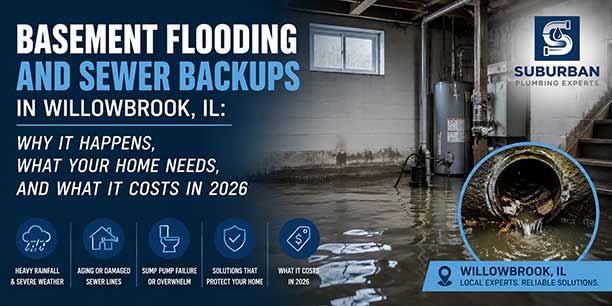
The Complete Guide for Willowbrook Homeowners Who Want Real Answers Before the Next Storm
Willowbrook is a village that doesn’t get talked about the way Naperville or Downers Grove does — it’s quieter, smaller, and a little more under the radar. But what Willowbrook homeowners know that outsiders don’t is that the village has a water problem that’s been around longer than most of the homes built here. Salt Creek. Sawmill Creek. The flat DuPage County terrain that sends runoff toward foundations instead of away from them. The split between older Route 83-era homes with 60-year-old cast iron drain systems and the newer developments near Waterfall Glen built on what used to be farmland.
Willowbrook’s basement flooding problem isn’t random bad luck. It’s geography, geology, aging infrastructure, and the specific way this village grew — and understanding those factors is the difference between spending money on the right solution and spending money on a fix that doesn’t address what’s actually happening in your basement. For a deeper breakdown of why Willowbrook homes keep flooding despite county efforts and what actually works on the private side, read our flood control and sewer guide in Willowbrook.
The Village of Willowbrook’s Stormwater Management Program acknowledges these challenges directly — all Willowbrook properties are subject to the DuPage County Storm Water and Flood Plain Ordinance, and the village has invested in capital improvement projects specifically targeting stormwater infrastructure along Executive Drive and other flood-prone corridors. The fact that the village is actively investing in stormwater management tells you what Willowbrook homeowners already know from experience: this is a real and recurring problem, not a once-in-a-generation event.
This guide covers everything Willowbrook homeowners need to know: why flooding happens here specifically, how the village’s two distinct property eras create two different flooding problems, what each solution costs in 2026, and how to get the diagnosis right before spending money on the wrong fix. Our licensed Willowbrook plumbers are based just 10 minutes away in Brookfield and have been serving every neighborhood in zip code 60527 since 1978.
Why Willowbrook Floods: The Geography and Infrastructure Behind the Problem
To understand why Willowbrook homeowners deal with basement flooding at the rate they do, you need to understand four things about the village’s specific situation.
Salt Creek and Sawmill Creek
Willowbrook sits in a watershed defined by Salt Creek and its tributary Sawmill Creek — two waterways that have shaped the village’s flooding profile for decades. Salt Creek runs along the northern and eastern edges of the village, and Sawmill Creek drains through the interior. During significant rain events, both waterways rise and their floodplains expand, affecting properties throughout the village — not just those with obvious waterfront exposure.
DuPage County Stormwater Management is actively developing a Sawmill Creek Watershed Plan specifically to address flooding, drainage, and water quality concerns throughout the watershed. The county’s April 2026 stakeholder meeting for the Sawmill Creek Watershed Plan is part of a longer-term infrastructure response to the flooding challenges the watershed creates for Willowbrook and neighboring communities. This level of active county involvement confirms what flooding maps show: a meaningful percentage of Willowbrook residential properties carry genuine flood risk, and that risk is being actively managed at the municipal level because it’s well-documented.
The Village of Willowbrook’s Floodplain Information page notes that the village participates in the National Flood Insurance Program’s Community Rating System — a program that rewards municipalities for proactive flood management with reduced insurance premiums for residents. Willowbrook has earned a 20% reduction in flood insurance premiums for its residents, which is a meaningful recognition of the flood exposure that exists in the village.
Flat DuPage County Terrain and Clay Soil
Like much of DuPage County, Willowbrook sits on flat terrain with clay-heavy glacial soil — the same conditions that make the entire western suburban corridor particularly vulnerable to basement flooding. Clay soil absorbs water slowly and holds it tenaciously. When rain falls faster than the ground can absorb it — which happens multiple times each year in Willowbrook — water pools on the surface, runs toward foundations, and works its way into basements through walls, floor joints, and window wells.
The flat topography means water doesn’t drain away by grade the way it does in hillier terrain. It stays where it lands until it finds the lowest available path — which is often a basement floor drain, a foundation wall joint, or a sump pit.
Two Completely Different Housing Eras — Two Different Flooding Problems
This is the most important thing to understand before spending any money on flood protection in Willowbrook. The village’s housing stock divides roughly into two eras, and each era has a completely different primary flooding problem.
Older Willowbrook — Route 83 Corridor Homes Built in the 1960s and 1970s
The homes along and near Route 83 — the original Willowbrook residential neighborhoods built during the village’s growth period from the late 1950s through the 1970s — are the ones our team’s Willowbrook location page specifically calls out for having cast iron sewer lines from that era. These pipes are now 50 to 60 years old and are at or past their reliable service life. The same homes often have original sewer laterals connecting to infrastructure that dates to the same period.
For these older Willowbrook homes, sewer surcharge backup is a real and recurring risk. The sanitary sewer systems in parts of Willowbrook are maintained by either the Flagg Creek Sanitary District or the DuPage County Sanitary District — and during heavy rain events that overwhelm sewer capacity, pressure can build in the mains and travel backward through residential laterals. The result is sewage coming up through the floor drain, basement toilet, or any below-grade fixture. It carries sewage. It smells. It’s a health hazard.
And critically — a sump pump cannot stop this. The sump pump has zero connection to your sewer lateral. If you’ve had your basement flood during a storm while your sump pump was running perfectly, this is almost certainly the explanation.
Newer Willowbrook — Waterfall Glen Area and Post-1985 Developments
For homes in Willowbrook’s newer developments — the subdivisions built in the 1980s, 1990s, and 2000s near Waterfall Glen and the village’s southern and western edges — the primary flooding problem is typically different. These homes generally have more modern sewer infrastructure, which reduces but doesn’t eliminate the sewer surcharge risk. Instead they face:
Groundwater intrusion from a high seasonal water table. Built on the flat, clay-heavy terrain of former farmland, many newer Willowbrook homes sit above a water table that rises significantly during sustained rain events or spring snowmelt. Hydrostatic pressure pushes water up through the slab, through floor joints, and into the sump pit. A properly functioning sump pump with adequate capacity is the primary defense — but if the pump fails, lacks battery backup, or is undersized for the volume your property generates, flooding results.
Surface drainage failures. On flat lots with minimal natural grade, surface water from heavy rain has nowhere to go. It pools in yards, runs toward foundations, fills window wells, and eventually finds its way into basements through above-grade penetrations. This is a French drain problem — water needs to be intercepted and redirected before it reaches the foundation.
Proximity to Sawmill Creek and detention basins. Subdivisions built near Sawmill Creek or adjacent to subdivision detention basins can experience flooding during extreme events when those water features exceed their capacity. The detention basins that manage stormwater for Willowbrook’s newer subdivisions were designed for historical storm patterns — the more intense rain events Chicago has experienced in recent years have exceeded those design thresholds repeatedly.
The Four Solutions and What Each Costs in Willowbrook in 2026
Solution 1: Sump Pump — Groundwater Accumulation
For newer Willowbrook homes where the primary problem is a rising water table and groundwater accumulation in the sump pit, the sump pump is the core solution. Most Willowbrook homes built after 1985 were constructed with sump pits — but the original pumps are often undersized, aging, or missing battery backup.
The battery backup issue is non-negotiable in Willowbrook. The storms that cause the most severe groundwater accumulation — the events when you need your pump most — are the same events most likely to knock out power. A sump pump without battery backup is a pump that will fail at the worst possible moment, every single time.
Our sump pump services cover the full Willowbrook area including same-day and 24/7 emergency response. Here’s what to expect on cost:
Standard sump pump replacement (existing pit, submersible): $400 to $900 installed. Includes pump, float switch, and check valve. If your pump is more than seven years old or has failed once, replacement before the next storm season is the right call.
Sump pump with battery backup: $700 to $1,500 installed. The non-negotiable configuration for any Willowbrook home that depends on the pump for basement protection.
New sump pit and pump installation (no existing pit): $1,200 to $2,500. For older Route 83-area homes that were built without a sump system.
Combination primary and battery backup unit: $1,000 to $2,000 installed. The most comprehensive single-unit protection for Willowbrook’s storm conditions.
If you’re not sure whether you need a sump pump, an ejector pump, or both — and what the difference is — our complete guide to sump pumps vs ejector pumps in Chicago covers exactly what each one does and when your home needs both.
Solution 2: French Drain — Surface Drainage and Lateral Groundwater
For Willowbrook homes where the problem is surface water pooling in the yard, water running toward the foundation across flat lots, or groundwater moving laterally through the clay soil and building pressure against foundation walls, a French drain is the right tool.
Our French drain installation services are tailored to Willowbrook’s clay soil conditions — which require more careful gravel selection, proper filter fabric, and correct discharge point design than sandy-soil installations. Here’s the cost breakdown:
Simple yard French drain (20–50 linear feet, open yard): $1,500 to $4,000. Addresses pooling in specific low spots, along property boundaries, or in areas where surface runoff concentrates.
Perimeter foundation French drain: $3,000 to $8,000+. Installed at footer depth around the foundation perimeter to intercept lateral groundwater before it builds pressure against the walls.
Interior perimeter drain tile system: $4,000 to $10,000. Installed inside the basement by cutting the concrete floor perimeter, laying drain tile, and routing to the sump pit. A good option when exterior excavation is impractical.
For a complete breakdown of what drives French drain costs higher in Chicagoland and what to look for in contractor quotes, see our Chicagoland French drain cost guide.
Solution 3: Backwater Valve — Sewer Surcharge Backup
For older Willowbrook homes in the Route 83 corridor where sewer surcharge backup is a risk, a backwater valve is the solution a sump pump simply cannot replace. The valve installs in the main sewer lateral in the basement floor and physically prevents city sewer pressure from entering your home’s drain system during a surcharge event. For homeowners dealing with repeated sewer backups, an overhead sewer conversion is often the only permanent solution.
Our sewer backflow prevention services handle the full installation including all required permits. Here’s the cost:
Backwater valve installation (main lateral, accessible location): $2,500 to $5,500 installed. Permits required — we pull all permits as part of every installation.
Backwater valve plus ejector pump (complete flood control system): $6,000 to $12,000 installed. The ejector pump handles wastewater from basement fixtures when the valve is sealed during a surcharge event — essential for homes with basement bathrooms or laundry.
Overhead sewer conversion: $12,000 to $30,000. The permanent solution — reroutes all basement drain lines above the surcharge level, making sewer backup physically impossible regardless of what happens in the sewer main. For more detail see our overhead sewer services page.
Solution 4: Sewer Camera Inspection — Before You Spend Anything
For any Willowbrook home that has experienced repeated basement flooding, unexplained slow drains, or water backup from below-grade fixtures, a professional sewer camera inspection is the right first step before committing to any solution. For older Route 83-area homes with cast iron laterals, camera inspection reveals exactly what 50 years of Chicago winters, root intrusion, and hard water have done to the pipe — and tells you whether you’re dealing with a surcharge backup problem, a deteriorated lateral problem, or a groundwater problem entirely.
Our sewer camera inspection services are available throughout Willowbrook on same-day and next-day scheduling. Finding a problem through a camera inspection before it becomes an emergency failure is consistently the most cost-effective decision a Willowbrook homeowner can make.
How to Diagnose Your Willowbrook Flooding Problem Before Calling Anyone
Use this framework before spending money on any solution:
Question 1: Does the water have a sewage odor? Yes → sewer surcharge backup. The solution is a backwater valve not a sump pump. No → groundwater or surface drainage. Continue to Question 2.
Question 2: Where does the water enter? Through the floor drain or basement toilet → sewer backup regardless of odor. Through the sump pit, up through the slab, or through wall-floor joints → groundwater. Sump pump territory. Through foundation walls at or above grade, window wells, or above-slab penetrations → surface drainage failure. French drain territory.
Question 3: When does it happen? During peak storm intensity, fast onset → sewer surcharge indicator. During or after sustained rain over many hours, spring snowmelt → groundwater accumulation indicator. In specific yard areas that pool before any basement flooding occurs → surface drainage, French drain first.
Question 4: How old is your home? Pre-1985, Route 83 corridor or original Willowbrook neighborhoods → higher probability of sewer backup risk, cast iron laterals, older sewer infrastructure. Post-1985, subdivision construction → higher probability of groundwater and surface drainage issues.
Question 5: Did your sump pump run during the flooding event? Pump ran but basement still flooded → likely sewer backup, not groundwater. Pump didn’t run (power outage or mechanical failure) → groundwater flooding from pump failure. No pump in the home → groundwater flooding risk is high and unprotected.
The Willowbrook Flooding Scenarios We See Most Often
Scenario 1: Route 83-Area Home, Floor Drain Backing Up During Heavy Rain
Classic sewer surcharge backup. The floor drain in an older Willowbrook home connects directly to the main sewer lateral. When the system surcharges during a heavy rain event, pressure travels backward through that lateral and up through the floor drain — the lowest available opening. The sump pump is completely uninvolved. The solution is a backwater valve, and in many cases an ejector pump if the home has basement bathroom or laundry fixtures that need to remain functional during storm events.
Scenario 2: Newer Subdivision Home, Sump Pump Running, Basement Still Flooding
The most common call we get from newer Willowbrook subdivision homeowners. The pump is working — you can hear it running — and the basement is still taking on water. Either the pump is working but incoming groundwater volume exceeds its capacity during extreme events, the pump lost power and backup battery was depleted, or the flooding is actually coming through above-grade penetrations that the pump can’t address.
Scenario 3: Flat Lot Near Sawmill Creek, Yard Pools for Days After Rain
A French drain problem. The lot was built on clay with minimal grade near the Sawmill Creek drainage corridor, surface water has no effective path to the street or storm inlet, and pooling water gradually works toward the foundation. The solution is a French drain designed for Willowbrook’s clay soil conditions with a properly selected discharge point.
Scenario 4: Home Near Detention Basin, Flooding During Extreme Events
When a subdivision detention basin overflows, neighboring homes face water volume that can’t be stopped by standard solutions alone. The appropriate response is a combination of French drain to intercept lateral groundwater movement and a high-capacity sump pump with battery backup to handle what reaches the pit. Some homeowners in this situation also explore overhead sewer conversion to permanently eliminate the sewer backup risk.
Willowbrook-Specific Considerations You Won’t Read About Elsewhere
The sewer district matters for your flooding risk. Willowbrook properties are served by either the Flagg Creek Sanitary District or the DuPage County Sanitary District depending on your specific location — your address determines which district maintains your sewer connection. Understanding which district serves your property and what infrastructure conditions exist in that district’s service area is relevant context for evaluating your sewer surcharge backup risk. If you’re not sure which district serves your address, the village’s public works department can tell you.
Willowbrook participates in NFIP with a 20% flood insurance reduction. This recognition reflects documented flood risk in the village. If you don’t carry flood insurance or sewer backup endorsement on your homeowners policy, review your coverage before the next storm season. Standard homeowners policies don’t cover sewer backup or groundwater intrusion — the coverage gap is broader than most homeowners realize.
The Sawmill Creek Watershed Plan is active and ongoing. DuPage County Stormwater Management is actively developing this plan specifically because flooding and drainage concerns throughout the Sawmill Creek watershed — which runs through Willowbrook — are significant enough to warrant a comprehensive county-level response. This is long-term good news for the village’s infrastructure, but it doesn’t address the private drainage systems of individual homes in the near term. Your sump pump, backwater valve, and yard drainage are your responsibility regardless of what municipal infrastructure improvements are planned.
Cast iron pipes in Route 83-area homes are at end of service life. A 1965 home on one of Willowbrook’s original streets has cast iron sewer lines that are now 60 years old. Cast iron corrodes from the inside out in Chicago’s hard water environment, creating rough interior surfaces that catch debris and accelerate blockage formation. Combined with root intrusion at joints that have been shifting through six decades of freeze-thaw cycling, these laterals are high-priority candidates for camera inspection and replacement planning before an emergency failure forces the issue.
Permits are required for flood control installations in Willowbrook. Sump pump system installations, backwater valve installations, and significant drainage work require permits in Willowbrook. We pull all required permits as part of every installation — it protects you at resale and ensures the work passes inspection.
What Willowbrook Homeowners Should Do Before the Next Storm
If your home is in the Route 83 corridor and has never had a sewer camera inspection: Schedule one this season. Cast iron laterals in 1960s and 1970s Willowbrook homes are at or past their reliable service life. Finding root intrusion, offset joints, or partial collapse before a failure occurs is dramatically less expensive than emergency excavation.
If your sump pump is more than seven years old: Have it assessed. A pump past that threshold in a Willowbrook home that depends on it for basement protection is a liability going into storm season.
If you don’t have battery backup on your sump pump: Install one before the next major storm. This is the single highest-value, lowest-cost flood protection upgrade available to any Willowbrook homeowner with a basement.
If your yard pools for 24+ hours after every significant rain: Get a French drain assessment. Flat Willowbrook lots with clay soil don’t improve on their own — the problem worsens as soil settles and grades change over time.
If you’ve had sewage backup through your floor drain even once: Get a backwater valve assessment immediately. One backup event is a warning. The second one is a much larger remediation bill.
Frequently Asked Questions: Basement Flooding in Willowbrook
Is my Willowbrook property in a flood zone? Portions of Willowbrook — particularly properties near Salt Creek, Sawmill Creek, and their floodplains — are in FEMA-designated Special Flood Hazard Areas. Most residential Willowbrook is outside those mapped zones, but being outside the flood zone does not mean a property is immune to basement flooding. The most common flooding problems in Willowbrook affect properties throughout the village, not just those in FEMA-mapped areas.
What’s the difference between the Flagg Creek Sanitary District and the DuPage County Sanitary District? These are the two entities that maintain sanitary sewer infrastructure in different parts of Willowbrook. Which one serves your address depends on your specific location within the village. Both are responsible for the public sewer mains — but the private lateral connecting your home to the main is your responsibility to maintain. Call the village’s public works department at (630) 323-8215 if you’re not sure which district serves your property.
Does homeowners insurance cover basement flooding in Willowbrook? Standard homeowners policies typically exclude flooding, groundwater intrusion, and sewer backup. Separate sewer backup endorsements are available from most insurers for $50 to $150 per year and are worth adding if you haven’t already. Given Willowbrook’s documented flood risk and the village’s NFIP participation, reviewing your coverage before storm season is a priority.
My sump pump ran during the flooding but my basement still flooded. Why? Almost certainly a sewer surcharge backup — water coming backward through your floor drain from the sewer system. The sump pump is handling groundwater in its pit, which is a completely different water source from what’s coming through the drain lines. This is one of the most common and most misunderstood flooding scenarios in Willowbrook’s older neighborhoods.
What if I have both a groundwater problem and a sewer backup problem? Both are solvable. The complete protection strategy is a sump pump with battery backup for the groundwater side and a backwater valve for the sewer surcharge side. For homes with basement bathrooms or laundry, an ejector pump is also needed to keep those fixtures functional when the backwater valve is sealed during a surcharge event. Our complete flood control systems page covers how all the components work together.
How long does a backwater valve installation take in Willowbrook? The installation typically takes one day. We cut an opening in the basement floor to access the main sewer lateral, install the valve, bed it with stone, and restore the concrete surface. We pull the required permit and handle inspection coordination — you don’t need to contact the village yourself.
Dealing With Basement Flooding in Willowbrook? Let’s Figure Out What’s Actually Causing It.
Licensed, insured, and based just 10 minutes away in Brookfield since 1978. We assess your specific flooding situation — sump pump, French drain, backwater valve, or sewer camera — and tell you exactly what your home needs before we quote anything. Written prices before we start, permits pulled on every job, our own licensed employees on every call. Send us a message and we’ll get back to you fast.
Or call us directly: 630-749-9057 | Open 24/7
—
Suburban Plumbing Sewer Line & Drain Cleaning Experts
Licensed & Insured | Open 24 Hours | Serving Willowbrook & Chicagoland
View our Google Business Profile and customer reviews
📞 Suburbs: 630-749-9057 | 🚨 Emergency: 708-518-7765