

The Most Iconic Homes in Chicago Come With Plumbing That Needs to Be Understood — Not Feared.
There’s no housing type more distinctly Chicago than the bungalow. Drive through Berwyn, Cicero, Oak Park, Bridgeport, Beverly, or virtually any neighborhood on the Northwest or Southwest Side and you’re moving through block after block of brick bungalows built between 1910 and 1940 — low-slung, solid, beautiful, and full of character that newer construction simply can’t replicate. Two-flats and three-flats from the same era define entire stretches of the North Side, and they remain some of the most practical housing investments in the city.
What doesn’t come up in the listing description — or the home inspector’s report — is that these homes carry plumbing systems that are now between 60 and 110 years old. And while a well-maintained Chicago bungalow or two-flat is an exceptional place to live or invest, the original plumbing these buildings were constructed with is at or past the end of its functional life in ways that aren’t always visible until something fails.
This guide is written specifically for Chicago bungalow and two-flat owners — and for buyers doing due diligence before they close. If you want a deeper breakdown of how bathroom plumbing systems work in Chicago homes, including toilets, drains, shower setups, leak risks, and real-world costs, you can review our complete 2026 bathroom plumbing guide.
Why Chicago’s Bungalow Belt Has a Unique Plumbing Profile
The roughly 80,000 bungalows that make up Chicago’s famous bungalow belt were built during a concentrated building boom driven by the city’s postwar population growth and the expansion of streetcar lines into previously undeveloped residential areas. Two-flats and three-flats followed similar construction patterns — dense, practical, built to last structurally, and built with the plumbing materials that were standard at the time.
The problem is that “standard at the time” means:
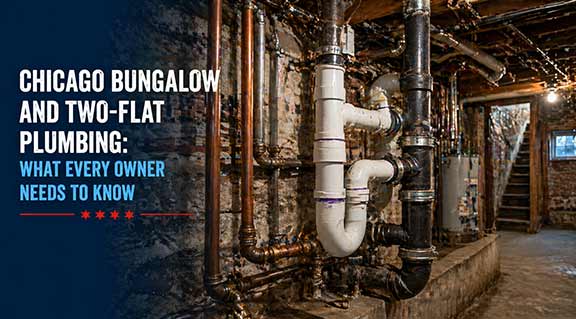
Cast iron drain, waste, and vent lines throughout the interior of the home — in the walls, under the basement floor, in the ceiling cavities between floors in a two-flat, and running down through the structure as the main stack. Cast iron was the right material for its era. It’s now 70 to 100 years old in most of these homes, and it fails in specific, predictable ways.
Galvanized steel supply lines for water distribution inside the home. Galvanized pipe corrodes from the inside out over decades, progressively narrowing the interior diameter through scale and rust buildup until flow is severely restricted — and eventually leaking at fittings and joints as the pipe wall thins.
Lead or brass solder connections at joints and fixtures in older supply systems. In some of the oldest buildings, short sections of lead pipe remain in the supply system as well, particularly at the connection between the city’s water main and the building’s interior supply.
Clay tile sewer laterals running underground from the building’s foundation to the city main beneath the street. Clay tile was the standard material for underground sewer lines through most of the first half of the twentieth century. It doesn’t corrode the way metal does, but it cracks, shifts, and develops joint separations as soil moves over decades — and those gaps are exactly what tree roots are looking for.
Combined drain configurations in which above-grade and below-grade fixtures share drain lines that connect to the city’s combined sewer system — meaning that when the city’s sewer surcharges during a heavy storm, the path of least resistance for that backed-up sewage is directly into the building’s basement.
None of these systems are disqualifying on their own. Many Chicago bungalows and two-flats with largely original plumbing function adequately — until they don’t. Understanding what you have, what its condition is, and what the failure modes look like is the difference between managing your building proactively and getting surprised by a $15,000 emergency.
Cast Iron Drain Lines: The Most Common Failure Point
Cast iron drain, waste, and vent piping is the most universal feature of bungalow and two-flat plumbing — and the one that causes the most significant problems as these buildings age.
Cast iron corrodes from the inside out. The interior pipe wall is continuously exposed to moisture, organic acids from waste, and hydrogen sulfide gas produced by bacterial activity in the drain system. Over decades, this creates internal pitting and scale buildup that roughens the pipe surface, restricts flow, and eventually thins the pipe wall to the point of perforation and leakage.
In a Chicago two-flat, cast iron corrosion is accelerated by one additional factor: the volume of use. Two units sharing a single drain stack mean that every bathroom, every kitchen, every laundry connection on both floors is cycling waste through the same cast iron system continuously. A drain stack in a two-flat sees approximately twice the daily throughput of a single-family home, and that means the corrosion timeline is compressed.
What failure looks like in practice:
Pinhole leaks and weeping joints in the basement are often the first visible sign — a damp patch on the basement ceiling, a slow drip along a vertical section of pipe, rust streaking down a section of cast iron that’s always dry on the surface but wet beneath the corrosion layer. In finished basements, the first sign is often water damage to drywall or subfloor before the pipe itself is ever visible.
In wall cavities and ceiling spaces between floors, cast iron failure is invisible until the leak is significant enough to penetrate through the surface — which often means the water damage is already extensive by the time it’s discovered.
Our drain cleaning services for Chicago-area homes include camera inspection of drain lines as part of diagnosis, and in older Chicago homes we consistently find internal corrosion that isn’t visible from the outside and wouldn’t be caught by a standard home inspection.
What to do about it:
A sewer camera inspection of the interior drain system is the only way to know what you’re actually dealing with. The camera goes through the drain stack and lateral, showing you the real condition of the pipe interior — the degree of corrosion, any existing perforations or cracks, areas of significant scale buildup, and sections of pipe that are approaching failure.
From there, the decision is informed rather than speculative. Some cast iron is in adequate condition for continued use with monitoring. Some sections need targeted replacement. Some systems — particularly in homes where the cast iron is original and 80 or 90 years old — are better candidates for whole-home repiping that replaces the cast iron drain system with modern PVC, solving the problem permanently rather than managing it section by section.
Galvanized Supply Lines: Low Pressure, Discolored Water, and Worse
If your Chicago bungalow or two-flat has noticeably weak water pressure — showers that never quite perform the way they should, faucets that run thin, the upstairs unit in a two-flat that always has worse pressure than the downstairs — galvanized steel supply pipes are almost certainly the reason.
Galvanized pipe corrodes internally as iron oxidizes and scale accumulates on the interior wall. In a new galvanized pipe, the interior diameter is the full nominal size of the pipe. In a 70-year-old galvanized supply line, the effective interior diameter may be reduced by 50 to 80 percent due to scale buildup — meaning a ¾-inch pipe is effectively performing like a ⅜-inch pipe. The pressure loss is significant and gets worse over time.
Beyond pressure, galvanized corrosion produces a second problem: discolored water. The rust and scale that flakes off corroding galvanized pipe shows up as brownish or reddish water from taps — most noticeable after the water has been sitting in the pipes overnight and you run a faucet in the morning. If you’ve ever turned on a Chicago bungalow faucet and watched brown water run for 10 to 15 seconds before clearing, you’ve seen this firsthand.
The third problem is structural failure. As the pipe wall thins through years of corrosion, galvanized supply lines become prone to pinhole leaks and joint failures — particularly at threaded connections where the wall is thinnest and where corrosion concentrates. A galvanized supply failure inside a wall cavity or under a floor can cause significant water damage before it’s discovered.
For two-flat owners, the supply line situation has an additional dimension: the city of Chicago requires that water service lines serving buildings with multiple units be sized appropriately for the demand. Many two-flats were originally constructed with undersized service connections that were barely adequate when installed and are now significantly undersized by modern standards — contributing to pressure issues that can’t be fully resolved just by repiping the interior without also addressing the service line size.
A whole-home repiping service replacing galvanized supply lines with modern copper or PVC resolves all three problems simultaneously — pressure, water quality, and structural integrity — and is one of the highest-value plumbing investments available to Chicago bungalow and two-flat owners.
The Sewer Lateral: Clay Tile, Root Intrusion, and Shifting Soil
Beneath every Chicago bungalow and two-flat, running underground from the foundation to the city sewer main in the street, is the sewer lateral — and in homes of this era, that lateral is almost certainly clay tile.
Clay tile performs differently from cast iron or PVC. It doesn’t corrode, but it has two significant failure modes: joint separation and root intrusion.
Clay tile sewer laterals were installed in sections, with hub-and-spigot joints packed with oakum or lead at each connection point. Over 70 to 100 years of soil movement — frost heave, settling, the expansion and contraction of Chicago’s clay-heavy soil through extreme temperature cycles — those joints shift and separate. A joint gap of even a few millimeters is invisible from the surface but creates both a leak path for sewage into the surrounding soil and, more critically, an entry point for tree roots.
Chicago’s dense urban tree canopy — the parkway elms, silver maples, and willows that line virtually every residential block — produces root systems that actively seek out moisture underground. A clay tile lateral with a separated joint is essentially a beacon to nearby tree roots: warm, wet, nutrient-rich, and accessible. Once inside, roots grow aggressively, build into blockages, and expand the joint gap through mechanical pressure until sections of clay tile collapse entirely.
The City of Chicago’s Department of Water Management administers the Private Drain Program specifically because lateral failures in Chicago’s aging housing stock are so common — and because failed private laterals affect the city’s own infrastructure when they leak sewage into the combined sewer system or cause soil settlement near street mains.
For Chicago bungalow and two-flat owners, the practical guidance is straightforward: if you haven’t had a camera inspection of your sewer lateral in the last three to four years, you don’t know what condition it’s in. Lateral failures rarely announce themselves dramatically — they develop over years, causing slowly worsening drainage, periodic backups that get attributed to other causes, and eventual catastrophic failure that requires emergency excavation at the worst possible time.
A sewer camera inspection of the lateral takes about an hour and gives you a definitive picture of the pipe interior — joint conditions, root intrusion presence and severity, any collapsed sections, and the overall structural state of the line. From that information, you can make a planned, budgeted decision about whether maintenance, sewer tree root removal, spot repair, or full lateral replacement is the right course of action.
Drum Traps: The Plumbing Feature in Chicago Bungalows That Every Plumber Knows
If you’ve had a plumber work on a Chicago bungalow and watched them pause and say “oh, drum trap” — you’ve encountered one of the most distinctly vintage features of this housing stock.
A drum trap is a cylindrical trap — typically 4 to 6 inches in diameter, made of lead or cast iron — installed beneath bathtubs and occasionally other fixtures in homes built through roughly the 1950s. It performs the same function as the P-trap under a modern sink (holding water to create a gas seal), but it does so less efficiently, accumulates debris far more readily, and is not recognized by current plumbing codes.
Drum traps cause problems in two ways. First, they clog chronically — the cylindrical shape creates a dead zone where hair, soap scum, and debris settle and accumulate, and because the trap isn’t self-cleaning the way a P-trap is, it needs to be opened and cleared manually when it clogs rather than being clearable with a standard drain snake. Second, they are lead or cast iron — the same aging materials as the rest of the drain system, subject to the same corrosion issues, and in many cases original to the home.
When we work on bathroom plumbing in Chicago-area bungalows, drum trap replacement with a proper code-compliant P-trap configuration is often part of the work — either because the trap has failed, because it’s chronically clogging, or because we’re replacing the cast iron drain lines it connects to and it makes sense to address everything simultaneously.
If you have a Chicago bungalow with a bathtub that drains slowly and has for years, and conventional drain clearing hasn’t solved it permanently, a drum trap is probably the explanation.
Basement Flooding and the Combined Sewer: A Two-Flat Owner’s Specific Risk
For two-flat owners in Chicago, basement flooding deserves its own section — because the risk profile is meaningfully different from a single-family home, and because the basement in a typical Chicago two-flat is frequently a finished or partially finished living space with real financial exposure.
Chicago’s combined sewer system routes both stormwater and sanitary sewage through the same underground infrastructure. During heavy rain events — which have become more frequent and more intense over recent decades — the combined system can reach capacity and surcharge, pushing sewage backward through private laterals and up through the lowest fixtures in connected buildings. For a Chicago bungalow or two-flat, those lowest fixtures are almost always in the basement: floor drains, laundry connections, and in buildings with basement units, the bathroom fixtures themselves.
The Metropolitan Water Reclamation District of Greater Chicago manages stormwater and wastewater for Chicago and 128 surrounding communities, and their data on combined sewer overflow events makes clear that this is a systemic infrastructure challenge — not something that individual homeowners can prevent at the city level. What individual homeowners can do is protect their own buildings from the consequences.
For two-flat owners specifically, the calculus is worth running carefully. A basement sewage backup affects not just the structural building but potentially a rented unit, a tenant’s belongings, habitability during cleanup, and your landlord obligations under Chicago’s Residential Landlord Tenant Ordinance. A single significant backup event in a basement unit can cost $20,000 to $40,000 in total damage, remediation, tenant displacement, and repairs — plus the legal and insurance complexity that follows.
The protective options, roughly in order of cost and comprehensiveness:
Backwater valve installation — a valve in the sewer lateral that allows waste to flow out normally but closes automatically when the city main surcharges backward. Meaningful protection at a fraction of the cost of more comprehensive systems. Our sewer backflow prevention specialists install these throughout the Chicago area and they are often the right first step for buildings that haven’t had significant backup events.
Sump pump with battery backup — addresses groundwater intrusion rather than sewer surcharge, but many Chicago basements need both. A properly sized sump pump with a battery backup system provides reliable protection against water table rise during heavy rain events. Our sump pump installation and service team handles both new installations and upgrades to underpowered existing systems.
Overhead sewer conversion — the most comprehensive solution, eliminating sewer backup risk at the source by rerouting drain lines to exit the building above the sewer main elevation. The right choice for buildings with repeated backup history, finished basement units, or significant financial exposure. Our overhead sewer installation specialists assess each building individually and give you an honest recommendation on what level of protection is appropriate.
What to Check Before Buying a Chicago Bungalow or Two-Flat
If you’re in the due diligence process on a Chicago bungalow or two-flat purchase, here’s what a thorough plumbing assessment should include — beyond what a standard home inspection will tell you.
Sewer camera inspection of the lateral. This is the single most important additional inspection for Chicago vintage properties. A standard home inspector does not camera-inspect the sewer lateral. They run water and check for drainage speed. A camera inspection shows you what’s actually inside the pipe — root intrusion, joint conditions, collapsed sections, overall remaining service life. The cost is minimal relative to the information it provides and the potential repair cost if you find a problem after closing.
Camera inspection of interior cast iron drain lines. In a two-flat, the main stack and branch lines serving both units represent significant replacement cost if they’re in advanced deterioration. Knowing the condition before you close — not after the first major leak — changes the financial picture of the purchase.
Water pressure measurement at multiple fixtures. Run the shower in the upstairs unit and the downstairs kitchen simultaneously and pay attention to what happens to the pressure. Significant pressure loss under simultaneous demand is consistent with undersized or severely scaled galvanized supply lines.
Documentation of any previous sewer backup events. Ask directly. Ask the seller and ask the disclosure documents. A two-flat that has had repeated basement backups is a building with a known flood control problem that the new owner will inherit. Buyers considering properties in older Chicago neighborhoods should also understand the plumbing challenges that are common in specific areas of the city. Our Wicker Park & Bucktown Plumbing Guide covers many of the sewer, drain, and aging infrastructure issues frequently found in these historic neighborhoods.
Identification of the trap configuration under bathtubs. If you can access the area beneath the tub — through a basement ceiling, a crawlspace, or an access panel — note whether you see a cylindrical drum trap or a modern P-trap configuration. Drum traps are a known maintenance item and a likely future replacement project.
Our team performs plumbing inspections for home buyers throughout the Chicago area and routinely works alongside real estate transactions to give buyers the complete picture of what they’re purchasing. We’re straightforward about what we find and what it means financially — no upselling, no scare tactics, just honest assessment from plumbers who work in these buildings every day.
Common Plumbing Questions for Chicago Bungalow and Two-Flat Owners
How do I know if my bungalow still has galvanized supply pipes?
The clearest indicator is water pressure — specifically, whether it’s noticeably weaker than you’d expect from a municipal supply. Discolored water in the morning, particularly the first draw from a faucet that’s been sitting overnight, is another strong indicator. If you can access your supply lines in the basement, galvanized pipe has a dull grey exterior and will typically show surface rust at fittings and connections. Copper pipe has a distinctive reddish-brown color. If you’re not sure, a licensed plumber can identify what you have quickly during any service call.
My upstairs unit always has worse water pressure than downstairs. Is that a plumbing problem or just physics?
It’s often both — and in a Chicago two-flat with original galvanized supply lines, it’s almost certainly the plumbing. Some pressure loss between floors is expected due to elevation, but the degree of loss in many older two-flats is far beyond what physics alone explains. Scale-narrowed galvanized lines compound the elevation effect significantly. If the pressure difference is severe enough to make the upstairs shower genuinely inadequate, that’s a supply line problem worth addressing rather than a condition to simply accept.
How much does it cost to repipe a Chicago bungalow or two-flat?
For a single-family bungalow, whole-home repiping of supply lines typically runs $3,500 to $8,000 depending on the size of the home, accessibility, and whether the work includes fixture connections. For a two-flat, the cost is higher — typically $6,000 to $14,000 or more — because of the additional unit’s supply system, the greater total pipe length, and any service line sizing work. Cast iron drain system replacement adds significantly to those figures depending on scope. We provide free estimates and will walk you through exactly what the work involves and what it costs before any decision is made.
Is it worth repiping an older two-flat if I’m planning to sell in five years?
Generally yes — for supply lines, the return is strong. Buyers and their agents are increasingly sophisticated about aging plumbing in Chicago vintage properties, and a building with documented modern copper or PVC supply lines commands a meaningfully stronger position in negotiations than one with original galvanized. The cost of repiping is typically recovered in the sale price differential, and you avoid the liability of a supply line failure in a rented unit during the years you still own the building.
What’s involved in getting the plumbing up to current Chicago code in an older building?
Code compliance in Chicago and suburban municipalities covers a range of items in older buildings — drum trap replacement, venting configurations, pipe material requirements for certain applications, and sewer lateral conditions. For buildings that haven’t had significant plumbing work, a licensed plumber doing an assessment can identify what current code requires versus what represents a best-practice upgrade rather than a code mandate. We pull all required permits for work in Chicago and throughout the suburbs and coordinate the required inspections — which is not something every plumber does, and it matters both for code compliance and for your building’s documentation if you sell.
My bungalow has had one basement backup. Should I be worried about it happening again?
Yes — realistically, you should treat a single backup event as a signal rather than a one-time occurrence. The conditions that caused it are almost certainly structural rather than coincidental. Chicago’s combined sewer system surcharges repeatedly during heavy rain seasons, and a building that backed up once has a lateral configuration and drainage setup that is susceptible to it. A sewer backflow prevention device is the minimum protective step at that point. Depending on the severity of the event and your basement’s use, a more comprehensive solution may be the right answer. We’re direct about the options and what each one actually provides.
Own a Chicago Bungalow or Two-Flat? Let’s Talk.
Send us your info and we’ll follow up fast — free assessments available across Chicago and the suburbs. We work in these buildings every day and we’ll give you straight answers about what you have and what it needs.
Or call us directly: 773-570-2191 | Open 24/7
—
Suburban Plumbing Sewer Line & Drain Cleaning Experts
Licensed & Insured | Open 24 Hours | Serving Chicago & the Suburbs Since 1978
📞 Chicago: 773-570-2191
🚨 24/7 Emergency Line: 708-518-7765