
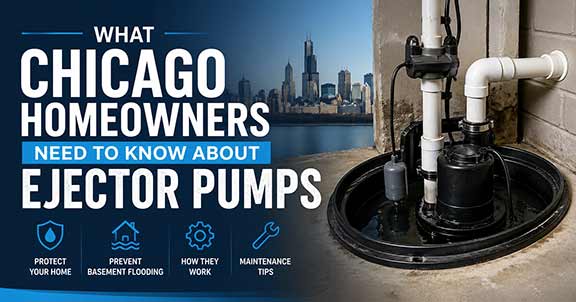
The Basement Plumbing Device Most Homeowners Ignore Until It Fails — and What Happens When It Does
There is a piece of equipment in roughly half the homes in Chicagoland that most homeowners couldn’t locate, describe, or explain — and it’s one of the most critical components in the entire plumbing system. It runs automatically every time someone flushes a basement toilet or runs the basement laundry. It works around the clock without maintenance for years. And when it finally fails, it fails dramatically: raw sewage backs up into the basement, the smell is immediate and overwhelming, and the cleanup is expensive and genuinely unpleasant.
That device is the ejector pump. If your home has a basement bathroom, a basement laundry room, or any plumbing fixture located below the level of the main sewer line, you have one — or you need one. This guide tells you exactly how ejector pumps work, why Chicago homes are particularly dependent on them, how long they last, what replacement costs, and what the warning signs of failure look like before the situation becomes an emergency.
If you’re already experiencing warning signs such as strange noises, sewage odors, frequent cycling, or slow-draining basement fixtures, our detailed guide on troubleshooting sewage ejector pump problems walks through the most common causes and what homeowners should check before the issue turns into a basement sewage backup.
What an Ejector Pump Is and How It Works
In most homes, gravity does the work of moving wastewater from fixtures to the sewer. Water from sinks, showers, and toilets flows downhill through drain pipes, enters the main sewer lateral, and continues toward the city main. The system works elegantly as long as everything being drained is located above the level of the main sewer line.
The problem in Chicago and most Chicagoland homes is that basements are below the main sewer line — sometimes significantly so. A toilet in a basement bathroom cannot rely on gravity to push waste uphill to the sewer. Neither can a basement laundry room or a utility sink in a lower-level mechanical room. The waste has nowhere to go on its own.
An ejector pump solves this problem. It consists of a sealed basin — called an ejector pit — set into the basement floor, into which all below-grade wastewater flows. A float switch in the basin monitors the water level. When the water reaches a set threshold — typically 12 to 15 inches — the pump activates automatically, grinds solid waste into a slurry, and forces the entire contents of the pit upward through a discharge pipe until it reaches the home’s main drain line at a height where gravity can take over. The pump then shuts off until the basin fills again.
The cycle repeats dozens of times a day in a home with active basement plumbing — silently, automatically, and mostly unnoticed. Until it stops working.
Why Chicago Homes Are Especially Dependent on Ejector Pumps
Chicago’s housing stock makes ejector pumps not just common but essential. The city’s bungalow belt — the arc of two-bedroom and three-bedroom bungalows running through neighborhoods on the North, West, and Southwest sides — was built primarily between 1910 and 1940 with full basements that were originally used for utilities and storage. As those homes aged and families sought more living space, finished basement bathrooms and laundry rooms became standard.
The same pattern holds true in virtually every established Chicagoland suburb. Berwyn, Cicero, Oak Park, Riverside, La Grange, Westchester, Brookfield — the housing stock is dominated by homes built before 1960 with basements that have been finished or partially finished over the decades since. Most of those finished basements include a bathroom. Most of those bathrooms have an ejector pump handling the waste.
Unlike sump pumps — which handle groundwater and are well known to most Chicago homeowners — ejector pumps handle raw sewage. This distinction matters enormously when a pump fails. A sump pump failure results in a wet floor. An ejector pump failure results in sewage backing up into the basement from the pit. The health hazard is immediate, the remediation is significant, and the urgency is real.
Chicago’s older combined sewer infrastructure adds another layer of complexity. The same sewer system that can surcharge during heavy rain — pushing sewage back toward private laterals — is the system that ejector pumps are discharging into. When city mains are under heavy load, proper ejector pump function and properly installed check valves are critical to preventing a backup from working in both directions simultaneously.
Ejector Pump vs. Sump Pump: Understanding the Difference
This is one of the most common points of confusion for Chicago homeowners, and it matters practically because the two systems are often located near each other in the basement and both involve pits in the floor. If you’re planning or evaluating a basement bathroom system, it’s important to understand how ejector pump sizing, rough-in requirements, and Chicago plumbing code all affect installation cost and design decisions. This detailed guide breaks down exactly what homeowners need to know before building or upgrading a basement bathroom system.
A sump pump handles clean or moderately contaminated groundwater — rainwater that has infiltrated through the foundation, hydrostatic pressure water, and drainage tile discharge. The sump pit is typically open or covered with a loose lid, and the pump discharges water outside the home or to a storm drain.
An ejector pump handles raw sewage — toilet waste, sink drain water, shower and tub discharge, and laundry water from basement fixtures. The ejector pit is always sealed with a bolted, airtight cover because it contains sewage gases that would otherwise fill the basement. The discharge line connects to the home’s main sanitary drain rather than to the exterior.
Many Chicagoland homes have both systems operating simultaneously and independently. The sump pit and ejector pit may be located near each other in the mechanical room, which can create confusion when something goes wrong. If you’re unsure which system you have or whether both are present in your home, our ejector pump services team can assess your setup and explain exactly what you’re working with.
How Long Do Ejector Pumps Last in Chicago?
The honest answer is: it depends heavily on what the pump is made of, how heavily it’s used, and whether it’s been maintained. A cast iron pump from a quality manufacturer — Zoeller, Liberty Pumps, or Myers — installed correctly with proper venting and a functional check valve, can last 20 to 30 years with annual inspection and occasional maintenance. A lower-end plastic pump in a high-use household may fail in 7 to 10 years.
Chicago’s environment is harder on ejector pumps than milder climates. The combination of hard water mineral deposits, the heavy grease and debris load from cooking households, and the sediment that comes with older cast iron drain lines creates conditions where pump components wear faster than they would elsewhere. Impellers clog, float switches stick, check valves fail, and seals deteriorate.
The average ejector pump replacement cycle in a typical Chicagoland residential installation is 10 to 15 years. If your home is more than 15 years old and you’ve never had the ejector pump inspected or replaced, the question isn’t whether you should have it looked at — it’s whether it’s already overdue.
What Ejector Pump Replacement Costs in Chicago
Based on current Chicagoland market data, here’s what homeowners typically pay for ejector pump work in 2026:
Ejector pump replacement (standard residential) — $800 to $1,800 for most single-family home installations. This includes the pump itself, installation labor, testing, and disposal of the old unit. The wide range reflects differences in pump quality — a basic plastic unit runs significantly less than a cast iron commercial-grade pump that will last decades longer.
Ejector pump replacement with pit work — $1,500 to $3,500 when the pit itself needs to be repaired, relined, or replaced, or when the discharge piping or check valve needs replacement as part of the job.
Emergency ejector pump replacement — add 35 to 50 percent to standard pricing for after-hours, weekend, or holiday emergency calls. This is the cost of waiting until the pump has failed completely rather than replacing it proactively.
New ejector pump installation (no existing system) — $2,000 to $4,500 depending on the complexity of the rough-in, the depth of excavation required, venting requirements, and permit costs. Installing a new system from scratch — typically as part of a basement bathroom addition — requires more work than replacing an existing pump in an already-established pit.
The single most effective way to avoid the top end of these cost ranges is to replace the pump before it fails. An emergency call at midnight when sewage is backing up into a finished basement will always cost significantly more than a planned replacement during business hours — and that’s before accounting for any cleanup or remediation costs.
Warning Signs Your Ejector Pump Is Failing
Most ejector pump failures don’t happen without warning. The pump communicates distress in several specific ways before it fails entirely — and knowing what to look for gives you the opportunity to replace it before the situation becomes an emergency.
Unusual sounds are often the first indicator. A healthy ejector pump produces a consistent hum when it runs. Grinding, rattling, or loud vibrating sounds indicate a worn or damaged impeller — the component that grinds solid waste and creates the pumping action. A pump that makes grinding sounds is working harder than it should and is closer to failure than its age alone would suggest.
The pump runs continuously or cycles on and off very rapidly. Both patterns indicate that the pump cannot keep pace with the inflow, which suggests either a pump that is losing capacity or a float switch that is malfunctioning and unable to shut the pump off at the correct water level.
Sewage odors in the basement near the ejector pit. The ejector pit lid should be sealed airtight at all times. If you’re detecting sewage smell near the pit, the lid seal has failed, the vent line is blocked, or the pit cover has been disturbed. Any of these allows sewage gas — including hydrogen sulfide — to escape into the basement. This is not a minor inconvenience; sewage gas is toxic at elevated concentrations.
Slow drainage from basement fixtures. If the basement toilet flushes sluggishly, the basement sink drains slowly, or water takes longer than usual to clear the basement shower, the ejector pump is struggling to process the volume. This can indicate a partially clogged impeller, a failing motor, or a check valve that is not opening and closing correctly.
The pump alarm activates. Quality ejector pump installations include a high-water alarm — typically a small float switch set above the normal operating level that triggers an audible or visual alert if the pit water rises above where the pump should have activated. If your alarm goes off, the pump has failed to activate and the pit is filling with sewage. This requires immediate attention.
Visible moisture or efflorescence around the pit. Any sign of moisture seeping from the ejector pit, condensation on the discharge line, or white mineral deposits around the pit cover indicates a seal or fitting failure that needs to be addressed before it worsens.
What You Should Never Put Into an Ejector System
Ejector pumps are designed to handle toilet waste and toilet paper, sink and shower water, and laundry discharge. They are not designed to handle — and will fail prematurely if subjected to — a long list of common household items that get flushed or poured down drains.
Flushable wipes are the single biggest cause of ejector pump damage we see in Chicagoland homes. Despite the packaging claim, these products do not break down in water. They wrap around the impeller, jam the grinding mechanism, burn out the motor, and require service calls that would not have been necessary otherwise. Do not flush them — ever — in a home with an ejector pump.
Cooking grease and food oils poured down a basement sink or laundry sink accumulate in the ejector pit and on the pump components over time, reducing pumping capacity and accelerating wear. Feminine hygiene products, paper towels, cotton balls, dental floss, and any other non-toilet paper material should never enter an ejector system.
This is not a suggestion — it is the difference between a pump that lasts 20 years and one that requires replacement in 7.
Ejector Pump Maintenance: What to Do and When
Unlike sump pumps, which most Chicago homeowners know to test annually, ejector pumps are almost universally neglected because they’re sealed, underground, and out of sight. This neglect is expensive.
Annual inspection by a licensed plumber should include: checking the float switch operation and trigger level, inspecting the check valve and shutoff valve, testing the discharge line for blockages or restrictions, checking the pit seal and cover for integrity, listening for unusual sounds during a test cycle, and inspecting the vent line for blockages. This service typically takes 30 to 45 minutes and costs far less than the service call after a failure.
You can also do a simple functional check yourself: run water into the basement fixtures and listen for the pump to activate. If you hear normal operation — a consistent hum for 15 to 30 seconds followed by shutoff — the pump is at least activating correctly. If the pump doesn’t activate, runs continuously, or makes unusual sounds, call a plumber.
Our ejector pump services include inspection, repair, and replacement for all makes and models throughout Chicago and the suburbs. If you’re not sure when your ejector pump was last serviced or replaced, we can assess its condition and give you an honest evaluation of how much life it has left.
When Ejector Pump Problems Are Actually Sewer Line Problems
One important diagnostic note: not every ejector pump symptom is actually an ejector pump problem. Slow drainage from basement fixtures and occasional backups can also be caused by a blockage or restriction in the main sewer lateral — downstream from where the ejector pump discharges.
If a sewer camera inspection reveals a blockage, root intrusion, or structural damage in the main lateral, clearing or repairing that issue may resolve the slow drainage problem entirely without replacing the ejector pump. Our sewer camera inspection service always comes before any major repair recommendation — because the right diagnosis is the only way to know which problem you’re actually solving.
If you’re dealing with recurring basement drainage issues and want to understand what’s driving them and what it would cost to fix, our Chicago sewer line repair cost guide covers the full range of repair options and pricing so you know what to expect before you get your first quote.
Frequently Asked Questions: Ejector Pumps in Chicago
Do I definitely have an ejector pump if I have a basement bathroom?
Almost certainly yes. Any basement bathroom with a toilet requires an ejector pump because the toilet sits below the main sewer line and waste cannot flow uphill by gravity. If you’re not sure, look in your basement mechanical room for a sealed pit cover — typically 18 to 24 inches in diameter — with a discharge pipe running upward from it. That’s your ejector pit. The pump is inside. If you’d like a deeper explanation of how ejector pumps work, why Chicago homes rely on them, common failure points, and what replacement typically costs, see our complete guide to ejector pumps for Chicago homeowners.
How is an ejector pump different from a sump pump?
A sump pump handles groundwater and discharges it outside the home. An ejector pump handles raw sewage from below-grade plumbing fixtures and discharges it to the home’s main sewer line. Ejector pits are always sealed because they contain sewage and sewage gases. Sump pits are open or loosely covered. Both are common in Chicagoland homes — many properties have both operating independently.
How do I know if my ejector pump is working?
Run water from your basement bathroom or laundry and listen for the pump to activate — you should hear a consistent hum for 15 to 30 seconds as it processes the water and shuts off. If you hear grinding, rattling, or continuous running, or if you notice sewage odors near the pit, call a plumber for an inspection. If you never hear anything when you use basement fixtures, either the pump is very quiet and working correctly or it has already failed silently — the only way to know is to check the pit water level.
What happens if my ejector pump fails completely?
Sewage from the ejector pit backs up into the basement through the lowest fixtures — typically the basement floor drain or toilet — and the pit overflows. This is a sewage backup situation that requires immediate professional attention. Stop using all basement plumbing fixtures, call our emergency line at 708-518-7765, and keep family members away from the affected area. Raw sewage is a Category 3 biohazard.
Can I replace an ejector pump myself?
The pump itself can be swapped by a mechanically capable homeowner — it’s typically a bolted connection and a direct discharge pipe. However, ejector pump work in Chicago requires a permit, and the system must be properly vented and sealed to prevent sewage gas from entering the home. Improper venting or an inadequate pit seal creates a genuine health hazard. We strongly recommend professional installation for a system that handles raw sewage.
How often should ejector pump maintenance be done?
Annual inspection is the standard recommendation for residential ejector pumps in Chicagoland. At that inspection a plumber checks the float switch, check valve, discharge line, pit seal, and overall pump condition. Between annual inspections, avoid flushing anything other than waste and toilet paper through basement fixtures and have the pump inspected immediately if you notice any of the warning signs described in this article.
Need Ejector Pump Service in Chicagoland?
Whether you need an inspection, a repair, or a full replacement, our licensed team services ejector pumps throughout Chicago and the suburbs — with same-day availability and upfront pricing before we start any work.
For emergencies call: 708-518-7765 | Open 24/7
—
Suburban Plumbing Sewer Line & Drain Cleaning Experts
Licensed & Insured | Open 24 Hours | Serving Chicago & the Suburbs Since 1978
📞 Suburbs: 708-801-6530
📞 West Suburbs: 630-749-9057
📞 Chicago: 773-570-2191
🚨 24/7 Emergency Line: 708-518-7765