
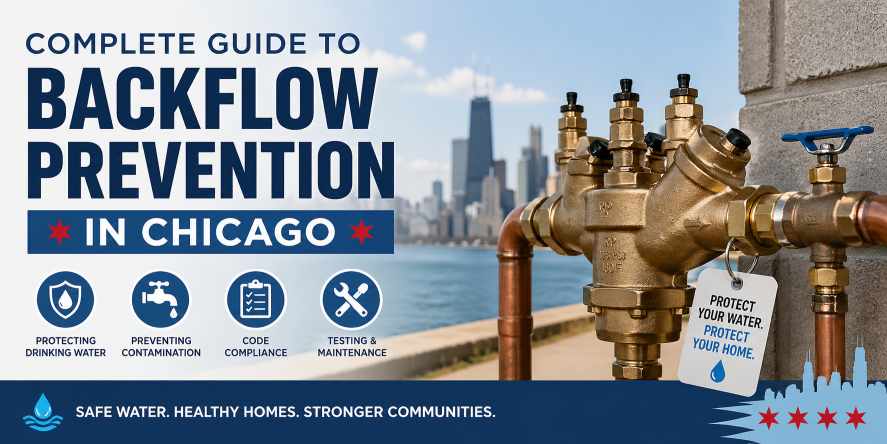
The Law Requires It. Most Homeowners Have Never Heard of It. Here’s Everything You Need to Know About Protecting Your Water Supply.
Most Chicago-area homeowners have never thought about backflow prevention. They know about sump pumps, they’ve heard about backwater valves, and some have dealt with sewer line issues. But backflow — the reversal of water flow that can pull contaminants back into your drinking water supply — is something the State of Illinois takes so seriously it has built an entire regulatory framework around preventing it, including mandatory annual testing requirements for commercial properties and specific installation requirements for residential ones.
If you’ve received a notice from your municipality about a cross-connection survey, if you’re a business owner wondering why you’re required to have a device tested every year, if you have an in-ground irrigation system and aren’t sure whether it’s properly protected, or if you’ve simply never heard of backflow prevention and want to understand what it is and whether your home or property requires it — this is the guide you need.
What Backflow Actually Is — and Why It Matters for Your Water
To understand backflow prevention, you first need to understand what backflow is. Your home’s plumbing delivers fresh water under pressure from the municipal water supply. That pressure — typically 40 to 80 PSI in Chicagoland municipal systems — is what pushes water from the main through your service line, through your pipes, and out of your fixtures when you open a tap.
Backflow is what happens when that pressure relationship reverses. There are two mechanisms by which this occurs:
Back-siphonage happens when pressure in the supply line drops below atmospheric pressure — creating a vacuum effect that pulls water backward, out of whatever vessel or system it was flowing into, and back toward the municipal supply. This can happen when a water main breaks nearby, when fire hydrants are opened for firefighting, when a pump is shut down abruptly, or during any event that creates a sudden drop in municipal water pressure.
Back-pressure happens when downstream pressure exceeds supply pressure — forcing whatever is in a downstream system back toward the water supply. This occurs in systems where pumps, boilers, or other pressurized equipment can create pressure exceeding municipal supply pressure.
Both mechanisms create the same result: water — and whatever is in it — flows backward into the potable water supply instead of forward to the fixture. In a home with a garden hose submerged in a bucket of fertilizer solution, back-siphonage can pull that fertilizer into the municipal water system. In a commercial building with a boiler containing antifreeze, a back-pressure event can introduce antifreeze into the water supply. In a dental office with chemical treatment lines, in a car wash with reclaimed water, in a factory with process fluids — the contamination scenarios are as varied as the buildings connected to the water system.
This is not a theoretical risk. Backflow incidents across Illinois have been serious enough that the Illinois Environmental Protection Agency has continuously increased enforcement of cross-connection control regulations, noting that liability insurance costs for water supplies that don’t enforce stringent programs have risen sharply as a direct result of actual contamination events.
What Illinois Law Requires for Backflow Prevention
The legal framework for backflow prevention in Illinois is more comprehensive than most property owners realize — and it applies to a broader range of properties than most people expect.
At the state level, the Illinois Plumbing Code (77 Ill. Adm. Code 890) establishes device requirements, installation standards, and testing intervals across residential, commercial, and industrial settings. The Illinois EPA administers a cross-connection control program that requires every community public water supply — meaning every municipality with a water system — to maintain an active program for identifying and controlling cross-connections throughout its service area.
As the Illinois EPA’s Cross Connection Control program states directly: industries or facilities installing or possessing backflow prevention devices must have those devices inspected and tested at the time of installation and at least annually thereafter to ensure continued proper operation. Verification of inspection must be submitted to community public water supply officials.
This means that if your property has a backflow prevention device — because your municipality required you to install one, or because you have an irrigation system, a fire suppression system, or any commercial water connection — annual testing by a licensed Cross-Connection Control Device Inspector (CCCDI) is not optional. It is a legal requirement.
For Chicagoland homeowners and businesses, the practical reality is that requirements are administered at the municipal level — each village and city has its own cross-connection control program that implements the state’s requirements. Naperville, for example, has contracted with Backflow Solutions, Inc. to manage its program and sends annual testing reminders directly to property owners with registered devices. The City of Naperville’s Cross Connection Control Program even notes that failure to comply can result in water service disconnection for customers who place the public water supply at risk. Municipalities throughout Cook and DuPage Counties have equivalent programs with similar enforcement mechanisms.
Types of Backflow Prevention Devices: What’s Required When
The Illinois Plumbing Code classifies backflow prevention requirements based on the degree of hazard present at a given cross-connection. Understanding the classification helps you understand why certain properties require more protection than others.
Air Gap (AG) — A physical vertical separation between the water supply outlet and the receiving vessel. No mechanical parts, no failure modes, considered the highest level of protection. Required for high-hazard connections involving toxic chemicals, sewage, or other severe contamination risks. Common in commercial dishwashers and certain industrial applications.
Reduced Pressure Zone Assembly (RPZ) — Contains two independently acting check valves and a differential pressure relief valve. Required for high-hazard commercial and industrial connections — food processing, hospitals, car washes, laboratories, commercial facilities with chemical injection systems, irrigation systems with fertilizer or pesticide injectors, and fire suppression systems with chemical additives. The RPZ is the most protective mechanical assembly available and is required wherever the contamination risk is classified as high hazard.
Double Check Valve Assembly (DCVA) — Two independently acting check valves in series. Required for moderate-hazard applications including standard commercial connections, fire suppression systems without chemical additives, and certain irrigation systems. Less protective than an RPZ but appropriate for lower-hazard situations.
Pressure Vacuum Breaker (PVB) — Protects against back-siphonage only. Standard minimum protection for residential irrigation systems in Illinois where no chemical injection is present. Less expensive than RPZ or DCVA and appropriate for the hazard level typical of a standard residential lawn sprinkler.
Dual Check Valve — The minimum protection required for residential water meters in Illinois. Most homeowners already have this installed as part of their meter assembly without ever knowing it. It prevents back-siphonage at the point where the municipal supply enters the private plumbing system.
Who Needs a Backflow Preventer in Chicagoland
This is the question most property owners want answered directly. Here’s who needs backflow prevention beyond the dual check at the meter — and at what level:
Residential irrigation systems — Any home with an in-ground lawn sprinkler system connected to the potable water supply requires a backflow preventer. In Illinois, a Pressure Vacuum Breaker is the minimum requirement for irrigation systems without chemical injection. If you have a fertilizer injection system connected to your irrigation, you need an RPZ. If your in-ground system does not have a properly installed and tested backflow preventer, your municipality may require you to install one — and failure to do so can result in disconnection of your water service.
Homes with boilers or hydronic heating systems — If your home has a boiler connected to the potable water supply for make-up water, a backflow preventer is required at the connection point. This is common in older Chicago-area homes with hot water radiator systems.
Homes with swimming pools or decorative water features — Any pool or fountain with an automatic fill connection to the potable water supply requires backflow protection at the fill connection.
Commercial properties of all types — Restaurants, retail, office buildings, medical and dental offices, salons, car washes, laundries, food processing, hotels, manufacturing — virtually every commercial property in Illinois has cross-connection hazards that require backflow prevention at the water meter connection and at individual cross-connection points throughout the facility. The hazard classification determines whether a DCVA or RPZ is required.
Multi-unit residential buildings — Apartment buildings and condominiums require backflow prevention at the domestic water meter and often at individual unit connections depending on the plumbing configuration and local requirements.
Fire suppression systems — Any sprinkler system connected to the potable water supply requires backflow prevention. The assembly type depends on whether the system contains additives and what type of fire department connections are present.
Backflow Preventer Installation Cost in Chicago in 2026
Backflow preventer installation cost varies significantly based on the type of assembly required, the application, the location of installation, and whether any additional plumbing work is needed to accommodate the device. Here are realistic 2026 installed costs for the Chicago area:
Residential PVB for irrigation system — $300 to $700 installed. The most common residential backflow installation — a pressure vacuum breaker at the irrigation system connection point. Straightforward installation in an accessible location runs toward the lower end. An installation that requires working in a tight space or modifying existing piping runs higher.
Residential dual check valve upgrade — $150 to $400 installed. If your meter assembly needs a dual check valve upgrade or your existing unit needs replacement, this is a quick and relatively inexpensive installation.
Residential RPZ for irrigation with chemical injection — $800 to $1,800 installed. RPZ assemblies are more complex than PVBs and require more precise installation. They also require annual testing by a licensed CCCDI, which adds $75 to $150 per year in ongoing compliance costs.
Commercial DCVA at meter connection — $1,200 to $3,500 installed depending on the size of the water main, the location of the meter, and the complexity of the installation. Commercial meter connections are typically larger diameter than residential, which increases both device and installation cost.
Commercial RPZ at meter connection — $2,000 to $6,000 installed for most small to mid-size commercial properties. High-flow commercial applications, larger pipe diameters, and difficult access conditions can push costs higher. RPZ assemblies for large commercial or industrial applications can cost significantly more depending on pipe size and installation complexity.
Annual backflow device testing — $75 to $200 per device per year for a licensed CCCDI to test, certify, and submit results to your municipality. This is the ongoing compliance cost for any property with a registered backflow device.
Annual Testing Requirements: What the Process Looks Like
If your property has a backflow prevention assembly — an RPZ, DCVA, or PVB — annual testing is required by Illinois law. Here’s what the testing process involves and what you need to do to stay compliant.
A licensed Cross-Connection Control Device Inspector (CCCDI) — a licensed plumber who has completed additional certification specifically for backflow testing — visits your property and performs a field test of the assembly using calibrated test equipment. The test verifies that each check valve and relief valve in the assembly is functioning within acceptable parameters and that the device will prevent backflow under the conditions it was designed to address.
The entire test typically takes 15 to 30 minutes for a standard residential or small commercial assembly. After the test, the CCCDI submits the results directly to your municipality’s cross-connection control administrator — you don’t need to file anything yourself. You receive a copy of the test results for your records.
If the device fails the test, the CCCDI documents the failure and the device must be repaired or replaced before the next test. A failed backflow device is a code violation — your municipality may require you to address it within a specified timeframe or face enforcement action.
Our team includes licensed CCCDI-certified plumbers who perform backflow testing throughout Chicago and Chicagoland for both residential and commercial properties. Our backflow prevention services cover installation, testing, repair, and replacement for all assembly types across our full service area.
Backflow Prevention vs. Backwater Valve: Understanding the Difference
This is one of the most common points of confusion for Chicago-area homeowners, and it’s worth addressing directly because the two devices protect against completely different things.
A backflow preventer protects your drinking water supply from contamination caused by reverse flow in the water supply system — the clean water coming into your home. It prevents contaminants from being pulled or pushed backward into the municipal potable water system.
A backwater valve (also called a backflow valve or check valve in the flood control context) protects your basement from sewage backup caused by the municipal combined sewer system surcharging during heavy rain. It prevents sewage from flowing backward from the city main into your home through your drain lines.
These devices address completely different problems. A homeowner who needs a backwater valve to prevent basement sewage backup needs a completely different installation than a homeowner who needs a backflow preventer to protect their irrigation system connection. Both may be relevant to the same property — but they are separate devices installed in separate locations for separate purposes.
Our flood control system installation team handles backwater valve installation for basement flood protection. Our backflow prevention team handles water supply cross-connection protection. If you need both — which many Chicagoland properties do — we can assess and address both in the same visit.
What to Do If You Receive a Cross-Connection Notice from Your Municipality
Many Chicagoland homeowners receive a cross-connection survey notice or a backflow testing reminder from their municipality and don’t know what to do with it. Here’s the straightforward answer:
If you receive a cross-connection survey notice, your municipality is conducting its state-mandated survey to identify potential cross-connection hazards on your property. Complete the survey honestly — it typically takes a few minutes and asks about irrigation systems, pools, boilers, and other potential cross-connection sources. If the survey identifies a hazard that requires backflow protection, your municipality will follow up with specific requirements.
If you receive a backflow testing reminder, you have a registered backflow device on your property that is due for its annual test. Contact a licensed CCCDI plumber, schedule the test, and make sure results are submitted to your municipality before the deadline. Ignoring the reminder can result in escalating notices and eventually water service disconnection.
If you’re not sure what you have, what’s required, or whether your property is compliant, call us at 708-801-6530 and we’ll assess your situation and tell you exactly what you need.
Backflow Prevention for Commercial Properties: A Compliance Checklist
For Chicago-area business owners and property managers, backflow prevention compliance involves more than a single device. Here’s what a thorough commercial compliance review should cover:
Domestic water meter connection — Is there a properly sized and tested backflow assembly at the point where the municipal supply enters the building? This is typically required for all commercial properties.
Fire suppression connection — If the building has a sprinkler system, is there a properly sized assembly at the fire system connection? Has it been tested within the past year?
Irrigation system connection — If there’s an in-ground sprinkler system, is the backflow device appropriate for the hazard level and has it been tested?
Individual cross-connection points — Are there any locations within the building where potable water is connected to or in close proximity to non-potable systems? Chemical lines, cooling systems, boilers, process equipment, and any submerged fill connections are common points requiring individual protection.
Testing records — Are annual test records on file for all registered devices? Illinois requires records to be maintained and available for inspection.
Our commercial plumbing services include backflow prevention assessment, installation, testing, and compliance documentation for commercial and industrial properties throughout Chicagoland. For business owners and property managers looking for a broader overview of commercial plumbing systems, maintenance requirements, common issues, and professional solutions, our complete guide to commercial plumbing in Chicago and the suburbs covers everything you need to know about protecting your commercial property.
Frequently Asked Questions: Backflow Prevention in Chicago
Does my home require a backflow preventer?
It depends on what’s connected to your water supply. If you have an in-ground irrigation system, a pool with an automatic fill connection, a boiler with a make-up water connection, or any other system that creates a cross-connection with the potable water supply, a backflow preventer is required at that connection. Your municipality’s cross-connection control program can tell you specifically what’s required for your property. If you’re not sure, we can assess your situation during a service visit.
How much does backflow preventer installation cost in Chicago?
A residential PVB for an irrigation system runs $300 to $700 installed. A residential RPZ for a chemical injection irrigation system runs $800 to $1,800 installed. Commercial DCVA and RPZ assemblies at meter connections run $1,200 to $6,000 or more depending on pipe size and complexity. Annual testing by a licensed CCCDI runs $75 to $200 per device.
Is annual backflow testing really required by law in Illinois?
Yes — for any RPZ, DCVA, or PVB assembly. The Illinois Plumbing Code requires testing at the time of installation and at least annually thereafter. Your municipality administers the program locally and enforces compliance. Failure to test can result in notices, fines, and ultimately water service disconnection for properties that place the public water supply at risk.
What happens if my backflow device fails the annual test?
A failed test means the device is not functioning as designed and is not providing the required protection. The device must be repaired or replaced before it can pass a subsequent test. A failed device is a code violation — your municipality will require you to address it within a specified timeframe. We repair and replace backflow assemblies of all types and can typically schedule service quickly to keep your property in compliance.
Can any plumber test a backflow device in Illinois?
No — backflow device testing in Illinois must be performed by a licensed plumber who also holds a Cross-Connection Control Device Inspector (CCCDI) certification. The CCCDI certification requires specific training and examination beyond the standard plumbing license. When you hire a plumber for backflow testing, verify that they hold both a current Illinois plumbing license and a CCCDI certification before scheduling.
What’s the difference between a backflow preventer and a backwater valve?
A backflow preventer protects your drinking water supply from contamination — it’s installed on the water supply side of your plumbing and prevents reverse flow from contaminating the potable water system. A backwater valve protects your basement from sewage backup — it’s installed in your drain system and prevents sewage from flowing backward from the city sewer into your home during heavy rain events. These are completely different devices solving completely different problems.
Need Backflow Prevention Installation or Annual Testing?
Our licensed CCCDI-certified plumbers install, test, repair, and replace backflow prevention assemblies for residential and commercial properties throughout Chicago and Suburbia. Send us a message and we’ll get back to you fast!
Or call us directly: 708-801-6530 | Open 24/7
—
Suburban Plumbing Sewer Line & Drain Cleaning Experts
Licensed & Insured | Open 24 Hours | Serving Chicago & the Suburbs Since 1978
📞 Suburbs: 708-801-6530
📞 West Suburbs: 630-749-9057
📞 Chicago: 773-570-2191
🚨 24/7 Emergency Line: 708-518-7765