
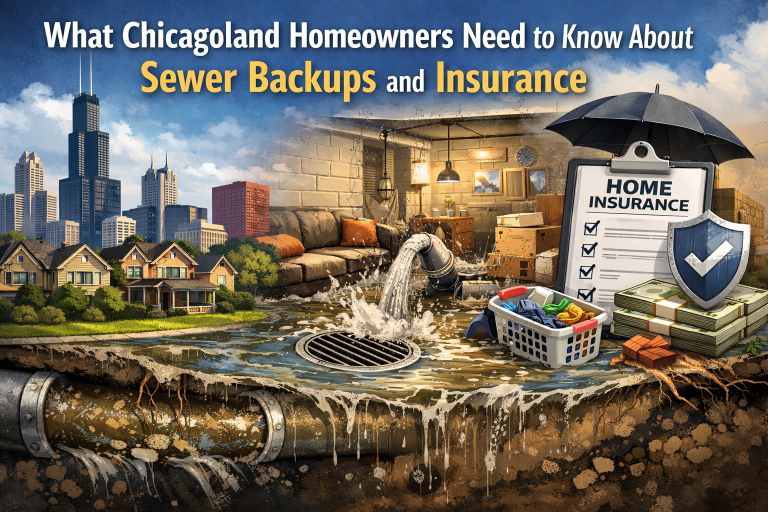
Your Homeowners Policy Probably Won’t Cover It — Here’s What Will, and How to Protect Yourself Before It Happens
You come downstairs on a rainy Saturday morning and step into something cold, dark, and unmistakably sewage. Your basement — finished or not — is backing up. You reach for your phone, call your insurance company, and hear the words nobody wants to hear after a disaster: “I’m sorry, that’s not covered under your standard policy.”
This scenario plays out across Chicagoland every year, and it blindsides homeowners who assumed they were protected. Sewer backups are one of the most common and most expensive plumbing disasters a Chicago-area homeowner can face — and they are specifically excluded from the standard homeowners insurance policy unless you’ve added a separate endorsement. Understanding what’s covered, what isn’t, and what you can do right now to protect yourself can save you tens of thousands of dollars and an enormous amount of heartbreak.
This guide covers everything Chicagoland homeowners need to know about sewer backups and insurance — from why Chicago’s infrastructure makes backups more likely, to exactly what coverage to ask your agent for, to the plumbing steps you can take to dramatically reduce your risk.
Why Sewer Backups Are Especially Common in Chicagoland
Chicago’s sewer system is old. Much of the underground infrastructure serving the city and its older suburbs was built in the early to mid-1900s, and a significant portion uses a combined sewer system — meaning stormwater and sanitary sewage flow through the same pipes. When a heavy rainstorm hits, that combined system can be overwhelmed within hours, pushing sewage backward through lateral lines and into basements across entire neighborhoods simultaneously.
This is not a rare event. Chicagoland homeowners experience basement backups after major storms with enough regularity that the Metropolitan Water Reclamation District of Greater Chicago has invested billions in the Tunnel and Reservoir Plan — commonly called the Deep Tunnel — specifically to address the problem. Despite those improvements, backups remain a persistent reality across Cook County and DuPage County, particularly in older neighborhoods with aging clay or cast iron sewer laterals. Brookfield homeowners have access to a Flood Mitigation Program that reimburses up to 50% of flood control installation costs — read our Brookfield plumbing guide before your next claim.
Beyond storm overload, the other leading cause of backups in Chicagoland is tree root intrusion. Chicago’s established neighborhoods are lined with mature oak, elm, and maple trees whose roots seek moisture aggressively. Once a root finds the smallest joint failure or crack in an aging sewer lateral, it enters and grows — eventually blocking flow entirely and causing a backup that has nothing to do with rain.
The combination of aging infrastructure, combined sewers, heavy rainfall, and mature urban tree canopy makes Chicagoland one of the highest-risk markets in the country for sewer backups. If you own a home here and don’t have specific backup coverage in place, you are exposed.
What Your Standard Homeowners Policy Covers — and What It Doesn’t
Standard homeowners insurance in Illinois covers a wide range of sudden and accidental damage — fire, wind, hail, burst pipes, and certain types of water damage from internal plumbing failures. What it does not cover by default is water or sewage that backs up into your home through a drain, toilet, or floor drain.
According to the Illinois Department of Insurance, standard homeowners policies exclude water damage caused by sewer backup unless specific coverage has been added to the policy. This is not a technicality buried in the fine print — it is a fundamental gap in coverage that affects the majority of Illinois homeowners who have never been specifically told about it.
The distinction insurers make is simple but consequential: water damage from a burst pipe inside your home is generally covered because it originates from your own plumbing system. Water that enters your home from outside — whether from an overwhelmed sewer main, a backed-up drain tile, or a failed sump pump — is treated as a separate peril that requires separate coverage.
Flood damage from rising surface water is yet another separate category, covered only by a standalone flood insurance policy through the National Flood Insurance Program or a private insurer. Your sewer backup endorsement does not cover surface flooding, and your flood policy does not cover sewer backup. These are three distinct types of water damage requiring three distinct types of coverage — and most Chicagoland homeowners have only one. For a broader look at what Illinois homeowners insurance covers across all plumbing emergencies — burst pipes, water heater failures, gradual leaks, and more — read our complete guide: Chicago Plumbing Emergencies — What’s Covered by Insurance and What Isn’t.
The Coverage You Need: Sewer Backup Endorsement
The solution to this gap is a water backup endorsement — sometimes called a sewer backup rider — added to your existing homeowners policy. According to the Illinois Insurance Association, this endorsement specifically covers water damage to your home and personal property from a sewer, drain, or sump pump backup or overflow. It is available from most major insurers and typically costs between $50 and $200 per year depending on your coverage limits and provider.
Here is what the endorsement typically covers: water damage to your home’s structure, damage to personal property and furnishings, cleanup and sanitation costs for sewage contamination, and in some cases temporary living expenses if the backup renders your home uninhabitable. Coverage limits are typically offered in increments from $5,000 up to $25,000 — and given what a serious backup cleanup and restoration can cost, choosing the higher end of available coverage is usually worth the modest premium difference.
Here is what the endorsement typically does not cover: damage caused by gradual leaks or lack of maintenance, damage to the sewer line itself outside your home, or any damage caused by flooding from surface water. Before adding the endorsement, read the exclusions carefully and ask your agent specifically what is and is not covered under the policy language.
If you have a finished basement — a home theater, a home office, guest quarters, or any improved living space below grade — a sewer backup endorsement is not optional. It is essential. A single serious backup event can destroy flooring, drywall, furniture, electronics, and personal belongings in a finished basement easily exceeding $20,000 to $50,000 in damage and remediation costs. The endorsement premium pays for itself many times over in a single claim.
What a Serious Sewer Backup Actually Costs Without Coverage
To understand why this matters, it helps to have concrete numbers. A sewer backup that reaches a finished basement typically involves several cost categories simultaneously.
Emergency plumbing to clear the blockage and stop the flow is the first call — typically $300 to $800 for a rodding or camera inspection, potentially significantly more if a collapsed line or major root intrusion is discovered. Water extraction and emergency drying services from a restoration company run $1,500 to $5,000 depending on the volume of water and the extent of saturation. Sewage cleanup and sanitation — sewage water is classified as Category 3 contaminated “black water” and requires professional remediation — adds another $2,000 to $8,000. Flooring replacement, drywall repair, and structural restoration can add $10,000 to $30,000 or more in a fully finished space. Replace damaged furniture, electronics, and personal property and the total can easily reach $40,000 to $60,000.
Without a backup endorsement, every dollar of that comes out of pocket. With one, your out-of-pocket cost is your deductible.
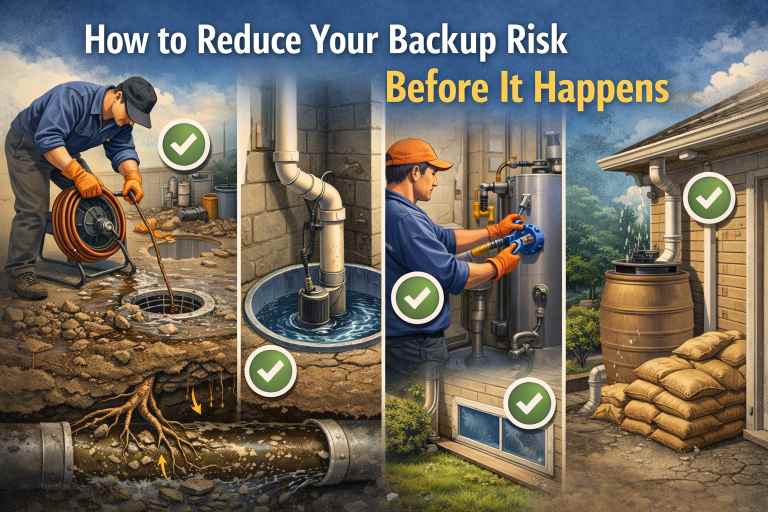
The Plumbing Side: How to Reduce Your Backup Risk Before It Happens
Insurance covers the damage after a backup. The right plumbing investments prevent the backup from happening in the first place — and in Chicago’s environment, that proactive approach is the most cost-effective strategy of all.
Backwater valve installation is the single most impactful flood control measure for Chicago-area homeowners. A backwater valve — also called a backflow prevention valve — installs in your main sewer line in the basement floor and allows flow to exit normally while physically preventing sewage from flowing backward into the home during a backup event. It is a one-way gate that closes automatically when flow reverses. Many municipalities in Chicagoland offer rebate programs for backwater valve installation as part of their flood control initiatives — your village or city hall can tell you if a rebate is available in your area.
Sewer backups don’t always start in the basement floor drain. In some cases, homeowners first notice water rising from a shower drain or the shower itself overflowing when another fixture is used or the main sewer line begins backing up. If you’re seeing that problem, our guide to why your shower is overflowing and what it can tell you about a sewer backup explains the most common causes and what to do before the problem gets worse.
Sewer camera inspection is the best diagnostic tool available for understanding what’s actually happening inside your lateral line. A sewer camera inspection for Chicagoland homeowners runs a high-resolution camera through the line and shows you in real time whether roots are present, whether the pipe has cracks or offset joints, and what the overall condition looks like. If you’ve never had your sewer line inspected and your home is more than 20 years old, you don’t know what’s down there — and what you don’t know can cost you significantly.
Sewer rodding clears blockages before they become backups. Annual or biennial rodding of your main sewer line removes root growth and buildup before it accumulates to the point of causing a full backup. It is one of the most cost-effective preventive maintenance services available for Chicago-area homes and our drain cleaning and sewer rodding services cover the full Chicagoland area.
Sump pump maintenance and backup power is essential for any home with a sump pit. Sump pumps fail most often during the heavy rain events when they are needed most — frequently due to power outages that accompany major storms. A battery backup sump pump system keeps your pit draining even when the power goes out. Have your sump pump tested annually and replace it proactively if it is more than seven to ten years old — don’t wait for it to fail during a storm.
Overhead sewer conversion is the most comprehensive flood control solution available for Chicago-area homes. An overhead sewer system reroutes your home’s drainage above the level of the city main, making it physically impossible for a city sewer backup to enter your home. Our flood control system installation team can assess whether an overhead sewer is the right solution for your property and walk you through the cost and process.
What to Do Immediately After a Sewer Backup
If a backup happens, the actions you take in the first few hours directly affect your ability to file a successful insurance claim and limit the overall damage.
Do not enter standing sewage water without protective gear — Category 3 black water contains dangerous pathogens including E. coli, hepatitis A, and other contaminants that pose serious health risks. Keep children and pets out of the affected area entirely.
Document everything before cleanup begins. Take photographs and video of all affected areas, damaged belongings, water levels, and the point of entry. Your insurance adjuster will need this documentation to process your claim, and once cleanup begins, the evidence is gone.
Call your insurance company immediately. Even if you’re not certain you have backup coverage, report the event as soon as possible. Delays in reporting can complicate claims.
Call a licensed plumber to clear the blockage and assess the cause. You need to stop the source of the problem before restoration work begins, and you need a plumber’s assessment to document what caused the backup for your insurance claim. Call our 24/7 emergency sewer backup team to clear the blockage and assess the cause fast.
Contact a licensed restoration company for water extraction, drying, and sewage remediation. Do not attempt to clean up sewage contamination yourself — it requires professional equipment and protective protocols.
Frequently Asked Questions: Sewer Backups and Insurance in Chicago
Does standard homeowners insurance cover sewer backups in Illinois?
No — not unless you have specifically added a water backup endorsement or rider to your policy. Standard homeowners policies in Illinois exclude sewer and drain backup damage. This is one of the most common and costly coverage gaps Illinois homeowners discover after it’s too late. Call your agent today and ask specifically whether you have backup coverage and at what limit.
How much does a water backup endorsement cost in Illinois?
Most Illinois homeowners can add a water backup endorsement for between $50 and $200 per year depending on the insurer, the coverage limit chosen, and the property. Given that a serious backup event can cost $20,000 to $60,000 or more in a finished basement, the endorsement is one of the highest-value add-ons available on a homeowners policy.
What’s the difference between sewer backup coverage and flood insurance?
They cover completely different types of water damage. Sewer backup coverage applies when water or sewage enters your home through drains, toilets, or a sump pump failure. Flood insurance covers damage from rising surface water — overflowing rivers, storm surge, or rainfall that accumulates on the ground and enters the home. You need both if you want comprehensive water damage protection in Chicagoland.
Can I get a backwater valve rebate in my Chicago suburb?
Many Chicagoland municipalities offer rebate programs for backwater valve installation as part of flood control initiatives. Programs vary significantly by municipality — some cover 50% of installation costs, others offer flat dollar amounts. Contact your village hall or city public works department directly to find out what’s available in your area.
How often should I have my sewer line rodded to prevent backups?
For most Chicago-area homes, annual or every-other-year rodding is a smart preventive schedule — especially if you have mature trees near your sewer lateral or a history of slow drains. Older homes with clay tile sewer lines benefit most from consistent maintenance. A sewer camera inspection every three to five years gives you a clear picture of what’s developing underground before it becomes an emergency.
How quickly can you respond to a sewer backup emergency?
We offer 24/7 emergency response across Chicago and the surrounding suburbs. If you have a backup in progress, call our emergency line at 708-518-7765 and we’ll get a plumber to you as fast as possible. The sooner the blockage is cleared and the source is identified, the less total damage you face.
Had a Backup? Worried About One? We Can Help.
Whether you need emergency help right now or want a sewer camera inspection before the next big storm, our licensed team is ready across all of Chicagoland — 24 hours a day.
For emergencies call: 708-518-7765 | Open 24/7
Suburban Plumbing Sewer Line & Drain Cleaning Experts
Licensed & Insured | Open 24 Hours | Serving Chicago & the Suburbs Since 1978
📞 Suburbs: 708-801-6530 📞 West Suburbs: 630-749-9057 📞 Chicago: 773-570-2191 🚨 24/7 Emergency Line: 708-518-7765