
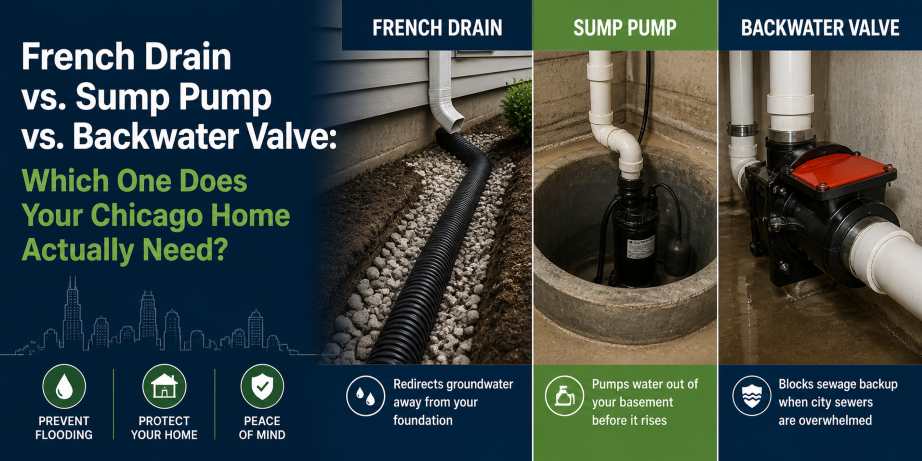
The Complete Guide for Chicagoland Homeowners Dealing With Wet Yards, Flooded Basements, and Water That Won’t Go Away
Water in the wrong place is one of the most common and most expensive problems Chicago and suburban homeowners face. A yard that holds water for days after rain. A basement that seeps every spring. A floor drain that backs up during storms. A window well that fills up like a fishbowl.
Every one of those problems has a solution — but they’re not all the same solution. And the single most costly mistake Chicagoland homeowners make when dealing with water problems is installing the wrong fix for the wrong problem. A sump pump won’t solve a yard drainage problem. A French drain won’t stop a sewer surcharge backup. A backwater valve won’t help if your basement is taking on groundwater through the walls.
Understanding which solution addresses which problem — and what happens when you combine them — is the difference between spending money once on the right fix and spending money repeatedly on fixes that don’t work. For a deeper breakdown of which basement waterproofing and flood prevention methods truly perform during Chicago storms — and which ones homeowners often waste money on — read our guide to Chicago flood control systems that actually work — and ones that don’t.
This guide breaks down all three systems completely: what each one does, what problem it actually solves, what it costs in the Chicago market in 2026, and how to diagnose which one your specific situation requires. By the end you’ll know exactly what to ask for and why — and you’ll be able to evaluate any contractor’s recommendation with confidence.
The Core Problem: Chicago Has Three Distinct Water Problems, and Most Homeowners Think They Have One
Before comparing solutions, you need to understand that “water in my yard” and “water in my basement” are not the same problem, and “water in my basement” itself breaks down into at least two completely different problems with completely different causes.
Problem Type 1: Surface and Yard Drainage Water that pools in your yard, runs toward your foundation, collects in low spots, drowns landscaping, or turns your lawn into a swamp after every significant rain. This is a surface drainage problem caused by grade, soil composition, and the inability of your yard to absorb or redirect water fast enough.
Problem Type 2: Groundwater Intrusion Water that enters your basement through the walls, through the floor slab, or up through the sump pit — pushed by hydrostatic pressure from saturated soil surrounding your foundation. This is a subsurface groundwater problem caused by a rising water table, poor perimeter drainage, or foundation wall failures.
Problem Type 3: Sewer Surcharge Backup Water — typically carrying sewage — that enters your basement through the floor drain, basement toilet, or any below-grade plumbing fixture during or after heavy rain. This is not groundwater at all. It’s the city’s combined sewer system backing up under pressure through your own drain lines.
Why this matters: Each of these three problems requires a fundamentally different solution. A French drain addresses Problems 1 and sometimes 2. A sump pump addresses Problem 2. A backwater valve addresses Problem 3. None of them cross over. Installing a sump pump when your problem is a sewer surcharge backup will accomplish nothing. Installing a French drain when your problem is groundwater intrusion through the foundation walls will not stop the water. Getting the diagnosis right before spending any money is the most important step in the entire process.
What a French Drain Actually Is — and What It Solves
How It Works
Our French drain installation service addresses one of the most common but least understood water problems in Chicagoland — subsurface drainage that intercepts and redirects water before it reaches your foundation or pools in your yard. At its core, a French drain is a trench filled with gravel and a perforated pipe wrapped in filter fabric, buried at a slope that directs collected water away from the problem area toward a discharge point — a storm drain, a dry well, a swale, or the street.
Water enters the system in two ways: it percolates down through the gravel from above (intercepting surface runoff), and it flows into the perforated pipe through the holes from the sides (intercepting subsurface groundwater moving laterally through the soil). The system works entirely by gravity — no pump, no electricity, no moving parts.
A French drain installed around the perimeter of your foundation — sometimes called a curtain drain or footer drain — intercepts groundwater before it builds hydrostatic pressure against your foundation walls. A French drain installed in the yard intercepts surface runoff and shallow groundwater before it pools.
What Problem It Solves
French drains are the right solution when:
- Your yard holds standing water for 24+ hours after rain in specific low spots or throughout the lawn
- Water flows toward your foundation during or after rain events
- Your window wells fill with water during rain
- Your basement experiences seepage through the walls at or near grade level — particularly in a block or brick foundation — that correlates with rain events rather than just high water table
- You have a specific drainage problem caused by grade — a neighbor’s yard drains onto yours, a downspout discharges near the foundation, or your lot has a low point that collects water
French drains are NOT the right solution for:
- Sewer surcharge backup (water coming up through floor drains with a sewage odor)
- Deep groundwater intrusion through a slab floor driven by a high water table
- Basement flooding caused by a failed or absent sump pump system
What It Costs in Chicago in 2026
French drain installation cost varies significantly based on the length of the system, depth required, discharge point, and whether excavation is in an open yard or tight against a foundation.
Simple yard French drain (20–50 linear feet, open yard, easy access): $1,500 to $4,000. Addresses pooling in a specific yard area or along a property boundary.
Perimeter foundation French drain (around partial or full foundation): $3,000 to $8,000+. More complex installation requiring careful excavation along the foundation, proper depth to intercept footer-level water, and appropriate discharge routing.
Full exterior foundation waterproofing with French drain: $8,000 to $20,000+. Complete exterior excavation down to the footer, waterproofing membrane on the foundation wall, drain tile installation, and backfill. The most comprehensive exterior drainage solution — and the most disruptive.
Interior perimeter drain system (alternative to exterior French drain): $4,000 to $10,000. Installed inside the basement perimeter by cutting the concrete floor, installing drain tile, and connecting to a sump pit. Less disruptive than exterior excavation, appropriate when exterior access is difficult.
What a Sump Pump Actually Is — and What It Solves
How It Works
A sump pump is a mechanical device installed in a pit — the sump basin — at the lowest point of your basement floor. The basin collects groundwater that accumulates beneath the slab through perimeter drain tile or through natural hydrostatic seepage. When the water level in the basin rises to trigger the float switch, the pump activates and pushes the collected water up through a discharge line, out of the home, and away from the foundation.
A sump pump has one job and does it well: removing groundwater that accumulates in the basin. It has no connection to your sewer lines, your floor drain, or the city’s sewer system. It is entirely isolated in its pit, collecting and removing groundwater only.
What Problem It Solves
A sump pump is the right solution when:
- Groundwater accumulates in the sump basin during rain or snow melt and the pit fills faster than water can drain naturally
- Your basement experiences seepage through the floor slab driven by a high water table — the water table rises during rain and pushes water up through the slab
- You have perimeter drain tile (interior or exterior French drain) that collects water and routes it to a pit — the sump pump is what removes that collected water from the pit
- You’ve had basement flooding caused by groundwater accumulation rather than sewer backup
A sump pump is NOT the right solution for:
- Sewer surcharge backup — the pump has zero connection to your drain lines and cannot stop water coming up through the floor drain
- Surface yard drainage — water pooling in the yard is not reaching the sump basin
- Foundation wall seepage at above-grade levels — that water needs to be intercepted before it reaches the wall
The Battery Backup Issue — Critical in Chicago
Chicago’s worst flooding events almost always coincide with power outages. The exact storms that cause the most severe groundwater accumulation — the events where you need your sump pump most — are the events most likely to knock out power. A sump pump without battery backup is a pump that will fail you at the worst possible moment.
A battery backup sump pump system — either a dedicated battery backup unit installed alongside the primary pump, or a combination primary/backup unit — is not optional for Chicago homeowners who depend on their sump pump for basement protection. The additional cost of $300 to $800 installed is among the most cost-effective investments in flood protection available.
What It Costs in Chicago in 2026
Standard sump pump replacement (submersible, existing pit): $400 to $900 installed. Includes pump, float switch, and check valve.
Sump pump with battery backup system: $700 to $1,500 installed. Strongly recommended for all Chicago-area installations.
New sump pit and pump installation (no existing pit): $1,200 to $2,500. Includes cutting the concrete floor, excavating the pit, installing the basin, pump, and discharge line, and restoring the concrete.
Combination primary and battery backup unit: $1,000 to $2,000 installed. The most comprehensive single-unit solution.
For a complete breakdown of sump pump types, failure warning signs, and what replacement costs in 2026, see our sump pump services guide. If your home also has a basement bathroom or laundry room, you likely need an ejector pump alongside your sump pump. Our complete guide to sump pumps vs ejector pumps in Chicago explains the difference and when your home needs both.
What a Backwater Valve Actually Is — and What It Solves
How It Works
A backwater valve — also called a check valve or backflow preventer — is installed directly in your main sewer lateral in the basement floor. It functions as a one-way gate: waste flows out normally when you flush or drain, but when pressure reverses from the city’s sewer system during a surcharge event, the valve’s flap seals shut automatically, physically blocking the sewage backup from entering your home through your own drain lines.
The backwater valve addresses Problem Type 3 entirely — the sewer surcharge backup that enters your home not as groundwater but as city sewage traveling backward through your lateral under pressure.
Why Chicago Needs This More Than Almost Anywhere
Chicago and most of its inner-ring suburbs operate on a combined sewer system — the same underground network carries both stormwater runoff and sanitary sewage. Under normal conditions this works fine. But when a significant storm drops two or three inches of rain in an hour, the combined system fills beyond capacity, pressure builds in the mains, and that pressure travels backward through every lateral connected to the main — including yours.
The result is sewage coming up through your floor drain, basement toilet, or any below-grade fixture. The Metropolitan Water Reclamation District’s Understanding Your Sewer guide explains exactly how Chicago’s combined system works and why heavy rain events cause basement backups even when everything in your home’s plumbing is functioning normally. It smells. It’s a health hazard. And your sump pump, running perfectly in its pit, cannot do a single thing to stop it because the water isn’t going through the pit — it’s coming through your drain lines from the city side.
This is the most common and most misunderstood flooding scenario in Chicago. For a complete explanation of how this works and why a sump pump can’t stop it, see our guide on why your sump pump can’t stop a sewer backup.
What Problem It Solves
A backwater valve is the right solution when:
- Water enters your basement through the floor drain, basement toilet, or basement sink during or after heavy rain
- The water has a sewage odor
- The flooding happens fast, during peak storm intensity, rather than gradually over hours
- Neighbors on your block have experienced the same issue
- Your home is in Chicago or an inner-ring suburb on a combined sewer system
A backwater valve is NOT the right solution for:
- Groundwater seeping through foundation walls (that’s a French drain or sump pump problem)
- Yard drainage and pooling (that’s a French drain problem)
- General basement flooding from any source other than sewer surcharge
One Important Limitation
When the backwater valve seals shut during a surcharge event, it blocks flow in both directions — meaning you cannot use your basement plumbing while the valve is engaged. If you have a basement bathroom, laundry, or any below-grade fixtures, you’ll need an ejector pump installed alongside the backwater valve to handle wastewater from those fixtures during a surcharge event. The ejector pump collects wastewater from basement fixtures and pumps it up above the valve’s closure point, allowing normal use of basement plumbing even when the valve is sealed against the city’s surge.
What It Costs in Chicago in 2026
Backwater valve installation (main lateral, accessible location): $2,500 to $5,500 installed. Permits required — we handle all permitting as part of every installation.
Backwater valve plus ejector pump (complete flood control system): $6,000 to $12,000 installed. The appropriate solution for homes with basement plumbing.
Overhead sewer conversion (permanent alternative, no valve required): $12,000 to $30,000. Reroutes all basement drain lines above the surcharge level, making backup physically impossible regardless of city sewer conditions. See our overhead sewer services for a full breakdown of how this works and when it makes sense.
For a complete breakdown of what Illinois law requires for backflow prevention and what rebate programs are available in the Chicago suburbs, see our Complete Guide to Backflow Prevention in Chicago.
How to Diagnose Which Problem — and Which Solution — You Actually Have
Use this framework before calling anyone or spending any money:
Step 1: Where Is the Water Coming From?
Water pooling in your yard, not reaching the basement: French drain. The problem is surface drainage and you need to intercept and redirect water before it becomes a foundation problem.
Water seeping through basement walls, especially at or near grade: French drain (exterior perimeter) or interior drain tile system. The problem is lateral groundwater movement against your foundation.
Water coming up through the slab or accumulating in the sump pit: Sump pump. The problem is a rising water table pushing water up from below.
Water coming up through the floor drain, basement toilet, or basement sink with a sewage odor: Backwater valve. The problem is sewer surcharge backup from the city’s combined sewer system. In many Chicagoland homes, especially older neighborhoods, one of the most common underlying causes of sewer line issues is tree root intrusion. Once roots enter a cracked or aging lateral, they can quickly restrict flow and contribute to recurring backups during storms.
Water coming through multiple sources simultaneously: You may need more than one solution — see the combination section below.
Step 2: When Does It Happen?
During or immediately after heavy rain, especially during peak storm intensity: Strong indicator of sewer surcharge backup. The city’s system surcharges during intense events.
After sustained rain over many hours, or during spring snowmelt: More likely groundwater accumulation — sump pump territory.
In specific yard areas regardless of rain intensity: French drain territory — grade and soil drainage issue.
Consistently when the ground is saturated, even without recent rain: High water table — sump pump and possibly perimeter drainage.
Step 3: What Does It Smell Like?
This is the single fastest diagnostic test. Odorless water is groundwater. Water with a sewage odor is sewer backup. There is no gray area here — if it smells, it came from the sewer system, and the solution is a backwater valve, not a sump pump or French drain.
When You Need More Than One Solution — The Complete Protection Strategy
Many Chicago and suburban homes need a combination of solutions because they face more than one type of water problem simultaneously. This is especially common in older homes where:
- The yard has drainage problems that send surface water toward the foundation
- The foundation has no perimeter drainage and groundwater intrudes through the walls and slab
- The home sits on Chicago’s combined sewer system and is vulnerable to surcharge backup
A fully protected Chicago home in this situation might have all of the following:
French drain in the yard to intercept surface runoff and keep it away from the foundation → addresses yard pooling and reduces hydrostatic pressure on the walls
Interior perimeter drain tile along the foundation perimeter routing to a sump pit → intercepts any remaining groundwater that reaches the foundation
Sump pump with battery backup removing water collected by the drain tile → addresses groundwater accumulation and ensures protection during power outages
Backwater valve in the main sewer lateral → addresses sewer surcharge backup from the city system
This combination sounds like a lot — but each component is solving a different problem, and a home with all four is protected against every type of water intrusion that affects Chicago properties. The total investment for a complete system typically runs $8,000 to $18,000 depending on existing infrastructure, lot conditions, and whether any components are already in place. If you’ve already experienced basement flooding and need help assessing what type of intrusion you’re dealing with, our basement flooding services team can assess your specific situation and recommend exactly what your property needs.
The good news: most Chicago homes don’t need all four. Many need only one or two. A proper site assessment before any installation tells you exactly what your specific property requires — and what it doesn’t.
Chicago-Specific Factors That Affect Your Decision
Clay soil throughout much of Chicagoland drains poorly, which means surface water sits longer, lateral groundwater movement is slow but persistent, and hydrostatic pressure on foundations builds faster than in sandy or loamy soils. The University of Illinois Extension’s landscape drainage guide covers how clay soil affects drainage system design and why surface grade is often the first problem to address before any underground system goes in. French drains in clay soil require proper gravel selection and filter fabric to prevent clogging — a common failure point in improperly installed systems.
The combined sewer system in Chicago and inner-ring suburbs means sewer surcharge backup is a genuine and recurring risk, not a theoretical one. The August 2025 flooding events demonstrated this clearly across tens of thousands of homes. If you’re in a combined sewer municipality and don’t have a backwater valve, you’re unprotected against the most common flooding event in the region.
Flat topography across much of Chicagoland means yards don’t drain by grade naturally the way properties in hillier regions do. French drain discharge points need to be carefully selected — the water has to go somewhere, and in flat suburban lots, that requires deliberate design.
Mature tree canopy in Chicago’s older suburbs means tree roots are a constant threat to French drain perforated pipe — root infiltration over time can clog a French drain system that wasn’t installed with root-resistant pipe and proper filter fabric. Installation quality matters enormously.
Municipal rebate programs exist in many Chicagoland suburbs for backwater valve installation specifically — Elmwood Park, Berwyn, Oak Park, and others offer significant reimbursement. Always check with your village hall before signing any flood control contract. Some programs reimburse $2,000 to $4,000 or more.
Frequently Asked Questions
Can I install a French drain myself? A simple shallow French drain in an open yard area is within DIY range for a capable homeowner — the concept is straightforward. However, a perimeter foundation French drain requires proper depth (to the footer level), correct slope, appropriate gravel and filter fabric selection, and a properly located discharge point. Errors in any of these elements result in a system that doesn’t work or that clogs within a few years. For foundation-level drainage work, professional installation is strongly recommended.
My basement floods but only at the floor drain. Is that a sump pump problem? No — water coming up through the floor drain is almost always a sewer surcharge backup, not a groundwater problem. The floor drain connects to your sewer lateral, not to your sump pit. A sump pump cannot stop water that’s traveling backward through your sewer lines. What you need is a backwater valve.
I have a sump pump but my basement still floods. Why? Two most common reasons: either the flooding is a sewer surcharge backup that the sump pump isn’t designed to address, or the pump failed — most likely due to a power outage during the storm that caused the flooding. Both situations are common in Chicago. Diagnosing which one requires looking at where the water entered and whether it had a sewage odor.
Does a French drain require maintenance? Yes. French drains can clog over time with sediment, clay migration, and root infiltration — particularly in Chicago’s clay soil environment. A properly installed system with quality filter fabric and root-resistant pipe minimizes maintenance needs, but periodic inspection and occasional flushing every five to ten years is advisable. Signs of a clogged French drain include the drainage problem returning in areas that were previously resolved.
How long does French drain installation take? A simple yard French drain typically takes one to two days. A perimeter foundation installation is more involved — two to four days depending on the length of the system and excavation complexity. Interior perimeter drain tile installation, which requires cutting the concrete floor around the basement perimeter, typically runs two to three days for an average basement.
What’s the difference between a French drain and a catch basin? A catch basin is a surface-level collection point — essentially an inlet grate set in the ground that collects surface runoff and routes it to an underground pipe or sewer connection. A French drain is a subsurface system that collects both surface percolation and lateral groundwater through perforated pipe in gravel. They’re sometimes used together — a catch basin collecting surface runoff that then connects to a French drain system for distribution and discharge.
Will a backwater valve affect my plumbing during normal conditions? No. The valve’s flap stays open during normal operation, allowing waste to flow out of your home exactly as it always has. The valve only closes when pressure reverses from the city side — which happens during surcharge events. You won’t notice it’s there under normal conditions.
My neighbor installed a French drain and it seems to be sending water toward my property. What can I do? Unfortunately this is a common dispute in flat suburban neighborhoods. A French drain that discharges toward a neighboring property rather than to a proper outlet is poorly designed and potentially a nuisance issue. If you’re experiencing increased water on your property that correlates with a neighbor’s drainage work, document it with photos and dates and consult with your municipality — most have drainage ordinances that address this. A site assessment by a licensed drainage contractor can also help establish what’s happening.
Communities We Serve
We serve the full Chicagoland area for all three types of water protection — yard drainage, groundwater, and sewer backup — including Chicago, Berwyn, Cicero, Oak Park, River Forest, Brookfield, LaGrange, Hinsdale, Downers Grove, Elmhurst, Lombard, Naperville, Westmont, Clarendon Hills, Burr Ridge, Darien, Willowbrook, Woodridge, Bolingbrook, Lemont, Homer Glen, and all surrounding Cook, DuPage, and Will County communities.
Not sure which solution your property needs? A site assessment costs nothing and gives you the information to make the right decision before spending a dollar on installation.
Not Sure Which Solution Your Home Needs? Let’s Figure It Out Together.
Licensed, insured, and locally based in Brookfield since 1978. We assess your yard, your basement, and your drainage situation and tell you exactly what’s causing the problem — and what will actually fix it. Written quotes before we start, permits pulled on every job that requires them, and our own licensed employees on every call. Send us a message and we’ll get back to you fast.
Or call us directly: 708-801-6530 | Open 24/7
—
Suburban Plumbing Sewer Line & Drain Cleaning Experts
Licensed & Insured | Open 24 Hours | Serving Chicago & the Suburbs Since 1978
📞 Suburbs: 708-801-6530 | 📞 Chicago: 773-570-2191 | 🚨 Emergency: 708-518-7765