What Illinois Law Requires, What the RLTO Demands, and What Every Chicago-Area Rental Property Owner Should Be Checking Right Now
If you own or manage rental property in Chicago or the surrounding suburbs, your plumbing obligations to your tenants are more specific — and more legally consequential — than most landlords fully understand. The Chicago Residential Landlord and Tenant Ordinance doesn’t just suggest that landlords maintain working plumbing. It classifies plumbing as an essential service, sets specific timelines for repair, gives tenants meaningful remedies when those timelines aren’t met, and exposes landlords to rent withholding, damage claims, and attorney’s fee liability when they fall short.
Plumbing failures are also among the most common and most costly maintenance issues in Chicago’s rental housing stock — because most of that stock is old. A two-flat in Logan Square, a six-unit in Berwyn, a three-story in Oak Park, a mixed-use building in Cicero — the pipes beneath and within these properties have been in service for 50 to 100 years. They fail on schedules that have nothing to do with your lease cycle and no respect for tenant move-ins. The landlords who stay ahead of those failures are the ones who avoid the emergency calls, the tenant complaints, and the city violation notices.
This checklist is built for Chicago-area landlords and property managers who want to understand exactly what they’re legally required to maintain, what proactive inspections should cover, and when to call a licensed plumber before a problem becomes a crisis.
What Illinois Law and the Chicago RLTO Require for Plumbing
The legal framework for plumbing maintenance in Chicago rental properties is worth understanding clearly before we get into the checklist — because it establishes why regular plumbing inspection isn’t optional, it’s necessary.
Under the Chicago Residential Landlord and Tenant Ordinance, plumbing is classified as an “essential service” — the same category as heat, hot water, electricity, and gas. Landlords are required to provide and maintain essential services at all times. When plumbing fails as a result of a condition within the landlord’s control, the ordinance gives tenants four significant remedies:
Restore and deduct — the tenant can pay to have the plumbing restored and deduct the cost from rent, keeping receipts.
Rent reduction — the tenant can stay in the unit and withhold from rent an amount reflecting the reduced value of the unit while plumbing is non-functional.
Substitute housing — the tenant can obtain substitute housing and be excused from paying rent for the period they cannot occupy the unit.
Rent withholding — the tenant can request that the landlord correct the failure within 24 hours and, if the landlord fails to do so, withhold a portion of the monthly rent.
The RLTO also requires landlords to restore hot water within 24 hours of being notified of a hot water failure — one of the shortest repair timelines in the ordinance. For a clearer breakdown of how responsibility is divided between property owners, landlords, and tenants when plumbing issues arise, see our guide on plumbing responsibilities for renters vs landlords. Under Illinois Legal Aid Online’s guidance on rental repair rights, private landlords generally have 14 days after receiving written notice to fix most non-emergency repair issues — but emergency plumbing failures can be acted on by tenants immediately.
For landlords in suburban Cook County, the Cook County Residential Tenant Landlord Ordinance applies similar requirements. DuPage County municipalities vary — but Illinois state law provides baseline habitability requirements that apply statewide regardless of local ordinance coverage.
The practical takeaway: a plumbing failure in your rental property is not a maintenance inconvenience. It is a legal event with a timeline, tenant remedies, and potential financial consequences. The way to manage that risk is prevention — which means regular inspection and proactive maintenance on a schedule that keeps problems from becoming tenant-notice events.
The Annual Plumbing Inspection Checklist for Chicago Rental Properties
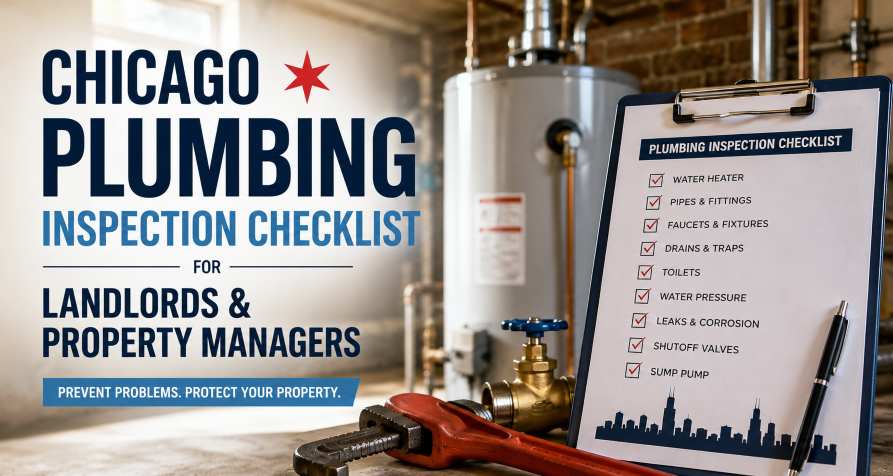
This checklist is organized by system and should be completed at minimum annually — at tenant turnover and ideally once more mid-tenancy on longer-term leases. Document everything. Photographs and written records are your protection in any dispute.
Water Supply System
Main shutoff valve — verify it operates fully and seats completely. A shutoff valve that doesn’t close all the way in an emergency is worse than useless. Test it annually and replace any valve that sticks, corrodes, or doesn’t seat cleanly. In Chicago’s older two-flats and three-flats, main shutoff valves are frequently the original gate valves — a valve type known for failure after decades of inactivity. Ball valves are the current standard and are far more reliable.
Water pressure — check pressure at multiple fixtures. Consistent low pressure throughout the building indicates a supply line issue, heavy mineral buildup in galvanized pipes, or a partially closed main. High pressure — above 80 PSI — stresses pipe joints, accelerates fixture wear, and increases the risk of sudden failures. A pressure-reducing valve is the appropriate response to consistently high pressure.
Supply lines at fixtures — check braided supply lines under sinks and behind toilets for corrosion, kinking, or deterioration at the connection points. These lines have a finite lifespan and fail suddenly when they go — releasing the full flow of the water supply into the cabinet below. Replace any line showing visible corrosion or that is more than 10 years old proactively.
Visible piping in mechanical rooms and basements — look for active drips, staining on pipe insulation, mineral deposit buildup at joints, and any sign of past repairs that may be holding temporarily. In older Chicago buildings, galvanized steel supply lines that have been in service for 50+ years are often narrowed internally to a fraction of their original diameter from mineral buildup — and periodically fail at fittings.
Exterior hose bibs — verify each bib opens and closes fully, check for drips at the body and at the pipe behind the wall in the basement or utility room, and confirm the interior shutoff is accessible and functional.
Hot Water System
Water heater age and condition — the single most important water heater fact for Chicago landlords: a failed water heater requires hot water restoration within 24 hours under the RLTO. That means you need either an immediately available replacement or a service provider who can respond same-day. In Chicago’s hard water environment, tank water heaters have a realistic lifespan of 8 to 12 years. If a unit in your building is approaching 10 years old, proactive replacement on your schedule is dramatically preferable to emergency replacement after a tenant complaint.
Check the unit’s serial number — the manufacture date is typically encoded in the first four digits. If the unit is more than 8 years old in a hard water environment, assess it. If it’s showing rust-colored hot water, making rumbling or popping sounds during heating, or has visible corrosion at fittings, replace it before it fails.
Anode rod condition — the sacrificial anode rod inside a tank water heater is the primary defense against interior corrosion. In Chicago’s hard water environment, anode rods deplete faster than in softer water markets. Annual inspection and replacement when depleted extends tank life meaningfully and is one of the most cost-effective maintenance items for a rental property water heater.
Temperature and pressure relief valve — test the T&P valve annually by briefly lifting the lever. It should release and reseat cleanly. A T&P valve that doesn’t open, doesn’t close, or weeps continuously is a safety issue that needs immediate attention.
Venting — check flue connections on gas water heaters for corrosion, separation, or improper slope. Blocked or deteriorated flue venting creates carbon monoxide risk. Our water heater services include assessment and replacement for all unit types across the Chicago area.
Drain and Sewer System
This is the highest-risk category for Chicago rental properties — and the most commonly under inspected. Here’s why: the drain and sewer system in a Chicago two-flat or multi-unit building is typically original clay tile and cast iron that has been in service for 50 to 100 years. It doesn’t announce its deterioration. It functions — slowly, increasingly, with occasional backups that the tenant attributes to what they flushed — until it doesn’t. And when it fails in a multi-unit building, it typically fails in a way that affects multiple units simultaneously.
Main sewer lateral camera inspection — every multi-unit rental property should have a sewer camera inspection of the main lateral every 3 to 5 years, and immediately upon purchase of an older building. The camera shows root intrusion, pipe belly, offset joints, structural damage, and the overall condition of the line from the building to the city main. This is the only reliable way to know what’s in the pipe before a backup forces the issue. Our sewer camera inspection service is available throughout Chicago and Chicagoland.
Floor drain trap seals in basements and utility areas — floor drains with dry traps allow sewer gas into the building. In a rental property, that means tenant exposure to hydrogen sulfide and other sewage gases. Check every basement floor drain by running water into it to confirm the trap is sealed. Infrequently used drains dry out — pour a gallon of water monthly to maintain the seal.
Drain performance throughout the building — run every fixture in each unit during turnover and observe drain speed. Slow drains at a single fixture are typically localized clogs. Slow drains throughout a unit, or gurgling at floor drains when fixtures are used, indicates a shared line restriction or main lateral issue that needs professional attention.
Ejector pump systems — if any unit in your building has below-grade plumbing — basement bathrooms, basement laundry — there’s an ejector pump handling that waste. Ejector pump failure means sewage backup into the basement. Inspect and test ejector pumps annually, replace any unit approaching 10 years old, and verify the pit seal is intact and sewage odors are not entering the building through a failed cover. Our ejector pump services cover inspection, repair, and replacement throughout the Chicago area.
Sump pump systems — test sump pumps at every inspection by pouring water into the pit. Verify the float switch triggers promptly, the pump runs cleanly, and the discharge line directs water away from the foundation. Battery backup systems are strongly recommended for rental properties — the pump failure during a power outage during a storm is a scenario you cannot afford to have play out in a building with tenants.
Catch basins — if your property has exterior catch basins — in the driveway, backyard, or parking lot — inspect them for structural integrity and clean the sump annually. A structurally failing catch basin creates a sinkhole liability. Our catch basin repair and rebuilding services cover the full Chicago area.
Fixture Condition
Toilets — check every toilet for running, for a properly seating flapper, for adequate water pressure from the fill valve, and for secure mounting to the floor. A running toilet can waste 6,000 to 12,000 gallons per month — and in a building where water is included in rent, that’s your cost. A toilet that rocks on its mount is a wax seal failure waiting to happen, with water damage below.
Faucets and showerheads — check for drips at the spout and at the base. A dripping faucet in a rental unit costs money and, under the RLTO, can be the basis for a repair request if it’s the result of a defective fixture rather than normal wear. Replace washers and cartridges proactively at turnover.
Garbage disposals — test each one. A disposal that leaks at the sink flange or at the discharge connection creates moisture damage inside the cabinet. Replace leaking disposals — don’t seal around them with caulk as a temporary fix. In some rental units or older kitchens, landlords and property owners may also choose to permanently remove a garbage disposal entirely and convert back to a standard drain setup. Here’s a step-by-step guide explaining how that process works safely and correctly.
Bathroom caulking and grout — failed caulking and grout at tub surrounds and shower enclosures allows water to infiltrate behind the tile and into the subfloor and wall framing. Water damage from a failed shower surround is one of the most expensive tenant-related repair categories in Chicago rental properties. Inspect and regrout or recaulk at every turnover.
Lead Service Lines in Chicago Rental Properties
This is a compliance issue that specifically affects landlords in Chicago and many inner-ring suburbs — and one that carries both health and legal implications.
Chicago has more lead water service lines than any other city in the country, and the city’s service line replacement program is actively working through tens of thousands of properties. Many rental properties — particularly in neighborhoods with older housing stock — still have lead service lines delivering water from the city main to the building.
As a landlord, you have disclosure obligations and a potential duty to act when you know or should know your building has a lead service line. Tenant exposure to lead from water is a serious health issue — particularly for children and pregnant women. If you manage a building in Chicago built before 1986, contact the Chicago Department of Water Management about your property’s service line status and understand your obligations. Our lead service line replacement team handles the full replacement process and can assess your building’s situation.
Flood Control and Basement Protection for Multi-Unit Buildings
Basement flooding in a Chicago multi-unit building is a landlord’s worst-case plumbing scenario. You potentially have tenant property, finished living space, and mechanical equipment all at risk simultaneously — and insurance may not cover all of it without a water backup endorsement.
A backwater valve is the minimum flood control protection for any Chicago multi-unit building that has experienced basement backups during heavy rain. An overhead sewer conversion is the most comprehensive protection. At minimum, every basement floor drain in a rental building should be protected by a properly functioning trap — a dry trap is an open invitation for sewage to back up into the building.
Our flood control services cover backwater valve installation, overhead sewer conversion, sump pump installation, and comprehensive flood control assessment for residential and commercial rental properties throughout Chicagoland.
Building a Proactive Maintenance Schedule
The most cost-effective plumbing maintenance program for a Chicago rental property is one that runs on a schedule — not one that responds to tenant complaints and building emergencies. Landlords who are new to rental property ownership or who want a broader overview of their maintenance obligations should also review our Essential Plumbing Tips for Landlords in Illinois guide, which covers preventive maintenance strategies, common liability issues, and best practices for protecting both tenants and properties. Here’s the framework we recommend:
At every tenant turnover:
- Run all fixtures and observe drain performance
- Test all toilets for running
- Check all supply lines under sinks and behind toilets
- Test sump pump and ejector pump
- Check water heater age, condition, and T&P valve
- Inspect bathroom caulking and grout
Annually:
- Sewer camera inspection if the building is older than 30 years and hasn’t been inspected recently
- Water heater flush and anode rod inspection
- Catch basin cleaning and inspection
- Main shutoff valve operation test
- Ejector pump inspection and testing
Every 3 to 5 years:
- Full sewer camera inspection of the main lateral
- Water heater replacement if approaching or past 10 years old in hard water environment
- Ejector pump replacement if approaching 10 years old
At purchase of any older building:
- Sewer camera inspection of the main lateral before closing
- Water heater age and condition assessment
- Lead service line status check with the city
Our commercial plumbing services cover the full range of rental property plumbing needs — from routine maintenance to emergency response — throughout Chicago and all of Chicagoland. We work with landlords and property managers on scheduled maintenance programs, respond to tenant-reported emergencies, and provide the documentation you need for your maintenance records.
Frequently Asked Questions: Plumbing for Chicago Landlords
How quickly do I have to restore hot water after a tenant reports it’s out?
Under the Chicago RLTO, hot water is an essential service and must be restored within 24 hours of being notified of a failure. This is one of the shortest repair timelines in the ordinance. If you manage multiple units and have aging water heaters, having a service provider who can respond same-day is essential — not optional. Call our emergency line at 708-518-7765 for same-day water heater response across Chicagoland.
What happens if I don’t fix a plumbing problem after a tenant reports it?
Under the RLTO, after giving written notice, tenants can restore the service themselves and deduct the cost from rent, withhold a portion of rent reflecting the reduced value of the unit, obtain substitute housing at your expense, or file a lawsuit for damages. For non-emergency repairs, you generally have 14 days after written notice to address the issue. Emergency plumbing failures — no water, sewage backup — can trigger immediate tenant remedies. Document all communications and respond promptly.
Do I need a licensed plumber for rental property plumbing repairs in Illinois?
Yes — for any significant plumbing work. Illinois law requires licensed plumbers for work involving the water supply, drain, waste, and vent system. Repair and deduct under the RLTO specifically requires that the work be performed by a licensed contractor. Our Illinois Plumbing License is #055-044116 and Sewer License is #2565 — both verifiable through the Illinois IDPH license database.
How often should I have the sewer line inspected in a rental property?
For any Chicago-area building more than 30 years old with original clay tile or cast-iron laterals, a camera inspection every 3 to 5 years is a reasonable preventive schedule. If you’ve had recurring tenant-reported slow drains or backups, inspect sooner. A camera inspection that catches developing root intrusion or structural damage before a backup occurs is dramatically cheaper than the emergency service call, cleanup, and tenant remedies that follow a backup in an occupied building.
What’s the biggest plumbing mistake Chicago landlords make?
Deferring water heater replacement. A water heater that fails in a multi-unit building triggers the RLTO’s 24-hour hot water restoration requirement — and an emergency replacement at that point costs significantly more than a planned replacement would have. In Chicago’s hard water environment, any water heater approaching 10 years old in a rental building should be assessed and replaced on your schedule, not the appliance’s schedule.
Need a Plumbing Partner for Your Chicago-Area Rental Properties?
We work with landlords and property managers throughout Chicagoland — scheduled maintenance, emergency response, camera inspections, and full documentation for your records. Send us a message and we’ll get back to you fast.
For emergencies call: 708-518-7765 | Open 24/7
—
Suburban Plumbing Sewer Line & Drain Cleaning Experts
Licensed & Insured | Open 24 Hours | Serving Chicago & the Suburbs
📞 Suburbs: 708-801-6530
📞 West Suburbs: 630-749-9057
📞 Chicago: 773-570-2191
🚨 24/7 Emergency Line: 708-518-7765